
Penstemon, often called beardtongue, makes tubular flowers on upright spikes above a leafy base. After the last blossom fades, the spike may be ready to remove, but the plant beneath it may still be green and active. The important distinction is between deadheading one finished flowering stem and cutting an entire perennial back for winter. Species and border hybrids differ, and some depend on retaining foliage or old stems through cold months. Start by identifying the flowering stalk and the living crown.
Identify a spent spike and live basal leaves
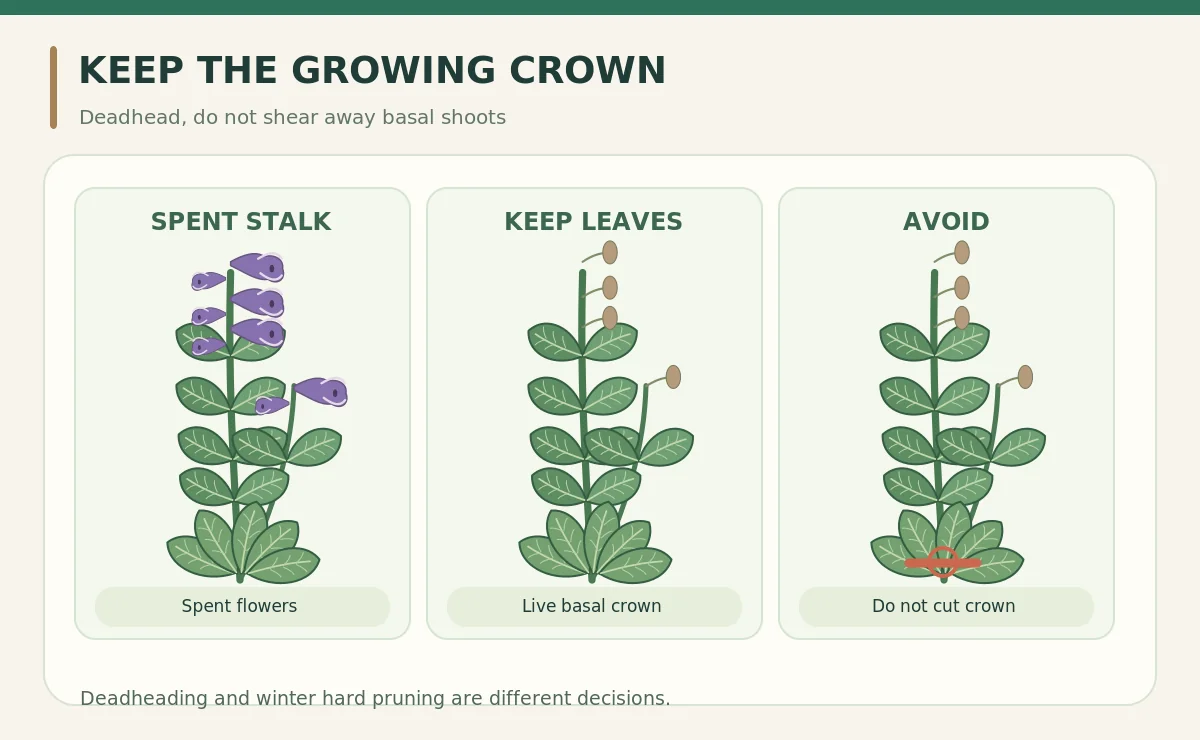
Most penstemons have opposite leaves attached in pairs at nodes along an upright stem. The terminal or upper sections carry tubular, often bell-like blossoms, with five lobes at their openings depending on species. When the spike is spent, blossoms wilt or drop and small seed capsules may develop where flowers were attached. The green leaves below those flowering nodes remain useful plant tissue, not debris to strip away automatically.
Look near the soil line for a leafy basal rosette or low new shoots emerging from the crown. The crown is the junction between shoots and roots, not a section of hollow dead stalk. It must remain intact. In some types, most active leaves are low; in others, healthy leaves continue up the stem. Accurate pruning shows scissors across the old flower stalk, not through the rosette or below all possible live nodes.

Deadhead after the final blossoms fade
Colorado State University Extension describes many penstemons as low-maintenance plants that benefit primarily from removing spent flowering stalks. South Dakota State Extension notes that spent stalks can be trimmed after bloom or left to mature seed. To tidy an ornamental clump, wait until its flowers are truly finished and clip the bare or seeded stalk above healthy leafy growth, avoiding damage to neighboring stems.
Do not assume every plant will bloom again. Some garden selections can produce additional bloom when faded flower stalks are removed, but timing, species and weather matter. Deadheading is useful for appearance and may reduce unwanted self-sowing. If you want seed for a native-plant project, leave selected healthy stalks intact and label them. Choose that deliberately rather than both removing and expecting mature seed from the same spike.
Place the cut above a living node
Trace the spent flower stem downward to the point where green leaves or basal shoots remain. Hold the old stem gently and make the cut just above healthy growth. If there is a branch with live buds below the flower cluster, preserve it. Do not slice through an intact leaf pair or across emerging crown shoots; the illustration should show the exact blades meeting the stalk above a true leaf junction.
Use clean sharp hand pruners or scissors for narrow stems and avoid crushing surrounding shoots. For a tall, heavily seeded stalk, cut in more than one manageable segment if necessary so it does not drag the whole clump sideways. A straight clean cut is enough; there is no special paste required to seal it. Check that the cut stem belongs to the spent stalk rather than an adjacent flowering branch.
Separate light deadheading from hard pruning
Light deadheading means taking away the exhausted floral portion while keeping the living framework. Hard pruning removes a large proportion of stems and foliage. Those are not interchangeable steps. The Royal Horticultural Society’s penstemon grower guide advises leaving top growth on many border forms through winter and shortening old stems in spring once frost danger has passed. Colorado State notes that requirements vary among species and hybrids.
A warm-climate garden may recover from harder trimming, but a cold and poorly drained site presents different risks. Do not issue an all-species rule to shear every penstemon to ground level in fall. If strong new shoots are clearly growing at the base after winter, older stems can be dealt with according to the plant type and local weather. Make separate decisions for flower stems and live overwintering leaves.

Protect the crown during wet winter weather
Penstemons often dislike poorly drained soil, and many western-native species particularly struggle when crowns stay wet. Colorado State Extension emphasizes choosing soil conditions suited to the species and avoiding excessive water after bloom. A collar of constantly soggy mulch should not be piled against living crown tissue. In a heavy clay or winter-wet garden, drainage problems matter more than a cosmetic pruning date.
Inspect the plant before watering. Green basal leaves and firm crown tissue suggest live growth even if flower stalks are dry. Dark, soft tissue at the base with overall collapse could indicate crown trouble and deserves diagnosis rather than an automatic fertilizer or spray. When preparing for winter, remove tangled weeds and improve airflow without ripping through the crown. Local hardiness and snow cover affect how much top growth is protective.
Choose between saved seed and tidy flowers
After a tubular penstemon flower drops, its seed capsule can continue ripening on the same flower stalk. Leaving some capsules benefits gardeners collecting seed, but seed from named hybrids may not reproduce the parent’s appearance. If you want controlled seed collection, label the parent plant and allow appropriate capsules to dry before harvesting. Do not cut off all seedheads and expect to harvest viable seed later.
If self-sowing is undesirable, remove spent heads before the capsules mature and split. Check where small seeds might drop and whether volunteer seedlings are practical to keep. South Dakota State Extension documents the choice between trimming after bloom and allowing fall seed. That simple tradeoff is more valuable than assuming that seed saving and vigorous rebloom always happen together.
Watch for healthy regrowth after trimming
A tidy penstemon should retain real live leaves and a visible basal growth point after the old spike is removed. Inspect it during the following weeks for new shoots and continuing green foliage. If no rebloom occurs, that does not mean the pruning failed; many penstemons have a main seasonal flowering window. Avoid heavy feeding merely to force flowers, especially for native plants adapted to lean soils.
If the clump sprawls, review the species’ sun and moisture needs rather than cutting green plants harder in response. Colorado State Extension notes that light and drainage shape the firmness of flowering stems. Stake temporarily if appropriate for an ornamental hybrid, but do not crowd air out of the crown. Keep the old-stem cleanup separate from routine irrigation and soil care.
Plan spring cleanup around actual shoots
At spring growth, look for low fresh leaves and distinguish them from dead brown stalks. Where a regional guide recommends spring pruning, use live shoots as a stopping point. Prune old dead stems above healthy new basal leaves, cleaning the tool between plants when disease is suspected. A spring cut made below the only surviving growing point can be more damaging than leaving a short old stalk.
Keep a photograph of the plant just before and just after deadheading; it makes it clear which flower stems were removed and which shoots remained. Next year, note whether the cultivar rebloomed, set seeds or retained green basal foliage over winter. Adjust to the specific penstemon rather than treating a purple-flowered native species and a large-flowered bedding hybrid as one uniform perennial.
How We Research and Verify Garden Advice
We consulted the following university Extension and research-based IPM sources on 2026-10-29: extension.colostate.edu; extension.sdstate.edu; www.rhs.org.uk. Our decision points focus on the actual plant anatomy, seasonal conditions and observations those resources support. We compared this intent with the full supplied VegWin WordPress title list, adjacent draft-batch topics and live search results to avoid duplicating an existing article. Garden schedules and cultivar traits depend on local conditions; these illustrations explain practices but are not diagnostic laboratory results.
This educational article contains no sponsored products or paid recommendations; no affiliate partnership is claimed. See the VegWin affiliate disclosure for current site policy. Before using any pesticide, rely on current local product labels and your Cooperative Extension guidance, not on a diagram or a general online list.
Wait until a flowering spike is substantially finished; avoid removing neighboring still-open blooms.
Cut the exhausted flower stem just above healthy lower leaves or basal shoots, without cutting into the crown.
Not automatically. Many border penstemons benefit from retaining top growth through winter, with harder cleanup deferred to spring.
No. Some types may rebloom, but species, cultivar, season and growing conditions determine whether more flowers form.
No. Leave selected seed-bearing flower stalks to mature if you want to collect seeds.