
Red clover (Trifolium pratense) is a living cover crop with three leaflets per leaf, rounded pink flower heads and a substantial root system. It is not the same as the quickly cut buckwheat cover crop or the annual crimson clover sold in flowered seed mixes. Red clover can live beyond one season, which makes it useful where soil needs a longer rest and inconvenient where vegetables must go into the same bed next month. The key decision is how long the bed can remain covered.
Identify red clover and choose the right purpose
Look for Trifolium pratense on the seed label. The leaf is made of three oval leaflets, often with a pale V-shaped mark, and the flower head is a tight cluster of small pink to purple florets. A red clover seedling initially looks modest; the large clump and branching stems develop later. Do not confuse the taller perennial red clover with low-growing white clover, which often spreads by creeping stolons, or with crimson clover and its more elongated red flower spikes.
Decide whether your goal is a cover crop for soil protection, a flowering insect resource, or a longer-term living understory. Those goals do not always share the same termination date. If the vegetable bed is needed immediately, select an easier-to-terminate annual instead. If the bed can rest and you can actively manage regrowth, red clover becomes more practical. A rooted stand can suppress some weeds but cannot repair compaction or supply a guaranteed amount of fertilizer on demand.

Time sowing for establishment, not a calendar slogan
Red clover can be established by spring seeding, interseeding into a compatible standing crop, or frost seeding in suitable cold-climate conditions. University of Minnesota Extension warns that it is slow to establish in fall, so a late sowing may leave exposed soil rather than a strong stand. In a home garden, plan backward from when the bed is needed again. Match the local growing season and soil conditions before committing a bed to a perennial-leaning cover crop.
Frost seeding is not a universal winter trick. It depends on freeze–thaw action, suitable ground conditions and good seed-to-soil contact; it is especially associated with established fields and pastures. Gardeners in warm regions should not copy a northern frost-seeding schedule. For a recently cleared vegetable bed, a shallow prepared seedbed often allows more deliberate watering and inspection. Do not bury fine clover seed deeply just because other legumes have large seeds.
Prepare a firm seedbed and broadcast carefully
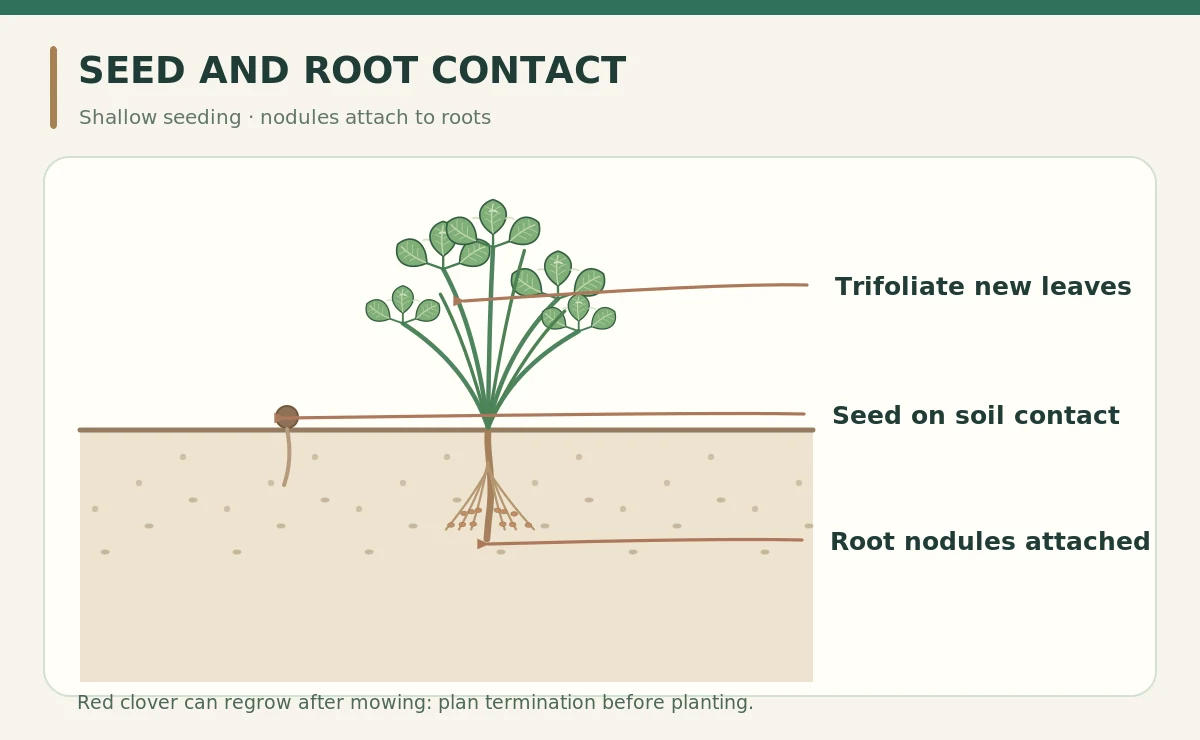
Remove tough perennial weeds before sowing; they are harder to eliminate once clover occupies the same space. Rake a reasonably level seedbed, scatter seed evenly at the locally recommended rate, and lightly incorporate only as the seed supplier or Extension guidance directs. A tiny seed needs firm contact with moisture and soil, not a deep planting hole. Use a fine spray to settle seed without washing it into the corners of the bed.
A patchy stand is not always a failed seed lot. Check for a soil crust, bird feeding, excessive surface drying and heavy residue that keeps seeds from touching soil. Clovers can be seeded with selected companion grains, but the seed sizes differ and broadcast distribution may become uneven. Avoid applying one generic mix rate to every bed size. The right rate depends on purpose, method and region; if the ground remains exposed, correct the underlying contact or watering issue before adding more seed.
Understand rhizobium and the root nodules
As a legume, red clover can form a partnership with appropriate rhizobium bacteria in its roots. Nodules are small swellings attached to living roots, not flower buds or seeds. The partnership can fix atmospheric nitrogen when the bacteria are present and conditions support the process. Missouri Extension recommends the correct clover inoculant when planting legumes in settings where compatible bacteria may not already be present. Inoculation is different from adding nitrogen fertilizer.
A root illustration should place nodules on lateral roots below the soil line, attached to actual root tissue. Do not promise that every plant will visibly form nodules or that all of its fixed nitrogen becomes available to the next crop at once. Nitrogen release depends on biomass, tissue decomposition and soil conditions. A strong clover stand can improve the nitrogen budget, but a soil test and the needs of the next crop still guide management decisions.
Recognize the flowering point and choose termination
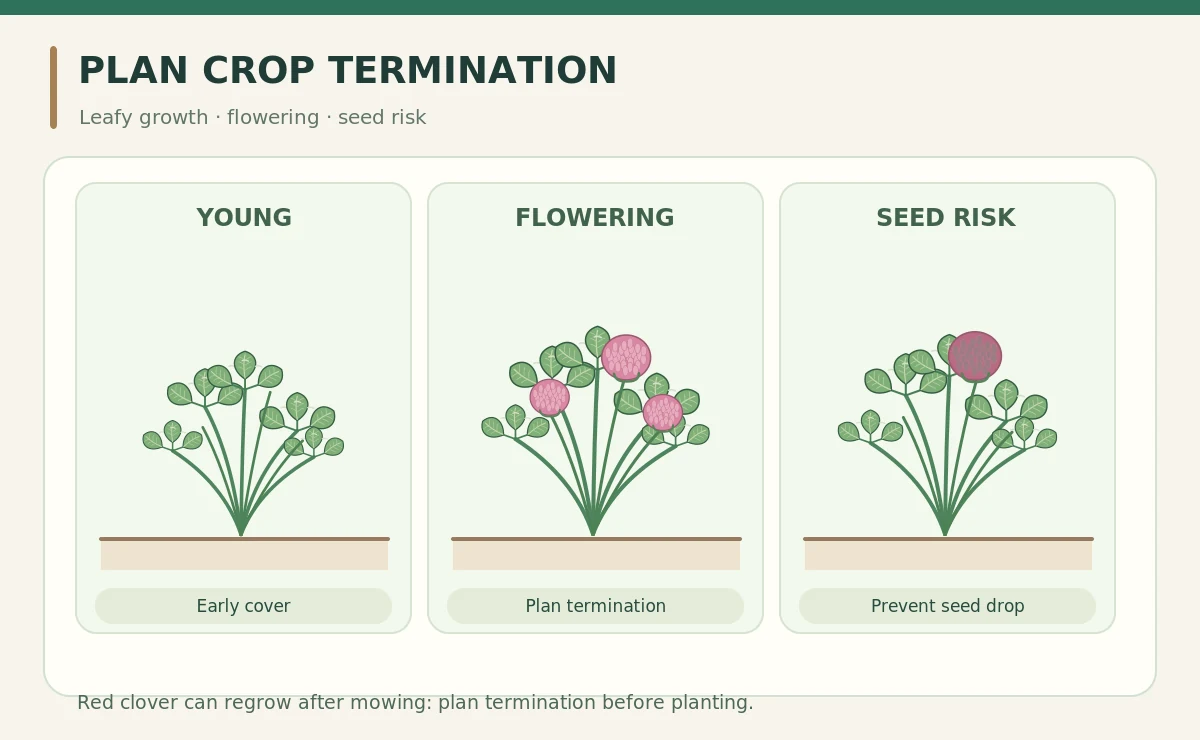
Red clover develops round flower heads from leaf axils near stem tips; the individual florets create the familiar pink ball. Letting the stand reach flowering can benefit insects and increase plant biomass, but it also means the clover is more established. University of Minnesota notes that mechanical termination of red clover is difficult and advises beginning when flowering starts if depending on mechanical methods. One quick trim is not a guarantee that the living crown and roots have died.
For a small garden, plan the termination method before sowing. Repeated mowing may suppress top growth without killing red clover, while complete removal or properly timed incorporation may be more reliable for preparing a vegetable row. Avoid a blanket promise that turning the top inch of leaves into mulch ends the stand. If flower heads progress to mature seed, volunteers can appear in later crops. Timing, soil moisture and root persistence matter more than cosmetic neatness.
Protect the next planting window and soil surface
Once terminated, plant residues can remain as surface cover or be incorporated according to the crop and soil-management plan. Fresh vegetation needs time to break down, and a newly planted small seed may struggle if residues form a thick, poorly mixed mat. Maryland Extension advises gardeners to allow a gap between incorporation and planting where decomposition is expected. The interval depends on weather, biomass and the next crop; a fixed universal number is not warranted.
Do not till the bed simply to make every fragment disappear. Wet soil can compact when worked, and aggressive repeated cultivation may counter the structural benefit of keeping living roots in the ground. Watch for new clover shoots from surviving crowns, especially along bed edges. If the next crop is already growing nearby, keep clover from overtopping it or competing for water. A cover crop is a managed crop, not an automatic soil improvement.
Use the plant to read soil and management conditions
Healthy red clover leaves are green and arranged in leaflets; older leaves or low growth shaded by a thick stand may yellow. Persistent stunting can have several causes, including drought, poor establishment, waterlogging or unsuitable pH, and cannot be diagnosed from one yellow leaflet. Lift a sample plant only if needed to inspect root development. Fine roots should extend into the bed; nodules, if present, are attached to roots rather than floating in soil.
Avoid treating pink flowers as evidence of confirmed nitrogen contribution. Flowering tells you about plant maturity and insect resources, not a quantified fertilizer credit. Likewise, the absence of visible nodules in a shallow casual inspection does not prove that the soil lacks every compatible bacterium. Keep notes on seeding date, coverage, flower stage, termination method and regrowth. Those observations make the following season’s plan more reliable than a one-size-fits-all schedule.
Decide when red clover is the wrong cover crop
If a spring vegetable planting must begin early and the bed cannot spare weeks for cover-crop termination, a vigorous perennial clover may cause more conflict than benefit. The same is true when the gardener cannot monitor resprouting or when seedling establishment would compete with a valuable young crop. Consider annual cover-crop alternatives matched to your climate, planting window and management capacity rather than forcing every bed to support the same species.
Red clover is also a poor choice if you intend to let every flower head mature without accepting volunteer plants. Its value comes from good establishment, a real root system and deliberate termination. Finish by inspecting the remaining crowns and soil before planting vegetables. A clean seedbed with modest residue, no aggressive regrowth and an appropriate moisture level is a more useful endpoint than a photograph of flowers alone.
Related Guides
- Cover Crops for Vegetable Beds: Choose, Sow, and Terminate
- When to Cut Buckwheat Cover Crop Before It Drops Seed
- When to Plant Hairy Vetch Cover Crop Before Fall Frost and Spring Growth
- When to Plant Crimson Clover as a Fall Cover Crop and Prevent Reseeding
- How to Plant Winter Cereal Rye as a Cover Crop, Not Annual Ryegrass
How We Research and Check Gardening Guidance
We reviewed these university Extension, research and horticultural guidance sources on 2026-10-29: extension.umn.edu; extension.missouri.edu; extension.umd.edu. The key decisions above rely on their specific crop identification, growing conditions and plant anatomy. We compared this topic with the supplied WordPress post list, existing draft-batch material and public site search; that comparison cannot reveal every unlisted future draft. Local climate, cultivar and actual growing conditions must guide timing.
This article contains no sponsored products or paid recommendations, and we do not claim an active affiliate relationship. Read the VegWin affiliate disclosure for the current site policy. Pesticide use, if ever needed, requires confirmed diagnosis, local IPM advice and a current product label, not a generic diagram.
No. Red clover has rounded pink flower heads and is often longer-lived; crimson clover is usually an annual with longer showy spikes.
It may if compatible rhizobia are already present, but the appropriate true-clover inoculant is recommended where they may be absent.
Do not count on one mowing to kill it. Plan a reliable termination method and allow for residues before sowing the next crop.
Not if volunteers would be a problem; decide whether flowering benefits are worth the additional seed-set risk.
No. Nitrogen fixation and release vary with nodulation, biomass, soil and decomposition.