
Hairy vetch (Vicia villosa) is a cool-season annual legume cover crop with paired leaflets, climbing tendrils, fine stems and later purple pea-like flowers. Its usefulness depends on establishment before cold weather and a workable spring plan to stop growth before the next planting. It is different from winter cereal rye or forage peas, even when grown alongside them.
Identify Vicia villosa as a climbing cover-crop legume
Hairy vetch is not the grain winter rye grown for a different cover-crop role. The plant has slender scrambling stems, compound leaves divided into paired small leaflets, and a tendril at the tip that can curl around other vegetation. Clusters of purple to violet pea-like flowers can form after the plant resumes growth. Below the soil, roots may form nodules when associated with appropriate nitrogen-fixing bacteria. A nodule belongs to a living root, not the stem or a loose object floating over the ground. Use Vicia villosa seed rather than an unidentified vetch mixture that may contain species with different growth habits.
Sow early enough to establish before severe cold
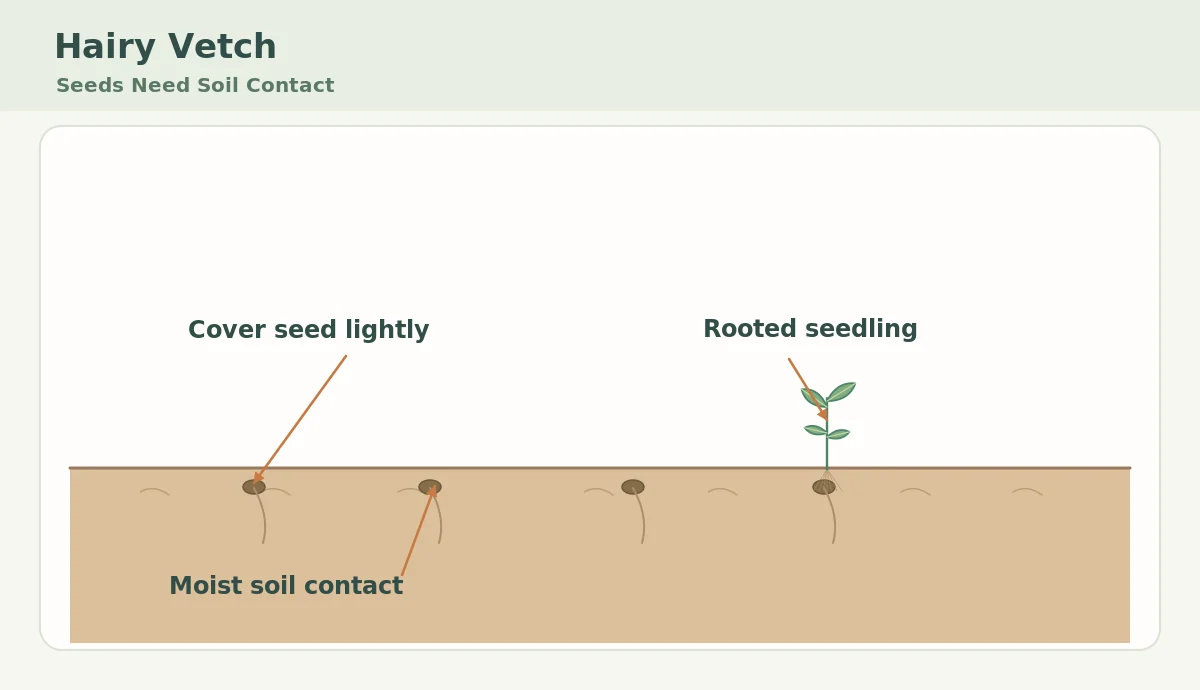
Iowa State Extension advises late-summer to early-fall sowing for its regional conditions; the correct window changes with local climate. UNH Extension notes that slower-growing legumes such as hairy vetch need earlier seeding than hardy winter rye in its region. The practical target is root establishment before sustained frost, not maximum vine length in autumn. A new seedling may look modest above ground while its roots establish. Where winter temperatures are extreme or autumn is dry, late planting raises winterkill risk. Consult your local Extension calendar instead of transferring a Northeast or Midwest date across the country.
Build a seedbed with moisture and real contact
Remove heavy competing weeds and rake the upper soil enough for seed to contact moist particles. Iowa State gives an agricultural range of roughly one-quarter to one inch deep, but home beds still need to match soil texture and planting method. A broadcast seed resting on dry straw may never establish properly. Cover and firm lightly where appropriate, then water to maintain germination moisture. Do not leave seed exposed on a dry surface and call it a planted crop. A dense competing weed mat can overwhelm new seedlings while they are growing slowly in fall.

Understand legume inoculation instead of overfeeding
Vetch can associate with nitrogen-fixing rhizobia, but successful nodulation depends on compatible organisms and suitable soil conditions. Use an inoculant only when its label specifically lists an appropriate vetch or pea group and follow its storage and application instructions. A soil test is more useful than heavy nitrogen fertilizer when planning legume cover. Roots and nodules need oxygen and drainage. Not every root bump proves active nitrogen fixation; color and internal appearance can vary, and destructive inspection is not necessary to manage the whole bed. Never substitute an arbitrary treatment rate for the product label.
Recognize the small fall plant and the spring vine
Young vetch has soft, low-growing shoots with leaflets; in spring, overwintered plants can produce long twining or sprawling stems. Tendrils may use a nearby cereal crop as support, so a mix can make a tangled canopy. University of Minnesota Extension notes substantial spring biomass and nitrogen benefit but also that the vine-like growth habit complicates termination. Allow access lanes for management and keep vetch off perennial crowns you must work around. The spring flush is normal; do not confuse its rapid growth with a new invasive species without checking the compound leaves and tendrils.
Decide what your cover crop is meant to achieve
A winter cover can protect bare soil, compete with weeds after establishment and eventually contribute nutrients through decomposition. Hairy vetch is especially valued as a legume, yet results depend on planting date, biomass and how residue is handled. It is not the same as applying a measured bag of fertilizer: fixed nitrogen varies, and immediate plant availability is not guaranteed. Plan the following vegetable crop before sowing; a sprawling vetch mat in May can obstruct seedlings you intended to plant. A cover crop should fit the main crop’s calendar rather than force a hurried cleanup.
Watch the transition from buds to flowers to seeds
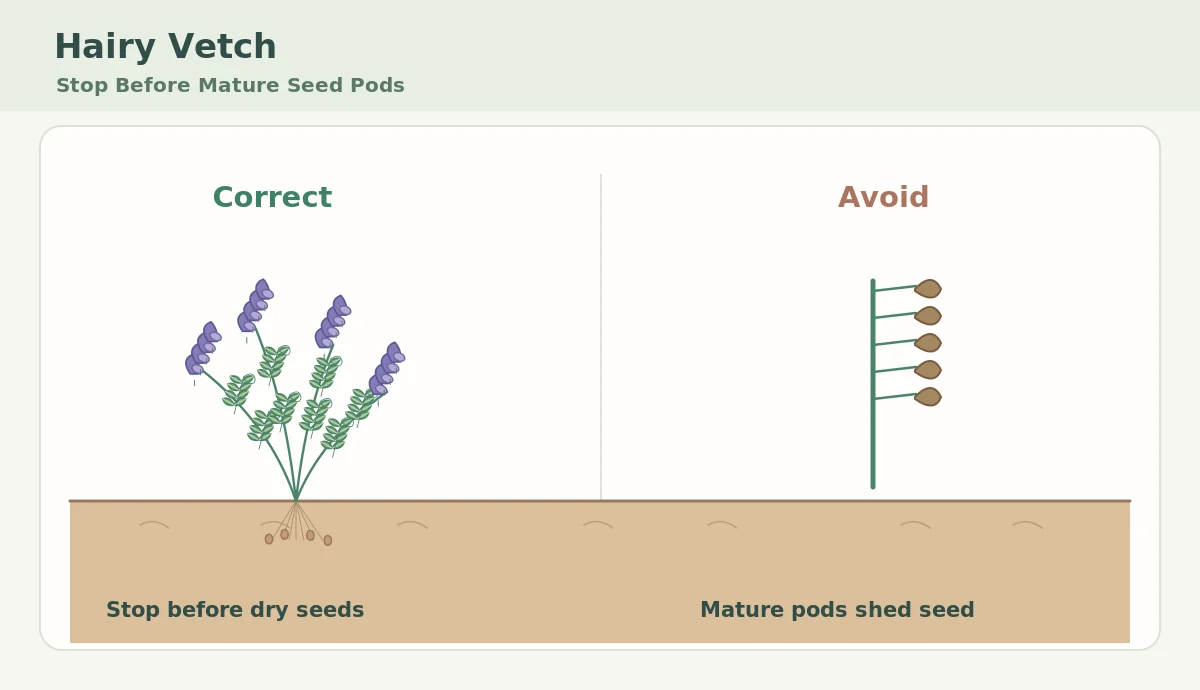
Hairy vetch produces pea-type flowers on flowering stalks; after pollination, a pod develops along a real attachment to the vine. Purple flowers are not seed pods and green immature pods are not dry, free-spilling seed. A late unmanaged crop can set viable seed and create volunteers in future beds. University of Minnesota warns that vetch seed can persist and become difficult to control. If preventing reseeding is the priority, plan termination before mature pods and seed release. Look at the actual developing buds and pods rather than merely counting days after winter ends.
Make a spring termination plan you can carry out
Home growers may mow and incorporate vetch, but cut vines can tangle equipment and some growth stages can regrow. UNH and University of Minnesota both stress terminating cover crops before the following vegetable planting. Choose mechanical methods appropriate to your space, and allow residue time to break down rather than planting delicate seedlings directly into a dense, wet mass. Avoid recommending an unverified herbicide mixture or off-label application. A small bed might be easier to manage by cutting and carefully removing stems before pods mature, followed by repeated inspection for regrowth.
Interpret regional planting trials correctly
A USDA NRCS report published October 8, 2026 describes Mid-South trials where fall planting and later spring termination improved biomass and nitrogen production. Those exact dates describe that experiment, not a universal mandate for an Oregon, Maine or Florida garden. Iowa State and UNH give different region-specific sowing guidance because their seasons differ. Use local climate, available moisture and your next crop’s planting schedule to decide a window. A useful garden log records sowing date, seedling establishment, frost arrival, spring vine growth and the date residue was managed.
Keep the soil covered without letting vetch take over
After termination, check for living crowns or vine tips, emerging volunteers and thick residues that impede planting holes. Leave soil protected with suitable mulch if it will not interfere with the main crop. Legume residue can decompose relatively quickly under favorable conditions, but cool, dry beds behave differently from warm moist ones. Inspect plant bases where tendrils may have wrapped around neighboring stems, and remove them without damaging desired crops. Success means a cover that protected soil, established before winter, was deliberately stopped, and did not turn into an unwanted persistent seed source.
Related Guides
- Cover Crops for Vegetable Beds: Choose, Sow, and Terminate
- How to Plant Winter Cereal Rye as a Cover Crop, Not Annual Ryegrass
- When to Cut Buckwheat Cover Crop Before It Drops Seed
- How to Grow Red Clover as a Cover Crop and Manage Its Roots
- When to Plant Crimson Clover as a Fall Cover Crop and Prevent Reseeding
How We Research and Check Botanical Details
This guide was researched on October 30, 2026 against crops.extension.iastate.edu; extension.unh.edu; www.nrcs.usda.gov; extension.umn.edu. We cross-checked the named species, the growing operation and the parts of the plant shown in the diagrams. Regional schedules and cultivar traits vary; check local Cooperative Extension and the actual seed or planting-stock label before adapting precise timing. Illustrations are explanatory botanical drawings rather than scale models or pesticide instructions.
VegWin publishes independent informational gardening guidance. The internal navigation links here are not paid placements and no affiliate relationship is claimed. Our affiliate disclosure explains the site policy. If a plant may be toxic, grown for food or affected by an uncertain disease, confirm identification and relevant safety advice before using or treating it.
No. Hairy vetch is a climbing legume with compound leaves and tendrils, unlike cereal rye.
Use a local late-summer or early-fall window that allows roots to establish before severe frost; dates differ by region.
A compatible pea/vetch rhizobium inoculant can support nodulation when appropriate; follow its label.
Usually not if you want to avoid volunteers. Plan termination before mature seed is shed.
A thick living mat complicates planting. Plan a workable termination method and allow residue management before sowing vegetables.