
Flat-leaf parsley is an aromatic biennial herb that often appears much later than impatient gardeners expect. A row can be weeded away before seedlings are visible, or kept so wet that roots struggle. The key is accurate shallow covering, steady moisture, patient checking, and correct recognition of the first divided true leaves.
Recognize Flat-Leaf Parsley Before Sowing
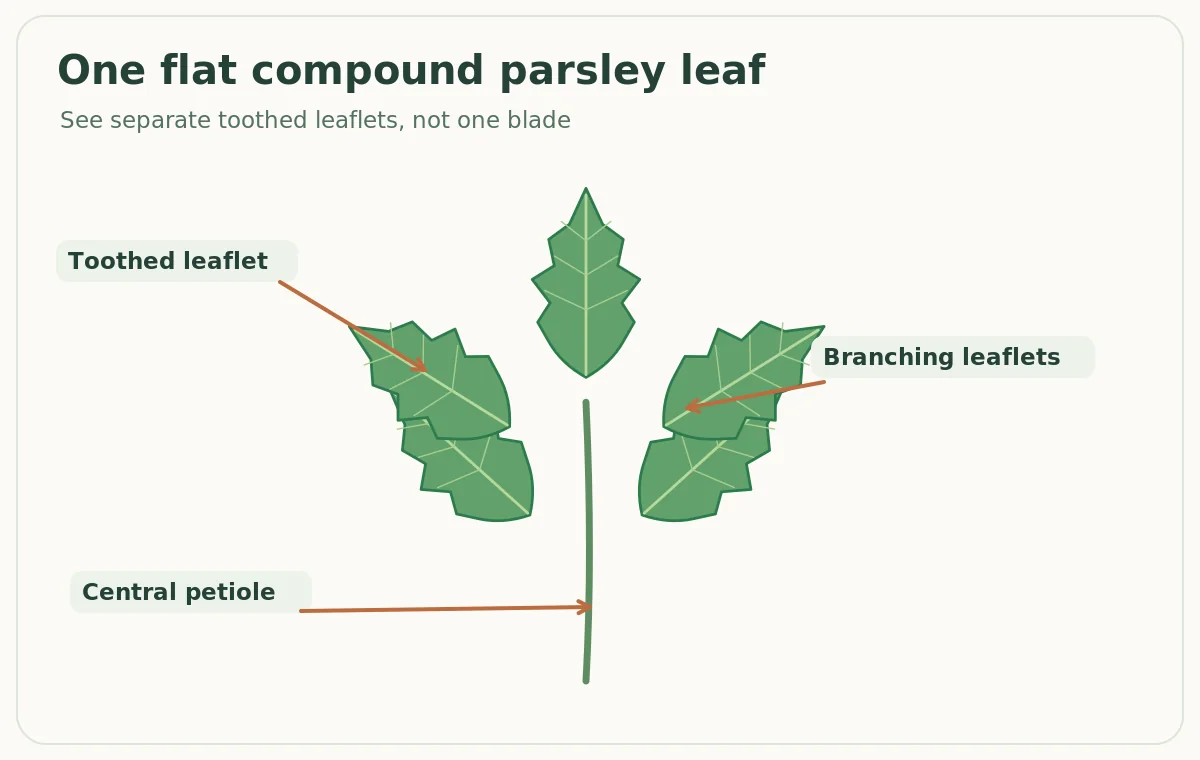
Petroselinum crispum makes a basal rosette of leaf stalks bearing divided, broad, toothed, green leaflets. The Italian or flat-leaf form differs from moss-curled parsley, whose leaflet edges fold into tight ruffles. Both are parsley, but the illustration here represents flat leaves with distinct leaflets branching from the petiole; it should not look like an undivided cilantro leaf glued to a long stalk. Parsley is biennial: it grows harvestable foliage first and typically produces a flowering stalk in a later growing season. Choose labeled, reasonably fresh seed and avoid mistaking wild parsley-like plants for a food crop.
Pick a Sowing Window Based on Soil and Light
RHS recommends spring-through-summer direct sowing, adjusted to growing conditions, or indoor modules for an earlier start. In a hot climate, plan around a cooler establishment period rather than assuming a UK calendar date suits your yard. In a cold-winter region, check that the soil can be worked and seedlings will not be exposed to extreme conditions. Parsley tolerates sun or partial shade, but warm, dry seedbeds need extra monitoring. For containers, choose a reasonably deep pot with drainage and access to consistent light. Planting several small batches can extend leaf availability without overcrowding one bed.
Prepare the Bed and Mark the Narrow Drill
Break surface clods into a fine texture, remove visible weeds, and moisten the soil before making a shallow straight drill. RHS recommends roughly 1 cm of seed covering for ordinary outdoor parsley sowing; this is real soil over the seed, not a seed exposed on top. Place a visible row marker at the ends so gardeners do not cultivate it accidentally during a slow wait. A small band of compost may improve a poor bed, but do not bury the row under undecomposed plant waste. A clean potting mix works in modules, provided water can drain out.
Space Seeds Thinly and Cover Gently
Distribute seeds with a little space between them along the drill. Press lightly, cover with the intended shallow layer of fine soil, then water through a gentle rose or a soft spray. A hard jet can move the seeds, turning an even row into a mound at one end. If using modules, sow sparingly so roots do not become tangled before moving. Some gardeners soak parsley seed overnight as discussed by Illinois Extension, but that is optional and does not guarantee uniform germination. Do not make a deep trench hoping to prevent drying; that often creates a different emergence problem.
Keep the Surface Moist During the Long Wait
Unlike fast-germinating radishes, parsley may take several weeks to show; RHS notes it may take a month or even longer in some circumstances. Check the topmost soil layer often enough that it never dries hard over the seed. Mulch that is too thick may block emerging seedlings, while a loose light cover can help conserve moisture if used carefully. In containers, avoid standing water and provide airflow. If you water from below, confirm the seed layer actually becomes damp. Keep sowing dates written down so you can judge delays against real temperature and moisture conditions rather than a vague memory.

Find the Seed Leaves and Then True Leaves
The first green structures are cotyledons, which do not yet display the characteristic divided parsley foliage. The later true leaves carry a leafy compound outline with toothed leaflets, making identification easier. Do not harvest the first tiny shoots. Compare the seedling to the illustration and check whether a volunteer weed has appeared in the same row. A dense mat of tiny seedlings needs thinning even if all seed emerged successfully. Parsley does not gain vigor from a permanently tangled carpet of roots; leaving space improves air circulation and supplies growing room for the eventual rosette.
Thin With Minimal Root Disturbance
RHS gives general mature spacing according to variety; thin gradually, aiming for room between vigorous plants rather than an exact universal distance in every pot. When seedlings have true leaves, snip excess stems at soil level if pulling might uproot a keeper. A small clump grown in modules can be transplanted while young, but water after moving and protect from sudden scorching sun. Firm soil gently around roots, not up the foliage. If you need a whole row of uniform plants, sowing directly in the final bed avoids repeated transplanting. Note which cells remain weak before applying a blanket fertilizer.
Harvest Outside Stems and Preserve the Crown
Once stems are sturdy and the rosette is established, remove a few mature outer stalks at their bases. Leave the inner younger growth so the plant keeps producing. Cutting every leaf from a weak seedling is not the same as harvesting a mature plant. A sharp tool reduces crushing and avoids pulling up a shallow root crown. Rinse harvested leaves and handle them as a normal culinary herb. Flowering in the second year diverts energy away from tender leaf production, so many gardeners treat parsley as an annual for kitchen use and sow new seed rather than waiting for a perennial-style clump.

Troubleshoot Missing Seedlings in Sequence
If a row is empty, check the sowing date, depth, germination temperature, and moisture history before digging it up. Seeds washed to one end will emerge unevenly; compacted soil may crust over very young shoots. A wet, airless pot may support fungus, while a dry tray can interrupt germination. Weed seedlings may be mistaken for the crop, so label rows carefully. If you must reseed, prepare a small new area and leave the original intact long enough to determine whether emergence is merely late. Compare true leaves before assuming a volunteer is edible parsley.
Build a Repeatable Parsley Sowing Routine
For the next batch, use fresh labeled seed, a 1 cm drill, light firming, gentle watering, and a written moisture check. Count seedlings only after giving them a realistic emergence window. Photograph cotyledons and first divided leaves so volunteers are easier to distinguish. Thin with reference to the mature size of your chosen variety and take outer stems after the crown is established. If the climate becomes hot and dry, shade the seedbed lightly and maintain moisture without sealing the soil under heavy covers. Small well-tended sowings often beat one densely seeded, forgotten tray.
Related Guides
- Growing Herbs by Type: Water, Harvest, and Winter Survival Guide
- How to Grow Hamburg Root Parsley for Straight Edible Roots From Seed
- Growing Parsley for Repeated Harvests: Seed, Leaf, and Bolting Guide
- How to Start Parsley From Seed Without Giving Up Before It Germinates
How We Research and Verify Plant Advice
The species descriptions, sowing and harvest actions, and environmental cautions were checked against RHS University Extension on October 28, 2026. We use the original plant-specific sources to distinguish botanical anatomy from generalized gardening habits. Local climate, cultivar and soil conditions may change timing and outcomes; this article does not imply a fixed yield, medical benefit, sponsorship, or pesticide prescription. The illustrations are explanatory diagrams rather than to-scale construction drawings. Review VegWin’s affiliate disclosure for the site’s general policy; no affiliate partnership is asserted in this guide.
RHS advises about 1 cm deep for its ordinary direct-sowing method.
They can take several weeks; RHS notes germination may take a month or more.
No. The first cotyledons are followed by more recognizable divided true leaves.
Snipping unwanted seedlings at the soil line can spare the roots of adjacent keepers.
Parsley is a biennial, but it is commonly grown as an annual for tender culinary leaves.