
Parsley is often presented as a simple sprinkle-at-the-end herb, but growing it successfully involves a slow start and a predictable change in the second year. The key question is how to keep harvesting usable leaves while the plant is in its leafy phase, rather than waiting until it is already flowering and expecting the same quality. Flat-leaf and curly parsley follow the same broad growth cycle even when their kitchen uses differ. This informational guide has no paid product recommendations. See our affiliate disclosure for our site-wide policy.
Pick Flat-Leaf or Curly Parsley by Intended Use
Flat-leaf parsley has broad dissected leaves; curly types form compact, strongly ruffled leaves. Both are culinary parsley, Petroselinum crispum, and both can be harvested repeatedly while growing actively. Leaf shape is an easy way to distinguish the types, but do not turn a preference for a certain texture into a claim that one cultivar always outperforms the other outdoors. Try one or two healthy plants of the type you actually cook with; a small succession can be more useful than a large planting that bolts at once. Our guide to growing herbs by type goes into more detail.
Use a source-identified packet, not collected look-alike wild foliage. The carrot family contains plants that can resemble culinary herbs, and identification matters. Choose garden soil or potting mix that drains yet retains enough moisture for even emergence. Parsley often grows happily in sun with some shade in hot climates. Florida IFAS notes its preference for the cooler part of the year in that region, illustrating why the same sowing month does not work for every US location.
Allow Enough Time for Slow Seed Germination
Parsley seeds frequently sprout more slowly than familiar quick crops such as radishes. Illinois Extension notes the slow germination and suggests soaking seed overnight as one possible preparation. Some gardeners prefer to sow directly; others use cell trays to protect the germination area from drying or weeds. Whatever the method, follow the packet’s seed-depth guidance and use consistently moist, not waterlogged, media. Do not dig up the row after a few days simply because no seedlings are visible yet.
Mark the seeded location and record the date. A row marker prevents accidental cultivation of the spot while the seed remains underground. If you start indoors, provide good light as soon as seedlings appear and harden transplants before outdoor planting. Avoid using a heat-setting rule borrowed from basil or tomatoes: parsley is a cooler-season herb. Check local Extension guidance for the preferred spring or fall window, especially where the summer becomes very hot. For a step-by-step method, see how to start parsley from seed without giving up before it germinates.

Set Parsley Plants Where Roots Can Stay Evenly Moist
Maryland Extension gives about six inches between established plants as a home-garden reference. Actual room depends on cultivar, airflow and whether you are harvesting baby leaves or full stems. Keep the planting area weeded while seedlings are small; competitors can shade and dry a slowly establishing plant. Organic matter may help soil structure, but soil-test results should guide any fertilizer application. Rich-looking foliage alone is not a reason to keep adding nitrogen.
In containers, use drainage holes and a quality growing medium instead of a closed decorative pot filled with garden soil. Water to moisten the root zone and let excess water drain; do not maintain standing water under the pot. Container edges and exposed surfaces dry faster than a mulched garden bed, so check moisture directly rather than copying a bed schedule. Position pots where leaves can receive useful daylight without being scorched during intense summer afternoons.
Harvest Outer Stems Without Removing the Crown
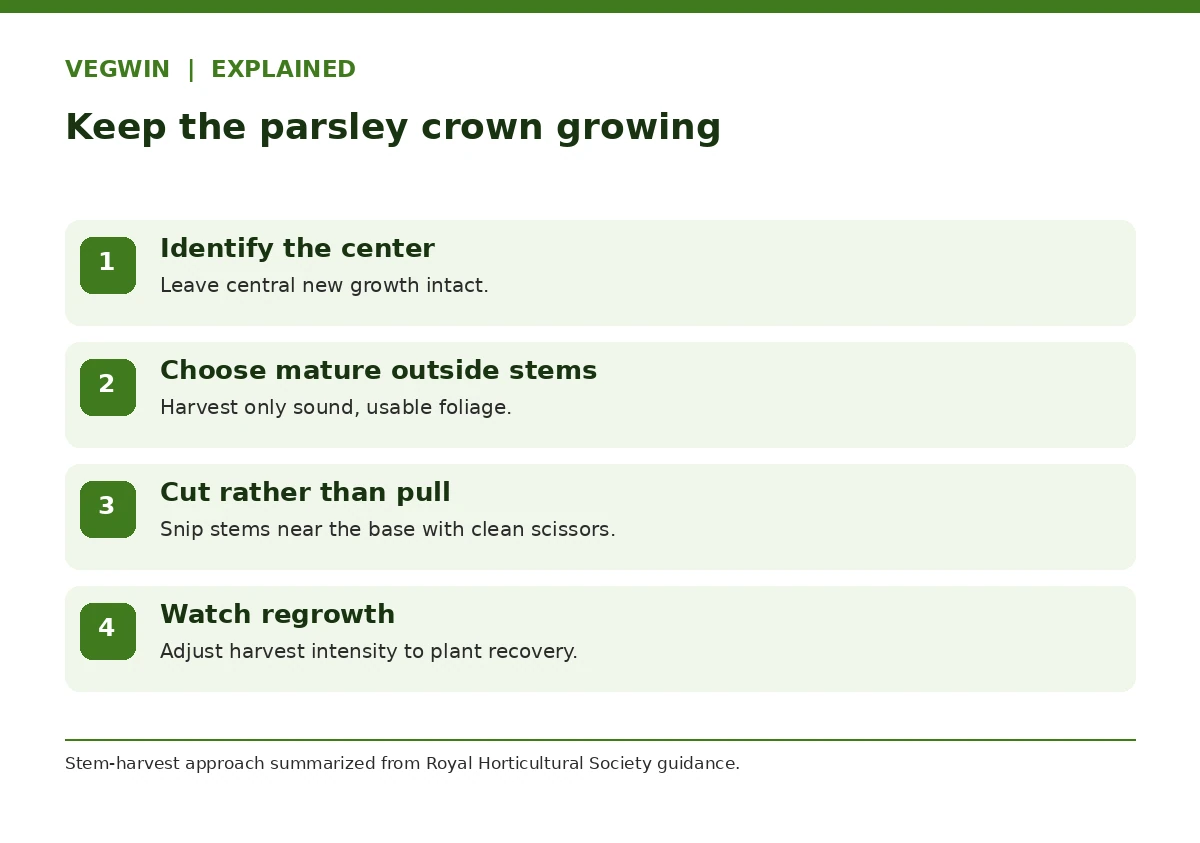
The Royal Horticultural Society recommends picking a few leafy stems from the outside and cutting near the base. This preserves the central growing area and gives the plant an opportunity to replace harvested foliage. Use clean scissors and do not tear out the whole crown when all you need is a handful for dinner. Gather sound, clean leaves and use them promptly; parsley destined for fresh food deserves the same clean-hands and safe-washing attention as other garden greens.
Repeated harvesting works best while the plant is actively making leaves. Take a modest portion and watch how quickly it recovers under the actual temperature and light conditions. A stressed plant with yellowing leaves needs diagnosis rather than harder pruning. If you want parsley every week, start another small sowing or transplant batch before the older plants lose leaf productivity. Your own harvest notes are a better measure of required plant numbers than a generic claim that one plant feeds a family.
| What you see | Likely stage | Best next action |
|---|---|---|
| No sprouts soon after sowing | Possibly still germinating | Keep media evenly moist; check packet timing |
| Young rosette making new leaves | Vegetative establishment | Protect roots and weed competition |
| Established leafy outer stems | Harvest phase | Cut a few outer stems at the base |
| Tall central flower stem | Reproductive phase | Plan replacement for leaf supply |
| Older planting with weaker regrowth | End of productive leaf phase | Start a new crop for the kitchen |
Expect a Biennial to Flower in Its Second Year
Parsley is botanically biennial: it normally produces leaves and roots during its vegetative phase and moves into flowering during the following year under suitable conditions. Gardeners commonly treat it as an annual because the best kitchen harvest occurs before flowering. Maryland Extension describes that lifecycle, and the RHS explains why keeping a second-year flowering plant for tender leaf production is usually unrewarding. Flowering is not evidence of a new pest or an unexplained fertilizer deficiency.
Warm spells, cold exposure, plant age and local season can shift the apparent flowering schedule. In mild climates a plant may survive the winter and form a tall central flowering stalk later; in other gardens cold or extreme heat ends the planting sooner. Once the stalk forms, evaluate whether you want seed and pollinator value or a replacement leaf crop. Removing a stalk may not turn an already committed biennial back into a vigorous first-year leaf producer.
Identify Common Problems Before Making Changes
A bare seeded row may reflect slow germination, dried seedbed surface, old seed, crusted soil or seed washed away. Check the date and the soil before re-sowing. Pale or yellow leaves on a mature plant may reflect natural aging, inadequate root conditions, nutrient issues or pests; the pattern and root-zone condition matter. Look beneath leaves for insects, inspect stems for decay, and compare affected foliage with recent weather. Avoid a one-size-fits-all fertilizer or pesticide treatment.
Premature flower stalks can be confusing if you expected a compact herb all season. Confirm plant age and exposure to cold or heat before calling it bolting. Leaf discoloration accompanied by distinct spots may need local disease diagnosis. Do not eat unverified, wild-collected plants just because the leaves resemble parsley. A labeled seed packet, a photo of a known cultivated plant and an accurate date log make these investigations more reliable.

Plan a Replacement Crop Before the Old One Bolts
Think in two overlapping lines rather than one immortal parsley plant: an established crop from which you cut outside stems, and a younger sowing that will take over as the first crop flowers or slows. Where heat is severe, the replacement may be a fall start instead of a summer sowing. Where winters are cold, seed-starting indoors may bridge the season. Regional Extension timing belongs in the plan; USDA hardiness zone alone cannot tell you when to begin annual herb seed.
If you also grow cilantro and basil, do not copy their management exactly. Basil favors warmth and reacts differently to cold; cilantro often runs to seed in warm conditions. Parsley combines slow emergence with a biennial lifecycle, which is why its replacement plan is different. You can grow all three near the kitchen, but their seed timing and harvest patterns deserve separate rows in your notes.
Keep a Kitchen-Scale Parsley Harvest Record
For two weeks, record which stems you cut, whether new leaves appeared, and whether the plant shows flower-stalk development. Harvest quality is easier to judge by color, aroma and regrowth than by an invented ideal number of stems per plant. Do not harvest leaves carrying unidentified sprays or residues. For preservation, follow a tested extension food-handling method instead of assuming fresh leaves will behave the same after thawing or drying.
At the end of the growing cycle, note which site produced cleaner leaves, which pot drained well and how long replacement seedlings took to become useful. This turns parsley from a sporadic garnish into a manageable small crop. The biggest improvement is often not a special product at all: it is sowing early enough to allow slow emergence, keeping moisture steady and starting the next plant before the older one goes to seed.
Related Guides
- How to Grow Hamburg Root Parsley for Straight Edible Roots From Seed
- How to Sow Flat-Leaf Parsley Seeds and Manage Slow Germination
How We Research and Check Local Exceptions
We reviewed an October 19, 2026 search-results sample for this precise query and read the cited primary university or government guidance. Before manual publication, an editor should search WordPress for the same intent, verify category placement and any claims that depend on local conditions. We did not treat advertisements, seed packet promises, or general garden myths as scientific sources.
Sources reviewed October 19, 2026: Maryland Extension parsley facts; Illinois Extension parsley guidance; RHS parsley grow and harvest guide. Our editorial approach distinguishes evidence from local decisions and avoids implying that sources endorse VegWin. This is general garden education, not a pesticide label, local planting schedule, or food-preservation processing instruction. Affiliate relationships for this article are not confirmed; our disclosure page describes site policy.
Parsley germinates relatively slowly. Review seed age, surface moisture, depth and packet instructions before assuming failure.
Usually harvest a few outer stems near the base and leave the central growing area to continue producing foliage.
In some climates it can overwinter, but it is biennial and may flower in the following season. Cold tolerance is local and not a promise of leaf quality.
They are forms of culinary parsley, Petroselinum crispum. Choose according to leaf texture and kitchen use.
No. Pinching may remove a stalk temporarily but does not reverse the plant’s biennial developmental cycle.