
Hamburg parsley grows familiar parsley-like leaves above a pale, enlarged taproot. Unlike common flat-leaf parsley grown mostly for green sprigs, this form is selected for the root you lift and cook.
Buy root parsley, not ordinary leaf parsley
Hamburg root parsley is a selected root form of Petroselinum crispum, often labeled Petroselinum crispum var. tuberosum or parsnip-rooted parsley. Its foliage resembles standard flat-leaf parsley, but the important harvest is an elongated cream to white storage taproot. Ordinary bunching parsley may have thin roots that never make an equivalent kitchen harvest. Read the cultivar description rather than judging seeds by eye: parsley seeds of different types look similar. Roots can resemble short parsnips, but the plant identity and flavor are different. Cornell lists Half-Long Hamburg Root as a root parsley variety. Plant the chosen seeds in a marked row so the crop is not pulled as weeds.
Prepare deep, stone-free, freely draining soil
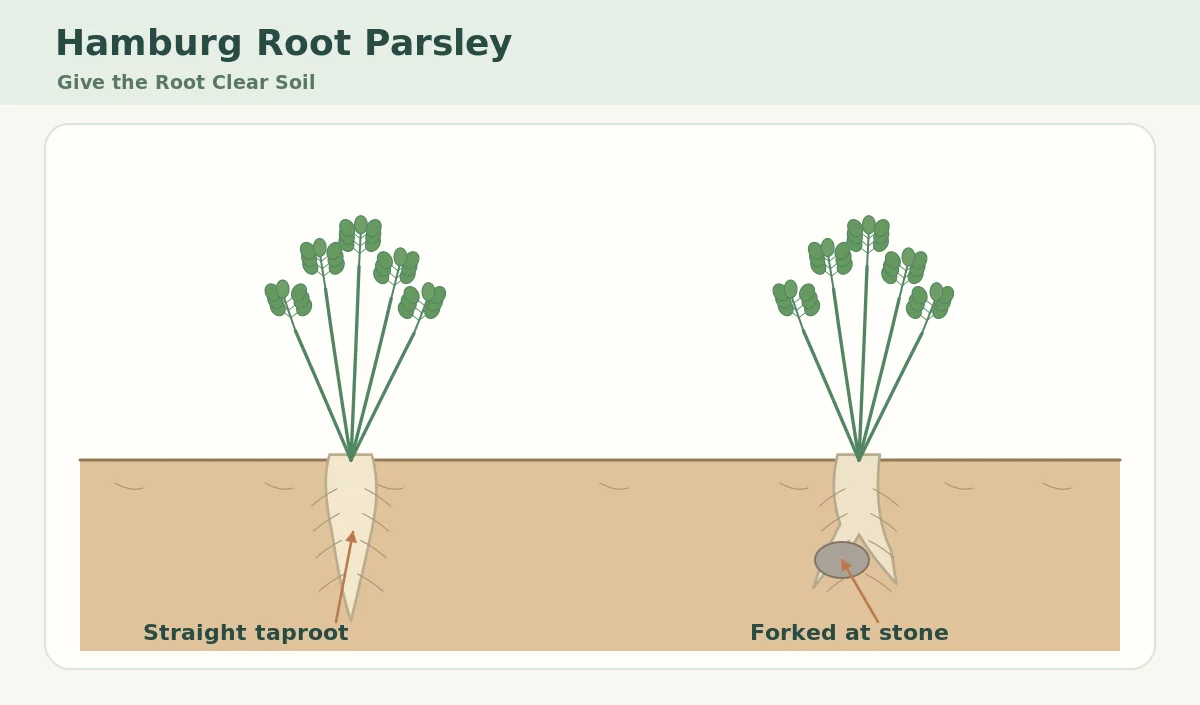
A straight, well-shaped storage root needs open soil beneath the seedling, not just a loose surface crust. Remove large stones and compacted chunks from the planting zone and rake it fine without pulverizing wet clay. Incorporate matured organic matter well ahead of sowing if the bed is low in fertility; avoid lumps of fresh manure that make root beds uneven. Root parsley tolerates fertile soil that stays moist, but it should not sit in a water-filled trench. Observe drainage after rain and loosen hardpan before sowing rather than pulling roots later to correct for it. A long, slender taproot can fork when it strikes a barrier or is physically damaged.
Sow directly where the roots will finish growing
Because the edible organ develops from the main taproot, direct sowing is generally preferable to repeatedly transplanting seedlings. RHS recommends direct sowing parsley as an easy way to avoid root disturbance. Form a shallow row, water the soil if needed, distribute seed thinly and cover according to the packet and local RHS guidance for parsley. The seed must sit in actual moist soil, not above a decorative line representing the surface. Mark the row on both ends and avoid replanting it with another crop while waiting for emergence. A tightly packed plug tray may be convenient but can bend roots before they ever reach the bed.
Allow slow parsley germination without resowing blindly
Parsley is slower to emerge than many leafy annual vegetables. RHS warns that germination can take weeks, so a bare row shortly after sowing is not reliable proof of failure. Keep the upper soil moist but not crusted and protect the row from hard overhead spray. If the surface dries repeatedly, seeds can pause or die before a stable root establishes. Do not dig them up daily to check. Plant a small, clearly labeled test section if seed age is uncertain. A severe weed flush may crowd emerging seedlings, so hand-remove weeds while avoiding the row center. Wait long enough for realistic germination before deciding to start again.
Thin seedlings for room to enlarge the root
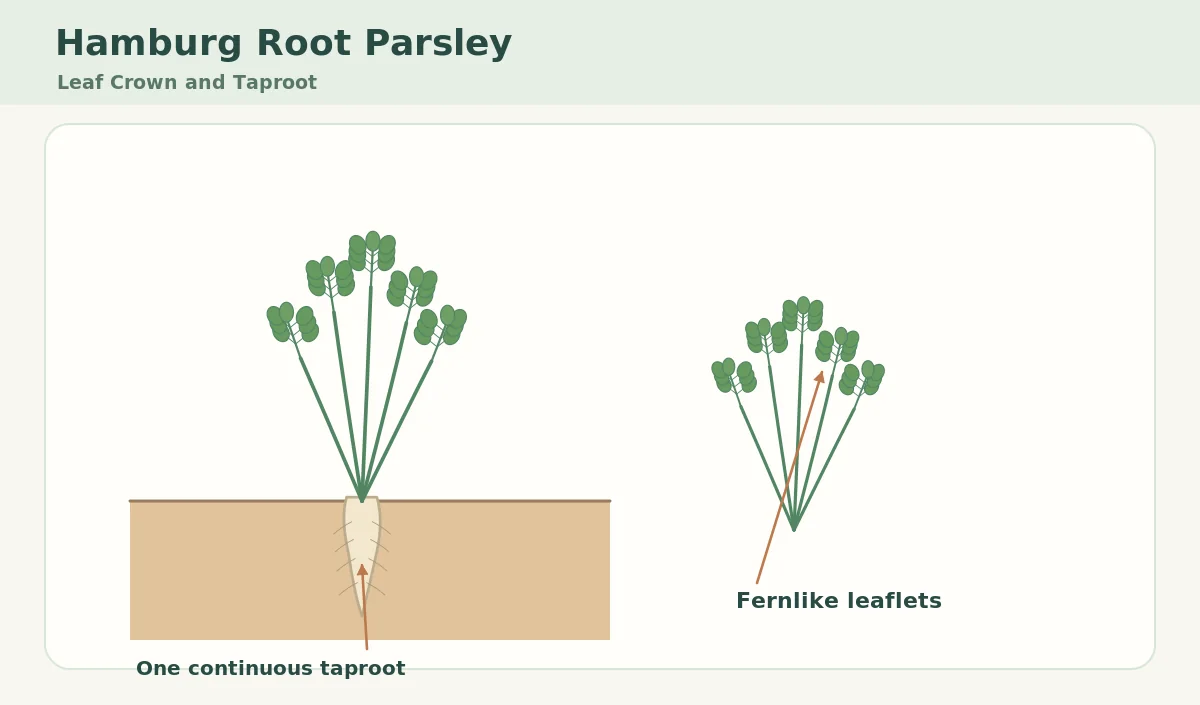
RHS advises thinning Hamburg parsley seedlings to approximately 20 cm apart, because a fattening storage root needs more room than a dense cutting-herb planting. Remove weak or crowded seedlings as soon as they are identifiable, preferably with scissors near soil level so the chosen neighbor’s taproot is not pulled sideways. A tiny parsley plant with two seed leaves is not yet proof of the final root size. Repeat a gentle thinning if the stand remains crowded. A neat aerial canopy can disguise severe root competition below. Use the diagram to separate aboveground fern-like leaves, the crown at soil level and one continuous tapered root descending from the crown.
Keep soil moisture consistent through root bulking
The root stores much of the plant’s first-season growth. Irregular dryness may slow development, while long periods of saturation deprive roots of oxygen. Water deeply enough to moisten the active root zone, then check before the next irrigation rather than repeatedly misting only the surface. Mulch between rows if useful to reduce evaporation, but keep a small open ring around foliage crowns. If leaf tips turn yellow, inspect the moisture profile and root zone before adding fertilizer. The crop does not need repeated high-nitrogen feeds merely because the leaves are small. Excess leaf growth is not the same outcome as a robust storage root.
Distinguish the living crown from the swollen taproot
Hamburg parsley’s leaf petioles emerge above a crown near the soil surface. Below that crown is a single enlarged pale taproot, often with fine lateral feeder roots. These are continuous botanical tissues: the taproot is not a detached parsnip glued beneath a leafy bouquet. The illustration labels the crown, storage root and finer side roots separately. If the root develops forks, look for compacted soil, a stone or previous root injury, rather than assuming all Hamburg varieties are naturally branched. Do not bury a growing crown under a heavy wet mulch, and avoid pulling leaves to inspect an unfinished root in the middle of the season.
Choose a harvest stage from real roots, not leaves
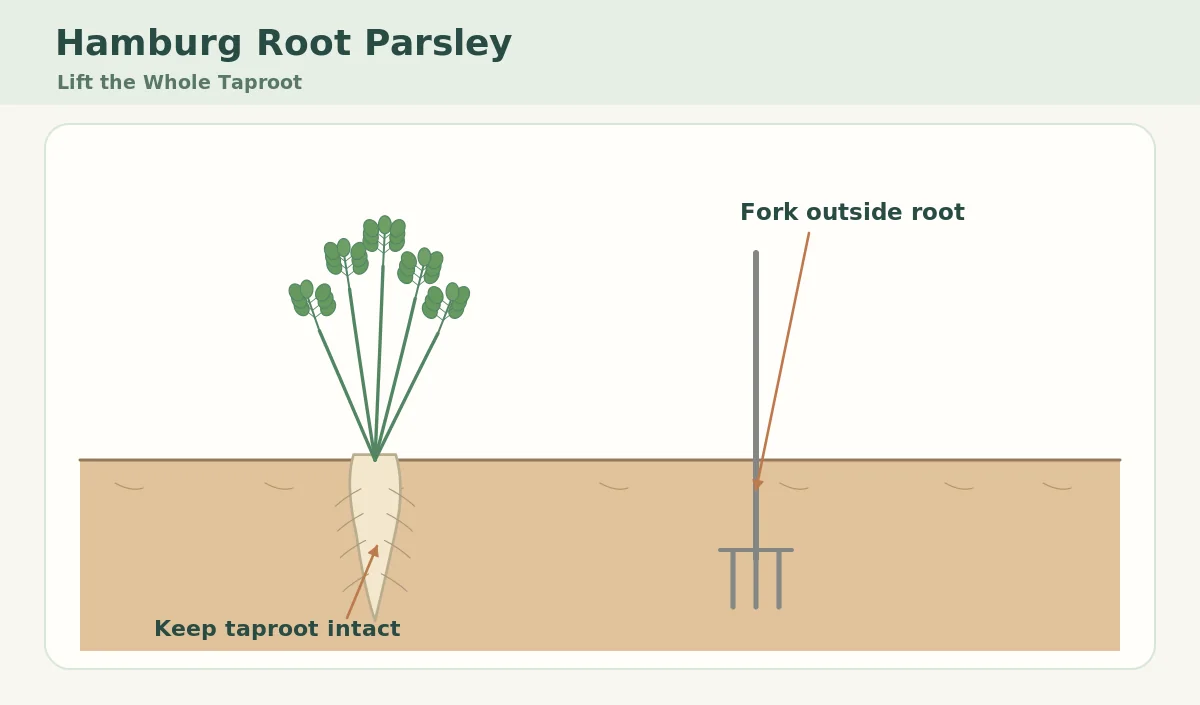
Hamburg parsley is a biennial commonly harvested during its first growing season for edible roots. RHS describes autumn and early winter harvest; timing varies by sowing date and growing conditions. Leaf height alone is unreliable because crowded and hot-grown plants can produce foliage without much root. Gently open soil beside an outer plant to check shoulder width if you are unsure. Lift a sample using a digging fork well away from the main taproot to avoid snapping it. Carefully shake off loose soil and inspect for fresh firmness, not for a mandatory single length. Save undamaged storage roots for cooking and handle harvested greens separately.
Harvest before flower stalks steal root quality
In the second year, parsley redirects energy toward an upright flower stalk and seed production. A root crop left too long may become tougher or woody as it bolts. This is different from an intentional seed crop; decide in advance which plants are for the kitchen and whether any will be left to flower. Pull a root for cooking while it is sound, clean, and properly identified, and do not claim that yellowing foliage automatically means its root is spoiled. If allowing a few plants to seed, label them so children and visitors do not confuse umbels with those of unrelated or potentially hazardous wild carrot-family plants. Never forage unidentified Apiaceae roots based on appearance alone.
Store sound roots and prevent next-season confusion
Brush excess soil gently from lifted Hamburg parsley and avoid bruising its main root. Use the roots promptly or refrigerate them under appropriate food-storage conditions, keeping damaged specimens for early use rather than long storage. Wash well before cooking and trim any decayed area; discard roots with widespread decay. Parsley leaves may be used as herbs, but heavy leaf harvesting while developing a root crop can reduce growth. Make a bed note distinguishing root parsley from standard leaf parsley and parsnips. A successful first season produces intact pale taproots and a repeatable sow-thin-water-lift routine, not an artificially perfect uniform crop. Local fall weather may determine the best final harvest window.
Related Guides
- Growing Herbs by Type: Water, Harvest, and Winter Survival Guide
- How to Sow Flat-Leaf Parsley Seeds and Manage Slow Germination
- Growing Parsley for Repeated Harvests: Seed, Leaf, and Bolting Guide
- How to Start Parsley From Seed Without Giving Up Before It Germinates
How We Research and Illustrate Plant Care
We reviewed the following horticultural sources on October 30, 2026: www.rhs.org.uk; www.rhs.org.uk; vegvariety.cce.cornell.edu. Their published cultivation and anatomical guidance informed the practical distinctions above; cultivar, climate and garden conditions may change results. The original drawings are explanatory, not measurements to scale.
VegWin provides independent educational gardening information. All three on-page navigation links go to VegWin information, are not affiliate offers, and create no paid relationship. Read the affiliate disclosure. For suspected disease, plant toxicity or identification uncertainty, ask a qualified local Cooperative Extension service.
It is a root-selected form of parsley with a thick edible taproot, unlike types grown mainly for leaves.
Direct sowing minimizes disturbance to the developing main taproot.
RHS advises roughly 20 cm between plants for root development.
Usually during the first season in autumn or early winter before flowering.
Yes, but avoid stripping the foliage heavily while you want the storage root to enlarge.