
A hanging basket can look watered because drops are falling from its dripper while the center of its root ball stays dry. Container size, potting mix, plants, wind and exposure determine how quickly moisture disappears. Drip irrigation can help, but only if the delivery point wets the root zone instead of running down the liner or leaking from a loose fitting.
Iowa State Extension identifies containers as good candidates for drip systems while emphasizing that each zone and emitter arrangement needs to suit its plants. Its hanging-basket guidance also stresses drainage and frequent watering. This guide turns those principles into a commissioning test you can repeat after storms, heat waves or seasonal growth, rather than giving one timer setting for every basket.
Start with the water source and hanging hardware
Draw a simple sketch of the hose bib or other approved water source, the path of the main tubing and the location of every hanging basket. A pressure-regulated, filtered irrigation setup may be appropriate depending on the hardware; follow the actual manufacturer specifications and local plumbing requirements rather than connecting unfamiliar fittings by guesswork. Gravity-fed barrels can deliver much less pressure than municipal water, so test compatibility instead of assuming the same emitters will work.
Check that each basket and hook can safely carry the weight of saturated media and foliage. Do not fasten tubing in a way that pulls on the hanger or makes someone step onto an unsafe ladder to repair it. Route lines away from walking paths, moving doors and sharp metal edges. The safest system lets you inspect a dripper from the ground or with an appropriate access method.
Group baskets by drying rate instead of appearance
Two equally pretty baskets may have very different water demand. A small coir-lined basket in full sun and wind may dry much faster than a large plastic planter under an overhang. Plant species, leaf canopy and the volume of potting mix further change water use. When practical, place containers with similar exposures and needs on the same zone; reserve independent adjustments for baskets that behave differently.
Iowa State Extension points out that larger, deeper baskets generally retain moisture longer but weigh more. Minnesota Extension notes that most container plants prefer moist rather than soggy media. A schedule that rescues a wind-exposed basket may saturate a shaded pot. Give each group an observational baseline before configuring automation, then separate outliers rather than increasing water to everything.
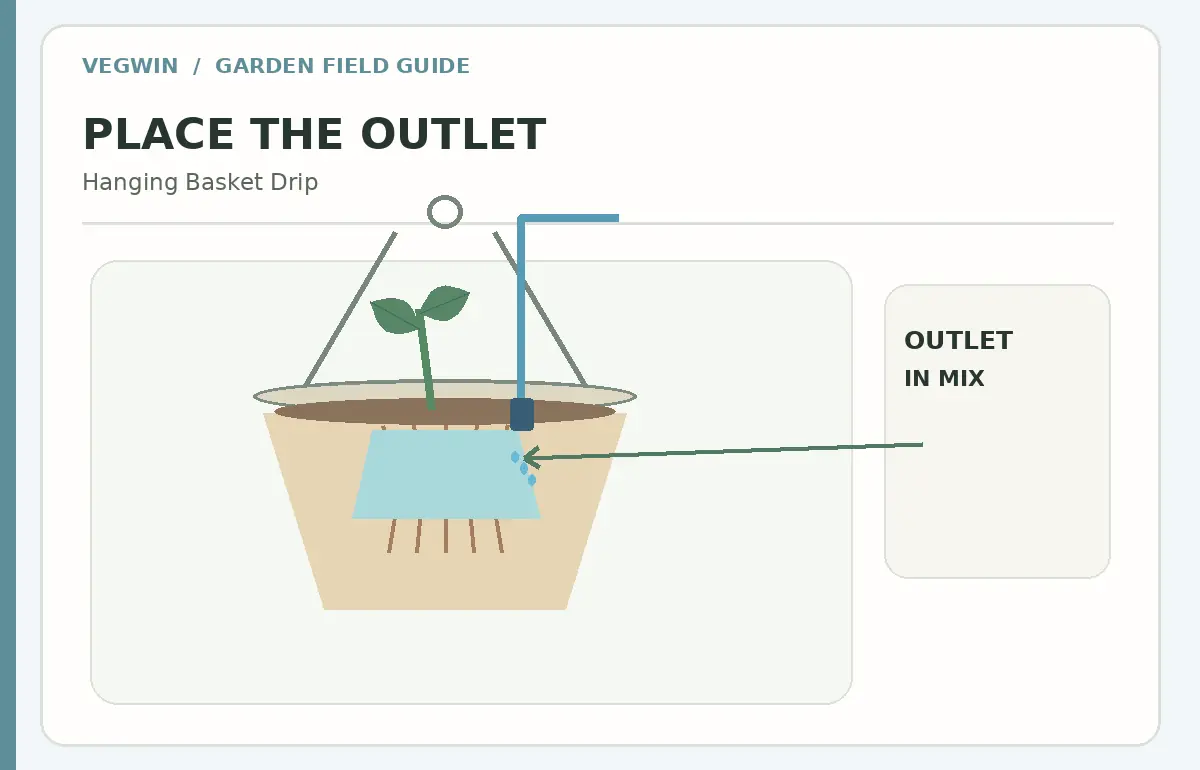
Place an outlet where roots can actually use water
Position the drip outlet over the potting mix, not on the outer wire rim, leaves or coco liner. Secure it so wind and basket movement cannot swing it away from the root zone. A stake or small tubing clip may help, but the component should not crush stems or pierce the pot where it could cause leaks. Avoid holding an emitter against a single tender crown.
One emitter is not always sufficient for a wide or densely rooted container; several wetting points can distribute moisture more evenly. The correct number depends on emitter flow, mix and container geometry, so begin with manufacturer guidance and inspect the result rather than copying numbers meant for garden soil. Keep drainage holes functioning. Watering from the top does not remove the need for excess water to escape.
Run a manual test before touching the timer
Fill the line, switch on the system manually and inspect every basket. Confirm that water exits every intended outlet rather than an open tubing joint. Watch for spray, clogged emitters or drips outside the pot. Look underneath and verify that drainage appears only after the mix has had time to absorb moisture, not because water immediately bypassed the root ball.
After the test, let the water redistribute, then use a finger or narrow trowel carefully away from stems to check the moisture below the surface. Iowa State notes that severely dried potting mix can pull away from the pot sides, so water may run straight out without wetting the center. A basket in that state may need deliberate rewetting before automated irrigation behaves predictably. Never infer root moisture from a wet surface alone.

Build a timer schedule from observed moisture
Only after the manual test should you try a programmable schedule. Begin conservatively and check every basket during the first several cycles. A fixed duration is not transferable between a small shaded basket and a densely planted sun-exposed basket. Adjust the schedule with actual weather, growth and potting mix moisture instead of assuming the timer knows when rain reached every hanging plant. To go further, our guide to how often to water a vegetable garden shows how to check roots, rain, and weather.
Some sheltered baskets receive very little rainfall even during storms; others may already be saturated. Stop irrigation when the media remains soggy or cold-weather growth slows. A timer makes repetition easier, but it does not replace inspection. Ensure the equipment is installed and weatherproofed according to product instructions, especially where electricity or freezing conditions are involved.
Troubleshoot an uneven or leaking line systematically
If the first basket is wet and the last is dry, inspect line routing, clogged outlets, connectors and pressure performance before increasing watering time. A kink in the small tubing or a pinched branch can prevent flow. If each emitter releases water but only one side of a basket is wet, change outlet placement or wetting coverage instead of lengthening every cycle and drowning the other plants.
If water escapes from the bottom immediately, feel the core of the mix. Hydrophobic or shrunken potting media may be routing water around the edge. Iowa State describes rewetting a severely dry basket separately so that the soil ball can absorb moisture again. Replace degraded potting mix when appropriate; no irrigation layout can permanently compensate for a container without working drainage or usable root space.

Make the system easy to inspect throughout the season
Photograph the tubing layout and label any shutoffs or zones. Revisit emitter positions as plants grow and trail over the basket sides. Confirm lines remain secure after strong wind, plant grooming or moving pots. Remove debris around an outlet without pushing contaminants into the line. Keep a record of which container dries first so your next adjustment is based on a pattern.
At season end, follow the equipment maker’s shutdown and winterization directions for your climate; do not guess at pressures or compressed-air procedures. The best small drip system is one whose failures are obvious and accessible. A clean, simple layout with repeatable soil checks is more reliable than elaborate tubing that nobody can test. For the fuller picture, see our guide “Set a Drip Irrigation Timer With Soil Checks Instead of Guesswork”.
Choose Your Next Step From the Evidence
| What you notice | What it may mean | Reasonable next step |
|---|---|---|
| Emitter drips but center is dry | Water bypassing root ball | Rewet medium and relocate outlet |
| Shaded basket remains saturated | Schedule exceeds demand | Reduce or separate its irrigation zone |
| Last outlet not dripping | Line, pressure or clog problem | Inspect tubing and manufacturer flow requirements |
| Water runs off wire liner | Outlet misses potting mix | Secure tube above the root zone |
Related Guides
- Set Up Soaker Hose Irrigation and Test for Even Root-Zone Watering
- Gravity Drip Irrigation From a Rain Barrel: Test Flow Before Expanding
How We Research and Check These Recommendations
We reviewed the original institutional and specialist horticulture guidance listed below on October 22, 2026. These sources support the specific biological and practical distinctions discussed above; they cannot forecast conditions in every garden. This is not a claim to have inspected the full published text of every older article. The simplified illustrations show decisions and recognizable plant structures, not photographic proof of a diagnosis. Always account for local weather, plant identification and the recommendations of a nearby Extension office.
Sources checked October 22, 2026: Source 1 — Iowa State Extension explains drip systems in containers and matching zones, emitter placement and pressure to root-zone needs.; Source 2 — Iowa State Extension explains hanging basket drainage, rapid drying and the need for proper potting mix.; Source 3 — University of Minnesota Extension describes container moisture checks and avoiding continuously soggy root zones.; Source 4 — Iowa State Extension explains hand-checking basket soil and watering until the entire mix becomes moist.. No paid partnership or affiliate approval is being claimed. For more detail, read our affiliate disclosure. No product treatment or application rate is being prescribed without its appropriate label or local expert context.
Not necessarily. Root volume, mix and emitter pattern determine whether one outlet wets enough of the container.
There is no universal time. First test wetting depth and drainage, then adjust for your actual basket and climate.
Check for shrunken, overly dry mix that is routing water around the root ball before adding more runtime.
Often they need frequent checks in warm weather, but actual watering depends on exposure, size and moisture.
Possibly, if the chosen components work at the available head pressure. Test the specific system first.