
Disclosure: This article offers independent educational guidance, not a paid endorsement or a verified affiliate recommendation. See our affiliate disclosure. Local Extension resources, plant variety, regional conditions and product labels take precedence over general examples.
How often should you water a vegetable garden? There is no dependable every-day or twice-a-week answer. Water moves differently through sand, loam and clay; rain may reach an exposed bed but miss the roots under plastic mulch; a new transplant needs attention at a different depth from a mature tomato. The correct interval is the interval between root-zone checks that show irrigation is needed.
A practical starting reference from Iowa State Extension is roughly one inch of total water per week from rain plus irrigation for many established vegetable beds, not a prescription that every crop or climate consumes exactly that amount. In very hot, windy conditions, demand can climb. You can make better decisions by measuring rainfall, soil moisture, plant stage and your irrigation system rather than memorizing a schedule.
Test Root-Zone Moisture Instead of Surface Color
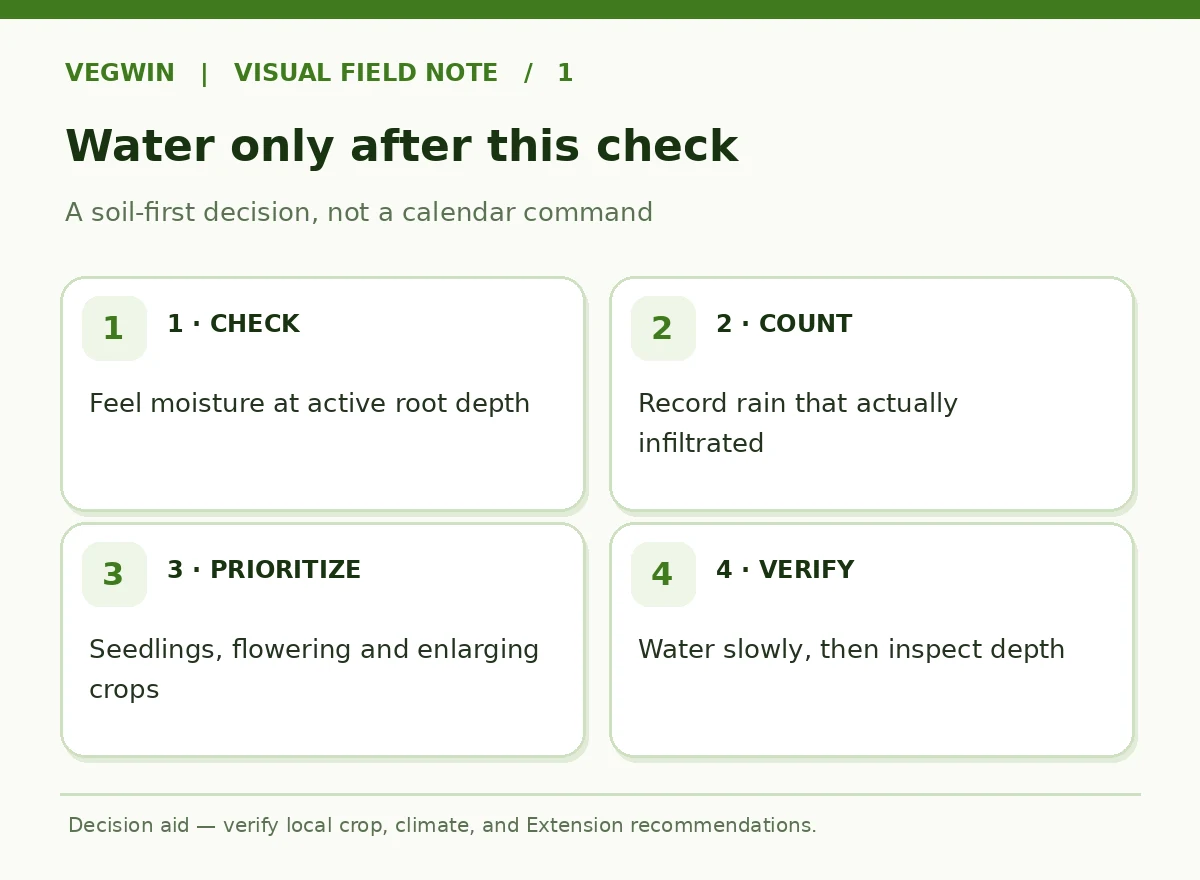
Soil can look dry on top while holding adequate water at root depth. Conversely, a quick splash can make the surface dark while leaving roots dry. Check just beside the crop using a hand trowel or an appropriate probe, avoiding significant root damage. Note whether soil below the dry crust feels cool and moist, crumbly and dry, or saturated and airless.
Young seedlings have small shallow roots, so their relevant check depth is shallower than for an established crop. Iowa State describes moistening much of the established vegetable root zone, often around 6–12 inches deep depending on method and plant. That is a diagnostic target for soil wetting, not an instruction to saturate every bed to a fixed depth daily.
Record the moisture pattern at the same few spots: near the emitter, midway between emitters, and at the far edge of a bed. If the soil is wet below while leaves droop at noon, investigate heat, roots and recovery at evening rather than treating the wilt alone as proof of drought.
Use Rainfall as Part of the Weekly Water Budget
Set a straight-sided rain gauge in an open representative location, empty it after reading, and log meaningful rainfall events. Iowa State uses about one inch of rain plus irrigation per week as a starting guide for typical established beds. Connecticut Extension explains that hot, sunny, windy conditions can raise demand, sometimes toward two inches per week depending on crop and setting.
For example, if an exposed bed receives six-tenths of an inch of useful rain and your planning reference is one inch, the remaining benchmark is roughly four-tenths of an inch. That is a planning estimate, not an order to irrigate regardless of soil moisture. Check actual infiltration, runoff, mulch and plant demand before applying it.
When plastic mulch sheds rainfall off the bed, rainfall recorded nearby may not have entered the root zone at all. Likewise, a thunderstorm can produce substantial runoff from compacted ground. Do not subtract rain mechanically without checking whether it reached plant roots.
Prioritize Sensitive Crop Growth Stages
Seed germination and recent transplant establishment are vulnerable to water interruptions because roots are limited. Flowering and fruit development are high-priority stages in tomatoes, peppers and cucurbits; root enlargement matters for carrots and beets; head formation matters for cabbage-family crops. Iowa State Extension provides a crop-stage table because all vegetables do not reach peak water demand at the same time.
Watch the crop, not only the thermometer. A healthy established plant in mulched loam may need water less frequently than a newly transplanted crop in sand even during the same week. Wind and low humidity accelerate water loss, while cool cloudy weather slows it. Water needs also change when the crop canopy closes and shades its soil.
Under genuine restrictions, prioritize establishing crops and the highest-value sensitive growth stages, and follow local water-use rules. Weed control and mulch can reduce loss so irrigation demand is not exaggerated by exposed bare soil and competing weeds.
| Observation / option | What to verify | Practical decision |
|---|---|---|
| Dry 2 inches down, moist deeper | Established plant may not need water yet | Recheck at relevant root depth |
| Dry at active roots | Root zone lacks available moisture | Irrigate slowly; verify depth |
| Wet roots, midday wilt | Water stress may not be drought | Review heat, drainage, disease |
| Gauge shows rain, soil remains dry | Runoff or mulch exclusion possible | Test infiltration before subtracting rain |
| One drip-line plant wilts | Emitter or location issue possible | Inspect individual outlet and wetting pattern |
Choose Delivery Method and Calibrate It
Drip and soaker hoses direct water near the roots and usually keep foliage drier than overhead sprinklers. They also have blind spots: a clogged emitter, an uneven line or too-short runtime can leave entire plants dry. Sprinklers are easier to check with identical straight-sided catch containers placed around the bed; compare collected water in different positions before accepting one average.
For drip irrigation, read the emitter or tape specifications and measure how deep and wide the wetting front moves after an initial session. Penn State gives run-time calculations based on actual tape flow and bed width; its example numbers cannot be copied to a different emitter model or pressure. Set a trial runtime, inspect several root-zone points, and adjust.
Apply water slowly enough that it infiltrates rather than running off. Early-day watering can let leaves dry if overhead irrigation is unavoidable. Do not rely on automation alone; a timer can faithfully repeat a wrong amount of irrigation until someone checks the soil.

Recognize Signs of Too Little or Too Much
A dry root zone, poor fruit enlargement and persistent early-morning wilting support concern about drought. However, curled leaves, scorched margins or midday drooping can have causes beyond underwatering. Soil saturation and oxygen deprivation can also injure roots, giving plants the appearance of thirst while the soil is already too wet.
If soil is consistently saturated, investigate blocked drainage, irrigation leaks or overly frequent cycles. Give soil time to aerate instead of adding more water. If only the surface is wet, increase infiltration depth through an appropriate slow application rather than adding more frequent superficial splashes.
Persistent asymmetric wilt, plant lesions or stunting in a properly moist bed calls for disease or root diagnosis through Extension resources. No water schedule can resolve a stem infection or a fundamentally unsuitable site.
Keep a Seven-Day Irrigation Check Log
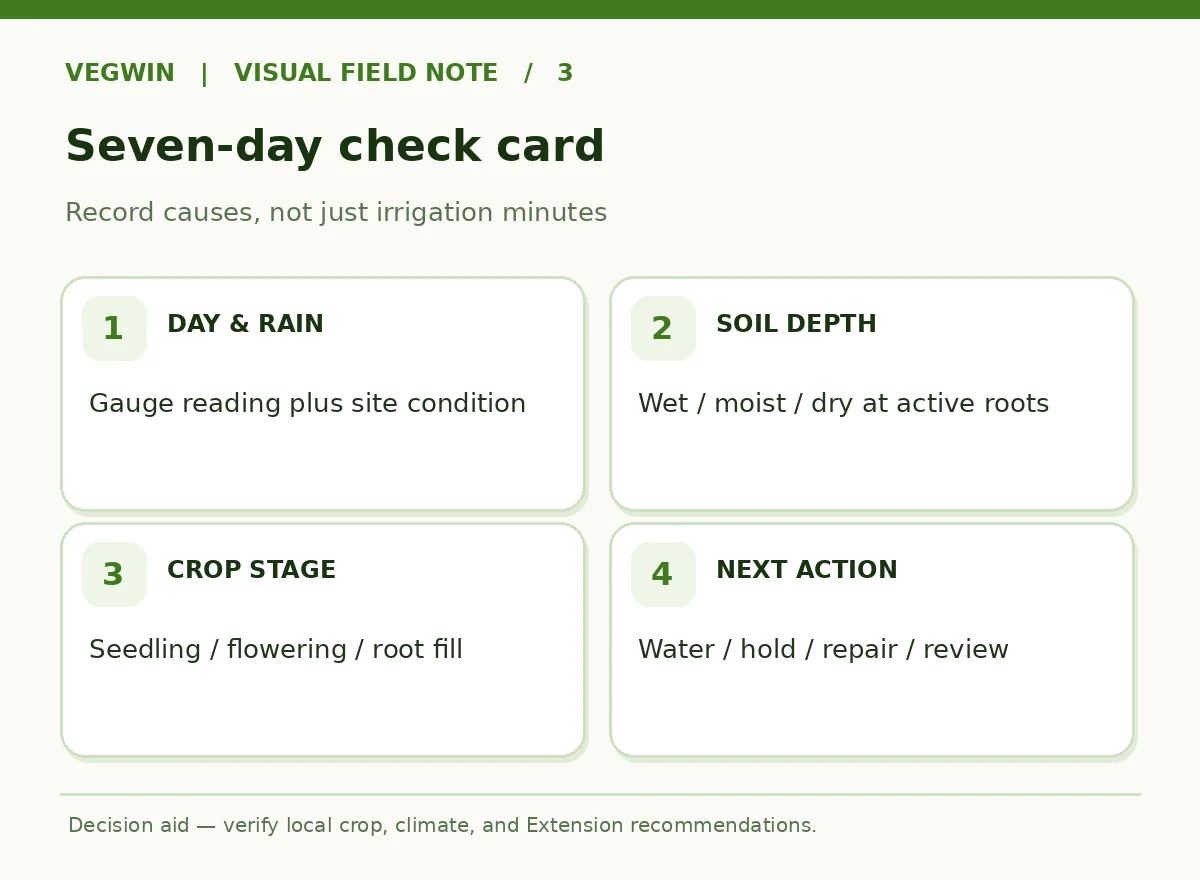
Use a single-page log with day, rain-gauge reading, root-zone moisture, irrigation runtime or amount, crop stage and weather observations. Recheck after a watering event to see if the wetting front reaches the intended roots. Revisit the interval after heavy rainfall, heat waves, new mulch or installation of new drip tubing. For a step-by-step method, see how to water newly planted trees by checking the root ball.
Decisions from the log should be small and testable: reduce run time on a persistently wet area; add a session for a dry sandy bed; repair a clogged emitter rather than increasing water everywhere. Compare the plant’s growth and soil response for several checks before calling the adjustment successful.
The purpose is consistent available moisture, not the pursuit of a perfect universal quantity. In a mixed garden, group plants with similar needs when possible, then check exceptional crops individually rather than using the thirstiest plant to set the schedule for every bed.
How We Research and Apply Local Exceptions
This article adds one specific reader job: A repeatable check–measure–adjust irrigation workflow estimates bed rainfall deficit, verifies wetted root depth and differentiates young seedlings from established crops without imposing a daily schedule. We keep claims traceable to crop biology and site conditions; we do not treat a hardiness zone as an annual planting calendar or presume every cultivar reacts alike. Original diagrams illustrate decision logic rather than experimental data. This page is about measuring water need and delivery in the ground. Live WP URL inventory unavailable.
Sources reviewed 2026-10-20: Iowa State University Extension — Watering the Home Vegetable Garden; University of Connecticut Extension — Helping Vegetable Crops Through Drought and Heat; Iowa State Extension — Using Drip Irrigation in the Garden; Penn State Extension — Determining Drip Run Time. Each source supports the specific factual points recorded in this article’s metadata. These sources are independent educational institutions, not product partners. Recommendations and guidance may be updated; consult your regional Cooperative Extension office for local conditions and read the VegWin disclosure for the site’s commercial policy.
Not automatically. Daily checks may be sensible for establishing seedlings, but irrigation frequency should follow moisture at the active roots and current demand.
It is a common planning baseline for many established beds, not a fixed prescription. Hot winds, crop stage and soil texture can change demand.
Only to the extent it actually infiltrated the root zone. Rain may run off compacted soil or plastic-covered beds.
Heat, poor aeration, root damage and disease can cause wilting. Check deeper soil conditions and plant symptoms before adding water.
Run a trial, inspect the depth and width of moist soil at representative points, and adjust to the hose and bed—not a universal minute count.