
A statice bouquet can look colorful for months because the stiff purple, pink, yellow or white calyces keep their color after the true little flowers fade. That attractive papery material is not itself a packet of ready-to-sow seed. For seed saving, choose a correctly identified annual statice plant, Limonium sinuatum, let selected flower clusters mature fully on the plant, and inspect the dry floral structures for actual fruits. This guide separates decorative drying from seed ripening so you do not store a handful of colored chaff as though it were viable seed.
Identify Limonium sinuatum instead of another sea lavender
The commercial cut-flower statice usually called Limonium sinuatum has a basal rosette of somewhat lobed, wavy leaves and upright branching stems with thin wing-like ridges. The branching tops carry many small cups of colored papery calyx tissue, among which the tiny true flowers appear. Garden labels can use “sea lavender” for unrelated Limonium species, so begin with the botanical name.
The genus includes annuals and perennials that differ in habit, and not every stem in a mixed dried bouquet is L. sinuatum. Source seed from a known plant rather than an unidentified florist arrangement. A stem lacking its basal leaves is particularly easy to misidentify. Cornell describes this species as a seed-propagated annual cut flower, often sold as either raw or cleaned seed.

Distinguish colored calyces, true flowers and hidden fruits
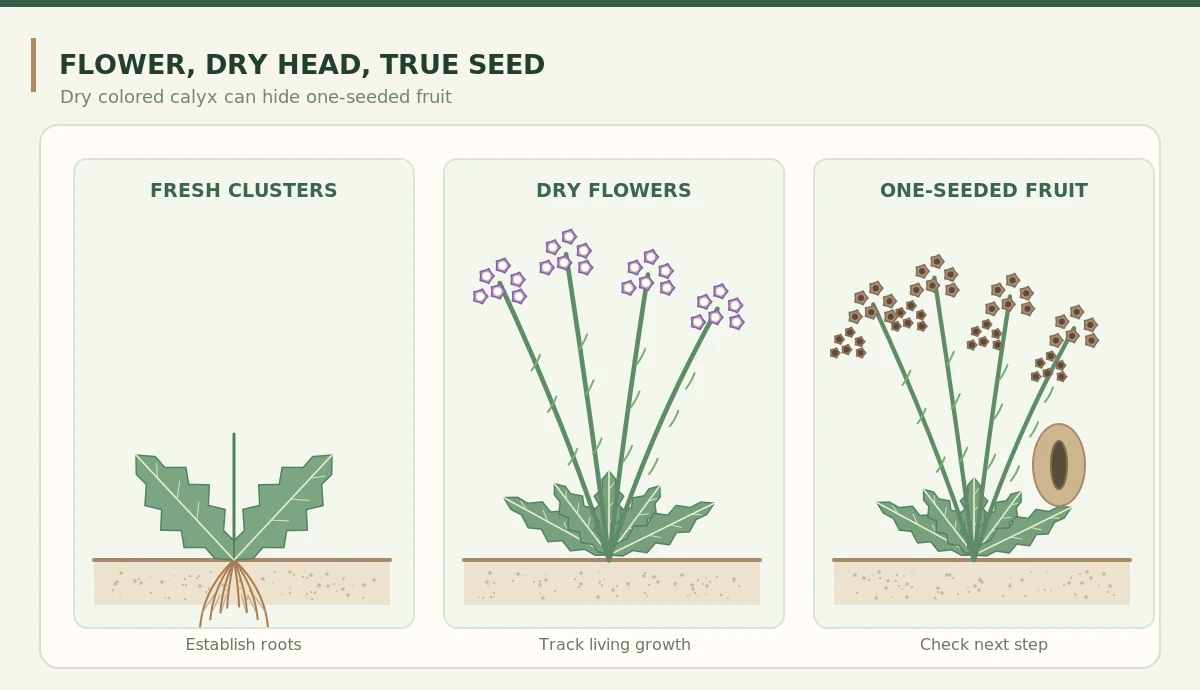
A statice flowering branch can contain colored cups and much smaller pale or white true flowers. NC State notes that the persistent papery calyces remain long after the short-lived corollas disappear. A calyx is part of a flower, not automatically the seed; the mature one-seeded fruit develops within the remaining floral structure. This is why colorful material from a recently dried bouquet may contain little mature seed.
When inspecting a seedhead, use a tray and good light. Peel open a few fully mature dry units and look for a firm small seed-bearing structure rather than counting each colored papery cup. Seeds may remain enclosed in dry flower fragments until cleaned. Treat the illustration as a guide to relative location, not an exact scale for every cultivar.
Allow selected stems to finish ripening on a healthy plant
Select vigorous, disease-free plants whose flowers you liked. Leave some clusters on the plant beyond their attractive fresh-cut stage; harvesting them for bouquets while young is a different task. Watch for the transition from fresh small flowers and vivid calyces to dry brownish floral tissues. Color remaining in the calyx alone does not prove that its fruit has matured.
Seed set can vary with weather, pollination and cultivar. Named hybrids may not produce offspring identical to their parent, so label saved lots with a general plant name and flower color rather than promising a perfect replica. Avoid collecting stems covered with mold, and do not rely on a firm calendar week as proof of ripe seed.
Cut dry clusters into a paper bag without losing loose seed
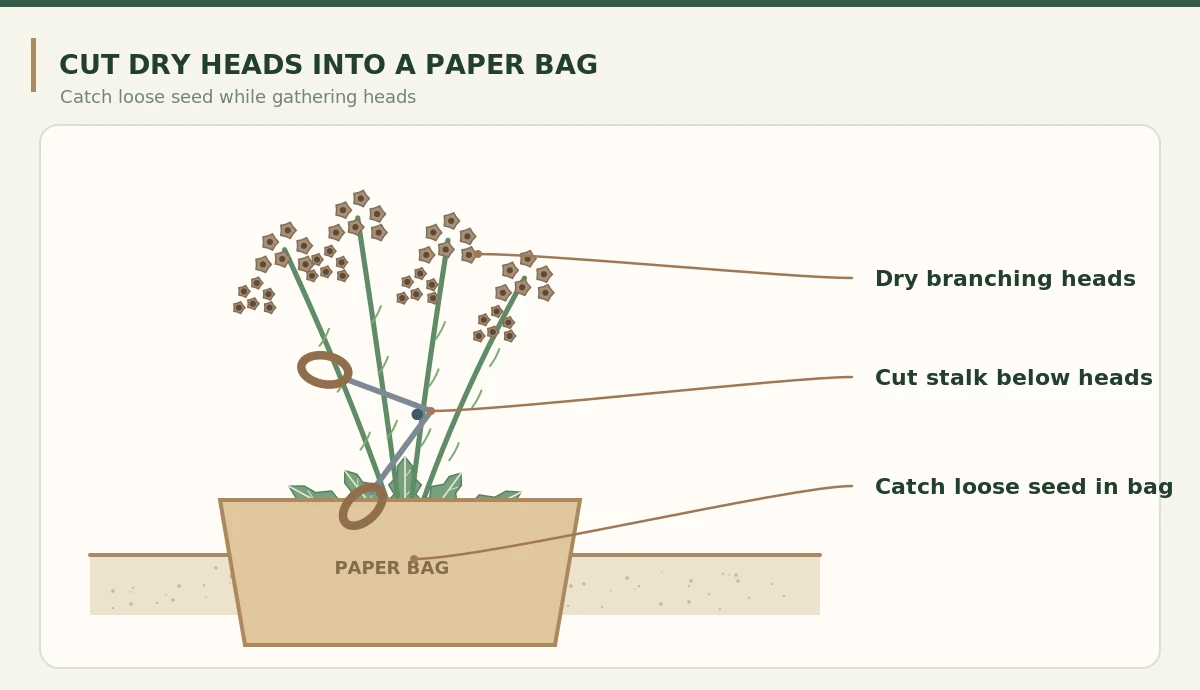
Choose a dry day after rain or dew has disappeared. Hold an open paper bag beneath the cluster and cut its stem, letting loose fragments fall into the bag. Cut below the mature branch of small flowers, not through the basal crown. Illinois Extension recommends keeping harvested dry seedheads in paper bags so they can finish drying without trapping moisture.
Keep different colors or plant groups in separate labeled bags if their identity matters. Paper breathes more readily than a sealed plastic bag containing a still-damp head. Store bags in a sheltered airy location away from heat and direct wetness, and check for mold. If a sample is soft and damp, it was harvested too early for safe storage.
Separate true seed structures from decorative chaff
Spread a small amount of completely dry material on a clean pale tray. Rub or tease apart the oldest floral clusters gently, then remove large wings, stems and colorful papery cups. Look for the darker, more substantial seed-bearing structures left within the flower remains. A close-up and magnifier are helpful because seed is much smaller than the entire colorful spray.
Do not crush everything aggressively and call the dust “seed.” Try opening a few individual units first so you recognize what you are retaining. Cornell notes that both raw and cleaned statice seed can be used for propagation, so perfect cleaning is not essential; a modest amount of dry surrounding tissue is preferable to destroying seed by over-processing.
Dry, label and store seed without sealing in moisture
Dryness is the key storage condition. Leave cleaned seed or a seed-and-chaff fraction spread on paper in a protected dry place until no damp material remains. Then transfer it to a labeled paper envelope or suitable dry airtight container, recording species, cultivar or color if known, and collection year. Keep it cool, dark and away from moisture rather than on a humid windowsill.
Illinois Extension emphasizes dry storage and clearly identifying seed lots. If condensation appears inside a closed container, reopen it and re-dry the contents; visible mold is a reason to discard affected material. Seed viability declines over time and cannot be proved by a glossy photograph of the stored packet. A small germination test before the next planting season can help assess the lot.
Do not confuse bouquet harvest with seed harvest
Florists commonly cut statice while the display is still colorful and its tiny true flowers are showing. That stage is ideal for arrangements but often earlier than mature seed. If you want both bouquets and seed, reserve some flower branches for each purpose. Harvesting every stem young leaves no mature heads to collect later.
The wings running along the stem and the wavy basal leaves are plant-identification features; they are not seed pods. In a drawing, the cut line belongs to the stalk beneath a dry branch, while the seed is located within the floral material above it. This spatial distinction prevents the common mistake of collecting dry stems and assuming they contain seed.
Use saved seed cautiously and monitor the next sowing
Cornell describes reliable propagation from commercial cleaned or raw seed but also recognizes variation in seed condition. For saved seed, sow a modest trial in a well-drained starter mix according to the seed packet’s directions and protect the seedlings from waterlogged roots. The plant’s mature foliage grows from a basal rosette, so do not expect a new seedling to look like a miniature colored blossom.
Mark the germination tray and compare emerging plants to a known statice seedling. If germination is weak, consider maturity at harvest, storage moisture, seed age and normal variability before changing all growing conditions. The successful seed-saving result is a labeled lot of real dry seeds from positively identified stems, not just attractive papery florets.
Related Guides
- How to Save Nasturtium Seeds After Pods Turn Tan and Dry
- How to Save Gomphrena Seeds From Dry Globe Amaranth Heads
- How to Save Mexican Sunflower (Tithonia) Seeds From Dry Flower Heads
- How to Save Cleome Spider Flower Seeds Before Dry Pods Split
- How to Save French Marigold Seeds From Fully Dry Flower Heads
How We Research and Verify Our Garden Guidance
We reviewed primary horticultural and university Extension sources on 2026-10-29: plants.ces.ncsu.edu; plants.ces.ncsu.edu; extension.illinois.edu; blogs.cornell.edu. The illustrations explain the anatomy and decisions described in those resources; they are educational botanical artwork, not photographs or a claim that every cultivar grows identically. We cross-checked this distinct topic against the user-supplied WordPress article list and earlier VegWin batches. Local soil, climate, provenance and actual plant condition still determine practical decisions.
This article contains no sponsored recommendations or paid product links. See the VegWin affiliate disclosure for site policy. Follow current local Extension or IPM guidance before using any pest control product; no specific pesticide rate or medical benefit is recommended here.
No. The colorful parts are persistent calyces; the single-seeded fruit develops within the floral structure.
Allow selected flower clusters to ripen fully and dry on a healthy plant, then collect on a dry day.
Not reliably. Bouquet stems may have been harvested before seed matured and may not be identified to species.
Work over a tray, gently break apart dry floral clusters and remove large stems and papery chaff while retaining firm seed-bearing units.
Not necessarily. Hybrid or cross-pollinated plants can yield seedlings different from the parent.