
Winter savory (Satureja montana) is a small, peppery-flavored, woody perennial, not the annual summer savory sold beside it in seed displays. A packet can produce winter savory, but a nursery start or rooted cutting is often a simpler route to a reliable plant. If you do choose seed, protect its small roots and let the framework establish before harvest. The useful distinction in this guide is where green leafy stems end and older wood begins, because the harvest point matters as much as the soil.
Distinguish perennial winter savory from summer savory
Read the name on the packet: Satureja montana is winter savory, while Satureja hortensis is annual summer savory. Winter savory tends to be stiffer, woody and evergreen or semi-evergreen where conditions permit, with small dark-green opposite leaves along fine stems. It is commonly used to flavor beans, soups and other savory dishes. Illinois and Georgia Extension both stress its perennial habit and stronger flavor.
The distinction affects expectations. Summer savory is readily raised as an annual from seed; winter savory is also seed-propagated, but Georgia Extension says it is generally best grown from cuttings or division. If a packet germinates irregularly, do not mistake that alone for a failure of your gardening skill. Keep a backup start or rooted plant when continuity is important.

Give the crown sun and a fast-draining root zone
Choose a sunny place with freely draining soil. Illinois Extension specifically warns that winter savory planted in poorly drained ground can rot in winter. A raised herb edge or a container with real drainage holes is safer than a depression where cold water lingers. Soil that stays permanently saturated is not improved by simply adding a thin decorative gravel layer on top.
Leave enough room for the short shrub to branch, and keep mulch from piling against the crown where stems enter the soil. Once rooted, the plant tolerates comparatively drier conditions, but new seedlings still need careful moisture until roots reach beyond the starting plug. Water the medium, not a calendar: check below its surface before deciding whether another drink is needed.
Start seeds without inventing a universal burial depth
Use fresh, clearly labeled Satureja montana seed, a clean seed tray and a loose, sterile seed-starting mix. Pre-moisten the mix and sow thinly. Small herb seeds are easy to bury too deeply, so follow the supplier’s stated cover depth rather than treating every savory species alike. A light mist or gentle watering keeps seed positioned, whereas a strong stream can move it to the tray edge.
Place the tray in a bright, appropriate environment and monitor it for germination without allowing standing water. Seed packets differ in the precise conditions they recommend. Record sowing date and the first appearance of seedlings, and inspect for excessive elongation rather than assuming more water will correct weak growth. As soon as roots hold a small plug, handle it by its leaves or surrounding mix, not by stretching the stem.
Transplant seedlings at their original soil level
Move established seedlings into small draining pots before roots tangle severely. Set the crown near the level at which it grew in the tray and firm mix around the root plug. A tender seedling placed deep inside wet compost may struggle long before any leaves look obviously unhealthy. Give new transplants light without abruptly scorching plants that were raised under sheltered conditions.
Harden container-grown plants gradually before a permanent outdoor placement after local weather allows it. A late frost date is only a planning guide; cold, wet soil and poor air circulation can still hold them back. Where winter survival is marginal, pot cultivation makes it easier to give the plant a dry, sheltered resting period instead of treating USDA hardiness zones as exact sowing dates.
Recognize opposite leaves, flower tips and old wood
Winter savory’s leaves are small and pointed, attached in pairs along branching stems. Young growth is green and flexible, while the lower framework eventually becomes brown and woody. Flowers are small and pale, often white to lilac, near upper stem portions. Inspect a real live shoot before pruning: a woody section that looks bare at winter’s end can still produce a bud when spring growth resumes.
This anatomy matters because plants are not bunches of detachable herb leaves. Every leaf and flower belongs to a stem, and roots arise from the crown beneath soil. Do not confuse a dry flower stalk with a rooting cutting, and do not shear a struggling plant below its last green growth point just because you want a fresh mound immediately.
Harvest tender tips while leaving leafy nodes to regrow
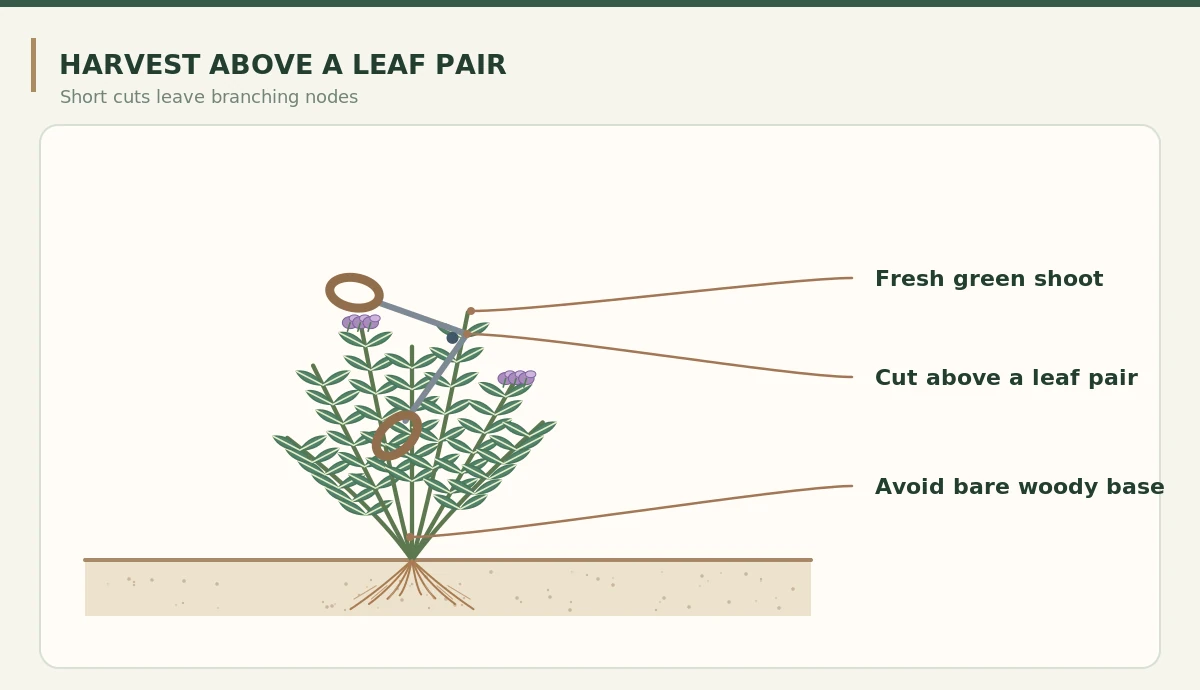
Take modest green sprigs once growth is well established. Follow the shoot down to a healthy set of attached leaves, then make the cut just above a leafy node. The remaining leaves supply energy and provide nearby points for fresh side growth. Harvest from several stems rather than stripping one entire side and leaving an unbalanced woody shrub.
RHS recommends regular tip harvesting to keep savory compact, whereas Illinois Extension emphasizes young shoots. Avoid a hard cut into leafless old wood, especially in a plant already weakened by winter wetness. Wash culinary sprigs before use and use only positively identified savory from clean growing conditions; decorative cultivars and neighboring plants should never be gathered by guesswork.
Prune at the right season and replace tired plants as needed
The RHS suggests light pruning of winter savory in mid- to late spring to maintain shape. Faded flowering stems can be tidied, and soft new shoots can be rooted as cuttings in summer. Do not treat dormancy as proof of death: look for new buds before deleting all the old branches. If a plant has become extremely woody, replacing it with a rooted young plant may be safer than a severe one-time chop.
Where stems fall sideways, a low branch touching soil may layer and form roots; detach only after roots are real, not imaginary. Pruning should improve a living framework rather than erase it. You may use dried leaves later, but dry them completely, store away from moisture and label the species to avoid confusing the flavor with summer savory.

Fix wet roots, patchy germination and sparse foliage
Wilting in moist soil calls for a drainage inspection, not an automatic second watering. Check whether the pot has an open exit, whether mix is dense, and whether the crown sits beneath wet material. Poor germination can involve seed age and sowing conditions; compare a new packet or consider a nursery transplant rather than repeatedly changing all factors at once.
A sparse center on an older plant can simply be its woody habit. Look for green side shoots near the edges and clip only where living nodes remain. Watch for pests, but diagnose before treating. Your successful result is a compact plant with aerated roots, intact lower framework and a steady supply of tender leaves, not a forced annual crop regenerated by severe cutting.
Related Guides
How We Research and Verify Our Garden Guidance
We reviewed primary horticultural and university Extension sources on 2026-10-29: extension.illinois.edu; extension.uga.edu; www.rhs.org.uk. The illustrations explain the anatomy and decisions described in those resources; they are educational botanical artwork, not photographs or a claim that every cultivar grows identically. We cross-checked this distinct topic against the user-supplied WordPress article list and earlier VegWin batches. Local soil, climate, provenance and actual plant condition still determine practical decisions.
This article contains no sponsored recommendations or paid product links. See the VegWin affiliate disclosure for site policy. Follow current local Extension or IPM guidance before using any pest control product; no specific pesticide rate or medical benefit is recommended here.
No. Satureja montana is a woody perennial; summer savory, Satureja hortensis, is usually annual.
Yes, but cuttings, divisions or nursery starts are often more dependable than seed for establishing this perennial.
No. It requires well-drained soil, and persistent winter wetness can damage the roots.
Cut tender green sprigs above leafy nodes, leaving enough foliage and young growth to recover.
Avoid severe cuts into leafless old wood. Light spring shaping or replacement of an old plant is safer.