
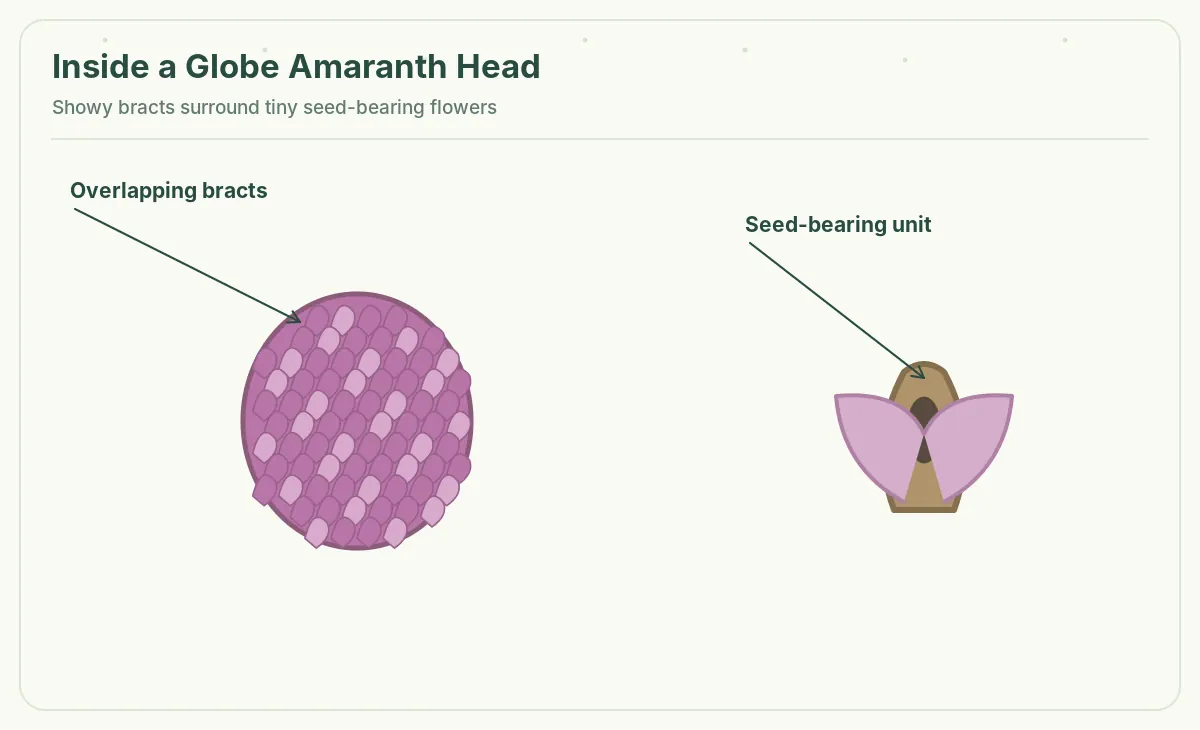
The bright little globes of gomphrena can look like jars full of ready-made seeds, but much of what you see is actually decorative papery bract tissue. In Gomphrena globosa, the true flowers are comparatively inconspicuous within the dense head, as Wisconsin Horticulture explains. That distinction makes seed collecting less confusing: wait for mature dry heads, cut them before weather destroys them, gently break them apart and look for small firm seed-bearing units instead of calling every purple flake a seed. Penn State and Illinois Extension recommend careful drying and chaff separation for saved flower seed. This guide focuses on the actual anatomy and an orderly, labelled collection process.
Identify the Papery Bracts and Seed-Bearing Flowers
Globe amaranth, Gomphrena globosa, grows on branching stems with opposite, elongated, sometimes hairy green leaves. The rounded colorful flower head has many tightly packed papery bracts in shades of purple, pink or white. Wisconsin Horticulture specifically points out that the showy structure is chiefly persistent bracts and the individual flowers are inconspicuous. The seed develops with the small flower structures nested among them, not as a bright purple grain formed from each visible bract.
When drawing a close-up, give the head its fine overlapping scale texture, the narrow stem below and a small portion opened to show the tucked-in interior. A generic spiky zinnia seedhead or wheat ear is not botanically interchangeable. Different Gomphrena species and hybrids have other colors and forms, so keep this article anchored to the common globe amaranth unless your packet identifies another species.
Choose Healthy Plants and Let Heads Mature
Pick seed parents that are healthy and representative of what you want to grow. Do not collect from plants with obvious severe disease just to preserve a flower color. Let several heads age on the plant while still keeping a separate supply of flowers for arrangements. A completely fresh colorful head looks dry because the bracts are papery, but that does not guarantee that the reproductive structures inside are mature. Watch the stem and lower head base as they age and dry.
Illinois Extension recommends harvesting flower seedheads when they are completely dry, brown and shriveled, before seeds disperse. Gomphrena may retain colored bracts even when other tissues have matured, so examine the entire head rather than insisting every purple scale turn brown. A dry feel, an aging supporting stalk and visible seed-bearing pieces are more useful indicators than color of the bracts alone. Avoid picking wet with dew or rain.
Snip Mature Heads Into a Paper Bag
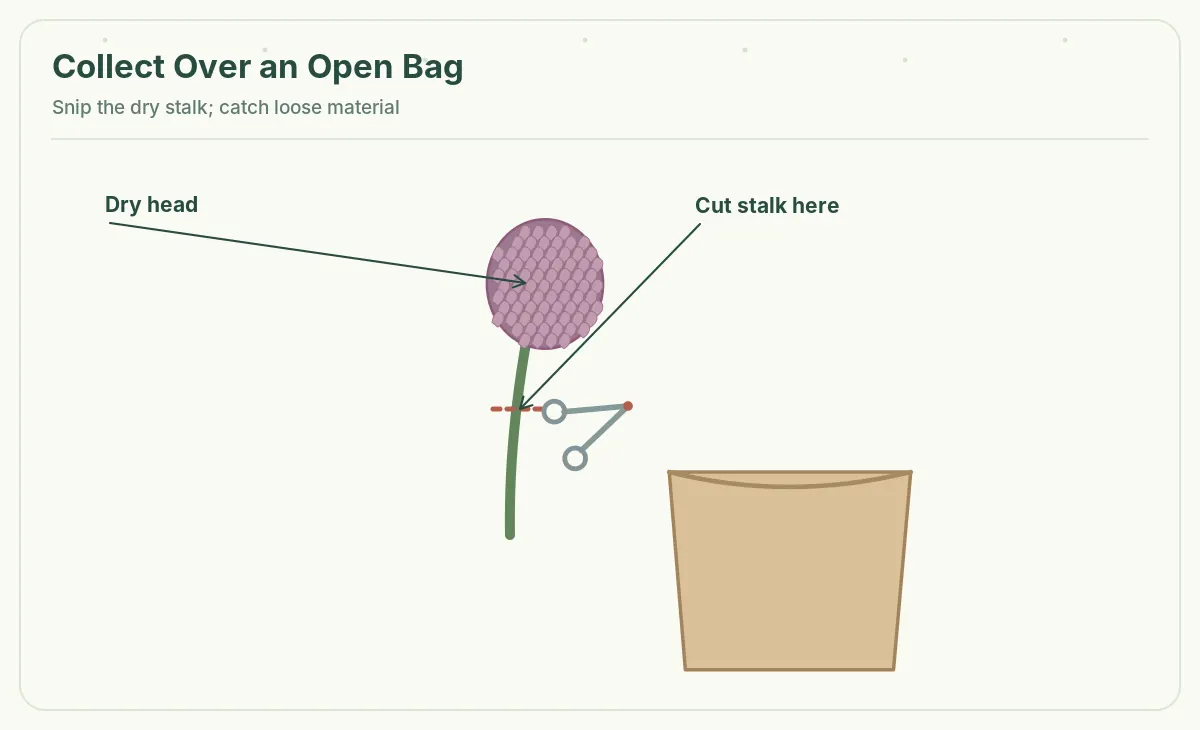
Use clean, sharp snips and hold an open paper bag beneath the selected head. Cut a short piece of stem beneath the head so that any loose material falls into the bag. Work in dry weather after surface moisture has dissipated. Do not pull hard against branches or shake the plant over an open path where small structures can fall into mulch and disappear. A diagram should show the cut through the narrow stalk, with the open bag catching the head from below, not an arrow to a leaf tip.
Keep each species and cultivar in a separately labelled bag. It is easy to mix multiple flower colors if you cut one border’s seedheads into a common basket. Do not tape the paper bag airtight while heads may retain moisture; that encourages condensation or mold. Move the bag to a dry sheltered location promptly and avoid allowing seedheads to sit on wet soil.
Dry Thoroughly and Open the Head Gently
Spread collected heads in a single airy layer over clean paper or use a paper bag with generous air exchange. Do not heat them in an oven or on a hot windowsill in an attempt to accelerate drying; extreme heat can harm seed viability. Once the structures are thoroughly dry, work over a white tray and rub apart a small sample with fingers. Separate larger colored bract fragments from the smaller seed-bearing material. Expect some chaff: clean seed will not necessarily look like polished retail seed straight from a packet.
Penn State Extension recommends rubbing or screening dried flower seedheads to separate seed from discarded tissues. A small sieve may help, but the correct opening size depends on the cultivar and collection. Avoid strong fan airflow that blows both chaff and seed off the work surface. If you cannot distinguish the seed structures confidently, keep the dried intact head with a clear label until closer inspection.
Do Not Confuse Seed Saving With Dry-Flower Harvest
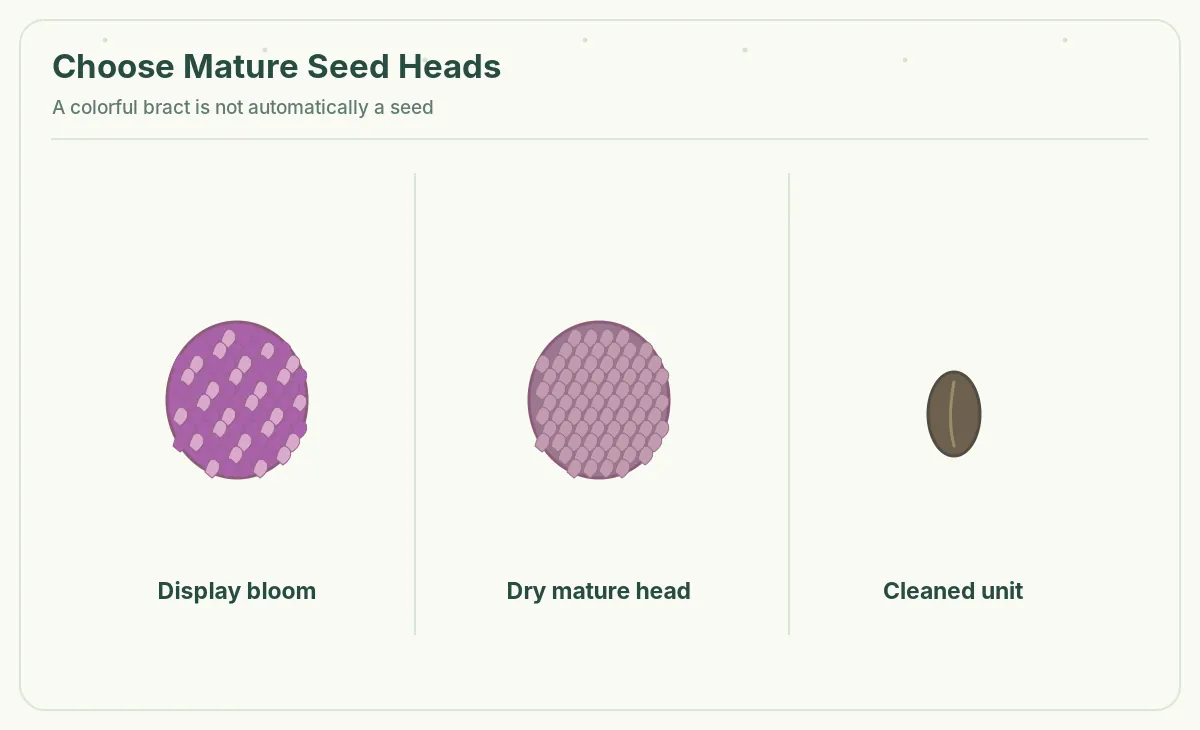
Gomphrena is excellent as a dried display flower because the papery bracts hold color and shape. Wisconsin Horticulture advises cutting blooms at a useful display stage and drying stems upside down for arrangements. Seed saving has a different objective: allow the reproductive parts to mature fully. A colorful display bouquet harvested early may make beautiful crafts but should not be assumed to contain viable seed ready to plant.
Compare two heads visually. One is fresh enough for a vibrant bouquet with a firm green stem; the other has an older, dry supporting stalk and a mature seed-bearing center. A third close-up may show a small cleaned unit alongside discarded bract tissue. The goal is not to brown every colored floret, but to distinguish ornamental texture from actual maturity and avoid storing immature moist material.
Label Seed Lots and Account for Variation
Write Gomphrena globosa, any named cultivar, collection date and garden location on the packet. Hybrids and plants visited by pollinators can produce offspring that differ from the parent in height, color or habit. Wisconsin Horticulture notes that self-sown gomphrena may vary from its parent; Illinois Extension similarly cautions that seed from hybrid flowers may not come true to type. Do not promise that seeds from a mixed planting will reproduce a particular shade reliably.
Before sealing collected seed into a jar or other humidity-resistant container, confirm it is completely dry. Store away from heat, direct light and moisture. Include a small paper envelope inside the labelled container if seeds are tiny and prone to spills. If a bag develops condensation or a musty smell, do not assume the lot is safely stored: check for spoilage and improve drying practices for the next collection.
Test a Small Sample Before Committing a Bed
Home-saved annual flower seeds can differ in vigor based on weather, maturity, handling and age. Keep enough seed for a modest trial sowing instead of putting your entire spring planting plan behind an untested packet. Follow species-specific temperature and sowing guidance and provide clean seed-starting mix. Wisconsin Horticulture describes starting gomphrena indoors before the last frost and planting outside only after frost risk has passed. The saved seed should come from healthy, labelled plants and should be sowed into a suitable warm-season schedule.
If few seedlings appear, check seed age and storage, sowing depth, moisture and temperature before assuming that all heads failed to form seeds. Make a note of the test results on the envelope. A simple harvest and drying sequence gives better information than claims that every colorful gomphrena bract is fertile or that all home-saved seed will match a named hybrid.
Related Guides
- How to Save Gomphrena Seeds From Dry Globe Amaranth Heads
- How to Save French Marigold Seeds From Fully Dry Flower Heads
- How to Save Sunflower Seeds for Next Year Before Birds Take Them
- How to Save Celosia Seeds From Dry Flower Heads Without Keeping Chaff
- How to Save Zinnia Seeds From Fully Dry Flower Heads
How We Research This Guide
We reviewed the following horticultural sources on October 27, 2026: hort.extension.wisc.edu — Wisconsin Horticulture identifies the colorful papery bracts, inconspicuous flowers, opposite leaves and seed-grown globe amaranth.; extension.psu.edu — Penn State Extension explicitly lists globe amaranth among flowers suitable for seed saving and describes drying and separating chaff.; extension.illinois.edu — Illinois Extension gives criteria for fully dry flower heads, collection timing, cleaning and cool dry storage.. The cited research explains general plant biology; adapt timing and growing conditions to your garden and cultivar.
No paid product or manufacturer is endorsed here. Read our affiliate disclosure for the site-wide policy. We do not imply any private sponsorship or approval.
No. Most of the showy head is bract material; the small seed-bearing structures are nested among the true flowers.
After they have matured and dried, on a dry day before material is lost to weather.
Avoid sealing heads that retain moisture. Dry thoroughly in an airy setting first.
Not necessarily, especially from hybrids or mixed plantings.
No. Fresh flowers are best for displays; seed heads need enough additional time to mature.