
Learn sunflower seed maturity signs, collect a heavy seedhead before birds empty it, and dry seed fully before labeling it for next year. These illustrations explain visible botanical structures and practical decisions rather than offering a universal calendar. Match the steps to your cultivar and local weather.
Read the Back of the Seedhead, Not Just the Petals
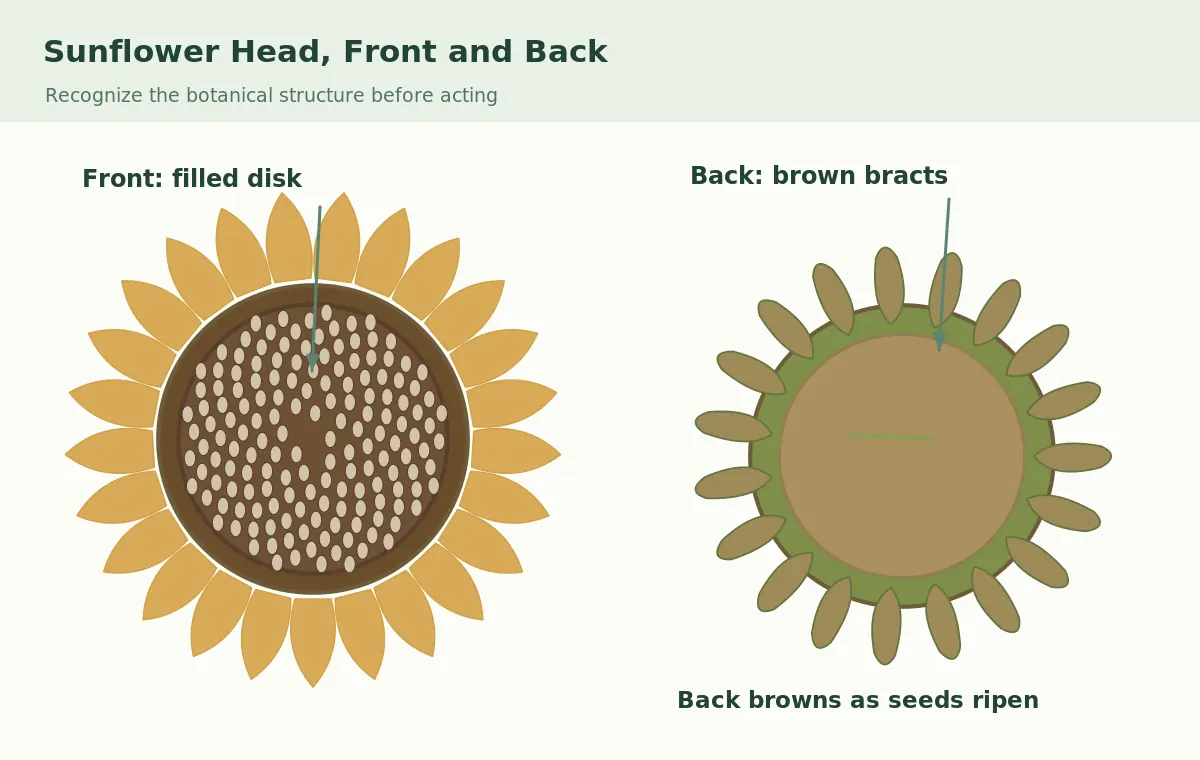
A sunflower, Helianthus annuus, has a composite flower head: outer ray florets look like petals while numerous central disk florets can each develop a fruit commonly called a seed. A bright yellow decorative head is usually not ready for seed saving. Watch for ray florets to wither, the heavy head to turn down, and the back of the head plus surrounding bracts to change from green toward yellowish brown and dry brown. Weather and variety affect how quickly these signs appear.
Check the front as well: developing fruits should look full and distinct in the repeating disk pattern, not like hollow pale spaces. The detail illustration compares the front of the head, where seeds can be felt, with the back, where the drying bracts provide a maturity clue. Penn State Extension advises waiting for seedheads to dry but also protecting them from hungry birds. The useful harvest window begins before every seed is pecked out of the center.
Distinguish Seed-Bearing Heads From Decorative Hybrids
Not every sunflower on sale makes the same kind or quantity of seed. Some cut-flower selections are pollen-free hybrids, some have many smaller heads, and others produce large single heads. Pollen-free does not necessarily mean a head cannot produce seed if it receives compatible pollen from another plant. Check the seed packet and look for actual filled developing seeds rather than assuming all large yellow flowers have a full edible crop.
If you save seed from an F1 hybrid, the seedlings may differ from the parent in height, branching or flower color. An Extension response about saved sunflowers makes that variability clear. Sunflowers are also visited by pollinators, which can move pollen between nearby compatible plants. Record the variety and whether others flowered nearby. Seed storage can preserve the seeds you grew, but cannot guarantee genetic uniformity when the original planting or pollination was mixed.
Shield Maturing Heads Without Trapping Wetness
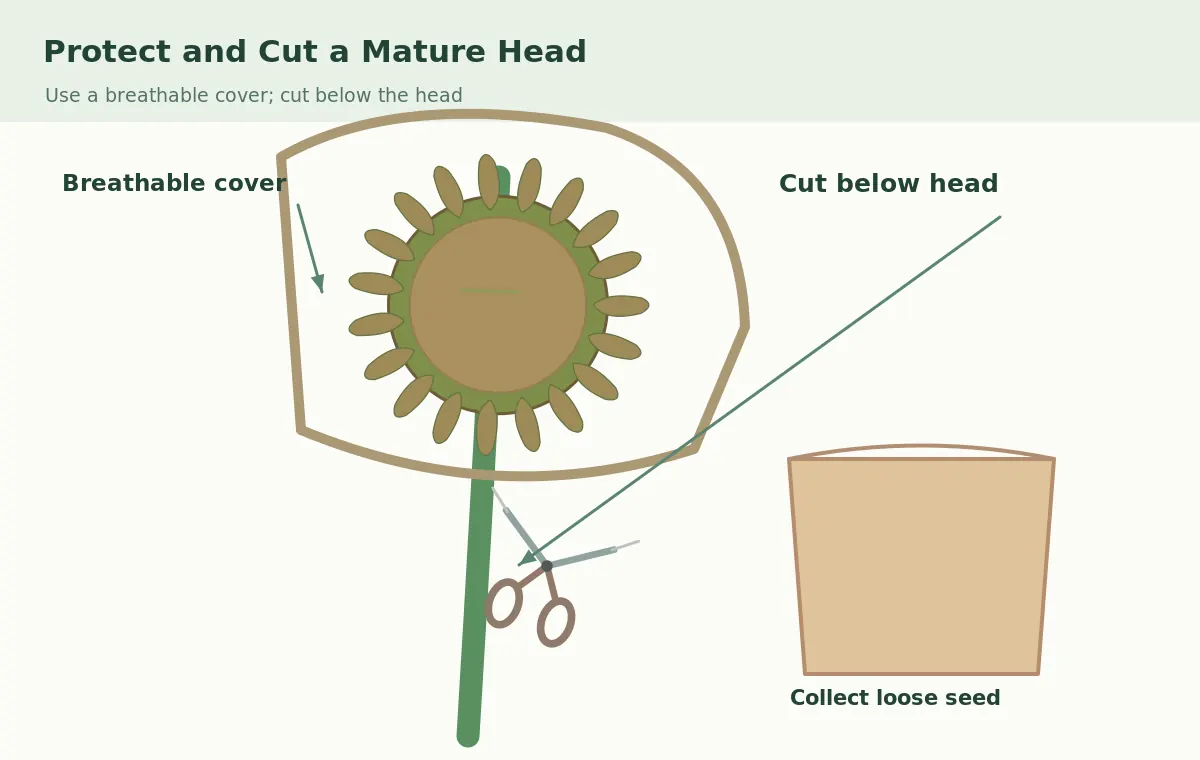
Birds and squirrels quickly find nearly ripe sunflower heads. A breathable paper bag or other ventilated barrier can protect a drying head in suitable dry conditions, but do not seal a wet head in plastic. Water trapped against fleshy tissue promotes mold. If persistent rain threatens, monitor whether the back is mature enough to cut and finish drying under shelter. Do not yank seeds from a green head simply because its petals are gone.
When bagging a standing head, leave space for air and support its weight so the stalk does not snap. Inspect the cover frequently, especially after rain. For multiple heads, prioritize those with well-developed seeds and brownish backs, not the newest flowers. The practical diagram shows a breathable cover over the head and pruning shears on the stem below it. It does not confuse an open flower with a seed-ready disk.
Cut the Head and Continue Drying Indoors
Use clean pruners to cut a mature head with a manageable length of stem. Bring it into a sheltered dry and airy place out of direct rain and reach of rodents. Place it on clean paper or hang it so loose seeds can be collected. Brooklyn Botanic Garden describes cutting heads after petals fade and finishing drying indoors. A few days may be sufficient in some conditions, but large damp heads can take longer, so rely on dryness rather than a fixed calendar.
Turn or inspect a large head to catch mildew early. Do not store heads in a sealed bin while the disk is still moist or rubbery. When seeds begin to come away easily after drying, loosen them by rubbing or gently wiggling them over a large tray. Avoid crushing the seed coats with pliers. Discard moldy heads; drying cannot reliably make a visibly mold-infested seedhead sound.
Clean and Test Seeds Before Storing Them
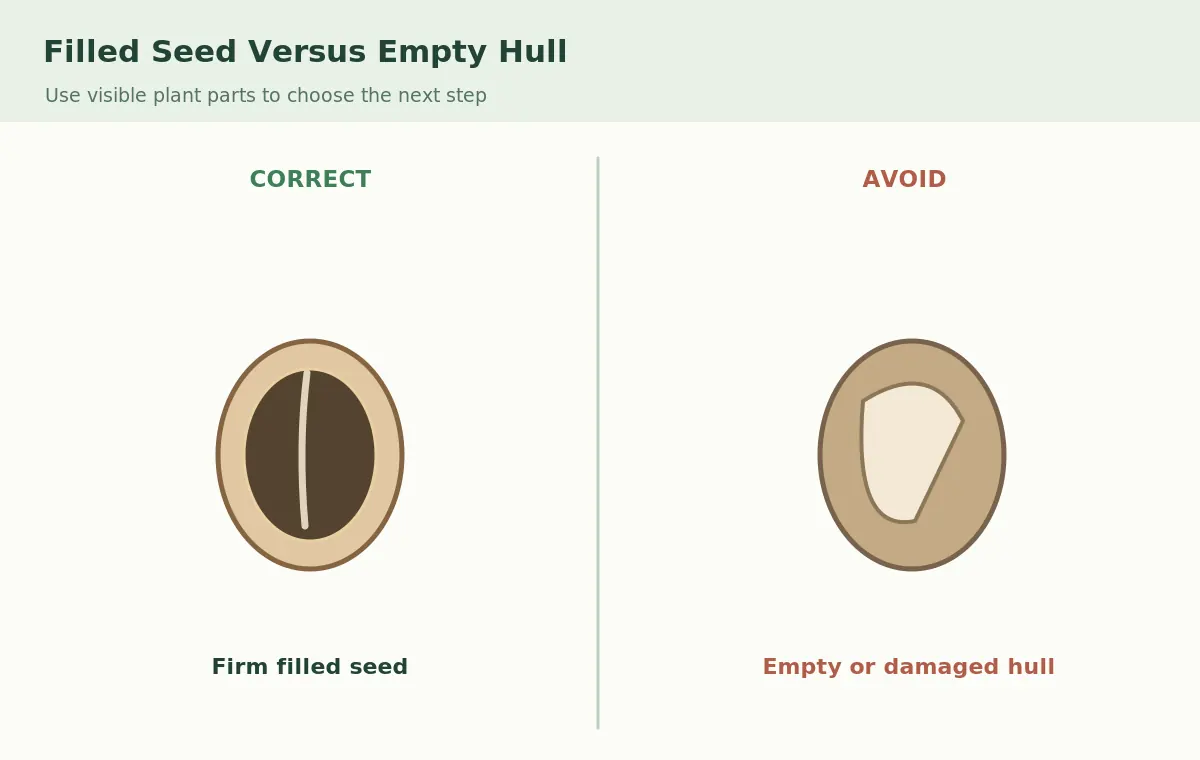
Rub dry seeds free from the disk and pick out the bulky chaff, insect-damaged material and empty hulls. Full seed generally feels firmer and heavier than papery blanks, although size and coloring vary widely by cultivar. Do not judge viability by a striped shell alone. Spread cleaned seed thinly to finish drying in a protected airy place. If moisture remains in the seeds or chaff, long-term closed storage encourages decay.
Once thoroughly dry, place seed in a clearly labeled envelope and protect it in an appropriate cool, dry storage setting. Note the harvest year, variety and planting location; if hybrid or possible cross-pollination is involved, state that on the packet. A small test sowing next season can tell you whether germination is adequate before you devote a large bed to older seed. The image distinguishes hard filled seeds from empty, damaged and visibly moldy material.
Keep Seed Saving Separate From Food Preparation
Sunflower seed saved as planting stock needs to be dry and viable, not roasted or salted. Seed sold for eating may have been heated, hulled or processed and is not necessarily suitable for sowing. If the seeds came from a plant treated with a pesticide, consult the specific product label and avoid assumptions about their suitability for food. The emphasis in this guide is saving healthy untreated seed for next year, not home-preserving an edible snack.
For a few named varieties, seed of an open-pollinated cultivar grown apart from other flowering sunflowers offers a better chance of repeating the parent type than seed of an unknown hybrid. Even then, no picture can guarantee genetic purity without knowing pollen sources. Keep documentation with the seed and do not advertise saved seed as true-to-type on appearance alone. The collection bag is a loss-prevention tool, not a method of controlling pollen that arrived weeks earlier.
Use the Seedhead Comparison to Decide When to Act
If the head back is fully green, the disk is plump but soft and its rays remain fresh, wait and inspect again. If the back browns, the rays fade and filled fruits are visible, protect the head and consider harvest when further drying poses greater bird loss. If the disk is already empty with visible feeding damage, collecting a paper bag of chaff will not recreate missing seeds. The correct timing varies; visible fruit maturity is more reliable than a date on a calendar.
Never assume that every sunflower in a row matures on the same afternoon. Make separate notes and harvest heads individually. This matters especially for multi-branching ornamentals, where a single plant carries flowers at several stages. Keep developing flowers for pollinators and collect only the heads that have completed seed formation. A successful seed-saving batch is dry, labeled, reasonably clean and protected from birds—not merely a spectacular dried flower on the wall.
Related Guides
- When to Harvest Sunflower Seeds: Read the Back of the Flower Head
- How to Direct-Sow Sunflower Seeds at the Right Depth After Frost
- How to Save Celosia Seeds From Dry Flower Heads Without Keeping Chaff
- How to Save Zinnia Seeds From Fully Dry Flower Heads
- How to Save Calendula Seeds After the Flower Heads Turn Brown
How We Research and Verify Plant Identification
Sources checked on 2026-10-27: extension.psu.edu: Penn State Extension describes allowing sunflower heads to dry on stalks, covering them if birds are feeding and completing drying after cutting. www.bbg.org: Brooklyn Botanic Garden describes cutting fading heads, indoor drying and loosening dry sunflower seed by hand. ask.extension.org: University Extension response notes that seed from hybrid sunflower parents may not reproduce the same flower appearance. The botanical figures are explanatory drawings, not photographs; actual cultivars vary in appearance and scale. Specific sowing timing must follow local conditions.
This educational article has no sponsor or paid product placement. Read our affiliate disclosure. Follow local Cooperative Extension directions and legally approved product labels before using any pest-control product.
When its rays have faded, the back and bracts are drying brown, and the disk contains filled mature seeds.
Yes, a sufficiently mature head can often finish drying in a protected airy place.
Not necessarily. Seed from F1 hybrids or crossed plants can produce different heights and flower traits.
No. Poor airflow and trapped moisture increase the risk of mold.
No. Save untreated unroasted viable seeds for sowing.