
A pear tree can look overgrown even when many of its short, knobby shoots are the wood that carries next season’s crop. The wrong winter haircut removes those spurs, triggers a flush of upright shoots, and leaves a tree that is taller rather than easier to pick. The useful question is not simply “How much should I cut?” but “Which wood is bearing, which is shading it, and which cuts can the tree close safely?”
For most free-standing backyard pears in temperate climates, structural pruning is planned during dormancy, between leaf fall and renewed spring growth. But a newly planted tree, an established fruiting tree, an espalier, and a tree with possible fire blight do not get identical treatment. Walk through the inspection below before making the first cut.
Confirm the tree form before choosing a pruning method
Identify the training form. A free-standing bush or standard pear normally has a trunk and several structural scaffold limbs with smaller fruiting branches. A cordon, fan or espalier relies on deliberately positioned arms and has a separate training schedule. The open-center diagrams commonly used for freestanding trees are not instructions for chopping the top off a trained wall tree.
Next classify its age and vigor. Young pears need modest framework development rather than aggressive renewal. Established trees need light and accessible bearing wood. A long-neglected tree with substantial limbs may require a multi-year restoration, sometimes professional arborist help. Photograph the tree from two directions; what looks crowded from one angle may have reasonable branch spacing from the other.
Use dormant growth, not a fixed national calendar date
RHS winter pruning advice places ordinary pear pruning in the dormant period after leaf fall and before active growth. Its typical November-to-early-March window describes UK conditions, not a guaranteed date everywhere in the United States. In a cold interior climate, a locally advised late-dormant window may be less risky than severe midwinter pruning; in mild climates the window can start earlier.
Observe the tree as well as your regional Extension calendar. Wait until the leaves have dropped and the buds are still dormant; avoid working on frozen, brittle wood or during an ice event. Plan the work for a dry, safe day. Never assume USDA hardiness zones tell you the exact date for a particular pear in your yard.

Locate short fruiting spurs before removing branches
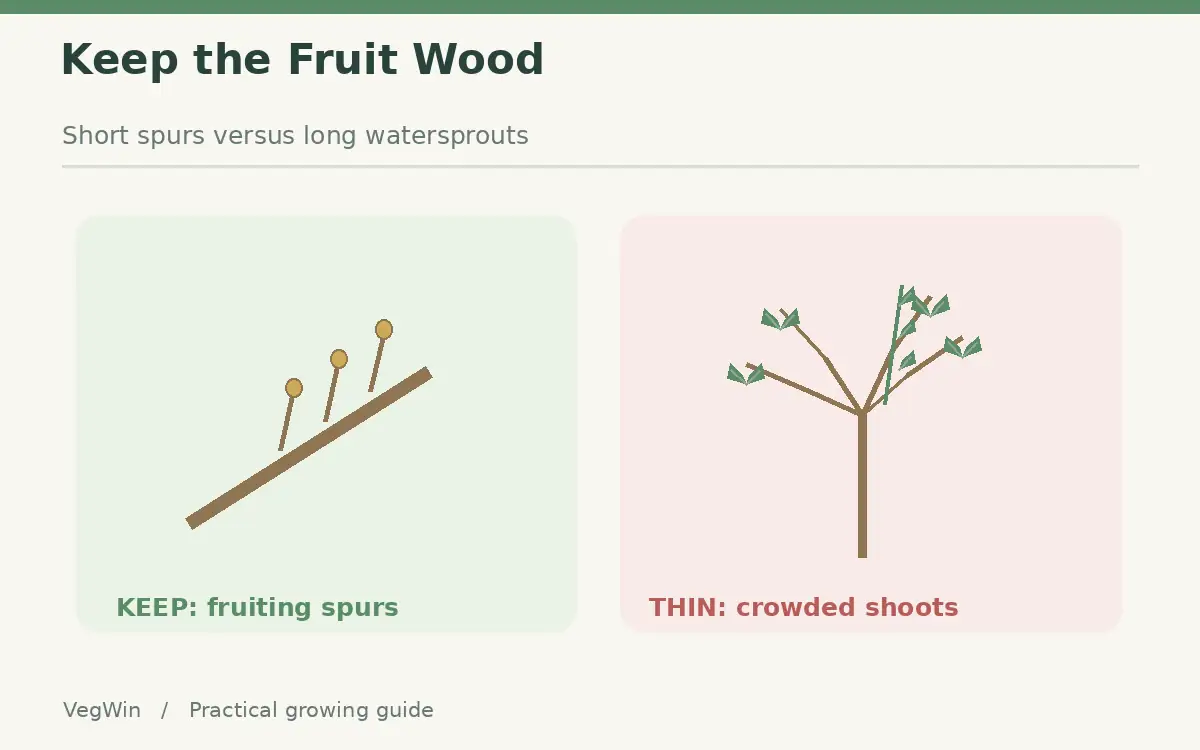
Many pears bear on short spurs arising from wood that is at least two years old. Spurs look like compact little branches with clustered buds, not merely the previous season’s long upright shoots. UC IPM explains that established trees need renewal of aging fruiting wood while preserving productive portions of the canopy. Before cutting, trace each potential branch removal back to the fruiting spur clusters it would take with it. For the basics, see our guide: When to Prune Grape Vines.
Not every pear cultivar behaves identically: some carry a portion of the crop at shoot tips. If the cultivar is unknown, keep a sample of healthy short spurs and well-placed terminal buds, then observe where flowers form the following spring. Avoid shortening every small lateral to the same length. Uniform clipping is easy, but it is not the same as managing bearing wood. For the basics, see our guide: When to Prune a Magnolia.
Remove obvious problems in a conservative order
Begin with dead or broken branches whose identity is clear. Next look for rubbing branches, structurally weak angles, and crowded inward growth that shades better-positioned limbs. Favor a few purposeful thinning cuts back to a suitable lateral or branch origin over dozens of random heading cuts. Keep permanent scaffolds where possible and distribute remaining branches so air and light can enter.
A sharp saw or bypass pruner makes cleaner work. On larger limbs, use the three-cut method to keep bark from tearing under falling weight, and finish just outside the branch collar; do not leave a long stub or cut flush through the raised collar tissue. Work from the ground whenever possible. Large limbs and high ladders are reasons to stop and call a qualified professional.
Separate spur renewal from heavy canopy reduction
An established pear may have dense clusters of old, shaded spurs. UC IPM describes gradual renewal of older fruiting wood rather than removing most fruiting shoots in one year. Look for an overburdened, low-light section and choose only the least useful part for removal. The objective is fresh, well-lit fruiting branches over time, not a bare tree by afternoon. If you are starting from scratch, read When to Prune a Plum Tree.
Resist the temptation to top a pear or remove large scaffolds just to make the crown symmetrical. Hard cuts stimulate vertical watersprouts and expose inner wood to bright sun. Reassess after one growing season, mark where new shoots appear, and thin excess growth selectively. If the canopy needs a major height reduction, plan a staged renovation with local guidance.
Keep fire blight decisions outside the ordinary checklist
Brown or black hooked shoots, scorched blossoms, or sunken cankers may suggest fire blight, a bacterial disease of apples and pears. These symptoms are not ordinary seasonal twig dieback, and indiscriminate pruning may spread infection or remove more healthy structure than necessary. Illinois Extension recommends dormant disease pruning when practical and specifies cutting below diseased tissue; exact distance and tool sanitation advice can vary with conditions. For the basics, see our guide: When to Prune Ornamental Crabapple Trees and Where to Cut.
If symptoms are present, stop routine cosmetic pruning, photograph the affected branch, and consult local Extension disease identification guidance. Use the regionally recommended removal procedure and dispose of infected material appropriately. Do not treat this general pruning article as a pesticide schedule, or assume that every darkened twig is caused by fire blight.

Check the canopy after every significant cut
Set the pruners down and step back. Can sunlight reach the interior? Are healthy short fruiting spurs still present around the crown? Does the tree retain a balanced set of scaffold limbs rather than a tall, bare trunk? A good practical stop point is when every further proposed cut seems to require a weaker reason than the preceding cut. Our guide “Prune Wisteria in Summer and Winter Without Losing Flowering Spurs” goes into more detail.
Make a short record: date, cultivar if known, branches removed, unusual symptoms, and pictures from the same viewpoints. This helps distinguish a structural improvement from a burst of excessive vegetative regrowth. Look again at flowering, harvest and leaf fall, because pruning quality is ultimately judged by the tree’s response, not the neatness of fresh cut ends.
| What you observe | Best next step |
|---|---|
| Short, healthy spur with buds | Retain unless an entire crowded limb must go. |
| Long upright shoot shading the center | Consider selective thinning; do not shear every tip. |
| Limb rubbing a valued scaffold | Remove or shorten the poorer-positioned limb at a proper union. |
| Large overhead or unstable limb | Stop and get professional arboricultural help. |
| Possible fire blight canker | Switch to local disease-diagnosis and sanitation guidance. |
Choose a next action from the problem you actually see
A young pear leaning toward one side may need training or support rather than wholesale thinning. A mature tree with heavy fruiting spurs but poor light needs selective canopy opening. A neglected pear with huge broken limbs needs professional risk assessment. A tree with suspicious cankers needs diagnosis before routine cuts. These outcomes should lead to different work orders.
If you are uncertain about variety, fruiting habit or a risky large branch, take clear photographs and ask a local Cooperative Extension office or an ISA-certified arborist. Conservative decisions protect the crop and your safety while allowing you to learn from what the tree does in the following season. If you are starting from scratch, read When to Prune Fig Trees Without Losing the Early Breba Crop.
How We Research This Gardening Advice
Research checked on October 23, 2026. We consulted the named university Cooperative Extension and/or Royal Horticultural Society materials and compared the recommended growing decisions. Numerical recommendations and seasonal windows are regional examples where noted, not guaranteed dates for every garden. The botanical sketches simplify plant structure rather than depicting a particular cultivar to scale.
Sources consulted: rhs.org.uk; ipm.ucanr.edu; extension.illinois.edu. Where advice differs by local climate or plant variety, follow your local Extension office or the specific plant label.
Editorial disclosure: These instructions are educational and contain no claim of paid endorsement or verified partner recommendations. For site-wide information, see our affiliate disclosure.
Small corrective cuts may be appropriate, but routine structural pruning is normally planned in dormancy. Summer disease symptoms require separate regional guidance.
It is a short, often knobby branch that can bear flower buds and fruit, commonly on wood at least two years old.
Avoid topping; it often produces vigorous upright shoots and creates large wounds. Reduce height gradually with suitable lateral cuts and professional advice when needed.
Severe cuts can stimulate watersprouts. The next step is selective thinning and lighter pruning, not another uniform haircut.
Do not assume ordinary winter damage. Seek local diagnosis for possible fire blight or another cause before routine pruning.