
Lavender seed often produces plants that vary in scent, height or flower habit. A stem cutting is the practical route when you want another copy of a lavender plant you already like. But simply pushing a flowering sprig into ordinary wet potting soil is unreliable: the bloom consumes resources, buried leaves decay, and a waterlogged stem may rot before roots form.
The goal is to select a healthy shoot, prepare a clean lower stem, and give it air as well as moisture. This article concerns ornamental and culinary lavenders used in US gardens; compare the timing to local conditions and the vigor of the actual parent plant, rather than assuming every species or cultivar roots on the same date.
Select a vigorous plant and avoid flowering tips
Choose a vigorous parent plant with normal leaf color and no suspicious dieback, distorted shoots or heavy pest damage. Colorado State University Extension recommends nonflowering shoots and notes that cuttings can be taken after flowering. Iowa State similarly identifies nonflowering lateral growth as a reliable source. Search the current season’s growth for flexible stems that have begun to gain substance but are not woody old branches. Avoid collecting from drought-stressed plants immediately after a hot afternoon. If your only available shoots bear buds, remove them when preparing cuttings, but do not assume a tired flowering stem is equal to healthy nonflowering growth. Label the parent cultivar at the start, especially if several lavenders grow side by side.
Prepare tools and rooting medium before cutting
Prepare a clean tray or small pot with drainage holes before harvesting stems. A low-fertility, well-drained propagation mix or horticultural vermiculite is preferable to heavy, wet garden soil. Colorado State advises sterile potting material or vermiculite; Iowa State explains that a clean, free-draining medium supports stem rooting. Moisten it first so the hole does not collapse and you do not need to flood cuttings after inserting them. Clean the blade and container to reduce transfer of stem diseases. Have a marker and a temporary shelter from intense midday sun ready. The simplest set-up is often better than a sealed mini-greenhouse whose condensation repeatedly drips onto lavender foliage without ventilation.
Cut a stem with usable leaf nodes
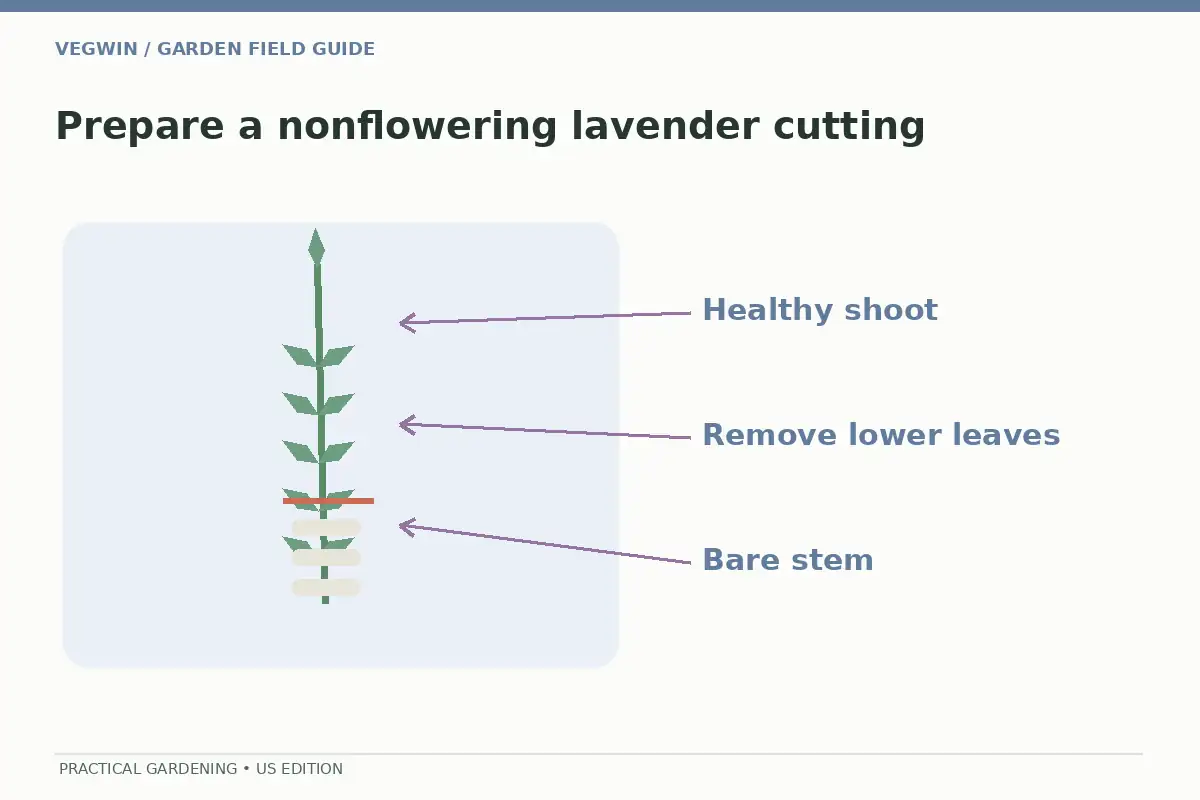
Take several short sections from healthy nonflowering shoots, making a clean cut rather than crushing the stem between blunt scissors. A node is the point where a pair of leaves attaches to the stem. Keep enough leafy growth above the future soil line for photosynthesis and strip the leaves from the lower portion that will be inserted into the medium. Colorado State specifically advises removing leaves from the bottom half. If the shoot has a flower bud, remove it so the cutting is not sustaining a flower while it lacks roots. Do not strip every leaf, leave ragged shredded bark, or force a fragile stem into coarse mix. Make a preformed hole so the freshly cut surface is not scraped by the medium.
Insert bare stem into a free-draining mix
Insert the stripped lower stem firmly enough to stay upright; keep remaining leaves above the surface and avoid burying a leafy tuft. Label the tray with cultivar and date. The medium should contact the stem but still contain air spaces. A saturated, heavy peat-and-garden-soil blend can collapse around the cutting and lead to rot. Firm gently, then water just enough to settle the medium. If several cuttings share a tray, give leaves room rather than packing them into a damp mat. Do not treat rooting powder as a substitute for healthy stems and drainage. CSU notes that rooting hormone is not essential under the conditions it describes. Follow any product label rather than inventing a home concentration.

Balance humidity with light and ventilation
Until new roots form, a cutting cannot replace leaf water loss as efficiently as an established lavender. Bright indirect light and moderate humidity reduce stress, but hot direct sun and an airtight wet bag can damage leaves. Iowa State’s propagation guide uses a covered propagation environment with indirect light; check periodically for discolored or moldy cuttings. Colorado State emphasizes misting and avoiding excessive dryness in an aerated medium. There is no universal daily watering dose: inspect the medium and container conditions. Vent a cover when condensation is excessive, and remove rotted pieces promptly. Keep young cuttings out of cold drafts and do not put a heating mat under them without a verified temperature target for the method you actually use. If you want the full process, read how to root Pelargonium geranium cuttings before cold weather arrives.
Check for roots without yanking on new growth
Different lavender types and growing conditions root at different speeds; advertised timelines are guides, not promises. Colorado State describes rooting around a few weeks in its system, while Iowa State’s general propagation material notes that many cuttings may take longer. Look for steady new leaf growth or gentle resistance to a very light tug. Never repeatedly uproot a cutting to inspect its base: fresh roots can be thinner than thread. A cutting may remain green for a time without rooting, so color alone is not proof. If a stem blackens at the medium surface or foliage collapses while the pot is soaked, remove that piece and improve sanitation, drainage and ventilation before trying again. If you want the full process, read how to root lavender cuttings in mix without losing them to rot.
Pot rooted cuttings without sudden exposure
Once roots hold the medium together and support new growth, transplant the plant into a small pot with drainage holes and suitable lavender growing mix. Handle by the root ball and avoid pulling upward by the leaves. Water to settle the new pot, then return it temporarily to bright, sheltered conditions while roots spread into the fresh medium. Gradually increase light and airflow before moving outdoors, following ordinary hardening-off practice. Newly rooted lavender is not instantly drought tolerant simply because mature lavender tolerates dry soil. Conversely, leaving its pot standing in a saucer of water defeats the purpose of a drained mix. Plant outdoors only when temperature, frost risk, cultivar hardiness and soil drainage match your local Extension guidance. Our walkthrough on how to root rosemary cuttings without leaving stems in soggy mix sets out each step.

Use failures to improve the next cutting batch
Track how many of the cuttings root rather than judging success by one lucky stem. If many blacken at the base, inspect drainage, container cleanliness and humidity; if many shrivel in a day, examine initial stem vigor, sun exposure and moisture loss. Take a small extra set rather than one irreplaceable tip from a valued plant. Cuttings are useful because a rooted plant generally keeps the parent’s cultivar traits, unlike seed-grown offspring that may vary. Still, they can also carry problems from the parent, so never multiply a clearly diseased plant. Labels, a clean medium and an honest rooting count make the next attempt both cheaper and more predictable. If you are starting from scratch, read When to Take Hydrangea Cuttings and How to Root Softwood Stems.
Related Guides
- When to Prune Lavender Without Cutting into Bare Woody Stems
- How to Start English Lavender Seeds Indoors Without Soggy Seedlings
How We Research and Verify the Instructions
We checked the linked sources on October 21, 2026. The distinct practical result is: A cutting-preparation and moisture-control workflow specific to lavender, showing which leaves to remove, where the stem enters the rooting medium, and how to judge readiness without pulling up fragile roots. That comparison is a title-and-tag overlap review for the older published list, not a full-text audit of every historical or unpublished WordPress article. The drawings simplify real plants to teach identification and workflows and are not measurements to scale. Local Extension recommendations, seed packet details and climate conditions take priority where they differ.
Sources reviewed October 21, 2026: 1. Colorado State University Extension — Lavender cuttings from nonflowering shoots, lower-leaf removal, sterile draining media and rooted transplant care. 2. Iowa State University Extension — Lavender cultivars are propagated reliably from nonflowering stem cuttings in draining medium. 3. Iowa State University Extension — General stem-cutting hygiene, rooting moisture and readiness; lists lavender as a cutting candidate. This educational guide contains no paid product endorsements or verified affiliate placements. Read the VegWin affiliate disclosure for the site-wide policy.
Prefer a healthy nonflowering shoot. Remove flower buds if necessary; flowers divert resources from rooting.
Some may, but Extension propagation guidance favors clean, well-drained media for reliable establishment and to avoid a delicate water-to-soil transition.
Not always. Colorado State Extension describes successful lavender cuttings without requiring it; stem quality and the environment matter.
Excess moisture, poor air movement or contaminated material may be involved. Discard rotting cuttings and improve drainage and sanitation.
Pot it after roots establish, acclimate it gradually, and plant out when local frost risk, hardiness and drainage are suitable.