
Yacon (Smallanthus sonchifolius) grows large leaves above a cluster of crisp edible storage roots, but next year’s plants arise from smaller bud-bearing crown pieces rather than those large eating roots. Its climate challenge is a long enough growing season and protection of living crown tissue from hard frost. A USDA zone alone cannot tell you whether your roots will mature or survive the winter.
Distinguish yacon from a dahlia or a potato
Yacon is Smallanthus sonchifolius, an Andean relative of sunflowers and dahlias. RHS describes tall stems, broad somewhat triangular leaves and small yellow daisy-like flowers. Below ground it makes two visually different structures. Large smooth to irregular fleshy storage roots are harvested as food; compact, knobbly crown rhizomes near the stem carry buds that can grow new shoots. Neither part is a true potato eye-covered stem tuber. Do not treat a large detached eating root with no attached crown bud as reliable planting material. Label crown sections and eating roots separately from the start.
Use frost risk and season length, not zone numbers alone
Garden Organic treats yacon as a frost-tender crop and recommends starting it under protection in a cool climate. The best planting schedule depends on your site’s frost-free period and how early a living crown piece can start under cover. USDA hardiness zones summarize typical winter low temperatures, not the warmth available for root enlargement or the exact last frost. Many gardeners grow yacon as an annual crop and preserve its crown indoors for replanting. A place with mild winter lows may still have a cold, wet site unsuitable for leaving planting stock exposed.
Choose a live crown section containing growth buds
Examine the knobbly crown at the top of a harvested root cluster, where last year’s stems attach. Small purple, pale or green growing points are potential shoots. Divide only when you can preserve a bud and enough firm crown tissue with each piece; a clean cutting tool and sound stock limit needless injury. The fleshy edible storage roots typically extend outward and downward from this crown. If you cut off only a large pear-shaped food root, it may remain edible but has no dependable new stem bud. Specialist propagation guidance from Cultivariable distinguishes rhizome starts from eating roots.
Start crown pieces in a protected draining pot
Set each sound crown piece with buds oriented upward in a clean container with draining compost. Do not invert growing points or drown an unsprouted piece in stagnant medium. Keep it frost-free and give emerging shoots sufficient light; in a cold spring, begin indoors rather than leaving the crown in cold wet soil. Garden Organic advises starting crown pieces under cover before outdoor planting. Water enough to keep the mix from becoming dusty while avoiding constant saturation. Wait for a firm young root system before removing the pot, and keep the small shoot attached to the crown through transplanting.
Move established plants after the cold risk passes
When outdoor conditions are reliably suitable, harden off pot-grown plants and choose a sunny bed with fertile, free-draining soil. Garden Organic notes that yacon can make a surprisingly large plant, so it needs more space than a lettuce transplant. Handle the whole root ball and set the crown near its original soil level, with attached roots below ground. Avoid digging close to nearby roots once the plant is growing; the crop enlarges its storage organs in the surrounding soil. A sturdy label and ample access space will help when harvest time comes and the top growth has died down.
Keep a large-leaved crop growing steadily
Broad leaves lose water in dry weather, so check moisture beneath the surface and water when the root zone starts to dry. Provide sun and a soil structure that lets the plant expand its underground storage roots without prolonged waterlogging. An exposed crown can be protected with a little loose soil but avoid mounding wet material onto shoots. Taller plants may need shelter or support in windy sites. Watch for damaged leaves and slugs, and inspect before applying any control. The objective is steady plant growth and root formation over the season, not a precise number of days for every location.

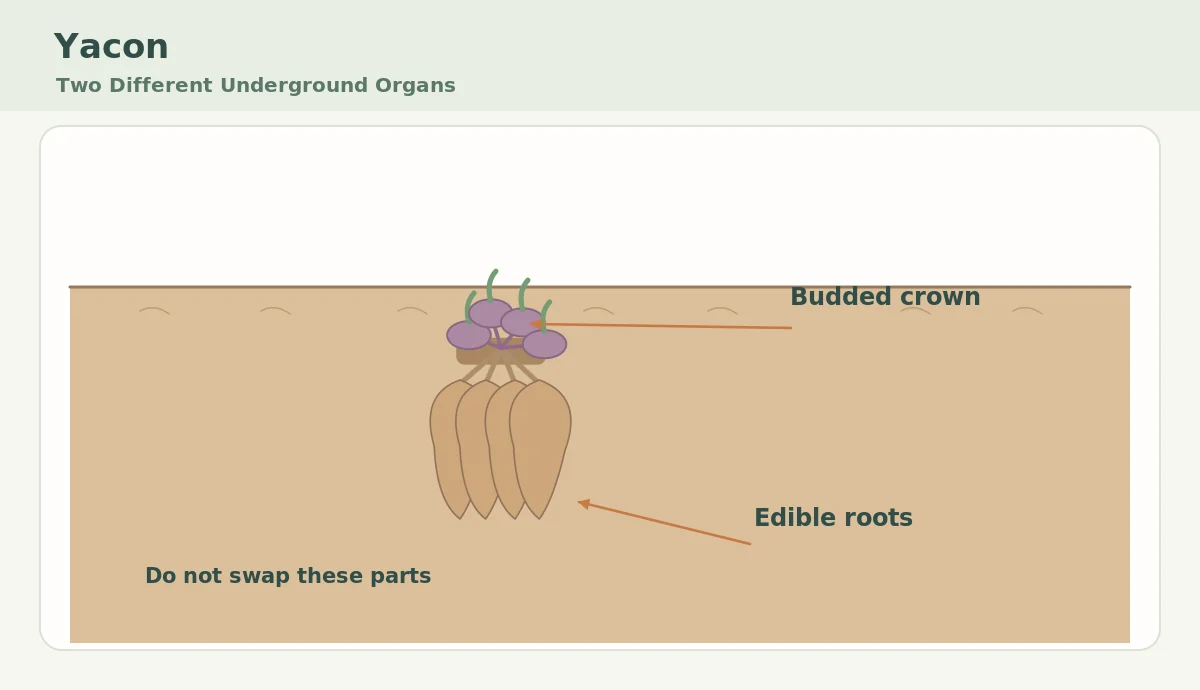
See the edible roots and propagating crown in one cutaway
At harvest, follow the stem base down to the compact crown; below it and radiating away are thicker, smooth, swollen food roots, often resembling elongated pears. The crown sits between the stems and roots, with the small bud-bearing pieces grouped close to the old stem base. Roots grow in soil and remain physically attached until separated with a knife or careful lifting. This distinction is a central teaching point: swollen storage roots feed the crop, but rhizome-like crown pieces with viable buds restart it. Keep a few clean, undamaged crown pieces before using all the food roots.
Lift after seasonal dieback without snapping roots
Garden Organic harvests after foliage is killed by frost in its climate, but do not let a severe freeze destroy the crown if you need it for propagation. Cut back spent stems at a manageable height and lift the root cluster gently with a fork positioned well beyond its likely spread. The storage roots are brittle and can break when pulled by the stems. Brush off loose soil, inspect for soft or damaged sections and keep cutting tools clean. Do not confuse a brown surface mark with deep rot without checking the underlying tissue. Handle roots gently so sound ones remain suitable for storage.
Store food roots and living propagules differently
The crisp eating roots and the living crown have different jobs. Clean, sound food roots can be kept cool for later use, while bud-bearing crown sections need protection from freezing, drying and rot to survive until planting time. Garden Organic recommends keeping crown material in a frost-free place in a suitable medium. Check stored pieces periodically rather than sealing them in an unventilated wet bag. If roots are shriveling or the crown is turning soft, correct conditions promptly. Do not promise a precise storage life without knowing variety, temperature, handling damage and humidity.

Check the next crop before calling it a success
In spring, an intact crown with a swelling living bud is a much better propagation sign than a large leftover food root. Record whether your plant matured before frost and whether the crown survived indoor storage. The stored root’s sweetness and texture may change, but this does not mean it has become a planting organ. If no shoots appear, examine the crown for loss of buds, freezing, dryness or rot. The practical success measure is two outcomes: healthy edible swollen roots to eat, and at least one firm bud-bearing crown section for the next growing season.
How We Research and Check Botanical Details
This guide was researched on October 30, 2026 against www.gardenorganic.org.uk; www.rhs.org.uk; www.cultivariable.com. We cross-checked the named species, the growing operation and the parts of the plant shown in the diagrams. Regional schedules and cultivar traits vary; check local Cooperative Extension and the actual seed or planting-stock label before adapting precise timing. Illustrations are explanatory botanical drawings rather than scale models or pesticide instructions.
VegWin publishes independent informational gardening guidance. The internal navigation links here are not paid placements and no affiliate relationship is claimed. Our affiliate disclosure explains the site policy. If a plant may be toxic, grown for food or affected by an uncertain disease, confirm identification and relevant safety advice before using or treating it.
Do not count on it. Yacon normally regrows from bud-bearing crown rhizome pieces, not detached swollen food roots.
Yes, often as a tender annual with protected indoor starts and frost-free crown storage.
No. Season length, local frost dates, cultivar and weather matter more than the hardiness-zone number alone.
Firm crown pieces with identifiable growing buds, protected from freezing and rot.
No. Yacon has enlarged edible roots and separate bud-bearing crown organs; potato tubers are modified stems.