
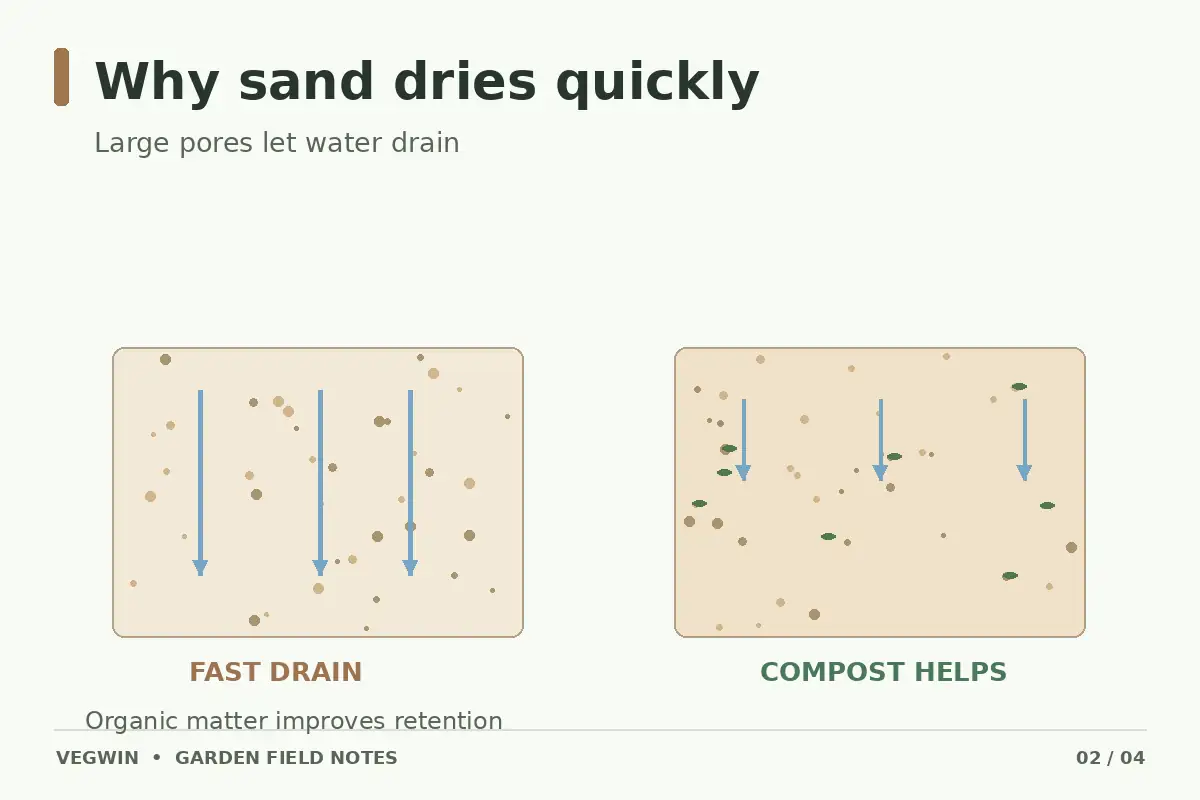
Sandy garden soil can be easy to work yet frustrating to keep evenly moist. Water moves into its large pores quickly and may drain beyond the root zone before shallow plants use it. Fertilizer nutrients can also be lost more readily than in finer soils. The solution is not to convert all that sand into clay: changing a whole garden’s mineral texture would require enormous amounts of material. The useful approach is to build organic matter, reduce surface evaporation, and match watering to the actual rooting depth.
Oregon State University explains that organic amendments improve water and nutrient retention in sandy soil. University of Georgia Extension describes similar benefits from properly finished compost. Those findings support a gradual plan—not a single giant delivery of manure or an automatic fertilizer schedule. Test, amend modestly, cover the surface, and monitor whether the bed becomes easier to manage through a growing season.
Confirm that fast drainage is the real problem
A soil can look sandy at the surface without being uniformly sandy below. Dig a few small observation holes where roots grow and compare the texture at different depths. A loose gritty feel and rapid drainage suggest coarse particles, but wilt also can result from compacted layers, dry mulch, root damage or a malfunctioning irrigation line. Check moisture beneath the surface after a normal watering before assuming every plant simply needs more frequent irrigation.
Plant response offers another clue. A bed that dries rapidly in summer yet remains well drained after rainfall behaves differently from a site that pools water after storms. If runoff is the main issue, examine slope and surface crust; if water vanishes downward rapidly, focus on water storage and root-zone access. Record the issue before purchasing amendments, because fertilizer alone cannot make a fast-draining soil retain water.
Build organic matter with fully finished compost
Well-decomposed plant-based compost can help sandy soil hold water and nutrients. Georgia Extension provides general guidance for incorporating modest layers into the upper garden soil; the appropriate amount depends on existing organic matter and soil testing. Choose finished compost with an earthy smell and recognizable quality rather than fresh, hot, or contaminated material. Undecomposed scraps can interfere with planting and attract nuisance animals.
Spread the amendment evenly over a defined area instead of pouring it into one deep planting hole. For vegetable beds, mix it into the surface root-zone soil where practical, and avoid repeated deep disturbance after soil structure improves. If the bed is already planted, use appropriate surface additions rather than tearing up established roots. More material is not automatically better: excessive compost, especially manure-based products, can add unwanted nutrients or salts.
Use mulch to slow surface moisture loss
Mulch cannot increase the soil’s basic sand-to-clay ratio, but it can reduce evaporation and protect organic matter at the surface. Choose clean, suitable materials for the crop and region, and leave a small open area around stems and woody trunks. The aim is an even protective cover, not a thick wet collar that touches delicate crowns. Pull mulch back briefly when you need to check the true root-zone moisture.
Organic mulch breaks down gradually and can contribute organic residues to the soil over time. It is not identical to deeply incorporated finished compost, and you should not claim that one light season of mulch will transform soil texture. Nonetheless, shade at the soil surface can make an immediate practical difference to summer management. Review the layer after heavy wind or rain, because exposed patches lose moisture faster than evenly covered ones.
Water in smaller decisions based on root moisture
Oregon State Extension notes that sandy soil often drains and dries quickly. Frequent light applications may sometimes be appropriate for shallow-rooted crops, but avoid designing a rigid schedule without considering root depth and plant needs. Water enough to reach the active roots and then check whether moisture is still available before watering again. If water runs past a shallow root system, simply applying a much larger volume may waste water and leach nutrients.
Use a finger, hand trowel or appropriate moisture device to compare wet and dry areas. Check early and late in the day during a hot spell to learn how quickly your particular bed changes. A seedbed needs different surface moisture management from established deep-rooted plants. Make sure irrigation reaches the whole intended area rather than repeatedly wetting one narrow strip of sand.

Read a soil test before adding fertilizer
Sandier soil often needs thoughtful nutrient management, but its texture alone does not tell you which nutrient is lacking. Soil testing provides a better basis for fertilizer decisions than pale leaves interpreted in isolation. University of Minnesota Extension warns that repeated manure or compost additions can build excess phosphorus. Use finished plant-based compost for structural goals where possible, and let soil-test recommendations guide any targeted feeding.
If a soil test reports adequate nutrients, extra general fertilizer may add cost and environmental risk without improving growth. Conversely, modest organic matter additions may not supply enough nitrogen for a demanding crop. Treat soil structure improvement and nutrient supply as related but different questions. Keep records of amendment types and dates; they help interpret future test results and prevent buying the same treatment each season by habit. For the basics, see our guide: Is Loam Soil Best for a Vegetable Garden?
Protect beds between active growing seasons
Bare sand is vulnerable to wind movement, raindrop impact and rapid drying. Where conditions allow, keep the bed covered with suitable mulch or a cover crop selected for your season and crop rotation. A cover crop can contribute residues and protect the soil surface, but it also uses water while actively growing. In a dry climate, termination timing and irrigation need consideration; there is no universal cover-crop recipe. Our guide “Cover Crops for Vegetable Beds” goes into more detail.
If you plant a living cover, plan how and when you will end it before the next vegetable planting. Do not let it set unwanted seed, and avoid assuming a legume will automatically meet every crop’s nitrogen needs. If you cannot manage a cover crop, clean mulch is a legitimate alternative. Aim to keep organic inputs steady over multiple seasons rather than applying one huge amendment and abandoning the bed.

Evaluate improvement using a short garden log
After a few weeks, compare treated and untreated sections if you have a suitable space. Note moisture a few inches below the surface after comparable weather, how evenly seedlings emerge, and whether plants remain healthy between irrigations. Useful improvement means less stressful water management and better root growth, not that the sand now looks like dark commercial potting mix. Natural mineral texture changes little with normal garden compost additions.
At the next appropriate interval, repeat soil testing as recommended locally, especially if using nutrient-rich materials. If roots are still struggling, reconsider drainage below the surface, salinity, compaction, or crop suitability before throwing more compost at the problem. Sandy soil can be productive; the goal is to manage its particular strengths and limitations honestly, with consistent practices rather than a miracle one-time fix.
A quick decision table for the garden
| Symptom | Check first | Useful response |
|---|---|---|
| Fast drying | Root-zone moisture | Compost, mulch, irrigation adjustments |
| Poor growth | Soil nutrient test | Targeted feeding only if indicated |
| Surface erosion | Bare soil exposure | Mulch or managed cover crop |
Related Guides
- Garden Composting for Beginners: Balance Materials and Fix Pile Problems
- How to Use a Compost Tumbler Without Making a Wet, Matted Batch
- How to Compost Grass Clippings Without a Wet, Smelly Pile
- How to Tell When Homemade Compost Is Finished Before You Use It
- Compost for Clay Soil: Improve Vegetable Beds Without Quick Fixes
How We Research and Check This Advice
We reviewed this topic against current university Extension and specialist horticultural guidance on October 22, 2026. The illustrations are original, simplified, not-to-scale teaching diagrams, not photographic evidence. Local weather, cultivar identity and soil conditions can change an otherwise sound practice. This page has no verified paid affiliate partnership. Read our affiliate disclosure.
Research references, checked October 22, 2026: 1. extension.oregonstate.edu — Organic amendments build water and nutrient retention in sand. 2. extension.uga.edu — Compost benefits and incorporation into garden soil. 3. extension.oregonstate.edu — Sandy soil dries quickly; mulch and observation inform watering. 4. extension.umn.edu — Soil tests help avoid excessive phosphorus from repeated compost.
Not in a literal texture sense; compost improves water and nutrient handling without changing the underlying sand percentage much.
Avoid trying to remake texture with large mineral amendments; soil tests and organic matter management are more practical.
No. Frequency depends on roots, weather, mulch and irrigation; check moisture within the rooting zone.
Not necessarily. Repeated manure can raise phosphorus or salts; use test results and suitably finished products.
Confirm the drainage pattern, test the soil, add appropriate organic matter and protect the surface with mulch.