
A wilting squash vine is not enough evidence to blame squash bugs. Squash vine borers, inadequate water, bacterial wilt and root problems can all produce distress, while actual squash bugs have recognizable life stages. The useful task is to check the underside of leaves and the base of the plant, identify what is present, and choose a proportionate response. This guide stays with scouting and lower-risk IPM steps rather than presenting a pesticide recipe.
Confirm Squash Bug Identity Before Acting
University of Minnesota identifies the squash bug as Anasa tristis, a flattened brownish or gray insect that feeds with piercing-sucking mouthparts. Adults are relatively broad and their abdominal margins have contrasting coloration. They should not be confused with every shield-shaped insect found in the garden. A photo showing the insect from above and the damaged plant’s location is more useful than a distant snapshot of a wilted leaf.
Squash bugs commonly attack squash and pumpkin plants, with related cucurbit hosts also possible. A few adult insects on a vigorous plant do not automatically call for a broad treatment. Inspect the underside of leaves and near leaf veins for eggs, and look for young nymphs clustered together. Distinguishing eggs, nymphs and adults matters because physical removal is more practical early than after many insects have dispersed.
Look Under Leaves for Egg Clusters
Minnesota Extension describes small bronze or yellowish oval eggs often arranged in clusters on the underside of foliage, especially near intersecting veins. Gently turn a leaf and use good light; eggs can be overlooked if you only inspect the top surface. Record which plants carry egg clusters. When the infestation is manageable, crushing or removing those eggs is a straightforward physical IPM action.
Do not assume every cluster of small objects is squash bug eggs. Beneficial insect eggs, other pest eggs and debris can occur on leaf undersides. Compare shape, color, grouping and host plant against the Extension photos before removing unknown organisms. Where uncertain, photograph the cluster and use a local diagnostic service. Correct identification protects beneficial species and prevents unnecessary action. Our walkthrough on how to Find squash bug eggs and protect zucchini before wilt sets out each step.

Recognize Nymphs and Adult Hiding Places
Recently hatched squash bug nymphs are small, often lighter colored than adults, and may stay together before dispersing. Minnesota and Utah State both describe a progression through several nymphal stages. Adults and nymphs tend to shelter in protected areas and can move quickly when disturbed. Look along leaf stems and the shaded base of the crop rather than relying on one inspection in bright midday sun.
A simple scouting card has space for eggs, small nymphs, adults and plant condition on each visit. Count only what you can confidently identify. If the main finding is older adults but no new eggs, that calls for a different follow-up plan from many newly laid clusters. The point of a count is to track change and focus attention where early removal might realistically protect the crop. For a step-by-step method, see how to identify leaffooted bugs on tomatoes and protect developing fruit.
Do Not Diagnose Wilt From Appearance Alone
Squash bugs can cause leaf spotting, wilting and severe damage, particularly on vulnerable young plants. But similar wilt can occur if roots are dry or damaged, or when other pests or diseases attack the stems. Check moisture at root depth, inspect stems for holes or sawdust-like frass, and observe whether insect feeding coincides with the damage. Do not prescribe a squash bug spray based only on floppy leaves. For a step-by-step method, see how to identify squash vine borer damage before cutting a vine.
If a plant collapses despite well-watered soil and you see little evidence of squash bugs, consider a different diagnosis. Take clear close photographs, include the whole plant and the stem base, and consult local Extension. The corrective action may involve changing irrigation, removing an irrecoverable plant or addressing a separate pest. Diagnosing first is both more effective and safer than scattering multiple unverified treatments.
Use Physical Control While Numbers Are Small
Minnesota recommends hand removal of egg masses and insects on small plantings. Adults or nymphs can be collected into a container of soapy water; this is a physical collection method, not a recommendation to spray homemade soap onto foliage. Boards or folded newspaper left in the planting can provide a temporary shelter that adults may gather under overnight, allowing collection in the morning.
Inspect under those shelters early and avoid leaving them as permanent pest habitat. Work gently around vines to avoid tearing leaves that are still photosynthesizing. Dispose of removed insects according to local practices. If there are hundreds of insects across a large garden, manual removal alone may be unrealistic; record the situation and request regional IPM guidance instead of escalating directly to a product with an uncertain label.
Protect Plants Without Trapping Pollinators
Floating row covers can limit access by flying adult pests early in the crop, but their use must account for crop stage and pollination requirements. Open-pollinated squash and pumpkin flowers generally need pollinating insects for reliable fruit set. Remove or adjust protective barriers when blossoms need access, unless an appropriate pollination strategy has been arranged. Do not trade an insect problem for a crop with no pollination.
Keep the garden free of unnecessary debris that protects overwintering adults, while remembering mulch choices affect moisture and weeds. Minnesota notes that squash bug adults can overwinter in sheltered spots. Cleaning up crop residues at the end of the season helps reduce hiding places; it is not a guarantee of no pests next summer, because adults can move in from beyond the property.

Recheck After Eggs Hatch and Record Results
A one-time egg removal is rarely the whole job. New adults can arrive and surviving egg clusters can hatch later. The Minnesota Extension page and its July 2026 update both emphasize that timing of monitoring matters. Make repeat checks that fit the crop stage and severity rather than treating your first visit as a complete cure. Compare yesterday’s observations with today’s and focus on where eggs or small nymphs are increasing.
Keep an honest record of plant condition. If you removed a handful of eggs and the crop continued growing, that is useful evidence for your garden, but not proof a method works universally. If the problem worsens, take your counts and photos to Extension. A regional specialist can help decide whether the infestation is economically meaningful and whether any registered product is appropriate for the specific crop and location.
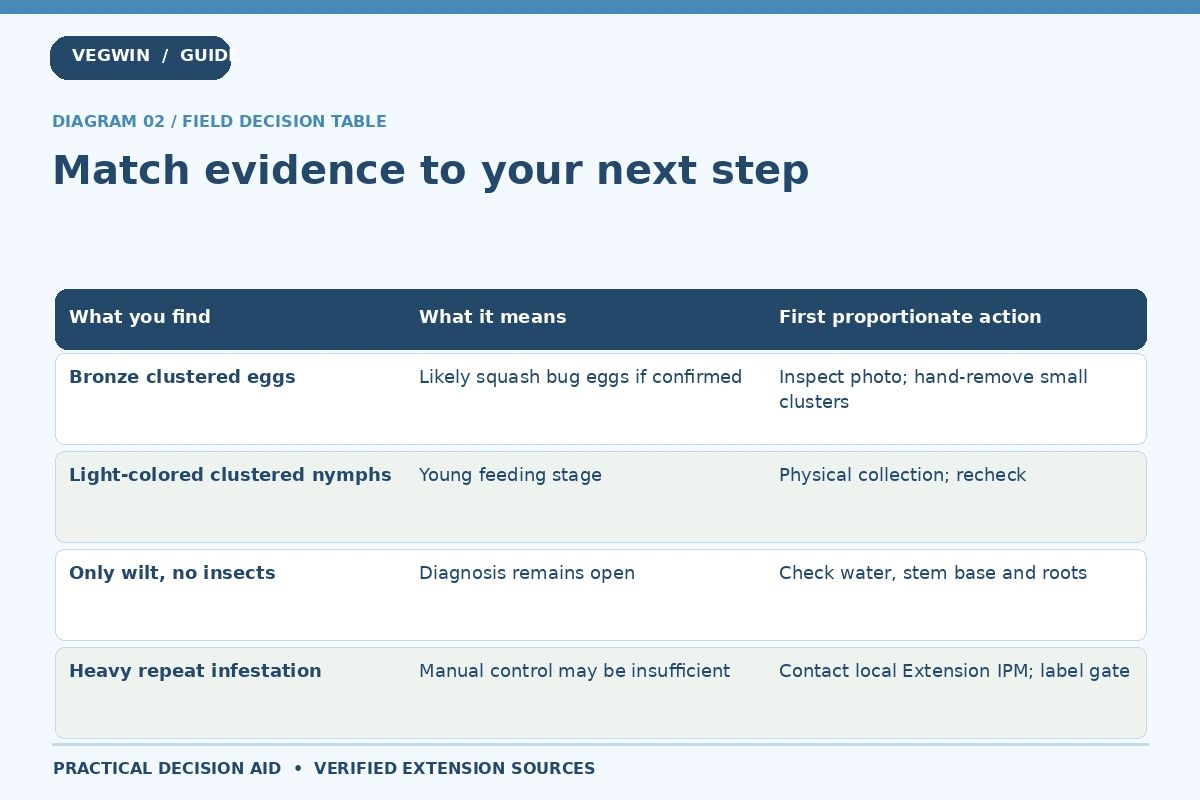
| What you find | What it means | First proportionate action |
|---|---|---|
| Bronze clustered eggs | Likely squash bug eggs if confirmed | Inspect photo; hand-remove small clusters |
| Light-colored clustered nymphs | Young feeding stage | Physical collection; recheck |
| Only wilt, no insects | Diagnosis remains open | Check water, stem base and roots |
| Heavy repeat infestation | Manual control may be insufficient | Contact local Extension IPM; label gate |
Treat Pesticide Decisions as a Separate Gate
Chemical products, including those marketed as organic, are not interchangeable or harmless. The correct choice depends on the identified pest, host crop, product label, legal registration and the presence of flowering plants and pollinators. This article intentionally gives no product-specific mixture, concentration or application schedule. Minnesota Extension notes that insecticides are usually not needed for many home-garden squash bug situations.
If monitoring establishes a severe infestation and a local Extension professional recommends considering a product, read the current EPA-registered label and follow all restrictions, protective equipment and pollinator precautions. Do not use household detergents or random “natural” mixtures as untested foliar sprays. The decision table is a triage tool: identify first, take practical physical steps when possible, then seek verified region-specific advice rather than improvise treatment.
Related Guides
- Squash Vine Borer: Identify Stem Damage Before Treating
- How to Prevent Squash Vine Borers Before They Enter Stems
- Powdery Mildew on Squash: Confirm Leaf Symptoms and Slow Spread
- How to Start Pattypan Squash Seeds in Warm Soil for Bush Plants
- When to Harvest Patty Pan Squash for Tender Scalloped Fruits
How We Research and Check the Evidence
Our research review on October 20, 2026 compared the user intent for squash bugs with the articles already drafted for VegWin, then checked the authoritative Extension and horticultural guidance linked below. We separated locally dependent advice from general plant biology and focused this article on its own decision tool: An egg–nymph–adult field identification and action matrix separates early hand removal from diagnosis of wilting and offers an IPM-first repeat-scouting workflow. This evidence review is not a substitute for observing a specific garden, for laboratory diagnosis, or for confirming a crop label or registered treatment.
Verified sources (checked October 20, 2026): extension.umn.edu — Squash bug adult, egg and nymph identification; scouting and physical control; source reviewed 2026; extension.usu.edu — Squash bug identification and biology, host range, damage and IPM; blog-fruit-vegetable-ipm.extension.umn.edu — July 23 2026 scouting update about egg masses and young nymphs. Regional calendars, weather, crop variety and current labels must be checked separately.
Disclosure: This independently prepared informational guide contains no confirmed affiliate promotions or sponsored product claims. Read the VegWin affiliate disclosure. Any third-party link above is provided for evidence, not as an endorsement of a seller. The availability of the site disclosure page was not independently established during this review.
Minnesota Extension describes small bronze or yellowish oval eggs often grouped on leaf undersides near veins.
No. Squash bugs feed externally with piercing-sucking mouthparts; vine borer larvae damage stems internally.
No. Check for the insects themselves and assess water, stem damage and other causes before choosing an action.
Yes, after proper identification. Physical removal of small egg clusters is an Extension-supported home-garden IPM step.
Not usually. Identify, scout and start with feasible nonchemical steps. If chemicals are considered, current local guidance and label directions control.