
Celery is not a loose collection of independently rooted stems. The crisp ribs are leaf stalks, or petioles, attached around a short central crown. A grower who wants a few ribs each week should take mature outside petioles and preserve the tightly folded younger heart. The method is different from cutting off a mature bunch for the kitchen or pulling celeriac for its swollen root. Use the base of the plant to decide which action is safe.
Identify Celery Petioles and the Central Heart
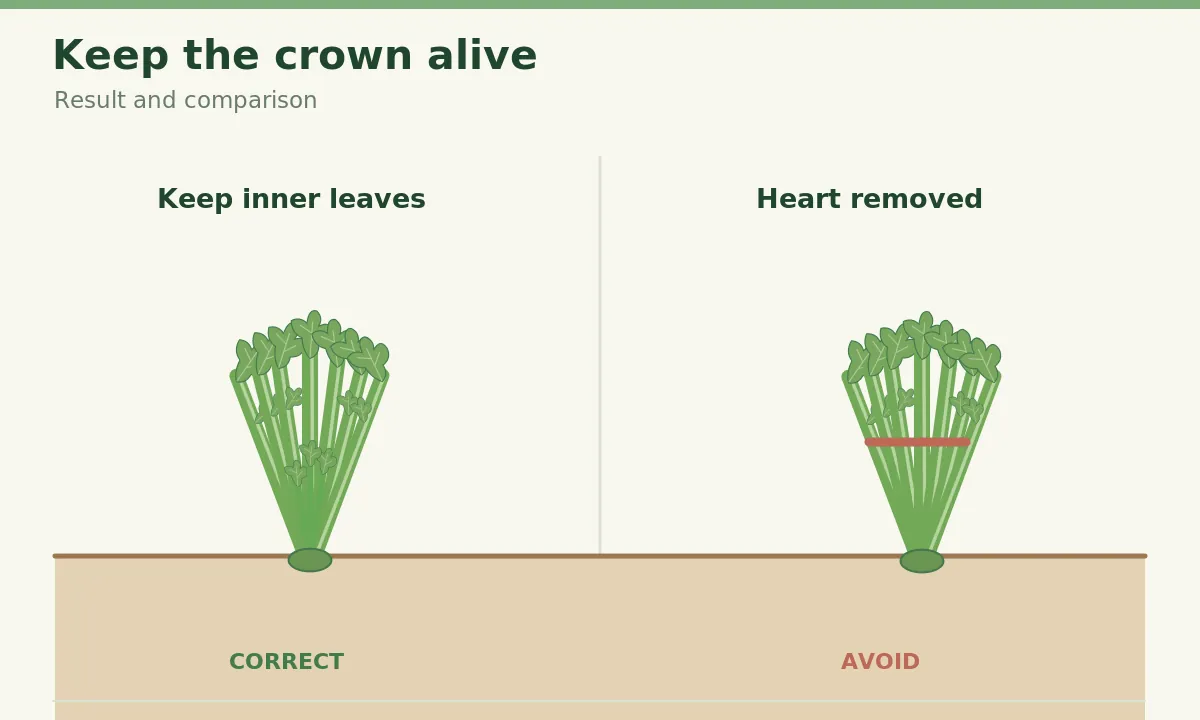
An ordinary stalk celery plant is a rosette of thick leaf stalks that end in leafy blades. The oldest, broadest petioles are generally positioned around the outside. Newer stalks rise from the crowded inner heart, above the short stem and root crown. Gently part the leaves before deciding what to take. Never treat the heart like another fully mature outside rib: removing it can stop fresh growth from that growing center. Celery and celeriac are forms of the same species, but celeriac is selected for a swollen basal organ; do not copy celeriac lifting instructions when your aim is to keep harvesting celery leaves and stalks.
Check Stalk Size and Texture Before Picking
A thick-looking rib is not necessarily ready if the entire plant is tiny. UC Marin Master Gardeners explains that outer celery stalks can be removed once the plant is reasonably developed. Inspect for a broad firm petiole with no collapse, rot, or severe mechanical damage. Try harvesting just one or two mature ribs from a healthy bunch instead of stripping every outer stem. Varieties differ in color, self-blanching habit, rib width, and crispness, so there is no single mandatory length for home picking. Commercial bunch maturity and household repeated picking are different end points; decide whether you want continuous smaller harvests or one large harvest.

Choose the Lowest Outer Rib, Not the Inner Spear
Follow one mature celery leaf downward with your eyes to see where its rib joins the bunch. Work on the outside of the rosette, not through the central cluster of pale new foliage. Support the plant with one hand, and use a clean, sharp knife or snips to separate that petiole near its base without gouging the living heart. A firmly attached stalk should not be jerked sideways hard enough to crack the crown. Remove any detached pieces from the bunch rather than leaving wet scraps tucked among emerging leaves. If you cannot clearly see the attachment, spread the leaves gently first.
Leave Plenty of Leaf Area to Regrow
Repeated celery harvest works only while enough mature leaf stalks remain to capture sunlight and maintain the root system. Taking a small outside share is different from slicing through the full bunch close to soil level. The crown may grow additional stalks after heavy cutting under favorable conditions, but recovery is not assured, especially near bolting, in heat, or on a weak plant. The simplest conservative rule is to leave all young center leaves and a substantial ring of healthy outer foliage. Revisit after new stalks enlarge; do not impose a fixed weekly quota regardless of the plant’s rate of growth.
Keep Water Steady for Tender New Stalks
Celery has a shallow root system and responds badly to extended dry periods. Utah State University Extension emphasizes even soil moisture as a basis for tender growth. Check below the mulch with a finger and irrigate the root zone when needed, rather than watering solely because leaves look briefly limp in midday sun. Avoid waterlogged soil as well: lack of oxygen can injure roots. Mulch can moderate fluctuations, but keep it from burying the tight central heart. Do not copy a regional irrigation volume without considering rain, container size, soil texture, heat and plant stage. Celery that experiences repeated drought stress may develop tough, strongly flavored stalks.
Recognize Heat Stress, Bolting and Disease
A central flower stalk is not just a tall new edible rib. It can signal that a plant is shifting from leafy vegetative growth into reproduction. Celery is a cool-season biennial usually raised as an annual crop; temperature and other stresses can contribute to premature bolting. As flowering progresses, stalk quality often declines. Inspect any blackened, mushy bases, unusual lesions or collapsed heart before taking more for food. Do not mistake a normal paler inner leaf for a nutrient deficiency. If you notice recurring trouble, document watering, temperature swings and cultivar before adding fertilizers. A soil test is more reliable than an invented feeding recipe.

Choose a Whole Bunch Harvest at the Right Time
For a large single kitchen harvest, cut or lift the plant at maturity using a clean tool and trim the soil-contaminated base away from edible portions. Utah State University’s harvest guidance discusses whole celery plants as a distinct option. It ends repeated picking from that plant, so keep other plants growing if you want a continuing supply. A mature bunch does not need to wait until every individual rib has the same diameter. In a frost-prone area, severe freeze may end the crop; in a warm climate, premature bolting or loss of crispness may be the greater deadline. Check local growing calendars, not perennial hardiness zones, for the appropriate harvest period.
Handle Edible Ribs Without Mud and Debris
Carry the clean cut stalks to shade and remove wilted or damaged foliage. Since petioles connect close to the soil, dirt can lodge in the ribs and the nested leaf bases. Separate stalks and rinse thoroughly under clean running water before use, especially if they will be eaten uncooked. Refrigerate promptly and keep fresh stalks from drying out. Do not leave rinsed celery in a hot car or a sunny harvest bucket. Wash tools that contacted decomposing leaves or soil, and avoid harvesting obviously spoiled tissue. Home gardens may have wildlife traffic and splash contamination that make careful washing important even when no pesticides were applied.
Troubleshoot Small Regrowth After Harvest
If new stalks remain thin, first ask whether the plant has adequate light, roots and intact central leaves. A severed crown cannot be fixed by fertilizer. Plants that lose much of their foliage may require a long recovery interval, and stress can shorten the remaining productive season. Inspect the undersides of leaves for aphids or other pests; minor sightings alone do not justify a broad-spectrum spray. Look for roots confined to a small container, excessively dry compost, or soggy conditions. A variety selected for compact growth also naturally makes smaller stalks. Compare photos taken several days apart to tell genuine new growth from remaining old stems simply spreading apart.
Adapt Harvesting to Cool and Warm Regions
Celery performs best with an extended moderate growing period. An inland northern gardener may raise transplants for a spring-to-fall harvest and protect them from hard frost. A mild-winter gardener may be more successful growing through a cooler season than trying to force growth in midsummer heat. High humidity does not cancel the need for consistent root-zone moisture. Container plants dry out faster than plants in deeper garden soil, but the pot must still drain freely. Use nearby Extension schedules and the chosen cultivar’s maturity information to determine whether continuing to pick ribs will lead to useful harvests before the weather changes.
Record What Works in Your Own Celery Patch
A short harvest record should include plant age or sowing date, number of ribs removed, leaf vigor afterward and recent weather. If one plant produces better repeated harvests, compare its water availability and sun exposure with weaker neighbors. In future, plant more than one celery if you routinely need several stalks at a time; no individual crown can endlessly replace an entire bunch. Leave a few inner petioles untouched through each round, and check the attachment before using the knife. The key observable result is healthy new central foliage followed by enlarged outer ribs, not merely a smaller plant that still looks green.
Related Guides
- When to Harvest Celery: Outer Stalks or a Whole Head Without Waste
- Growing Celery: A Moisture-First Plan for Crisp Stalks
- How to Start Celery Seeds Indoors for Strong Leafy Transplants
- How to Start Chinese Leaf Celery From Seed for Slender Aromatic Stalks
How We Research and Verify Plant Advice
Sources checked on 2026-10-26: ucanr.edu; extension.usu.edu; extension.usu.edu. We reviewed each institution’s plant identification, correct growth stage and relevant cultural recommendations before adapting them into an independently written step-by-step guide. Where sources are region-specific, their calendar details are not applied universally. Pictures use simplified teaching shapes and should be compared with living specimens; they are not a substitute for laboratory disease diagnosis or local climate guidance. The relevant advice is paraphrased rather than reproduced.
Safety and Independent Editorial Disclosure
This independently prepared educational article does not claim sponsorship or affiliate approval. Our category reading links are informational, not product endorsements. See the VegWin affiliate disclosure. Clean sharp tools before cutting plants, protect hands from thorns and blades, and keep cut plant material away from children and pets where appropriate. Use only locally registered plant treatments labeled for the actual crop, and observe the product label. Do not rely on unsupervised home remedies or unverified harvest-safety promises.
Yes. Harvest mature outer petioles individually while preserving the inner heart and enough surrounding healthy leaves.
The small central heart is new growth. Leave it intact if you want the plant to keep producing outer stalks.
Heavy cutting, heat, bolting, root problems and insufficient water may all restrict new growth; inspect the growing heart first.
Use clean snips or a knife near the outer petiole base when pulling could tear the crown; protect your other hand.
Yes, but removing or lifting the complete plant ends the cut-and-come-again harvest from that crown.