
Harvest Chinese Broccoli (Gai Lan) Before the Buds Open: the useful starting point is to identify the plant and the part that actually grows. This guide uses the botanical name, an observable plant-stage cue and a specific action rather than pretending every climate or cultivar follows one fixed date. The illustrated sequence highlights what belongs above or below the soil, which tissue should remain alive after cutting, and the difference between a normal developmental stage and a likely problem. Local weather, seed supplier information and careful observation still determine the final timing in your own garden.
Identify Chinese broccoli by stems and buds
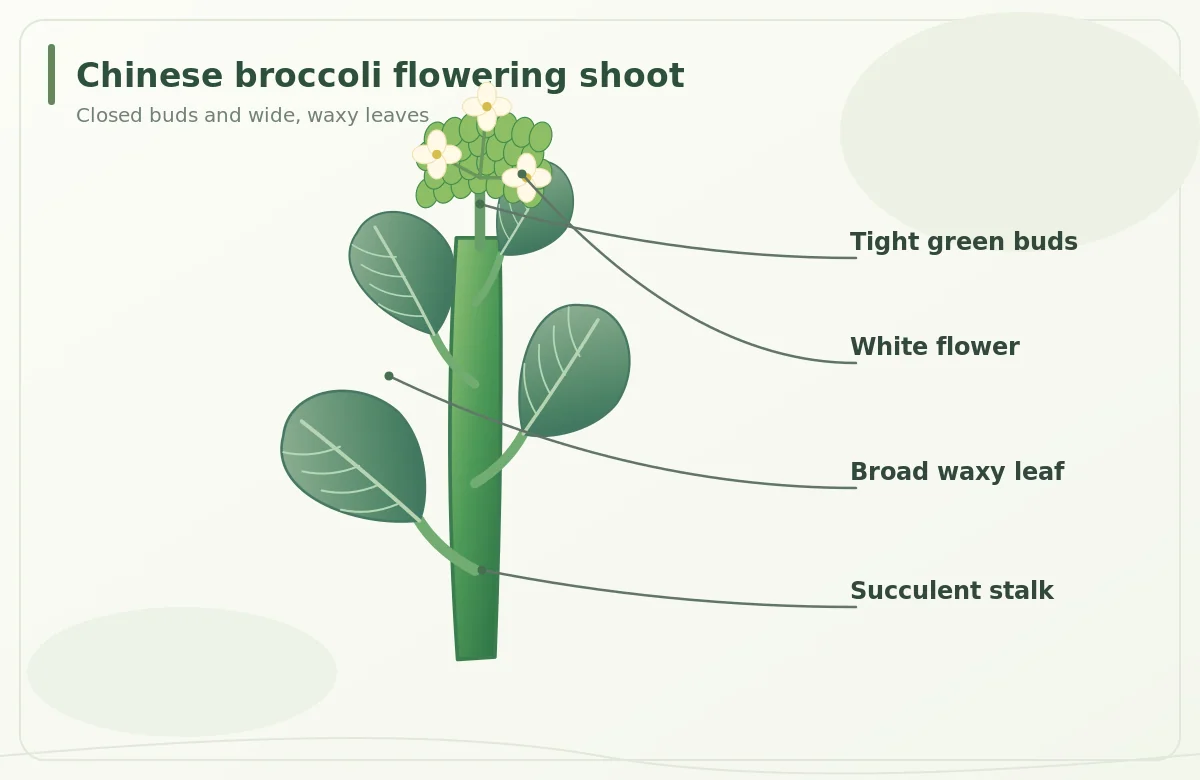
Chinese broccoli, often called gai lan, kailaan or Chinese kale, belongs to the Brassica oleracea group. It does not make the single massive tight head expected from heading broccoli. Instead, it develops fleshy upright stalks, broad slightly waxy blue-green leaves, and smaller clusters of green buds near the shoot tips. All three parts can feature in a harvest.
A growing stem can be thick and pale green beneath the top cluster, while a mature leaf has a strong central vein. Small white flowers may emerge as the buds age. Those blooms are a signal that the ideal tightly budded stage is passing, although RHS notes that open blooms can still be used in food. Identify what part you want before reaching for a knife.
Choose cool-season growing conditions
Plant gai lan when your local weather tends to be mild rather than at the height of severe heat. Warm days and lengthening daylight can rush flowering. UC Master Gardeners notes that their regional spring crops are more likely to bolt and that cooler autumn crops may offer a longer picking window; those dates must not be copied directly to other climates.
Prepare a sunny, well-drained bed with steady moisture, adequate spacing and a soil test where fertilization is uncertain. Young plants should not compete heavily for water, and drastic stop-start growth can make stems less pleasant. Ask local Extension for climate-specific schedules and do not confuse a USDA perennial hardiness zone with an annual brassica planting calendar.
Start seed or set out healthy transplants
Sow purchased gai lan seeds at the seed-packet depth in a finely prepared bed, or start healthy seedlings in cells that allow their roots to emerge without crowding. In locations with hot summer weather, choose a cool sowing window. Keep the upper medium moist during emergence, then thin or transplant before the plants twist tightly around one another.
Set transplants at the same general soil level they occupied in their original cells, without piling soil into leaf joints. Space them according to the variety and growing instructions, not by judging one small seedling as its future full size. Watch for cabbage-family flea beetles and caterpillars, and use crop barriers or other integrated pest management methods matched to actual identification.

Watch for closed buds above thick stems
The harvest signal is a rounded green bud cluster poised above a firm, succulent central stalk. Before visible white petals unfold, the flowering shoot is usually at a tender stage. Compare the tip with several nearby leaves: a bud is a tight cluster of miniature flower structures, not a newly unfolding blue-green leaf. Different varieties can make larger or smaller clusters.
The stem below the bud should still be easy to cut. A coarse, very elongated shoot with numerous fully opened flowers may taste different from a younger harvest, although flower appearance is a better cue than a rigid number of days. Clemson and RHS favor cutting before flower opening. If your plants are developing unevenly, harvest individual stalks rather than the entire row.
Cut above a live lower leaf node
Use a clean knife or scissors to cut the top flowering shoot while leaving at least one or two healthy lower leaf nodes on the plant. The cut goes through the main stem above a node, not through the leaf blade or at the soil line. A node is the meeting point of a leaf base and stem where a new side shoot may grow.
UC Master Gardeners specifically recommends preserving lower nodes to encourage future shoots. Hold the harvested stalk in your other hand so it does not tear from the crown. If a plant is small or stressed, taking less at once is better than removing every leaf. Cutting at the wrong place may sacrifice the very buds that would have provided the next small harvest.
Harvest tender leaves without stripping plants
RHS also describes harvesting young outer leaves as salad greens while retaining the center for regrowth. The same principle applies even if the final goal is flowering shoots: remove a few healthy leaves, never the entire central rosette. Mature leaves may be cooked separately because their texture differs from that of the succulent stem.
When trimming a mixed bundle, separate damaged leaves and wash the crop using ordinary food-handling precautions. Do not confuse a lacy insect-chewed margin with a normal cultivar trait. Scout the underside for larvae, avoid broad chemical sprays without identification, and follow current label directions for any food crop treatment.

Encourage second shoots without overpromising
After the central tip is removed, lower axillary buds may elongate. Keep soil evenly moist, give the plant enough light and watch the new growth at the saved nodes. The amount of regrowth varies with cultivar, temperature, nutrition and how much stem was retained. A side shoot should be cut once its buds are tight and its stem is usable.
Do not promise unlimited repeat harvests. Severe heat, disease, exhausted roots or a deep cut below all viable nodes can end production. If older leaves yellow all at once, look at soil moisture and root health before adding fertilizer. Use local guidance to interpret symptoms instead of treating yellow foliage alone as proof of one missing nutrient.
Compare gai lan with similar brassicas
Broccoli rabe, also called rapini, is a separate leafy brassica typically associated with more branched foliage and small clusters of yellow-flowered buds. Gai lan is recognized for its relatively thick, smooth stalks, broad blue-green leaves and usually white flowers. Standard heading broccoli forms a much larger head; these vegetables share some techniques but are not interchangeable identities.
When purchasing seeds, look for “Chinese broccoli,” “gai lan,” or a confirmed botanical designation. Write the chosen cultivar on your label, because maturity and stalk size can vary. Use the first plant of the season as a visual comparison for the others: a closed bud tip, still-tender stalk and intact lower leaf nodes make a more reliable harvest rule than one universal date.
Related Guides
- When to Harvest Purple Sprouting Broccoli for Tender Spears and Side Shoots
- When to Harvest Broccoli Heads and Keep Side Shoots Growing
- Growing Broccoli: Prevent Buttoning and Harvest Side Shoots
- How to Grow Gai Lan From Seed for Tender Stems and Closed Flower Buds
How We Research and Verify These Techniques
This guide was researched and fact-checked against www.rhs.org.uk, ucanr.edu, hgic.clemson.edu on October 29, 2026. We checked species names, germination or planting instructions, the plant stage used for cutting or harvest, and the cautions that apply to different growing conditions. The original illustrations are explanatory diagrams, not substitutes for observing a living plant. Where trusted sources describe different treatment for different seed lots, forms or regions, the difference is stated rather than silently averaged.
VegWin publishes independent growing information and does not imply sponsorship, approval or a partnership with cited institutions. This guide makes no affiliate product recommendation. Read our affiliate disclosure. Before using any pesticide or treating plant symptoms, identify the problem and follow current local Extension and product-label guidance; do not assume an illustration alone is a diagnosis.
No. They are related Brassica oleracea vegetables, but gai lan is harvested for smaller budding stalks and leaves, not a large heading broccoli crown.
Usually no. RHS and Clemson Extension recommend picking thick shoots while flower buds are still closed.
Cut through the stem above one or two healthy lower leaf nodes so axillary shoots may develop.
Yes. Gai lan leaves, tender stems and flowering shoots are grown as edible parts; prepare and handle them appropriately.
It may produce smaller side shoots when live nodes are preserved, but heat, weather and plant vigor limit regrowth.