
Okra is worth understanding on its own terms. It thrives where summer warmth is reliable, bears attractive hibiscus-like flowers, and can become an abundant source of tender pods. Yet a gardener who sows into a chilly seedbed may see a poor stand, while a gardener who waits too long between pickings may decide that all okra is woody. The solution is not a complicated feeding recipe. It is to match the planting method to warm soil, leave enough space to reach the stems, and judge harvest readiness by the pod and variety rather than an unchanging number on the calendar.
Test the Growing Window Before Planting Okra Seed
Okra is a frost-sensitive warm-season annual. Oklahoma State Extension describes reliable direct seeding after soil at planting depth has warmed sufficiently, using approximately 70°F as a commercial production threshold; Maryland Extension gives its home-garden context starting around 65°F. The difference reflects varying recommendations and growing circumstances, not a reason to select whichever number seems more convenient. Use a soil thermometer at sowing depth and nearby Extension advice, then inspect the seedbed for excess moisture or compaction. Air temperature alone does not tell you what a buried seed experiences.
A packet saying “warm season” also does not translate into one universal planting date. Check the local last-frost window, actual soil warmth and whether the expected growing season will accommodate that variety. In very short seasons, transplants may offer a head start, but okra seedlings dislike careless root disturbance. If you start them under protection, use a method that lets roots remain intact and transplant only into suitable conditions. Do not regard a few warm afternoons as a guarantee that nights and soil will remain warm.
Choose Growth Habit Before Deciding Spacing
Okra cultivars differ in mature size and pod characteristics. Oklahoma State Extension distinguishes dwarf from larger types in its spacing discussion because access for repeated harvesting is a real management requirement. Check the specific packet and regional guidance rather than using one fixed spacing for every plant. A vigorous tall row that looks beautiful in midsummer may become difficult to inspect if stems overlap and pods are hidden. Think about where your hands and cutting tools will travel once the foliage is mature.
Choose a spot with strong light, drainage and reasonable access to water. Plants can become tall or broad, so a narrow path beside a fence may not be the easiest harvest location. A compact cultivar can fit a smaller garden better, but “compact” should be verified for the actual variety. If a bed is shared with short plants, consider how okra foliage will change sunlight during the season. Support is not automatically necessary for every plant, yet strong winds or exposed sites may call for a stake or other local protection.
Prepare the Seedbed and Track Uneven Emergence
Work soil only when it is workable, not waterlogged. Follow the cultivar label and Extension for sowing depth and thinning; avoid piling extra seed into a cold pocket and then leaving surviving seedlings in a dense cluster. Okra has a relatively hard seed coat, which can contribute to slow emergence. Some Extension publications discuss soaking or lightly scarifying seed, but handle only untreated seed as directed by the packet and follow safety instructions; these techniques do not make cold, saturated soil suitable for planting.
If only part of a row emerges, mark the bare sections and investigate. Was the soil cooler in a shaded strip? Did heavy rain crust the surface? Was seed old or planted deeper than recommended? Dig carefully near one failed spot to see whether there is a germinating seed, a rotten seed or no seed at all. It is better to correct the seedbed or wait for warmth before resowing than to apply fertilizer to compensate for a physical germination problem. Seedling collapse warrants diagnosis rather than routine spraying.
| Observed situation | Likely decision point | Safer next step |
|---|---|---|
| Seed not emerging | Cool or saturated soil, crust or old seed possible | Check soil and seed condition before resowing |
| Tall crowded row | Poor access and hidden pods | Use packet spacing and clear picking path |
| Pod woody at harvest | Picking interval or variety cue wrong | Shorten checking interval; test tenderness |
| Crooked or bumpy pod | Several possible causes including insects | Inspect plant and pest identity before action |
Water for Root Health Without Forcing Growth
Young okra needs adequate moisture to establish roots even though a mature plant may tolerate some dry periods. Let the actual root-zone condition guide watering, and avoid repeatedly saturating a poorly drained spot. If foliage wilts at the hottest moment, check whether it recovers in cooler conditions and whether the soil is truly dry before adding more water. Wilting alone does not distinguish drought from damaged roots. Mulch can help moderate surface moisture after soil has warmed; do not use a heavy wet covering to keep spring soil artificially cold.
Fertilization should follow the garden soil test and Extension guidance. Vigorous leaves without good flowering do not prove the need for more nitrogen; heat, cultivar timing, shade and other factors may be involved. Keep weeds from competing while plants are small, but cultivate shallowly around established roots. Inspect plant bases and both leaf surfaces while watering. A repeating routine of checking moisture and growth is more valuable than any fixed amount of water or fertilizer prescribed without knowledge of the site.

Pick Okra Pods by Tenderness, Not One Universal Length
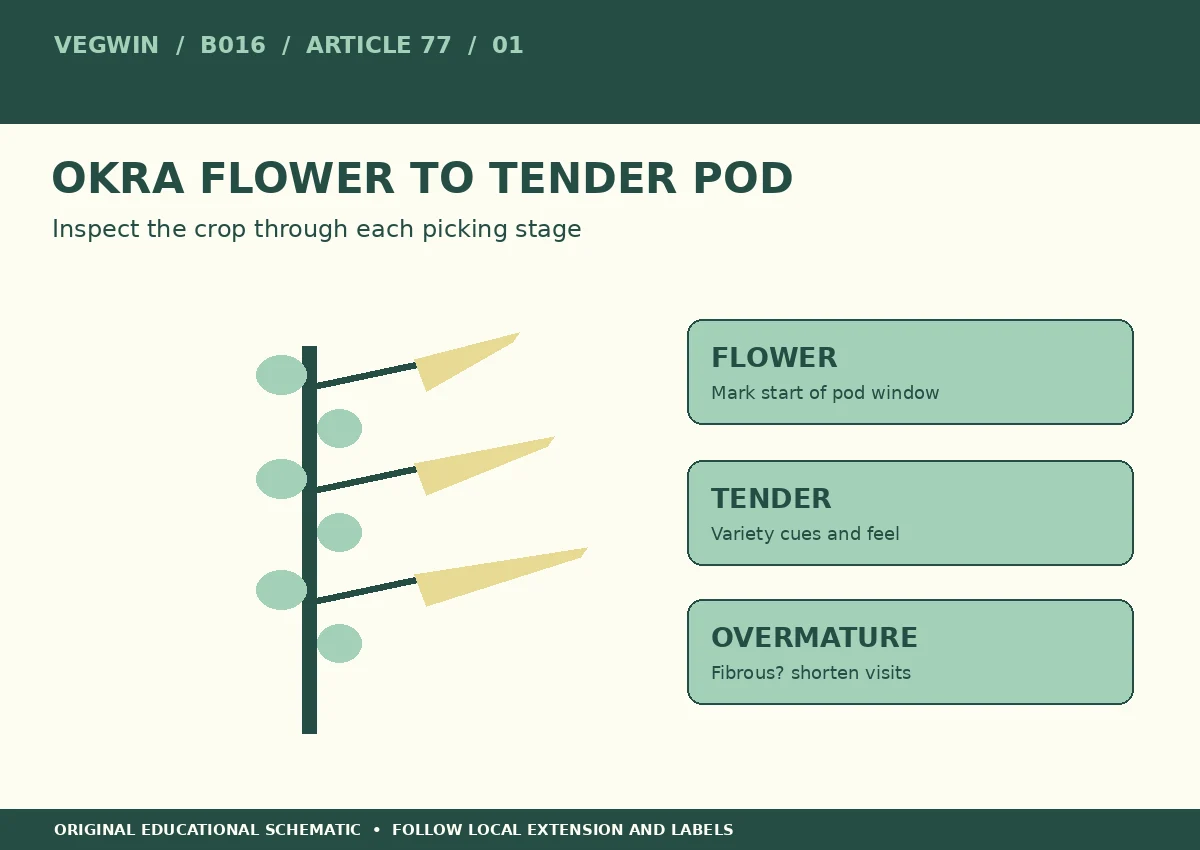
Okra pods develop quickly in warm weather. Oklahoma State Extension describes many fresh-market pods being harvested around three to four inches, but emphasizes that long-podded cultivars may stay tender at different sizes. The right harvest cue is the particular variety’s intended pod type and tenderness. A pod that is already tough is unlikely to become more tender if left on the plant. Begin checking soon after flowering and examine plants frequently when flowering is heavy. For the basics, see our guide: When to Harvest Okra for Tender Pods Instead of Tough Ones.
Use a clean, sharp pruner or knife to avoid ripping stems. Some okra leaves and pods have hairs or short spines that irritate skin, so gloves and sleeves are sensible for sensitive gardeners. Handle pods gently and move the harvest out of direct sun. Oklahoma State notes that leaving overmature pods can reduce continued productive flowering. If you miss several days and find woody pods, remove them and revise the next picking interval rather than interpreting one bad harvest as failure of the entire crop.
Identify Common Trouble Before Choosing a Treatment
Crooked, bumpy pods, holes, yellow leaves and weak growth have different possible causes. Stink bugs and leaf-footed bugs may deform fruit, while aphids or mites can build up on foliage, according to Oklahoma State Extension. But not every insect visiting a flower is harmful, and a misshapen pod is not diagnostic by itself. Look for the actual pest, feeding injury, distribution among plants and current soil conditions. Record photos of the whole plant as well as close-ups of symptoms.
Begin with sanitation, removal of spent pods, weed control and regular observation. If a fungal disease or serious insect outbreak is suspected, consult regional Extension or IPM for identification and risk assessment. Do not use a homemade pesticide cocktail or copy a commercial seed-treatment recommendation into a home garden. Any pesticide use must follow the current label, the specific crop listing, and local rules. Identification precedes treatment; “natural” does not mean a substance is harmless.

Keep a Harvest Log That Predicts the Next Picking
Write down the date of first flower, approximate pod development time under your conditions, the variety and what size was tender when you cooked it. Illinois and Oklahoma Extension describe rapid pod development, but their examples are guides rather than a promise that every plant follows identical timing. A simple repeatable observation—small bud, flowering, tender pod, overmature pod—will teach you what to expect at that site more reliably than a generic harvest-day chart.
At the end of the season, note whether the limitation was cool weather, poor germination, inaccessible tall stems, an unreliable picking routine or a verified pest. This makes next year’s changes specific: delay sowing, choose a more compact type, widen the path, or visit the row more often. Okra rewards a consistent check-in habit. The best growing guide is one that gets a tender dinner from the plant, not only a dramatic photograph of a tall stalk.
Related Guides
- How to Start Okra From Seed After the Soil Warms
- How to Save Okra Seeds From Brown Pods Before They Split Open
How We Research and Review These Gardening Decisions
We consulted these original public university Extension and government resources on 2026-10-20: Oklahoma State Extension, University of Maryland Extension, Illinois Extension. We checked how their recommendations depend on crop biology, growing environment, cultivar and region. The custom diagrams visualize decisions; they are educational illustrations, not experimental measurements or photographs. We compared the first 75 planned article topics for intent overlap, but could not independently inspect the full live WordPress index on VegWin.org. Current local advice, crop packets, measured conditions, and updated guidance take precedence over generic rules. Structural preflight cannot confirm every biological fact.
Buttons lead to public Extension or government educational resources; no partnership or approval is implied. We checked sources including affiliate disclosure. If products or treatments are later added, review labels, affiliations, and applicable rules first.
Okra is a frost-sensitive warm-season crop. Wait for locally suitable soil and air conditions rather than sowing by a universal calendar date.
Cold or waterlogged soil, crusting, seed condition or planting depth can interfere. Check soil and a sample of the seed row before deciding what to change.
Inspect frequently in warm productive periods because pods develop quickly; use cultivar-specific tenderness rather than a rigid schedule.
No. Pod tenderness varies with variety and growth conditions. The often-cited size is a reference for many fresh-market types, not a universal rule.
No. First identify whether the insect is causing damage. Use local Extension IPM and follow any applicable label and rules if treatment is warranted.