
Chives are a clumping perennial herb that can supply small, repeated harvests of hollow, onion-flavored leaves without replanting every season. Their maintenance is not quite the same as basil, rosemary, or scallions: the main tasks are keeping the clump healthy, harvesting without exhausting it, and dividing plants that have become crowded. This guide offers a harvest-and-division routine for ordinary chives, Allium schoenoprasum. Garlic chives are a different species with flattened leaves and a different flavor, so plant identification comes before following the care plan.
Identify The Chive Clump You Are Growing
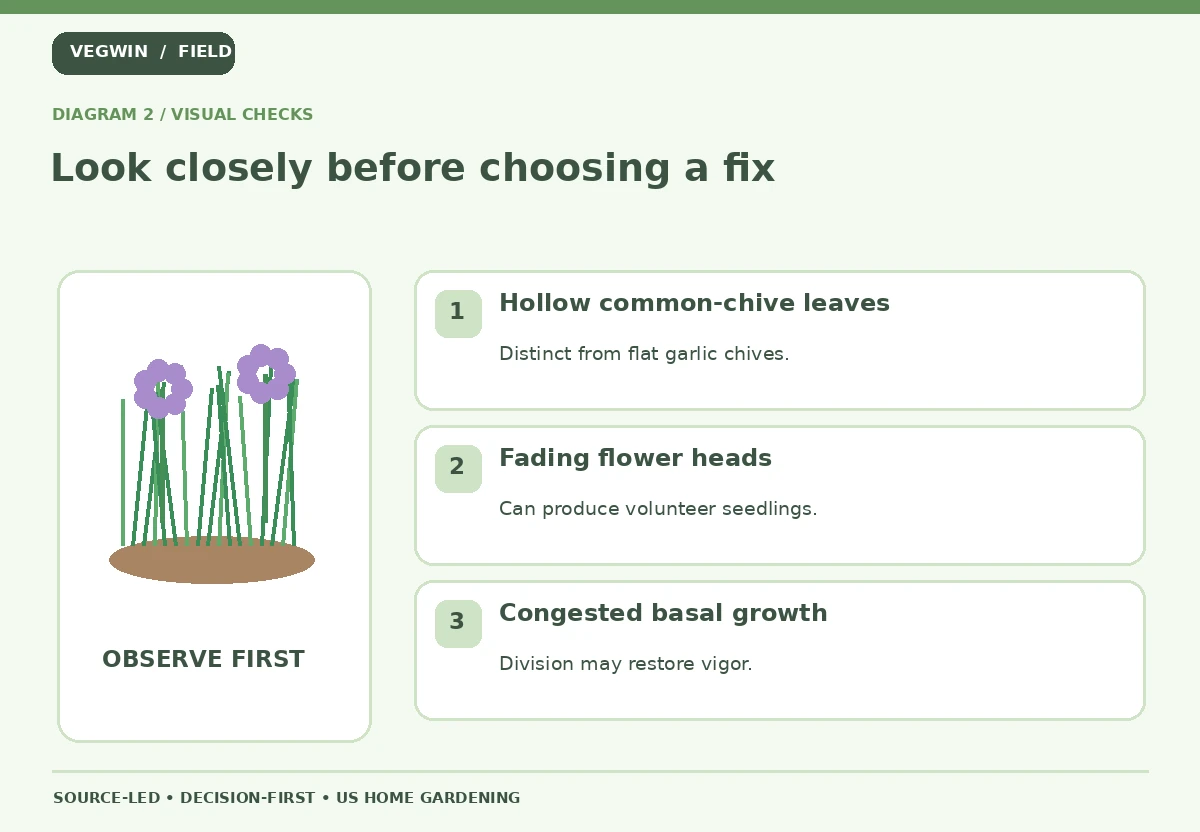
Common chives have slender, tubular leaves and usually rounded clusters of lavender-pink flowers. Garlic chives, Allium tuberosum, have broader, flatter leaves and typically white flower clusters. Both can be useful herbs, but a product marked “chives” may not tell the full story unless you inspect the botanical name. Wisconsin Horticulture documents the distinction. Determine the identity before saving seed, describing a flavor, or assigning a planting location; a mistaken identification can create confusion about flowering and spreading later.
A mature common chive plant usually forms multiple small bulbs or growing points in one clump rather than a single large kitchen onion. New leaves emerge from the base; you are harvesting leafy growth, not waiting for a storage bulb. Expect a seasonal cycle in cold climates, with shoots emerging in spring and foliage retreating as weather turns harsh. In warm or protected locations the timing can differ. An herb that looks dormant after winter is not necessarily dead, so check the crown and your regional climate before discarding it.
Choose Light Soil And A Container Or Bed
Common chives grow best with substantial sunlight and well-drained soil, although the Wisconsin Extension guide notes that they tolerate some light shade. A convenient location near a kitchen is useful only if it also has suitable light and drainage. Do not position them in a permanently wet corner simply because they are an undemanding perennial. In a raised bed, leave room for the clump to expand. In a container, use drainage holes and a potting mix rather than compacted garden soil.
Containers are a practical option when the vegetable beds are heavily cultivated or you want to move herbs close to a doorway for harvesting. Examine the root zone rather than relying on a pot-size rule that ignores plant maturity. Shallow roots can dry rapidly in hot containers, while continuously soaked media can damage the crowns. Mulch lightly to reduce surface drying and weed competition, keeping thick wet material away from the clump. Never claim one universal weekly water quantity works for an indoor windowsill and an exposed sunny bed.

Start New Plants By Seed Or Division
Seed starting gives you new plants, but division is usually the faster way to expand a well-established clump. University of Maryland Extension lists both methods, and Wisconsin recommends lifting and dividing crowded clumps every few years. Choose a healthy plant with numerous growing points; use a clean tool to separate viable sections containing multiple bulbs and adequate roots. Replant promptly at an appropriate depth, water the root zone, and protect the divisions from excessive drought while they settle. If you want the full process, read how to divide crowded chives and replant healthy bulblet clumps.
If starting from seed, follow the packet’s germination directions and regional outdoor transplant timing. The resulting seedlings may not be identical in vigor to the parent plant. For divisions, avoid cutting a tiny weak clump into numerous fragments merely to multiply it. Keep enough roots and foliage to support recovery. A few vigorous pieces are preferable to many poorly rooted ones. Record the division year on a plant tag so you can tell whether later low growth reflects age, shade, or an overcrowded root mass.
Harvest Leaves While Keeping Growth Active
Start cutting when leaves are well grown rather than clipping newly planted seedlings repeatedly. University of Maryland advises harvesting chives once plants are roughly six inches tall, while Wisconsin Horticulture emphasizes taking young, green leaves and leaving some foliage on a clump. Use clean scissors and cut near the base without gouging the crown. Harvest only the amount you expect to use, then allow the plant time to replace what you removed. For the fuller picture, see our guide “Grow Garlic Chives for Flat Leaves Without Letting the Plants Escape”.
You may take a few leaves from several places for a continuous supply or make an occasional larger cut from a vigorous stand. These patterns have different recovery times. Cutting every leaf in a small, recently divided clump leaves little photosynthetic area for rebuilding, so give new divisions a longer rest. Remove browned or damaged leaves rather than treating them as culinary harvest. Freezing fresh chopped chives is a useful preservation choice; drying often changes aroma and quality, so do not present a dried product as equivalent to fresh leaves.
Handle Flowers And Unexpected Seedlings
The rounded flowers of common chives are ornamental and can be used as a garnish when correctly identified and raised for food, without pesticide residues or contamination. Flowering is not automatically a disease or proof that the herb is dying. Once flowers fade, however, viable seed may develop. Wisconsin Extension notes that common chives can self-seed, so deadhead fading blossoms if you do not want volunteer seedlings appearing along neighboring beds or paths. Our walkthrough on how to grow garlic chives from seed and prevent unwanted self-seeding sets out each step.
Decide whether you want flowers, seeds, or tender leaves rather than trying to maximize all three. Blooming foliage can become less desirable for frequent fresh harvest, and a vigorous clump may need selective cutting afterward. Do not mistake garlic chives’ late white flowers for the ordinary purple chive bloom. If volunteers appear in an undesirable spot, remove or transplant them while small, after positively identifying them. Unchecked spreading in a mixed herb border is more manageable early than when crowded roots and seedlings occupy every gap. Our guide to growing lovage for tender leaves goes into more detail.
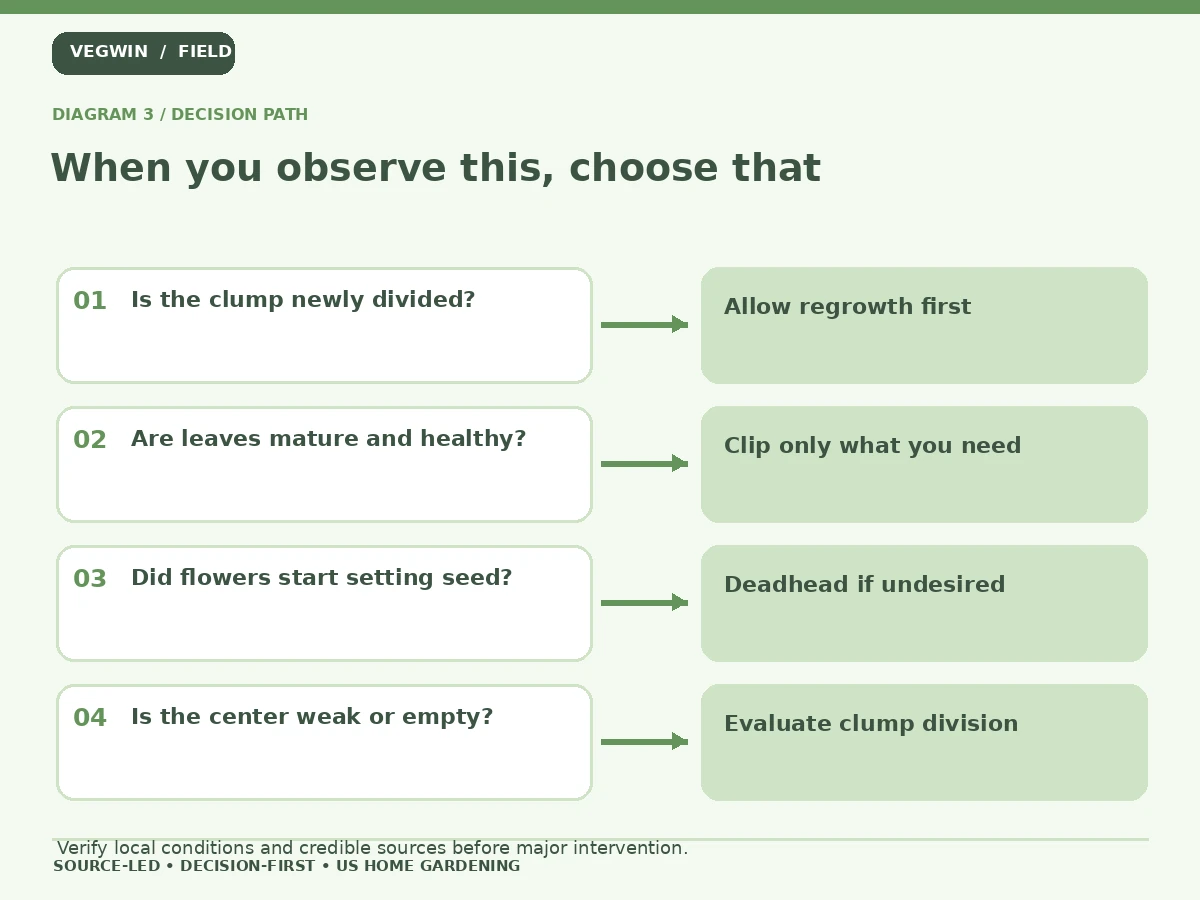
| Clump condition | Likely interpretation | Useful response |
|---|---|---|
| Vigorous many green leaves | Harvest-ready plant | Selectively clip leaves |
| Open or crowded center | Old congested clump | Divide in suitable season |
| Mature flowering heads | Seed set may follow | Deadhead if preventing volunteers |
| Soft roots and wet media | Possible overwatering | Inspect drainage and roots |
Diagnose Poor Regrowth Before Fertilizing
A clump that produces short, pale leaves may have insufficient light, root crowding, drought stress, waterlogging, or simply be recovering from an extensive harvest. Wisconsin Horticulture describes low routine fertilizer needs for common chives, so adding fertilizer automatically is not the correct first response. Check exposure, water movement, soil moisture, age of the clump, and whether the plant was recently divided or cut hard. Repair the evident environmental issue before changing nutrition.
If the crown is soft or foul-smelling, consider excess moisture or disease rather than merely slow growth. If only the tips brown, inspect drying, sun and wind exposure, and the timing of harvest; the symptom is nonspecific. Pest problems are usually less important in established chives than basic root-zone care, but accurate diagnosis matters if injury spreads. Where insects or lesions are present, take clear photographs and use local Extension resources rather than spraying a generic herbal mixture that could make edible leaves unsuitable for consumption.
Maintain The Clump Across The Seasons
In cold regions, leaves may die back naturally and vigorous plants can reappear from the crown. Remove genuinely decayed material as appropriate, avoid winter waterlogging, and mark the location so spring cultivation does not damage dormant plants. Container plants may experience colder root conditions than plants in the ground, so check local recommendations for overwintering pots rather than assuming a hardy perennial is invulnerable in every container. Do not force continuous winter harvest from a plant that needs a seasonal rest. For a step-by-step method, see how to grow sunchokes without letting tubers spread everywhere.
Review the clump every couple of years. An open or unproductive center with crowded growth around the edges can be a signal that division will restore convenient harvesting. Wisconsin Extension suggests a two- to three-year division interval as a useful guide, but vigor and local conditions determine whether it is needed. Keep simple records of how much foliage the plant supplies and whether flowers are allowed to seed. That routine offers a more sustainable herb patch than constant clipping followed by guessed fertilizer applications.
Related Guides
- Growing Herbs by Type: Water, Harvest, and Winter Survival Guide
- When to Divide Chive Clumps and Replant With Healthy Bulbs and Roots
How We Research and Verify This Guidance
We checked sources including hort.extension.wisc.edu — source 1, extension.umd.edu — source 2, hort.extension.wisc.edu — source 3 and extension.umn.edu — source 4 on October 20, 2026. Each source supports a crop- or practice-specific assertion recorded in the source list. Gardening outcomes depend on local weather, species, cultivar, soil and management. This page is not a live verification of all WordPress canonical URLs. Editorial assessment and appropriate local Extension checks remain necessary before publication.
Disclosure: There is no approved affiliate offer or compensated product placement in this article; its links point to educational references. Read the site affiliate disclosure for applicable policy information. No pesticide or fertilizer rate is recommended without relevant local Extension support and, where applicable, an approved product label.
No. They are distinct Allium species with different leaf shapes and flavors.
Snip mature green leaves near the base while leaving enough growth for recovery, especially on small clumps.
Wisconsin Horticulture suggests dividing crowded clumps approximately every two to three years.
Properly identified, pesticide-free chive flowers are edible, though flavor and texture differ from leaves.
Check light, root crowding, moisture and the previous harvest before assuming a fertilizer deficiency.