
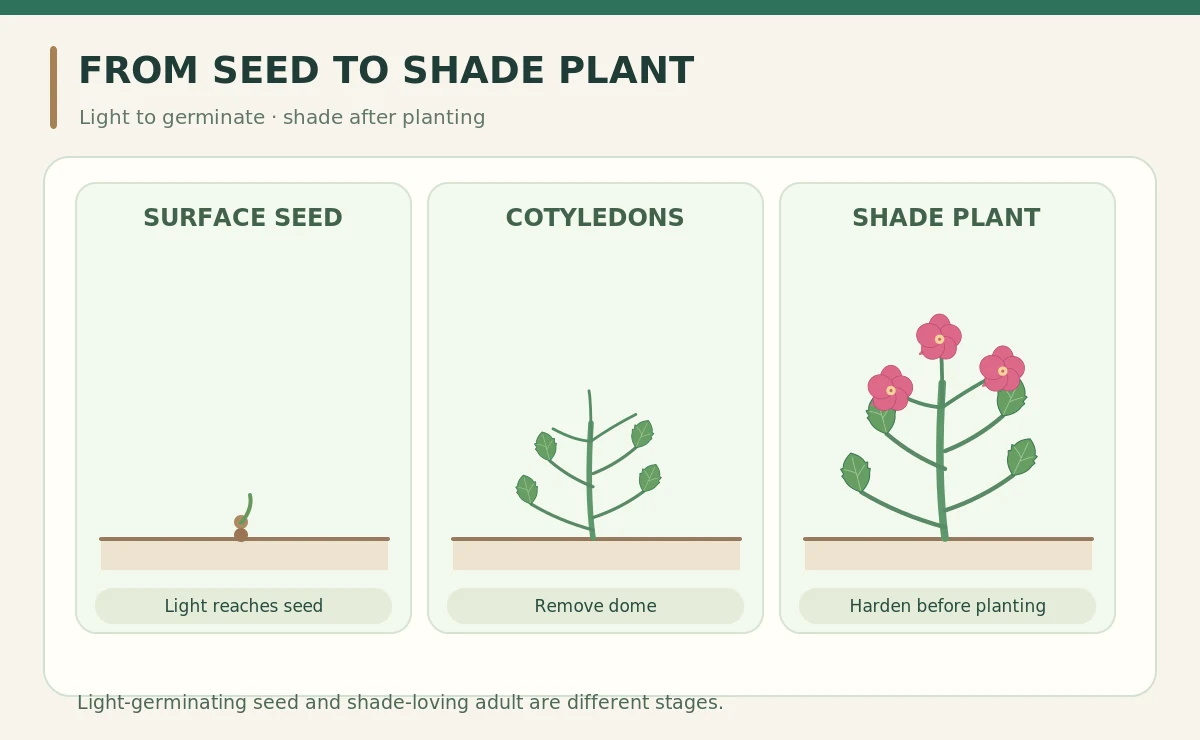
Garden impatiens (Impatiens walleriana) is a familiar shade-loving bedding plant, but its tiny seeds have a different light requirement from its flowering foliage. Seedlings need a bright, warm germination setup; established plants usually perform in partial to deeper shade. The common error is to bury the seed as deeply as a large vegetable seed or to keep a covered tray wet after emergence. The stages below show the seed actually resting on the medium and the seedling growing roots beneath it.
Choose true garden impatiens seed and clean supplies
Check the packet for Impatiens walleriana rather than assuming that all impatiens behave identically. New Guinea impatiens and interspecific hybrids may have different growing and disease-resistance characteristics. Garden impatiens typically have soft stems, pointed oval leaves with lightly toothed edges, and asymmetric flowers with a slender spur behind them. The seed is much smaller than a pea or sunflower seed, so sowing technique must be gentler.
Start with a clean shallow seed tray or small cells and a fine-textured seed-starting medium. Old garden soil can crust and introduce unwanted organisms to fragile seedlings. Pre-moisten the mix before sowing so watering does not wash tiny seed into one corner. Label the cultivar and the sowing date clearly outside the future image area. Avoid mixing several flower species with conflicting light or temperature requirements in the same covered tray.

Place seed on the medium where light can reach it
University of New Hampshire Extension lists impatiens among seeds that need light to help germination. Press each tiny seed gently against the prepared moist medium instead of burying it under ordinary compost. A dusting of translucent fine vermiculite may be suitable when the packet permits it, but a thick dark layer is not. In a correct cross-section, the seed is at the soil surface and a later root tip grows down into the medium.
A seed on the surface still needs contact with moisture. Merely scattering it onto dry fibrous material will not make it germinate. Light is a germination condition, not a reason to expose trays to scorching direct sun. Clear coverings can trap excessive heat when the container sits in a bright window. Use a bright location with controlled warmth instead, and keep the surface evenly moist rather than waterlogged.
Keep warmth, light and moisture balanced
Iowa State Extension recommends a warm germination medium around 70–75°F for impatiens. A transparent dome can help retain humidity while seeds germinate, but monitor condensation and avoid baking the closed tray in direct sunlight. Mist carefully or water from below where the tray design permits. Water should never cover the seed with a standing puddle; roots require oxygen as well as moisture.
Monitor daily for small green cotyledons rather than relying on a rigid number of days. The same seed may emerge at different times in different temperatures, and old seed can be slower or less viable. A domed tray is not a miniature terrarium for the whole growing season. Once seedlings emerge, fresh airflow and good light become more important than constant high humidity. Adjust management to the plant stage, not just the date.
Remove the humidity cover after emergence
Iowa State advises removing glass or plastic as soon as germination occurs. Leaving a dense sealed cover over developing foliage can encourage excessively wet conditions and weak growth. Lift it off, keep the young plants in bright indoor light and check the surface frequently so the unprotected small roots do not dry suddenly. Cotyledons come first; true serrated leaves appear as the plants establish.
A leggy seedling is not corrected by planting a mature plant’s foliage in direct midday sun. Instead assess the indoor light, spacing and temperature. Raising artificial lights as growth proceeds helps keep fixtures close enough to be useful without touching leaves. Avoid running lamps continuously; plants need normal dark periods. When more than one seedling occupies a cell, thin or transplant while small using clean tools and careful handling.

Pot up seedlings without crushing slender stems
Young impatiens are delicate at the stem base. When they are ready for individual cells, lift them by a leaf or a small piece of root ball, not by squeezing the soft stem. Iowa State describes moving seedlings into cell packs soon after emergence; follow their size and the actual root development. Set roots into lightly moist medium at a sensible level, keeping leaves and the living crown above the surface.
Water the medium around the roots and let excess drain away. If plants slump, investigate disrupted roots, oversaturated mix, poor airflow or excessive light heat before assuming they need more fertilizer. A few missing cotyledons do not automatically mean disease, but a pinched collapsing stem or gray growth warrants closer inspection. Proper sanitation is usually more useful than improvised sprays on tiny seedlings.
Harden young plants before planting outdoors
A strong indoor impatiens still needs a transition to wind and outdoor conditions. Iowa State Extension advises a gradual hardening period before moving plants into the garden after frost danger has passed. Begin in a sheltered shaded area and lengthen exposure progressively. A mature garden impatiens can prefer shade even though its seed needed light; those statements refer to separate biological stages.
Avoid sudden exposure to cold nights or baking direct afternoon sun. Transplant into moist but draining soil and preserve the root ball. The final planting depth should leave the original crown above the soil rather than burying the soft stem. Water after planting and monitor the bed for a few days. Vigorous growth does not require a waterlogged patch, especially in a shaded planting where soil dries more slowly.
Recognize flowers and separate shade from disease
Impatiens walleriana develops branching succulent stems, oval serrated leaves and colorful flowers with a distinctive spur extending behind the flower. The familiar flattened petal display is not a symmetrical five-petaled daisy. Flowers appear from leaf axils rather than from a rigid tall terminal spike. In garden beds, plant density, humidity and watering practices influence airflow around that tender foliage.
Wisconsin Extension describes downy mildew as a serious risk to susceptible garden impatiens, including yellowing, leaf drop and pale fuzzy growth, often on leaf undersides. Not every yellow leaf is downy mildew. Identify symptoms carefully, avoid moving suspect plants between beds and use local Extension guidance. A healthy young seedling and a diseased established plant should not be portrayed as interchangeable stages in a germination illustration.
Know what success looks like before planting time
Successful seedlings have a firm base, an expanding set of true leaves and roots holding the plug together without circling excessively. Their leaves should not be pressed against a plastic cover or stretched toward a distant window. Resist the urge to push an indoor plant outside before the bed is frost-free simply because its flowers have begun. Root protection and gradual light adjustment matter more than a specific transplant date copied from another state.
If the first tray fails, review seed placement, medium contact, temperature, moisture and how long the dome stayed on. Those observations can distinguish seeds that never imbibed moisture from seedlings that emerged and then collapsed. Keep the packet, record the environment and make one change at a time. A good result is a compact plant established in an appropriate shaded bed, not merely a quick sprout in a sealed tray.
How We Research and Check Gardening Guidance
We reviewed these university Extension, research and horticultural guidance sources on 2026-10-29: yardandgarden.extension.iastate.edu; extension.unh.edu; plants.ces.ncsu.edu; hort.extension.wisc.edu. The key decisions above rely on their specific crop identification, growing conditions and plant anatomy. We compared this topic with the supplied WordPress post list, existing draft-batch material and public site search; that comparison cannot reveal every unlisted future draft. Local climate, cultivar and actual growing conditions must guide timing.
This article contains no sponsored products or paid recommendations, and we do not claim an active affiliate relationship. Read the VegWin affiliate disclosure for the current site policy. Pesticide use, if ever needed, requires confirmed diagnosis, local IPM advice and a current product label, not a generic diagram.
Do not bury light-requiring seed. Press it onto moist medium; only a very light translucent covering may be appropriate if packet guidance allows.
Transparent covers can trap too much heat; choose bright controlled conditions instead.
Remove it promptly after seedlings emerge so foliage has airflow and is not kept constantly wet.
No. Seeds benefit from light for germination, while garden impatiens generally performs in partial to full shade outdoors.
Avoid it. Harden plants gradually and put them outside after danger of frost has passed.