
Daylilies form fans of straplike leaves above clumps of fleshy storage roots. They do not produce the scaly bulbs found in true Asiatic lilies. Division succeeds when every new section keeps a living fan or growing point and enough roots to establish, and when the original crown level is maintained during replanting.
Identify a Daylily Clump, Not a True Lily Bulb
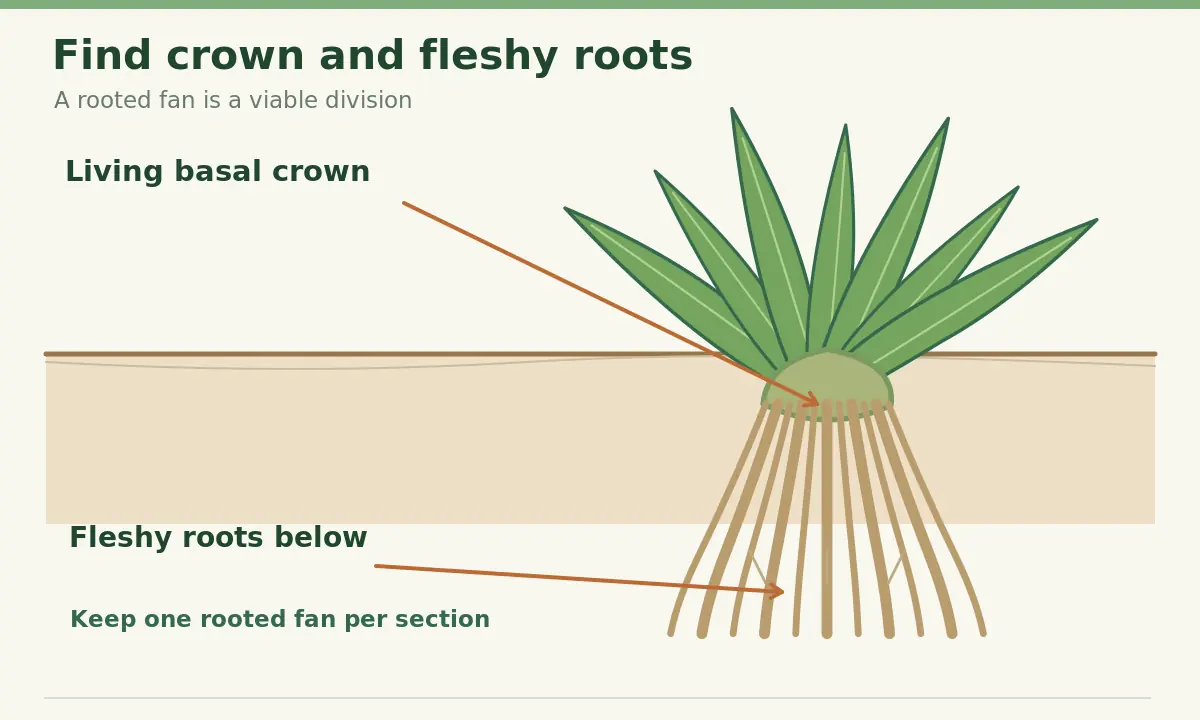
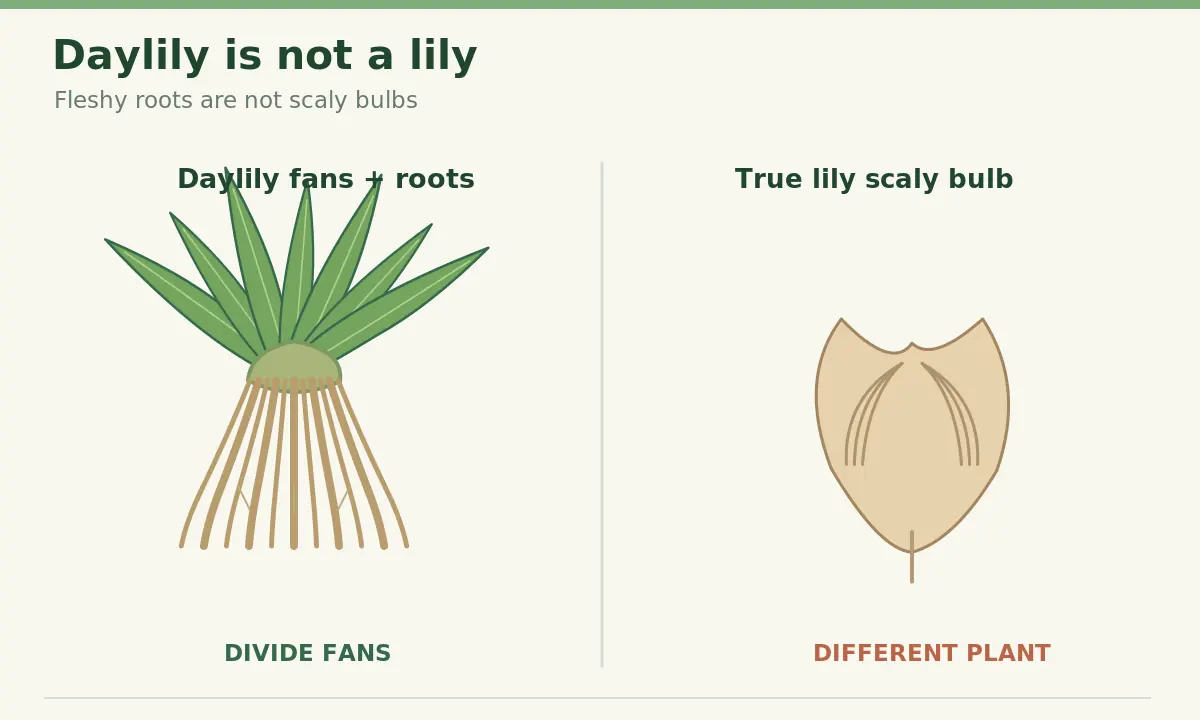
Daylilies (Hemerocallis) grow leaves in flattened fans arising from a basal crown and fleshy, sometimes thickened roots. True lilies (Lilium) have scaly underground bulbs with a different structure and planting method. Illinois Extension distinguishes these plants clearly, even though their common names sound alike. Before digging, locate the individual leaf fans and see where they connect at the base. Do not expect a cluster of separate onion-shaped bulbs to fall from the soil when you lift a daylily. This structural check controls every later step: divisions need living crown tissue plus attached roots, not a detached thick root by itself.
Choose Spring or Early Fall for Lower Stress
Penn State Master Gardeners list spring and early fall as suitable times to divide established daylilies. The best local date depends on whether plants have usable growing weather left for roots to establish before a severe freeze. Avoid lifting an actively flowering clump in the hottest dry spell merely because your schedule is convenient. In warm regions without a hard winter, choose a milder period when new roots can grow without prolonged heat stress. If the plant is vigorous and still flowers well, division may not be needed at all. A crowded center or declining bloom can be a better reason than the calendar.
Water and Prepare a New Planting Spot First
Moisten the soil before digging when it is dry enough to crumble and not saturated. This makes it easier to lift a coherent root mass and reduces dehydration. Prepare a well-drained planting space large enough to spread fleshy roots naturally, ideally in sun suited to the cultivar. Do not place a daylily division in a permanently wet depression simply because its crown seems hardy. Decide where the best divisions will go before cutting the clump into small pieces. Replanting promptly matters: thick roots can lose moisture when exposed to direct sunlight or wind. Keep a shaded tray ready for short delays.
Lift Beyond the Outer Ring of Leaves
Insert a spading fork or shovel outside the visible fan cluster and work around the clump in stages. Lifting immediately through its center can cut crowns and damage many roots. If the clump is old and tight, loosen soil from several sides before levering upward. Shake or brush away enough loose dirt to inspect where the fans join, but keep the live roots moist. Some roots will break in any realistic division; the goal is to retain a functional system rather than a perfectly clean botanical specimen. Do not force a fork through the crown while another person is holding tender leaves.
Find Natural Groups of Fans and Roots
Look beneath the foliage for separate fans that can be teased apart. Each viable division needs a basal crown segment supporting a fan or bud and an adequate cluster of fleshy and fine roots. Illinois Extension notes that daylilies may be divided into plantlets with a single fan, although a larger group of fans often establishes and looks substantial sooner. Discard mushy, dead or seriously diseased portions. Do not plant a detached orange-brown storage root as though it were a tuber with guaranteed buds. If a division has no crown or growing point, it is not equivalent to a rooted fan regardless of how plump it looks.
Split Gently and Trim Foliage as Needed
Pull naturally loose fans apart with your hands where possible. For an especially dense mass, use a clean, sharp knife through appropriate connecting tissue, trying not to crush the crown. Keep cutting surfaces limited and avoid making dozens of tiny pieces simply to maximize numbers. Penn State suggests trimming daylily leaves to about five to eight inches from the crown during division, which can make handling easier and reduce water demand. This is different from cutting into the crown itself. A stable leaf fan, a piece of basal growing tissue and living roots are more valuable than a symmetrical cut edge.
Replant the Crown at Its Original Level
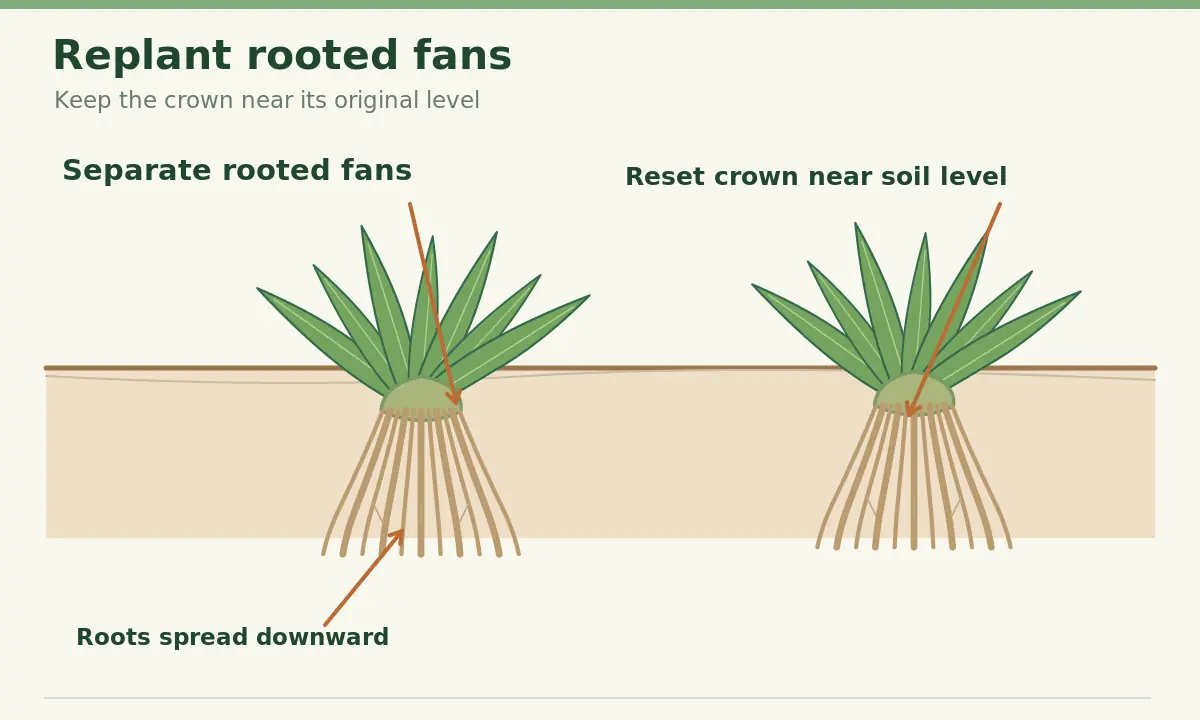
Spread the roots over a small mound of loosened soil so they point down and outward instead of bunching into a compact ball. Set the fan upright with the basal crown near its previous soil level, and backfill around roots without burying the lower leaf fan deeply. Planting deeper than the original level can impair recovery, while exposing roots to sun allows them to dry. Use the old soil mark on the clump as a practical guide. The planting-depth illustration labels the crown and the finished soil line rather than drawing a scaly lily bulb. Press soil gently to eliminate large gaps without crushing the roots.
Water In and Keep the Root Zone Evenly Moist
Water the newly planted sections so soil settles around the fleshy roots. Check for exposed roots or tilted fans after the first irrigation and correct the planting depth if necessary. Keep soil adequately moist while new roots form, but do not maintain a waterlogged planting hole. Mulch may help moderate temperatures, provided it is pulled back from direct contact with the crown. Avoid strong fertilizer applications onto raw cuts or unestablished roots. An initial pause in top growth does not automatically mean the division has failed: observe the crown for firm tissue and eventual new leaves under suitable growing conditions.
Expect a Short Blooming Pause After Division
A daylily division with fewer fans may need time to rebuild before flowering as freely as the original clump. Avoid promising an immediate display from a tiny division, even when it retains healthy roots. Some cultivars flower on different seasonal schedules, and repeated blooming varieties may behave differently from once-blooming plants. Remove spent flower stems where appropriate, but retain functional green leaves that feed the crown after blooming. Give plants adequate light and water rather than trying to force blossoms with an arbitrary fertilizer dose. Assess success by firm new foliage and stable crowns before judging the number of flower scapes.
Record the Cultivar and Recheck in the Next Season
Use a durable label if several daylily cultivars are divided in one session. Vegetative division generally preserves a named cultivar more reliably than seed, but mixing fans while the flowers are absent can make future identification difficult. Note which divisions had substantial root mass and which were small, and compare their recovery during the next growing season. Inspect any crown that remains soft or fails to send up leaves; environmental stress and rot can complicate establishment. Reserve another division for when the clump becomes genuinely crowded. Proper separation, correct crown level and a living root system matter more than dividing on an identical date every year.
Related Guides
- When to Divide Daylilies: Keep Healthy Fans and Replant Crowns Correctly
- When to Divide Agapanthus in Pots or Borders Without Losing Blooms
- How to Divide Shasta Daisies in Spring and Replant Healthy Crowns
- When and How to Divide Siberian Irises Without Losing Healthy Fans
- When to Divide Catmint Clumps and Keep Rooted Shoots Alive
How We Research and Verify Plant Advice
Sources checked on 2026-10-26: extension.psu.edu; extension.illinois.edu; extension.illinois.edu. We reviewed each institution’s plant identification, correct growth stage and relevant cultural recommendations before adapting them into an independently written step-by-step guide. Where sources are region-specific, their calendar details are not applied universally. Pictures use simplified teaching shapes and should be compared with living specimens; they are not a substitute for laboratory disease diagnosis or local climate guidance. The relevant advice is paraphrased rather than reproduced.
Safety and Independent Editorial Disclosure
This independently prepared educational article does not claim sponsorship or affiliate approval. Our category reading links are informational, not product endorsements. See the VegWin affiliate disclosure. Clean sharp tools before cutting plants, protect hands from thorns and blades, and keep cut plant material away from children and pets where appropriate. Use only locally registered plant treatments labeled for the actual crop, and observe the product label. Do not rely on unsupervised home remedies or unverified harvest-safety promises.
Spring or early fall is recommended by Penn State Master Gardeners; adjust to the local growing season.
No. Daylilies have fans attached to crowns and fleshy roots; true lilies have bulbs.
A single fan with a healthy crown and roots can grow, though a larger division may establish faster.
Keep the basal crown around its former soil level rather than burying the fan deeply.
Not necessary. Trimming foliage to roughly five to eight inches for division is a common Extension practice.