
A once-full Shasta daisy clump can thin at its center and flower less reliably as its crown ages. Division can rescue vigorous outer growth, but the useful unit is not an isolated stem: each new plant needs live crown shoots attached to healthy roots. Early spring is a practical season to work before stems become tall and brittle. This guide covers the clumping hybrid Leucanthemum × superbum, whose white rays and yellow flower disks differ from some wild oxeye daisies that may be undesirable or restricted locally.
Confirm That Your Daisy Is the Garden Hybrid
Shasta daisies generally have broad, white ray florets around a yellow central disk, upright stems and toothed, dark green leaves. Some cultivars are compact, while others grow several feet tall or carry frilly double flowers. Oxeye daisy and other white-flowered species look similar at a distance and can spread aggressively. Read the original plant label if you have one, and compare the foliage, flowering habit and clump structure with a reliable botanical description. Accurate identity matters when deciding whether division is a garden improvement or a way of multiplying a plant that should not be spread locally.
Look for Crowding and an Aging Center
Not every Shasta daisy needs to be divided each year. Useful signs include a thinning or dead-looking center, flower stems appearing mostly along the edge, smaller blooms, or crowding that reduces airflow. North Carolina Extension suggests division every two to three years for many Shasta daisies, while Iowa State notes the plants can be relatively short-lived. These statements describe tendencies, not an expiry date. A vigorous clump with an open center, attractive blooms and enough room may be left alone. If the middle has rotted from wet soil, division alone cannot fix the drainage that caused the problem.
Choose Early Spring for Easier Recovery
Iowa State lists spring as the preferred Shasta daisy division season. Small shoots are easier to handle then, and rooted pieces have the coming growing season to establish. A cloudy, cool day is easier on exposed roots than midday summer heat. Gardeners in milder climates sometimes divide healthy clumps in fall, but allow ample time before freezing weather and avoid winter-wet sites. Do not divide in the middle of a heat wave simply because flowers have finished. Use local soil conditions and new spring growth as cues rather than the calendar alone.

Prepare the New Bed Before Lifting the Clump
Pick a location with good drainage and enough direct sunlight for your cultivar to flower well. Shasta daisies tolerate some light shade but often bloom best in generous sun. The soil should not stay waterlogged after rain; soggy winter conditions can cause serious losses. Loosen the receiving soil and water it lightly beforehand if dry. Plan spacing according to mature cultivar spread, not the small diameter of a fresh division. If the new bed needs improvements, finish those first so roots can be replanted quickly. Avoid exposing a lifted crown while you hunt for tools or choose a spot. If you are starting from scratch, read When to Transplant Shasta Daisies Without Burying the Crown.
Lift a Generous Root Ball
Water dry soil ahead of time, then slide a spade or digging fork into the ground outside the cluster of emerging shoots. Work around the perimeter before lifting, keeping as many healthy roots attached as practical. Shake off only enough loose soil to see separate crowns; there is no requirement to wash every root clean. Keep the clump shaded and damp during work. With a badly congested plant, taking the whole mass out provides a clearer view of decayed central pieces than attempting to cut blindly through the middle while it is still buried. If you are starting from scratch, read When and How to Divide Daylilies While Keeping Healthy Fans and Roots.
Find the Crown-to-Root Connection
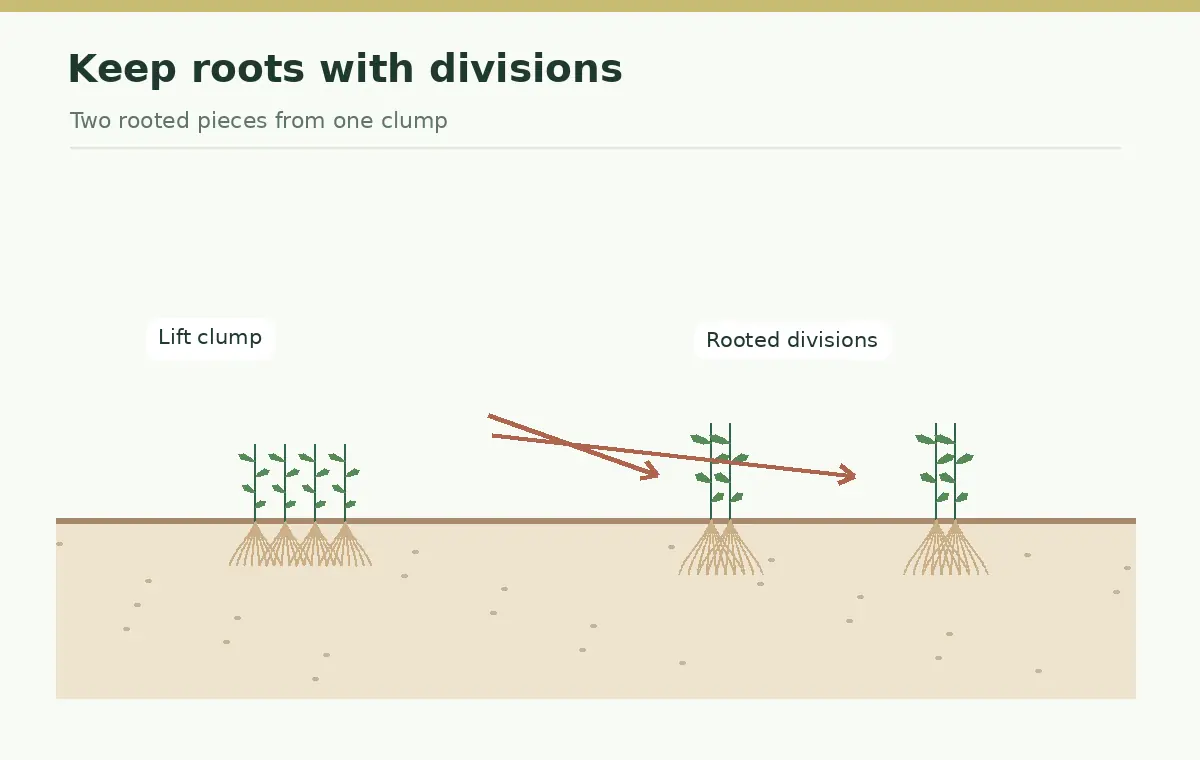
The crown is the point where leafy shoots join the root system. Select sections with several firm new shoots and a good bundle of attached living roots. University of Minnesota Extension suggests three to five vigorous shoots with roots as a useful general target for perennial division. Do not count an old dead stalk as a viable shoot. Roots should not be dark and mushy, and the crown should not have a soft rotten center. A smaller but sound outside segment can be worth saving, while a huge central piece with no healthy growing points is not.
Split Healthy Portions Without Shredding Them
Sometimes outer Shasta daisy sections separate by hand; tougher crowns may need a clean sharp knife or spade. Work along natural divisions in the clump. Keep roots with each crown and avoid repeatedly sawing through the same tissue. Discard mushy, dead or badly diseased material rather than distributing it around the garden. This method is not the same as rooting bare cut-flower stems in the soil. If a cultivar has unusually dense crowns, two sturdy forks set back to back can help lever a larger clump apart, but use controlled force to limit breakage.
Set the Crown at Its Original Soil Level
Replant each piece with the crown approximately level with the surrounding finished soil, allowing roots to spread downward into loosened ground. Do not bury the center under several inches of soil or leave roots sticking out above the surface. Gently firm the soil to remove large air gaps and water thoroughly to settle it around the roots. A thin surface mulch can reduce drying, but keep it away from the central shoots. A diagram that places the new crown deeply under soil would be misleading; maintaining the original depth is the safer visual rule. If you are starting from scratch, read When to Divide Ornamental Grasses and Remove a Dead Center.
Water New Divisions Without Making a Swamp
Newly divided plants need consistent moisture while roots recover, not permanent saturation. Feel the soil below the surface before watering again and adjust for rain, sun and texture. In sandy beds the surface can dry quickly; heavy soil may remain wet long after watering. Avoid large fertilizer doses right after division; there is no reason to encourage leaf growth faster than roots can support it. Some flowers may be reduced in the first season as the plant establishes. This is not proof the division has failed. Evaluate new leaves, crown firmness and gradual growth instead of expecting immediate blooms.
Prevent Rot and Problems in the New Planting
A clump that collapsed because its roots stood in winter water may fail again if replanted into the same soggy soil. Site drainage is therefore part of disease prevention, not an optional aesthetic improvement. Watch for leaf spots, aphids and wilting, but diagnose symptoms before applying treatments. Shasta daisy is mildly toxic if ingested and contact may irritate sensitive skin, according to North Carolina Extension, so wear gloves and keep children and pets from eating plant parts. These flowers are ornamentals, not salad greens, even if their daisy-like blooms look inviting.

Keep Track of Which Divisions Thrive
Label each new section with cultivar and division date. If some thrive and others stall, compare crown size, sunlight, drainage and moisture rather than assuming an unexplained fertilizer deficiency. Revisit the bed after heavy rain to identify the wettest patches. Future division frequency can follow clump vigor: a crowded fast-growing cultivar may need work sooner than a restrained one. Allow enough space between plantings to reach the crown without crushing neighboring flowers. Healthy rooted sections, correct planting level and sensible aftercare matter more than obtaining the maximum possible number of tiny pieces. If you are starting from scratch, read When to Divide Agapanthus in Pots or Borders Without Losing Blooms.
Related Guides
- When to Divide Black-Eyed Susans Without Losing Healthy Crowns
- How to Divide Autumn Joy Sedum Without Burying New Crowns
- How to Divide Herbaceous Peonies in Fall and Set the Eyes Shallowly
- When and How to Divide Siberian Irises Without Losing Healthy Fans
- When to Divide Catmint Clumps and Keep Rooted Shoots Alive
How We Research and Verify Practical Advice
We compared authoritative Cooperative Extension and established horticultural guidance for the exact plant and decision in this article. Our review checked species names, relevant developmental stages, regional weather or soil limitations, and possible hazards rather than treating seed-packet dates or common gardening sayings as universal rules. The editorial source review was completed on October 24, 2026. Observations about your own cultivar, frost pattern and drainage still matter; if local Extension recommendations differ for your region, use those more specific conditions.
Source Notes and Editorial Disclosure
Sources checked October 24, 2026: yardandgarden.extension.iastate.edu — Shasta daisy recommended spring division and cautions about limited lifespan.; plants.ces.ncsu.edu — Shasta daisy plant identity, drainage, division frequency and mild ingestion/contact toxicity.; extension.umn.edu — General safe perennial division technique, rooted shoots, timing and aftercare.. We cite these materials for the particular claims described, not as evidence of sponsorship or approval of our illustrations.
Disclosure: This educational article contains no verified paid partnership, product sponsorship, or affiliate recommendation. Our illustrations are explanatory diagrams rather than photographs of a specific garden. Read the VegWin affiliate disclosure and verify local growing rules and conditions before taking action.
Early spring, when new shoots are small and the soil is workable, is an especially useful time.
Many clumps benefit every two to three years, but divide based on congestion, center decline and actual growth.
Not as a normal crown division. Each division should have healthy shoots connected to functioning roots.
Keep the crown near its previous ground level and spread attached roots under the soil.
No. North Carolina Extension classifies Shasta daisy as mildly toxic if ingested; discourage chewing.