
Radishes can be among the quickest vegetables to harvest, yet that speed also makes mistakes visible fast. Thick green leaves do not guarantee a crunchy root. Crowded plants may never bulb, while roots left in the bed through a warm spell can become woody, hot or hollow. A reliable harvest comes from a cool sowing window, adequate room for each root, even moisture and timely checks rather than the promise that every radish is ready on one particular day. This guide separates quick round garden radishes from longer-season daikon and shows what to do when the leaves look better than the roots.
Pick Round Radishes or Long Daikon
Small round garden radishes and long daikon share a crop name but occupy different space and have different harvest schedules. Iowa State Extension describes many garden radishes as ready in about three to five weeks under suitable conditions, while daikon requires considerably more time. A daikon root also needs deeper, unobstructed soil and more room. Read the cultivar packet carefully: some winter radishes are grown primarily as a later cool-season crop, not as an instant spring salad harvest.
Decide which kitchen purpose matters. A quick round radish can be sown in a narrow strip and sampled often; daikon may need a dedicated long-root section. Do not promise that a shallow patio planter suitable for a small round type will support a full-size long-root variety. Some radishes produce edible greens, but if your goal is a plump root, leaf volume alone is a poor performance measure.
Sow Into Cool Soil and Avoid Summer Stress
Radishes generally perform better in cool spring or fall weather than in summer heat. Iowa State explains how hot weather and waiting too long to harvest can make roots spongy or sharply flavored. Regional sowing dates differ; its Iowa calendar should not be copied into a desert Southwest or coastal climate. Use local seasonal temperatures, the forecast and seed-packet maturity details to pick a time when roots can develop without an extended hot spell.
Direct-sow into a prepared bed rather than planning to transplant indoor seedlings. Radishes are especially useful for short succession plantings: sowing smaller sections at intervals prevents all roots from reaching peak maturity together. Iowa State provides a 7–10 day sequence as an example for appropriate weather; stop the sequence once conditions turn unfavorable rather than dutifully continuing into heat.
Prepare Loose Soil for Straight Roots
A radish root must enlarge inside the soil around it. Remove large clods and stones and improve excessively compacted beds before sowing. Good drainage matters too: saturated soil can rot the roots, while a hard surface crust can interrupt seedling emergence. A raised bed may help where the native soil is extremely compacted, but it still needs suitable water management. Do not add excessive nitrogen in hopes of bigger bulbs; lush leaves and weak roots can be the result.
Smooth the top layer to provide good seed-to-soil contact. Sow at the depth recommended by the cultivar packet and water gently so seed is not washed out. A thin clean surface covering may reduce crusting if the soil is prone to sealing after rain. Fresh manure is unsuitable for a crop frequently eaten raw: Iowa State notes both food safety and excess nitrogen concerns. If fertilizer is actually needed, use a soil test recommendation rather than copying a fixed rate. Our guide to growing beets goes into more detail.

Thin Seedlings Before Roots Compete
A thick carpet of radish seedlings is not a bonus harvest if every plant stays leaf-heavy and the roots fail to swell. Iowa State advises thinning small garden radishes to about two inches apart, with much more spacing for large daikon selections. Follow the cultivar label if it calls for a different final distance. Thin early by clipping weaker stems near the soil if pulling them would disturb the remaining roots. Our guide “Grow Daikon Radishes With Straight Roots and a Careful Harvest” goes into more detail.
Mark the date you thinned and compare a representative root a little later. If roots are tiny despite healthy-looking leaves, examine spacing and soil condition before adding fertilizer. Empty gaps can be resown during a suitable cool window; forcing two plants to share one spot rarely makes up for wasted seed. Keep weeds under control while radishes are still small, because their rapid season leaves little time for recovery from competition. For a step-by-step method, see how to grow watermelon radishes from seed for crisp pink-centered roots.
Keep Root Moisture Consistent
Water availability strongly affects texture. A dry spell can slow growth and intensify sharp flavors; sudden changes can contribute to cracking. Rather than watering by a fixed daily timer, check the soil at root depth and maintain even moisture as weather changes. Container plantings dry much faster than a deep garden bed in wind, but soaked containers can also fail. Adequate drainage and a consistent moisture supply work together.
Inspect roots after heavy rain as well as after dry weeks. The next rain cannot reverse a woody, mature radish, and extra fertilizer cannot restore a hollow center caused by poor growth conditions. If the weather becomes hot before the crop is ready, pick any usable roots early and note the timing for the next sowing. This is preferable to leaving increasingly coarse roots in place hoping they will sweeten.
| What you notice | First likely check | Decision |
|---|---|---|
| Leaves but thin roots | Spacing; nitrogen; soil clods | Thin and correct next sowing |
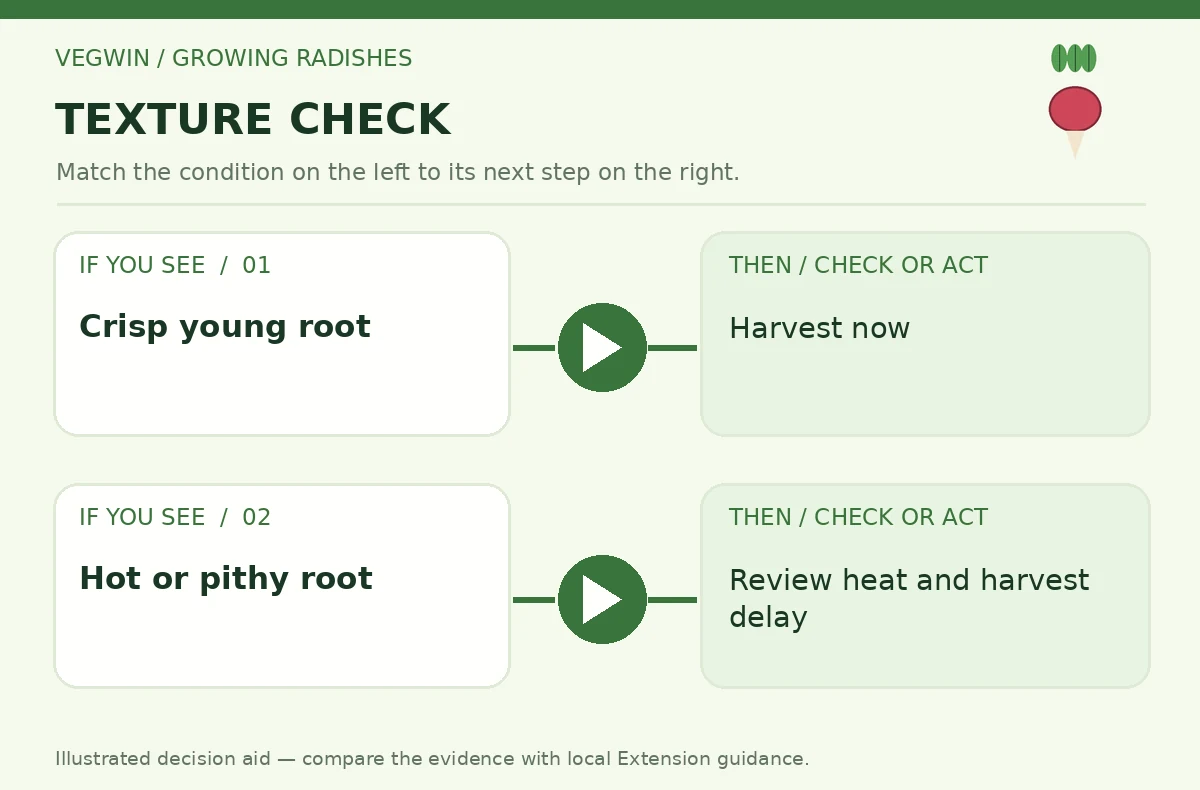
| Woody or hollow roots | Heat and late harvest | Pull usable roots sooner |
| Cracked skin | Moisture swings | Improve water consistency |
| Long daikon breaking | Root depth and harvest tool | Loosen soil before lifting |
Diagnose Small Bulbs and Hot Roots
When foliage is lush but roots are slender, check crowding, excess fertility and soil compaction. When the roots are large but unpleasantly pungent or pithy, review heat, prolonged growth and harvest delay. Cracking points toward inconsistent moisture, while tunneling or holes require inspection for feeding or mechanical injury. These symptoms are not interchangeable, so avoid treating all bad radishes with the same soil amendment.
Flea beetles may leave small shot holes in leaves; root maggots can damage below-ground parts. University of Minnesota Extension identifies both, but a hole alone is insufficient for a product recommendation. Start by documenting the insect or damage pattern and using local IPM diagnostics. Severe recurring damage may justify exclusion methods or a crop timing change after proper identification. An unverified homemade spray is not a substitute for diagnosis.
Harvest Small Roots While They Are Crisp
Near the packet maturity estimate, gently pull a sample root rather than waiting for every plant to match the catalog image. Small garden radishes are often best when usable but not oversized; oversized mature roots frequently lose crispness. Iowa State recommends repeated harvest in succession-sown rows for this reason. For daikon, loosen soil with a fork or spade before lifting a long root to avoid snapping it.
Wash off visible soil with clean water, remove foliage if storing and refrigerate roots promptly. Harvested quality is better preserved when plants were cut at their ideal stage, not when damaged mature roots are stored longer. Avoid inventing universal refrigerator shelf-life promises: variety, harvest age and refrigeration conditions matter. Compost badly deteriorated roots instead of expecting cooking to remove rot.

Rotate Radishes With Other Brassicas
Radish belongs to the mustard family even though its edible product is a root rather than a cabbage head. That makes it part of the same crop-family rotation group as broccoli, cauliflower, cabbage, kale and Brussels sprouts. A succession radish row in a brassica disease bed is not a family rotation. In a small garden, rotation is limited, so disease-free transplants for later crops, clean tools and avoiding spread of contaminated soil remain worthwhile. If you want the full process, read how to grow Brussels sprouts and harvest from bottom to top.
If roots are stunted and visibly swollen or distorted, separate crowding from possible clubroot and other soilborne problems. Do not diagnose clubroot simply because a plant has a small radish. Record weather, plant density and disease history, then seek local Extension help when repeated failures appear in one bed. A useful harvest log should capture planting date, thinning date, first pull and flavor, not merely the number of harvested roots.
Related Guides
- How to Grow Rat-Tail Radishes for Tender Edible Seed Pods
- How to Grow Black Spanish Radishes for Firm Winter Roots
- How to Grow French Breakfast Radishes in a Container
- How to Grow Daikon Radishes in Deep Pots Without Stunted Roots
- How to Grow Edible Radish Pods and Pick Them While Tender
How We Research These Crop Decisions
We reviewed the original university research-based crop guidance on 2026-10-20: University of Minnesota Extension, Iowa State University Extension, Iowa State University Extension. These sources support the crop-specific growing, diagnosis, season and harvest distinctions described above. Extension publications sometimes address Minnesota or Iowa directly; their example planting months, cultivar advice and soil test recommendations are not universal US instructions. The accompanying graphics are original explanatory decision aids rather than trial data or guarantees. The first 90 VegWin queue topics and search results were examined for potential overlap, but a complete inspection of existing live WordPress pages was not possible. An editor must compare published pages, confirm internal URLs and review material for local conditions before manual publication.
Its three buttons lead only to independent university educational references. Before publication, confirm that the site’s affiliate disclosure page is live and appropriate. No homemade pesticide formulas, unverified fertilizer rates or untested food-preservation instructions are provided.
Overcrowding, excessive fertility and unsuitable root conditions are common possibilities; begin with spacing and soil checks.
Direct sowing is usually preferable because this root crop does not transplant easily.
Warm weather, slow or stressed growth and harvest delay can make flavor harsher and texture fibrous.
No. Large-root daikon commonly takes longer and needs deeper growing room and more space.
No. Both belong to the brassica family and can share some pests and diseases.