
A daikon is not simply an oversized red salad radish. Many Japanese or mooli types build a long white tapering storage root that can extend a foot or more, and a shallow patio pot can stop it long before harvest. RHS and University of Minnesota Extension both describe the need for deep loose growing conditions for long types. The most useful container decision therefore comes first: match a known daikon variety to a pot deep enough for its likely root, or choose a shorter-rooted variety for a limited space. Then sow directly, thin early and harvest without snapping the lower section.
Match the Seed Variety to the Pot
Read the mature root length and form on the packet. RHS notes that daikon can form roots of thirty centimeters or more, while shorter and rounder oriental radishes also exist. A pot that comfortably grows small red salad radishes may not provide enough vertical room for a long white daikon. Choose a deep container with additional clearance beneath the expected storage root for drainage and roots. If that is impractical, change variety rather than promising a full-length harvest in a shallow window box.
Do not treat the pot’s outside height as the usable soil depth; a thick rim, false bottom or unfilled headspace reduces it. Use the cultivar’s stated size and choose a safe margin rather than one magic depth for every daikon. Wide spacing also matters: leaves spread and roots need room. Plan for fewer plants than look possible when seeds are first scattered. A heavy, stable pot is useful because large leafy tops can catch wind.

Prepare Deep Stone-Free Growing Mix
Fill the pot with loose, moisture-retentive but draining growing media. Avoid compacted clay lumps and large stones that obstruct straight root growth. University of Minnesota Extension advises loosening a foot or more for long radish types in the ground, and comparable freedom from obstruction matters in containers. You need fine-enough structure around a developing taproot, not a soggy bucket. Verify drainage holes before sowing and place the pot where water can escape freely.
Avoid adding fresh manure or excessive nitrogen in hopes of creating huge roots. Minnesota Extension cautions that readily available nitrogen can stimulate root branching. Use a balanced, appropriate medium and adjust feeding based on growing conditions rather than inventing a fixed schedule. A pot dries faster at its edges than garden soil, so pre-moisten the full column of mix and later check below the uppermost inch before watering. The lower root should not encounter a hard, airless layer.
Direct-Sow Seeds Instead of Transplanting
Sow daikon directly in the final deep pot. A developing taproot can be damaged if you raise crowded seedlings in tiny cells and untangle them afterward. RHS describes oriental radishes as direct-sown like winter radishes; consult the variety instructions for depth and season. Place individual seeds shallowly in the moistened surface and cover with fine mix, firming gently. Label the variety and date, especially if another container holds small spring salad radishes with a very different growth period.
Use a cool-enough seasonal window for the cultivar. Summer heat can make some radishes bolt or lose root quality, so local weather and the seed packet matter more than an arbitrary USDA hardiness zone. In a mild climate an autumn crop may be easier than peak summer; in a cooler climate scheduling differs. Protect small seedlings from drying out, but avoid waterlogged media. A plant with long healthy leaves is not proof that a straight storage root has formed underground.

Thin Early for One Straight Root per Space
When seedlings emerge and establish true leaves, thin them to the recommended distance for the cultivar. Minnesota Extension gives larger daikons more spacing than small radishes; RHS likewise emphasizes thinning oriental types. If crowded seedlings share the same little pocket, use scissors to cut surplus plants at the mix surface instead of wrenching roots around the one you intend to keep. This is a root crop: protecting the intact taproot is more important than rescuing every extra seedling.
Distinguish the seed leaves from the later slightly rough, sometimes lobed true leaves. A healthy seedling with space can make a single main axis into the soil. Crowding encourages small or poorly formed roots even when the tops look vigorous. Do not thin only once leaf canopies overlap; by then underground competition has already begun. Re-check spacing after germination because seeds may wash together during early watering. Retain the plant with the healthiest center and least disturbed soil around it.
Maintain Moisture Without Forcing Growth
Radishes generally make tender roots with steady growth and even moisture. RHS links drying and irregular watering with poorer roots, splitting and premature flowering. Containers need particular attention in warm or windy weather because the upper surface can dry long before you notice wilting. Water slowly enough to reach the lower media, and allow drainage; a surface splash is not enough for a long root. Check weight and feel of the container to understand its actual water needs.
Avoid forcing luxuriant leaves through repeated heavy feeding. If roots remain thin while foliage is enormous, first review variety, thinning, container depth, light and nutrient balance. Keep the pot in good light while respecting local heat. Watch for flea beetle holes on leaves and other brassica problems, but identify the issue before applying a product. Crop rotation is difficult in one pot; replace old infested media if a diagnosed soil problem recurs instead of assuming every blemish is harmless.
Inspect Root Shoulders Before Harvest
As daikon swells, the top shoulder can emerge partly above the mix; Minnesota Extension notes that daikon shoulders often stand out of soil. This is not automatically a reason to bury the whole leaf crown. Compare visible width and expected cultivar maturity, then make a test harvest if uncertain. Many oriental types require longer than fast salad radishes. A crisp white root with good flavor is more meaningful than counting days alone, which vary with weather and variety.
To harvest, water lightly if the medium is hard and loosen around the root. Hold the plant firmly near the crown while supporting the deep root with a trowel if needed. Minnesota Extension recommends digging beneath long roots so they do not snap. In a pot, loosening the sides and carefully tipping out some mix may be safer than hard upward pulling. Do not yank only the leaves if the lower end is still tightly gripped by compact soil.
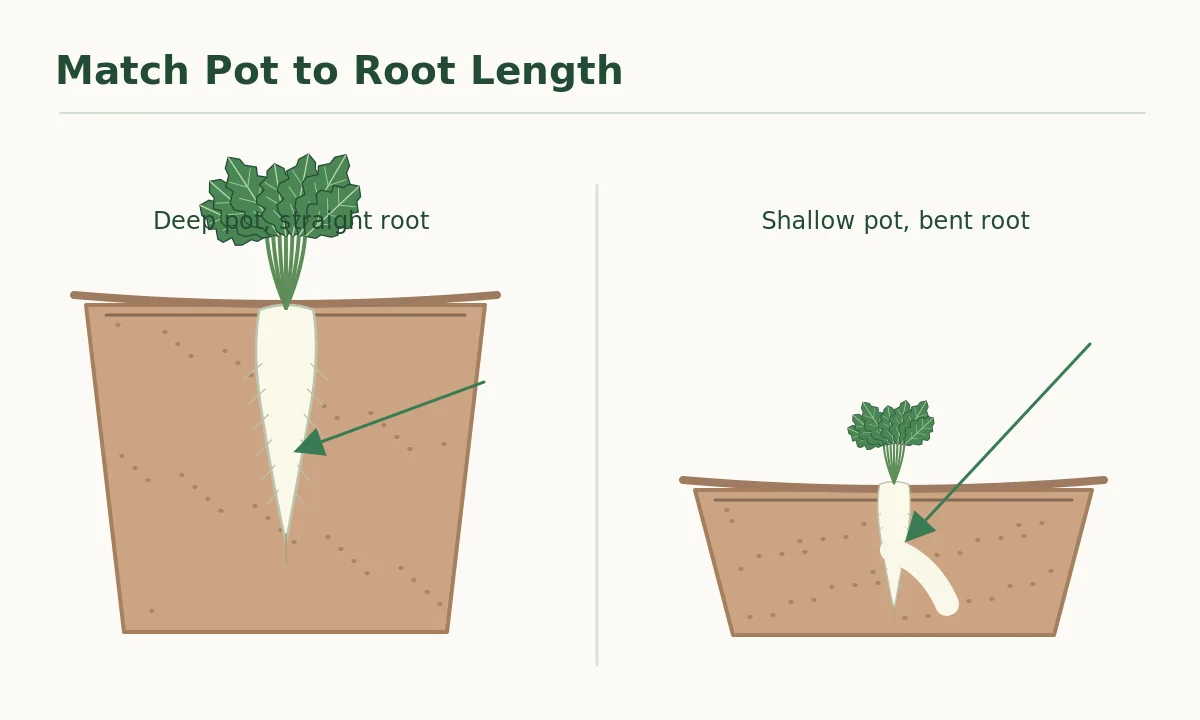
Compare a Straight Root With Forked Failure
A successful daikon has a storage root characteristic of its named variety, unbroken and free of major distortion. A shallow pot may create a shortened, bent or forked form when the root meets the bottom. Stones, compaction, fresh manure, root disturbance and inconsistent moisture can contribute to failure. Do not assume a slight bend means the root is unsafe to eat; inspect quality and any actual rot separately.
If this harvest is short and forked, measure the effective media depth and consider a shorter cultivar next time. If roots cracked, track drought followed by heavy irrigation. If they remained skinny, note spacing and temperature. Sketch the pot, soil line and root shape while details are fresh. The useful lesson is that daikon success depends on fitting the expected root to the physical container, not treating every radish as a tiny globe suitable for a decorative shallow bowl.
Related Guides
- How to Grow French Breakfast Radishes in a Container
- How to Grow Edible Radish Pods and Pick Them While Tender
- How to Thin Radish Seedlings Without Disturbing Nearby Roots
- Growing Radishes: Tender Roots Without Heat or Hollow Centers
- How to Grow Daikon Radish Microgreens in a Clean Shallow Tray
How We Research and Verify These Steps
The linked horticultural references were checked on 2026-10-27: www.rhs.org.uk — RHS explains oriental daikon types, long root potential, cool season timing, thinning and harvest. extension.umn.edu — University of Minnesota Extension explains deep loose soil, direct seeding, daikon spacing and lifting long roots without breakage. www.rhs.org.uk — RHS container-growing advice emphasizes matching crop and container size to actual needs. Each guide separates confirmed growing practices from climate- and cultivar-dependent choices. A diagram illustrates the physical action, not a guarantee of identical results in every garden.
No paid product placement was used in preparing this article. For the site-wide policy, review the VegWin affiliate disclosure.
Yes, if the container depth and width suit the variety and provide well-drained, loose growing medium.
Many daikon roots can reach a foot or more; select depth based on the named variety plus extra growing clearance.
Direct sow in the final container to avoid disturbing the developing taproot.
A hard obstruction, compaction, shallow depth, root injury or excess readily available nitrogen may contribute.
Loosen the growing medium around and beneath the root; support it rather than yanking only the leaves.