
Calendula officinalis, or pot marigold, produces a ring of unusually curved seedlike fruits after its daisy-shaped flowers fade. Those crescent-shaped pieces are quite different from the slim black-and-cream seeds of Tagetes marigolds. For a dependable home seed collection, let heads mature, collect them before the pieces scatter, finish drying them if needed, and write the plant name on the envelope.
Make Sure the Flower Really Is Calendula
Calendula officinalis has broad daisy-like orange or yellow flower heads and is often called pot marigold. French and African marigolds belong to Tagetes and make differently shaped seeds, typically slender dark units with a pale end. If you confuse the names, the seed-saving illustration will not match your flower. Check a plant label, foliage and flower structure before labeling harvested seeds. Calendula leaves are usually simple and elongated, while many Tagetes species have divided leaves. The flower center ultimately carries the curled mature achenes that can be gently lifted from the spent head.
Follow One Bloom From Petals to Seed Formation
A fresh flower has many bright ray florets around a center, and a fading one gradually loses petals. As seed matures, the head changes from a colorful disk into a coarse cluster of developing curved fruits. Calendula may hold different stages on the same plant: buds, fully open flowers and nearly dry seedheads can coexist. Mark a few flowers you want to save rather than removing every fading bloom during routine deadheading. Healthy source plants matter because severe fungal infection or rot can ruin a collection. Look at the seed structures themselves, not merely at the age of a flower.

Recognize Mature Curled Achenes
The individual units gardeners call calendula seeds are technically one-seeded fruits called achenes. They may be crescent-shaped, curled or irregularly hooked, with forms varying around a head. Mature dry achenes usually become tan to brown and separate relatively easily when rubbed. Some may differ in size and shape without necessarily being different species. Utah State Extension advises gathering calendula seeds when fully mature and dry for ordinary garden saving. Do not throw away the curved pieces because you expected round beads, and do not count empty loose petal fragments as viable seeds.
Pick on a Dry Day Before the Head Scatters
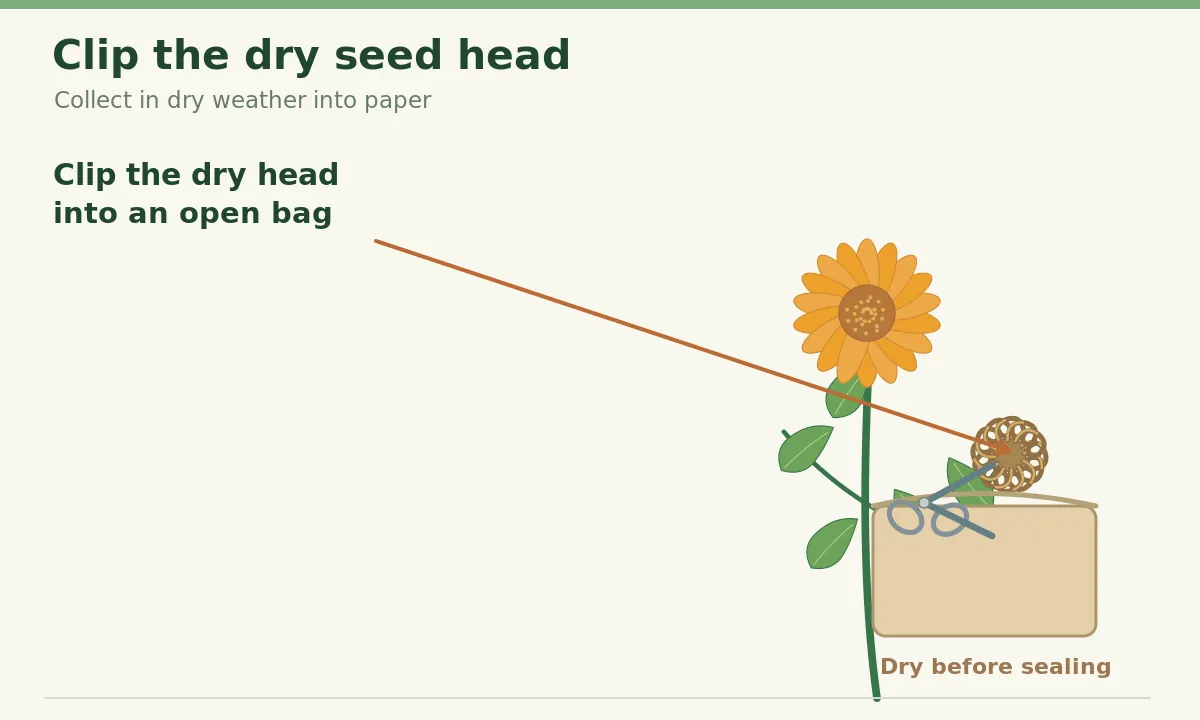
Watch the fading heads as their bases brown and achenes loosen. A dry day after dew has evaporated reduces the amount of moisture carried into the collection. Hold an envelope or tray beneath a nearly ready head and snip its short stem so loosened seed falls inside. University of Illinois Extension recommends collecting mature dry seedheads and clipping above the next set of leaves when keeping the plant tidy. Do not yank hard on a productive branching stem. If heavy rain is forecast, a slightly earlier gathering followed by careful airy drying may save an otherwise shattering head, but immature seed remains a germination risk.
Separate Curved Seed Units From Petal and Stem Chaff
Place dry heads on a clean shallow tray so that falling achenes cannot roll into the soil. Use fingers to tease the curled fruits away from the bracts and other papery material. A coarse screen may help separate large pieces, but avoid crushing the seed in an attempt to make all the fragments the same shape. Remove soft, moldy or insect-damaged material. Seed units that are plump and uniformly dry are preferable to watery pale pieces whose development is incomplete. Wash your hands and clean the work surface if plant debris is dusty or irritates your skin.
Finish Drying Without Baking or Sealing Wet Seed
Spread the cleaned achenes in a single shallow layer on plain paper in an airy, shaded indoor spot. Their surfaces should become thoroughly dry before long-term storage; trapped moisture supports mold. Illinois Extension and RHS both emphasize drying and preventing damp storage. Avoid leaving seeds in blazing sun, on a hot radiator or in a tightly sealed plastic bag while moisture is still present. Check every day or two and stir the material gently. The drying period varies with room humidity, seed maturity and how much plant debris came with the harvest, so use condition rather than an inflexible number of days.
Label Seed With Species and Collection Date
Once seed is completely dry, transfer it to a clearly labeled paper envelope or suitable dry container. Record Calendula officinalis, cultivar if known, the collecting date and any flower-color details worth remembering. The common term marigold alone is ambiguous. Store the packet cool, dry and away from strong light, then check periodically for a damp smell or mold. A container that is airtight is appropriate only when the contents are truly dry and protected from moisture. Keep the envelope away from food and curious children; collected ornamental seed is not a substitute for certified culinary seed or verified edible flowers.
Expect Variation From Cross-Pollinated and Hybrid Plants
A saved seed can grow into a healthy calendula without reproducing its parent flower’s exact color, size or doubleness. RHS and Illinois Extension note that saved seed from hybrids and open-pollinated garden flowers may vary. A nearby pot marigold of another color can also contribute pollen. If preserving exact ornamental characteristics matters, buy reliably labeled seed or use established breeding procedures rather than promising a clone from a seed. Saving from multiple vigorous, disease-free parent plants provides a broader sample than collecting a single odd head from a sickly specimen.
Differentiate Seed Collection From Harvesting Petals
Harvesting fresh calendula petals for crafts or culinary uses, where appropriate, removes flowering material before many of those heads can set seed. To obtain seed, leave selected flowers on the plant after their petals fade and stop deadheading those specific stems. Choose blooms in places where the head can dry without remaining in wet crowded foliage. A flowering plant can support both goals if the gardener deliberately reserves some heads. Culinary claims and skin-use claims require different safety checks, including correct identification, allergy awareness and pesticide history. This article is about propagating ornamental plants, not medical treatment.

Check Stored Seeds Before the Next Sowing
Before sowing season, open the packet and look for dry, intact curved achenes. Discard seed that smells moldy or contains visible living pests. You can sow a small labeled test group to see whether enough germinates to justify using the stored batch. One poor germination test does not prove all plants of that species are impossible to grow; seed age, storage and sowing conditions matter. Record the result on the envelope for next year. The final comparison image shows a mature tan head with curled achenes beside a still-green developing head that is not the preferred stage for routine dry-seed saving.
Related Guides
- How to Save Calendula Seeds After the Flower Heads Turn Brown
- How to Sow Calendula Seeds for Healthy Cool-Season Flowers
- When to Transplant Calendula Seedlings Without Burying Their Crowns
- How to Save Marigold Seeds from Fully Dry Tagetes Flower Heads
- How to Save Statice Seeds From Fully Dry Flower Clusters, Not the Papery Calyx
How We Research and Verify Plant Advice
Sources checked on 2026-10-26: extension.usu.edu; extension.illinois.edu; rhs.org.uk. We reviewed each institution’s plant identification, correct growth stage and relevant cultural recommendations before adapting them into an independently written step-by-step guide. Where sources are region-specific, their calendar details are not applied universally. Pictures use simplified teaching shapes and should be compared with living specimens; they are not a substitute for laboratory disease diagnosis or local climate guidance. The relevant advice is paraphrased rather than reproduced.
Safety and Independent Editorial Disclosure
This independently prepared educational article does not claim sponsorship or affiliate approval. Our category reading links are informational, not product endorsements. See the VegWin affiliate disclosure. Clean sharp tools before cutting plants, protect hands from thorns and blades, and keep cut plant material away from children and pets where appropriate. Use only locally registered plant treatments labeled for the actual crop, and observe the product label. Do not rely on unsupervised home remedies or unverified harvest-safety promises.
They are usually irregular, curved or crescent-shaped one-seeded fruits called achenes.
No. Calendula officinalis and Tagetes are different genera with different foliage and seed forms.
For ordinary home saving, collect mature, dry heads before the seed scatters.
Not while it is damp; dry the seed thoroughly first to reduce mold risk.
Not necessarily, especially if the plant is hybrid or crossed with another flowering calendula.