
An onion planting can look healthy for months and still produce disappointingly small bulbs. That is because a bulb onion responds not only to fertility and water, but also to the length of the day at its location. A variety suited to a northern summer may behave differently in a southern garden. Begin by choosing the correct onion type, then decide how to establish it and how to finish the crop. This is a practical guide to bulb onions (Allium cepa), not an interchangeable calendar for scallions, garlic, or leeks.
Match Onion Day Length to Your Latitude
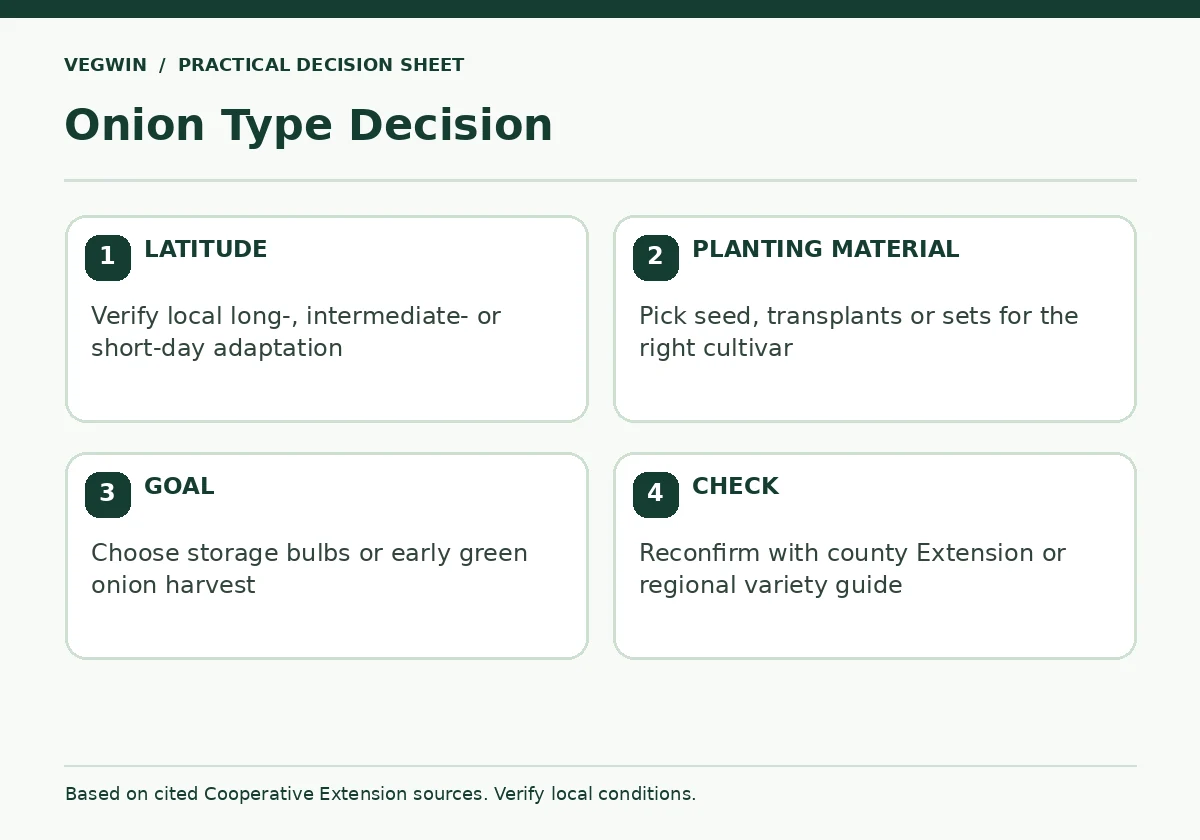
Bulb onions are commonly grouped as short-day, intermediate-day, and long-day. Each group begins forming bulbs after reaching its characteristic daylight threshold. That makes the seed packet’s adaptation region more useful than attractive bulb photographs. Minnesota Extension explains that long-day storage onions are typical in northern gardens, where summer daylight is long. Ask a regional Extension office or locally experienced supplier which classification suits your latitude. Do not assume that a USDA winter-hardiness zone provides this answer: zone maps describe average winter cold, not summer photoperiod.
If a healthy onion produces abundant leaves but a small bulb, check variety adaptation before reaching for fertilizer. Planting too late, crowding, drought, and competition also matter. Keep the variety name and seller information in your records; the words “red,” “sweet,” and “yellow” describe market types, not the daylight response needed for reliable bulbing.
Choose Seeds, Transplants, or Onion Sets
Onions can be established from seed, purchased transplants, or small dormant bulbs called sets. Seed opens the broadest selection, including locally adapted named varieties, but usually requires the most planning and an appropriately long season. Transplants save nursery time and provide a visible starting plant. Sets may be convenient for quick establishment, yet available sets are not guaranteed to be the correct day-length type or ideal for large storage bulbs. Extension guidance notes that sets offered in northern retail channels may favor short-day types. If you want the full process, read how to grow shallots from sets or seeds and cure bulbs.
Before buying, make a three-part checklist: is the cultivar adapted to local daylight, will the crop have enough cool growing time to produce leaves before bulbing, and do you want green onions or dry bulbs? Treat onion seed as a fresh-input choice because germination can decline during storage. Use the planting directions for your named variety and local Extension calendar; the timetable for indoor tomato seedlings is not a model for onions. To go further, our guide to planting onion sets shows how to sort small bulbs for storage and greens.
Prepare Root Space Without Excess Fertilizer
Onions have comparatively shallow roots, so a well-drained bed that holds adequate moisture is more important than a very deep planting hole. Remove persistent weeds before planting because onion foliage casts little shade and competes poorly with fast-growing grasses. Improve compacted soil by following a test and building soil structure over time; do not bury bulbs in fresh manure or add high-phosphorus fertilizer without knowing the existing nutrient status. University Extension recommendations for soil fertility are regional and depend on a tested bed.
Set out young onions at the depth and spacing appropriate to the planting material and the intended harvest. Bulbs grown for storage need room; green onions can be harvested earlier and often at closer spacings. Do not copy a commercial field configuration into a narrow raised bed without accounting for access, irrigation and final bulb size. Mark rows so shallow weeding does not slice tender plants. For the basics, see our guide: Why Onion Plants Flower.
| Decision | What to verify | Practical next step |
|---|---|---|
| Small bulbs, healthy tops | Variety day-length adaptation and planting date | Check regional cultivar suitability before extra fertilizer |
| Uneven seedlings | Seed freshness, moisture and emergence conditions | Review seed lot and avoid waterlogged soil |
| Necks still green and firm | Crop maturity, not calendar date | Wait for natural maturity when conditions allow |
| Bulbs wet after harvest | Ventilation and neck dryness | Cure in a protected airy space; sort injuries |
Keep Moisture Steady Through Leaf Growth
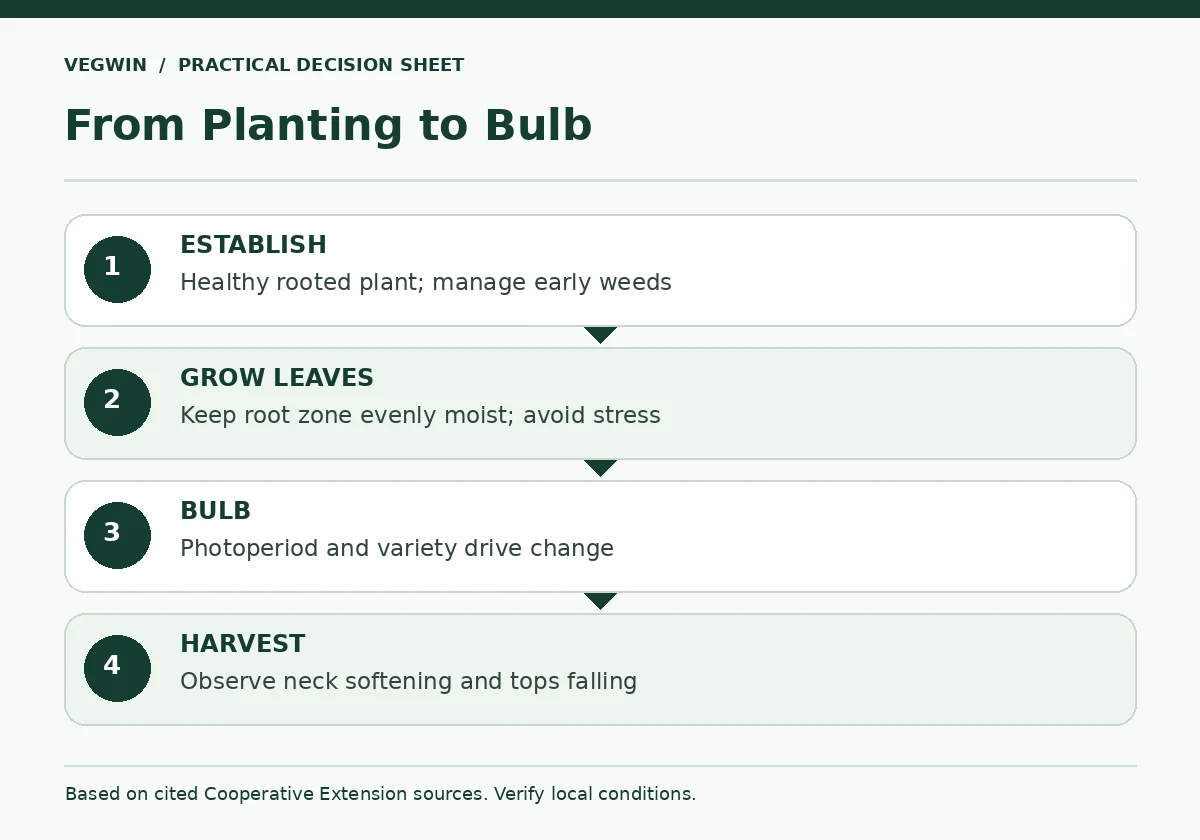
A plant makes the leaves that help feed its developing bulb before or during bulbing. Irregular water early in growth can reduce that productive leaf area. Minnesota Extension emphasizes maintaining moisture for these shallow-rooted plants, with more frequent checks in sandy soils. Water the root zone rather than just darkening the surface, and inspect beneath mulch to see whether moisture reached roots. A rain total alone does not show what was absorbed.
Avoid constant saturation: drainage still matters, and a soft bulb or yellowing foliage needs diagnosis rather than automatically more irrigation. Use clean, seed-free mulch where appropriate to reduce weed pressure, leaving plant necks exposed. As bulbs approach full size and tops naturally decline, reduce watering according to your regional growing guidance. This is a transition linked to plant maturity and weather, not a fixed calendar day.
Read the Bulbing and Harvest Signals
Onions shift from upright foliage to neck softening and tops falling as bulbs mature. For storage onions, Minnesota Extension describes lifting when about half the tops have fallen over and dried. Different varieties and weather can alter how quickly that stage arrives. Sample a few bulbs and inspect neck firmness and skins before harvesting the whole bed. A bulb that is rotting or has been damaged by pests is not rescued by curing and should be evaluated separately. If you are starting from scratch, read When to Harvest Shallots and Cure the Bulbs for Reliable Storage.
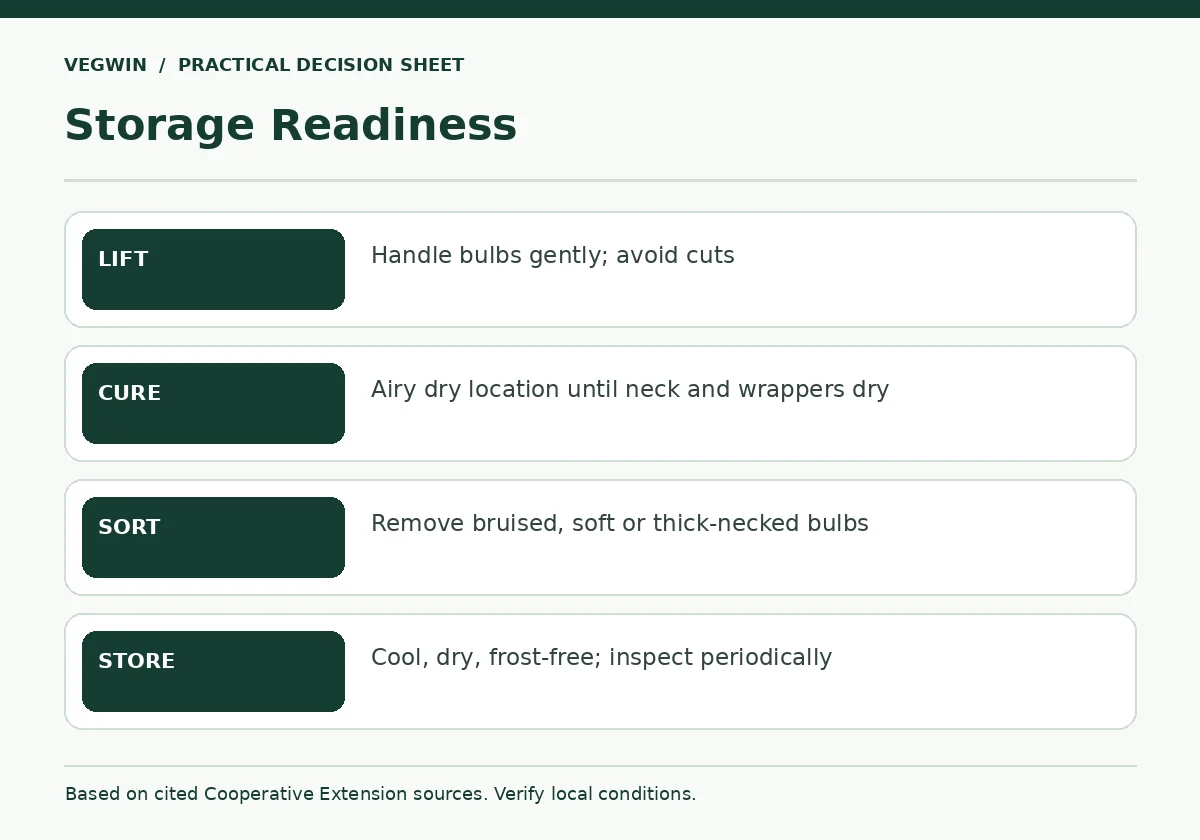
Lift bulbs gently rather than dragging against compacted soil. Bruises, cuts and broken necks can shorten storage life. Do not force all green tops to fall just because another gardener harvested in the same month. Growing conditions and cultivar maturity are stronger evidence than a photograph of a neighboring plot. Set aside thick-necked or injured bulbs for prompt use instead of mixing them with sound storage bulbs.
Cure Onions Before Long Storage
Curing dries the neck and outer scales to help storage bulbs keep. Minnesota Extension recommends a warm, dry, well-ventilated setting until necks are tight and outer scales are dry; the referenced northern guidance describes a period of weeks rather than a single overnight sunbath. Spread bulbs in a thin layer with air moving around them. If outdoor weather is wet, move them under shelter rather than leaving them in standing rain.
After curing, trim or braid only as appropriate to the variety and the dryness of the neck. Separate sweet or damaged onions from those intended for long storage: not all bulb types have equal keeping quality. Store dry storage onions where temperatures are cool and freezing is avoided, following the Extension advice appropriate to your climate. Check stored bulbs periodically and remove any that become soft or sprout; a moldy onion should not remain beside sound produce.
Diagnose Small Bulbs or Yellow Foliage
A small bulb can be a photoperiod mismatch, a late planting, crowding, limited leaf growth, or a moisture problem. Yellow tips may reflect natural maturation, drought, root injury, pest feeding or disease. These are different diagnoses. Start with a whole-plant inspection: when did symptoms begin, are nearby plants affected, are roots firm, and did the foliage yellow uniformly or in patches? Record variety, planting date and rainfall before drawing a conclusion.
If leaves collapse prematurely while bulbs remain immature, look for evidence of rot or insect damage and use a local diagnostic service when needed. Avoid preventive insecticide or fungicide applications without identifying a pest and checking current legally applicable labels. Onion maggots and other Allium problems are addressed by regional IPM publications. For a recurring issue, crop rotation, clean planting stock and reducing plant stress are safer first questions than increasing spray frequency.
Keep an Onion Record for Next Season
A useful record has five fields: day-length class and cultivar, planting material, establishment date, leaf-growth observations, and harvest or cure results. Add watering interruptions and unusual weather. This separates a reproducible adaptation problem from an isolated tough season. A gardener who writes only “onions did poorly” is left guessing; recording “short-day sets made foliage but small bulbs in a northern summer” points to a specific adjustment. For the fuller picture, see our guide “Garlic Gardening”.
Compare multiple varieties only when there is sufficient space to give each the same reasonable care. Do not claim one named cultivar stores better, tastes sweeter, or resists a disease without locally relevant trials or reliable breeder and Extension evidence. The goal is a better next decision, not an unverified universal ranking. If your local agricultural Extension office offers onion recommendations, prioritize those over generic internet planting-date graphics.
Related Guides
- Egyptian Walking Onions: Plant Topsets and Control the Patch
- Starting Onion Seeds Indoors: A Tray-to-Transplant Checklist
- How to Grow Welsh Onions From Seed for Clumps of Hollow Green Leaves
- How to Plant Egyptian Walking Onion Topsets With Their Points Up
- How to Plant Onion Sets Upright and Avoid Large Sets That Bolt
How We Research and Apply These Recommendations
This guide was written from research-based public university Cooperative Extension recommendations, with specific source claims checked on October 20, 2026. The diagrams are original editorial syntheses, not measurements from a VegWin field trial. Regional conditions, cultivar properties, product instructions, soil testing and current local rules can change the right action. No private product testing, guaranteed yields, controlled field experiments or verified on-site WordPress article inventory are claimed. Treat crop- and location-specific recommendations from your county Extension as the final local reference.
This guide is based on the sources linked throughout the article.
Sources reviewed on October 20, 2026: Minnesota Extension (onion daylight groups, establishment, water, maturity and curing); University of Georgia Extension (home vegetable garden site preparation, soil-testing and garden record decisions). Recommendations may be revised; recheck the institutional sources before manual publication.
This guide contains no affiliate links. We checked sources including affiliate disclosure page.
Sets are convenient, but they limit cultivar choice and may not suit your latitude or storage goal. Match day-length type first; seedlings and transplants give more control over varieties.
Long-day storage onions are commonly used in northern regions, but choose a cultivar recommended locally. Short-day onions can make undersized bulbs where summer daylight patterns differ.
Do not force maturity on a calendar. Watch the normal softening and falling of tops and confirm bulb and neck condition before lifting.
First check variety day-length adaptation, late planting, crowding, weeds and water consistency. Fertilizer alone cannot correct a photoperiod mismatch.
Storage onions generally need curing first to dry their necks and wrappers. Damaged or thick-necked bulbs should be used sooner rather than stored with sound bulbs.