
How to Plant Onion Sets Upright and Avoid Large Sets That Bolt starts with recognizing the right plant parts, not with rushing to cut or treat. An image showing those parts can keep a simple gardening job from becoming a costly mistake. This guide focuses on one distinct task and explains what to examine, which action to take, and when to delay. Conditions vary by cultivar, season and region, so always compare the instructions with the plant in front of you. The university and horticultural sources linked below inform the specific steps; they are not evidence that every garden will respond on the same schedule. Follow the diagrams together with the text, and stop if the living plant does not match the identification described.
Know What an Onion Set Actually Is
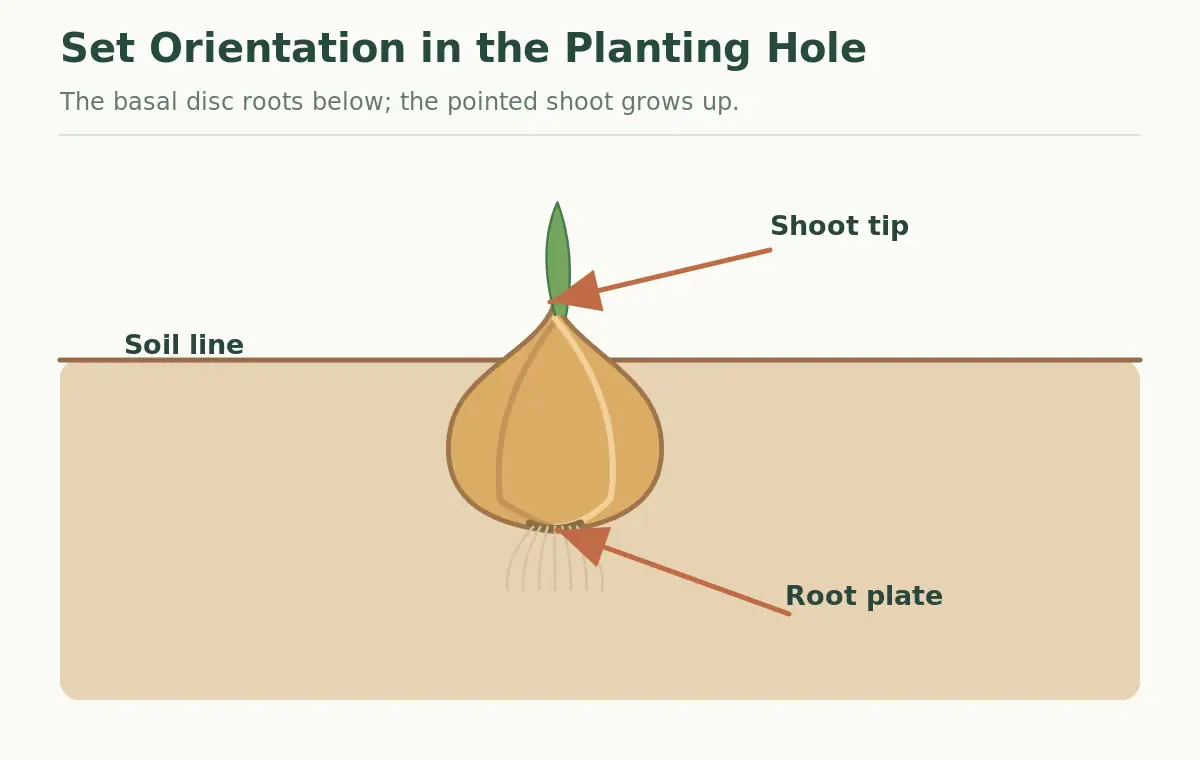
An onion set is a small bulb produced in a previous growing season and held dormant for sale, not a true onion seed. That stored bulb has a flatter basal plate where roots grow and a narrower shoot tip that points upward. Sets make planting straightforward because they start with more stored food than a dry seed, but they do not always give the cultivar selection possible from seedlings or seed. Iowa State Extension notes that sets may be labeled only by broad color rather than an exact cultivar. If you want a particular onion flavor, size or storage performance, confirm the source and cultivar instead of assuming every bag of sets performs alike.
Sort Small Sets for Bulbs and Large Sets for Scallions
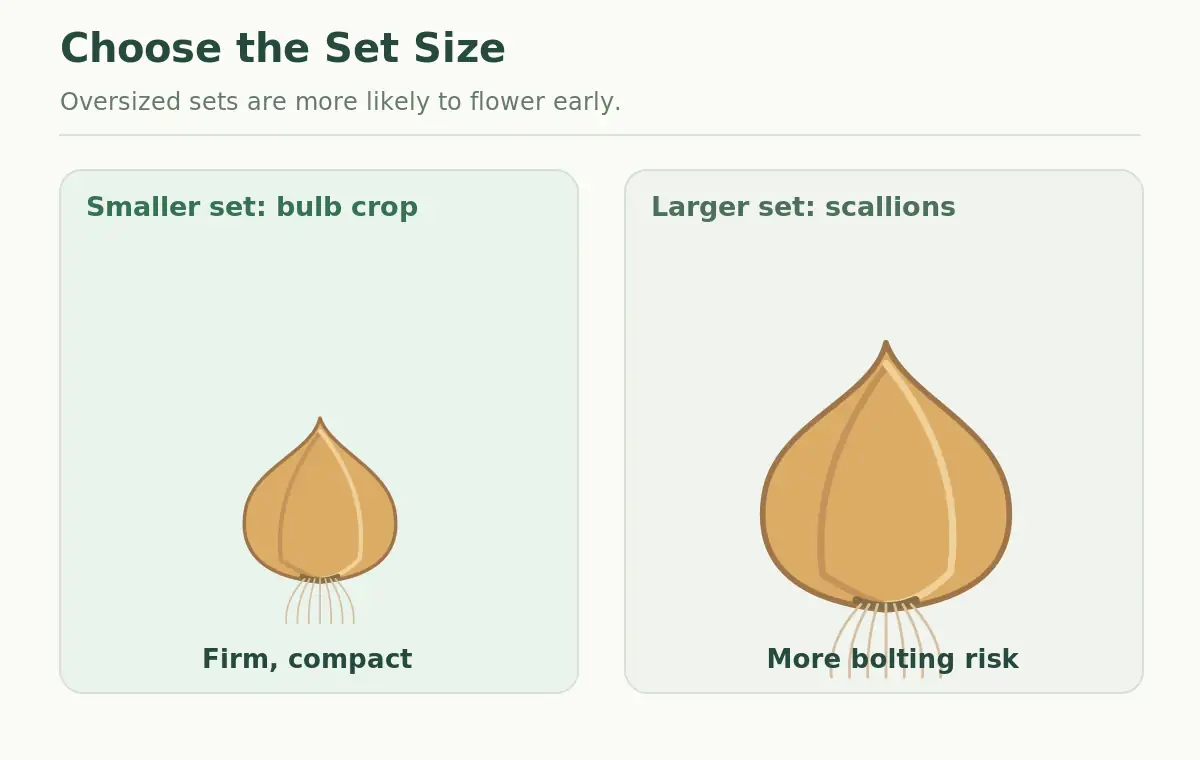
The largest bulb in the bag is not necessarily the best for a full-size onion. Iowa State Extension explains that large sets are more likely to send up a flower stalk, often yielding a poorer storage bulb. Separate the sets before planting: smaller, firm bulbs are better candidates for mature dry onions, while noticeably larger sets can be used for green onions. Its guidance suggests sets under roughly one-half to three-quarters inch in diameter have the best chance of producing well. Treat these size ranges as selection advice, not as a guarantee against bolting. Set aside shriveled, soft, moldy or badly damaged bulbs regardless of their size.
Match Onion Type to Local Daylength
Onion bulbing is influenced by daylength as well as temperature and cultivar. Short-day, intermediate-day and long-day types are adapted to different regions. The general planting steps below cannot overcome a mismatch between the onion’s daylength response and your latitude. University of Minnesota Extension warns that many locally available sets may be short-day types and also describes onion adaptation. Ask a regional supplier or Cooperative Extension which bulb type performs locally before buying a large quantity. Do not use USDA winter hardiness zones as a substitute for daylength or spring soil conditions. If the cultivar is unknown, trial a small row before counting on a storage harvest.
Plant in Spring as Soon as Soil Can Be Worked
In cool-climate home gardens, onions are typically among the earlier vegetables that can be planted after soil becomes workable. Iowa State advises planting sets in early spring, while Minnesota Extension likewise points to early workable ground. Exact dates depend on wetness, regional freezes and soil condition. If the bed makes sticky clods and stays saturated, forcing bulbs into it may create rotting problems. Prepare a loose, reasonably well-drained bed with enough sun, correct soil pH if a test shows a problem, and remove perennial weeds first. Avoid giving every state the same March or April date; local planting advice is more useful than a national calendar.
Set the Root Plate Down and the Shoot Tip Up
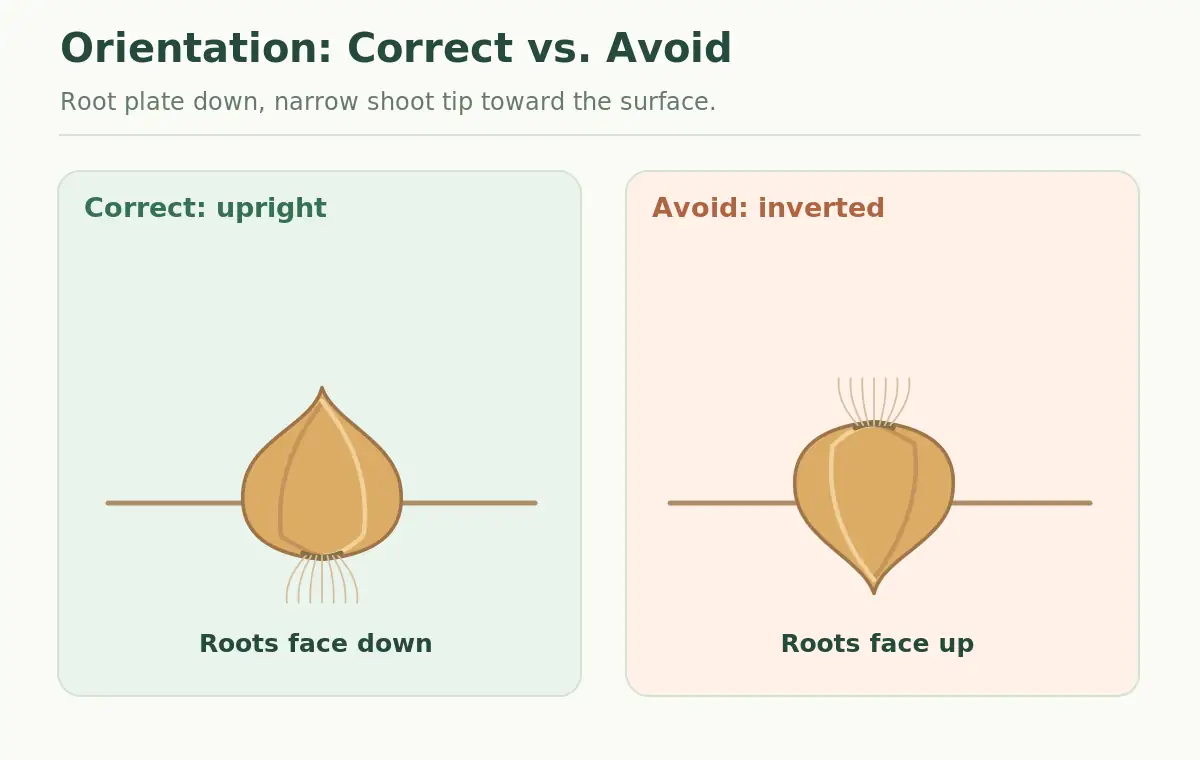
Inspect one set before digging. The underside is a broader, often rough basal plate, sometimes showing dry root remnants; the opposite end narrows to the shoot tip. Position the basal plate downward so new roots grow into soil and the shoot emerges upward. Do not press the bulb so hard that the plate is crushed. Use a narrow dibber or trowel to make the hole, position it, and backfill gently around the sides. If the tip is hard to identify, examine several bulbs and compare their papery coats and basal discs. A cross-section drawing is much more reliable than relying on which end of an irregular bulb seems heaviest.
Use Practical Depth and Spacing for the Goal
Iowa State’s home-garden guidance gives a planting depth of about one to one and a half inches for onion sets, with mature bulb plantings about two to three inches apart and rows roughly twelve to fifteen inches apart. Larger sets intended for green onions can grow closer together. Follow local or packet recommendations if they account for your soil and desired harvest size. Measure depth consistently for the size of your set; avoid burying tiny sets in a very deep trench or leaving the basal plate exposed. Water the planted row enough to settle soil without making a permanently soggy strip. Thin or harvest green onions as needed to relieve crowding.
Keep the Shallow Root Zone Moist and Weed Free
Onions develop a shallow fibrous root system and compete poorly with large weeds. Minnesota Extension emphasizes steady water supply, especially during active growth. Check actual soil moisture rather than irrigating by a calendar alone: sandy soils dry faster, while heavy soils can stay wet for longer. Weed by hand or hoe only shallowly near bulbs to prevent root damage. Mulch can conserve moisture, but avoid burying the growing shoots under a thick damp layer. A soil test should guide amendments and fertilizer, not a generic homemade feeding recipe. Uneven water and competition can shrink bulb growth even if the original sets were positioned perfectly.
Recognize Bolting Before Planning Storage
A firm upright flower stalk is different from the flat or hollow green leaves that onion sets send up for normal growth. Bolting uses resources that might otherwise contribute to a large storage bulb; it is more common with larger sets and also influenced by temperature and plant maturity. Iowa State Extension recommends using large sets primarily for green onions. Once a plant is clearly forming a flower head, do not expect it to become a top-quality, long-storing bulb. Use suitable bolting plants sooner as green onions where appropriate, and keep notes about the set size and local weather. Cutting a flower stalk is not a reliable reset of the plant’s development.
Compare Sets With Seedlings and Direct Seed
Sets are convenient, but they trade cultivar control for speed and simplicity. Onion plants or transplants often arrive as green seedlings, while true seed is far smaller and requires a longer establishment period in many locations. Iowa State notes that choosing a specific cultivar can be difficult when sets are sold only as red, white or yellow. For predictable storage qualities or a named variety, seedlings or seed may make more sense. This does not mean sets are inferior for every use; they can be particularly practical for modest early green onion harvests. Match the propagation material to the intended harvest instead of treating all three forms as interchangeable.
Use a Row-Side Orientation Checklist
Before finishing the row, uncover one newly placed set and check the basal disc is down, the growing point faces up, and the bulb sits in friable soil at a reasonable depth. Verify that the smaller firm sets occupy the area reserved for mature storage bulbs and the larger ones are separately marked for scallions. Label the planting date and source; that record will help if some plants bolt early or form unexpectedly small bulbs. Water evenly and inspect a few days later for emerging shoots or signs of rot. A quick orientation check is easier now than diagnosing dozens of sideways bulbs later, but not every imperfectly placed bulb will fail.
Compare the Key On-Plant Decisions
| What you see | Action | Why it matters |
|---|---|---|
| Small, firm set | Mature bulb trial | Lower tendency to bolt |
| Oversized set | Scallion or green onion | Flower stalk more likely |
| Soft or moldy set | Discard | Poor planting material |
Related Guides
- Onion Gardening: Choose Day Length, Start Bulbs, and Cure the Harvest
- Egyptian Walking Onions: Plant Topsets and Control the Patch
- Why Onion Plants Flower: Diagnose Bolting and Save the Harvest
- Starting Onion Seeds Indoors: A Tray-to-Transplant Checklist
- Planting Onion Sets: Sort Small Bulbs for Storage and Greens
How We Research and Verify These Steps
Sources checked on 2026-10-26: University or horticultural source 1; University or horticultural source 2; University or horticultural source 3. We compared those original recommendations with the specific crop, growth stage and real safety limitation before writing this guide. Site illustrations simplify the relevant botanical details, so always confirm the actual specimen and apply regional Extension advice when conditions differ. No pesticide or planting claim here should be taken as a replacement for a local label or growing guide.
Safety and Independent Editorial Disclosure
This article is independent educational gardening content, not paid sponsorship, and its internal links do not imply a vendor partnership. See the VegWin affiliate disclosure. Use clean tools, prevent injury to yourself and the plant, and wash food crops with clean water. Keep poisonous or irritating plant material out of reach of children and pets. For possible insecticide uses, follow current local registration and label directions; this guide does not provide treatment rates or off-label recipes.
The broad basal plate, where roots emerge, goes down; the narrower shoot tip faces up.
Usually not. Large sets are more likely to bolt; they are often best grown as scallions or green onions.
Iowa State home-garden advice gives about 1 to 1½ inches, with adjustments for the set and local guidance.
Plant in early spring when soil is workable, using local weather and soil condition rather than a fixed national date.
Not reliably. Once bolting starts, bulb quality and storability are often reduced.