
An old Siberian iris can become a dense ring of grassy leaves, with fewer flower stalks appearing from its aging center. Division renews vigorous outer sections and gives roots room to reestablish. But the shallow, exposed-rhizome instructions used for tall bearded iris do not apply to a Siberian iris clump. These plants have tightly interwoven roots and prefer more consistent moisture. This guide shows when division is justified, how to lift and split a substantial piece with several leaf fans, and how to replant it at the original depth so roots do not dry out or end up buried excessively.
Identify Siberian Iris Before Digging
Siberian irises form dense upright clumps of narrow, grasslike leaves and typically produce beardless flowers carried above the foliage. Their root systems are tightly knit and less obviously formed around the broad, thick surface rhizomes associated with familiar bearded iris. A plant label with Iris sibirica or a related Siberian iris hybrid is a useful clue. Check the flower and foliage if identification is uncertain: similar foliage may belong to another iris group that needs different handling. Iowa State and RHS both emphasize species differences in their division instructions. Do not transfer a diagram that shows a bearded iris rhizome baking in the sun to a moisture-loving Siberian iris that should be returned to its former soil level. Our walkthrough on how to divide bearded irises and replant healthy rhizomes sets out each step.
Decide Whether the Clump Actually Needs Division
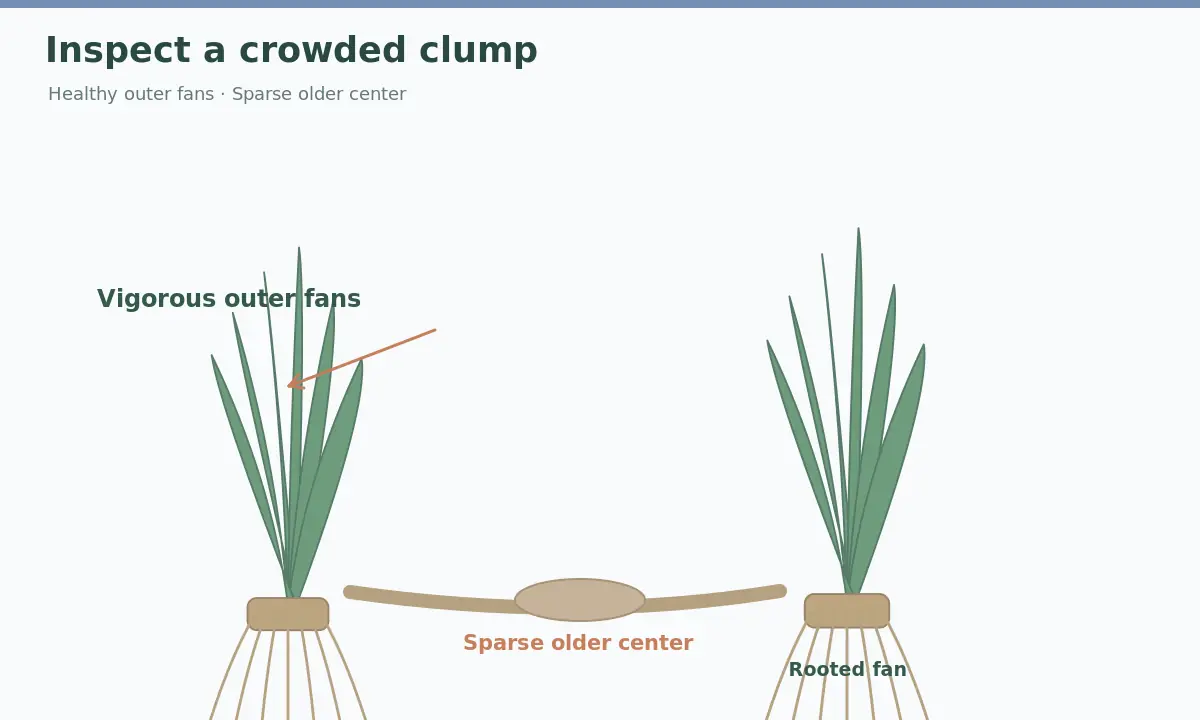
Siberian irises do not require annual digging. A healthy clump may flower well for many years. Division becomes useful when vigorous foliage is crowded into a solid ring, the center looks bare or weak, or flower production declines despite reasonable light and moisture. First rule out excessive shade, drought stress, or a recent site change. Iowa State Extension specifically cites congestion, reduced vigor, and ring-shaped clumps with bare centers as warning signs. Dividing a young, productive plant adds disturbance without benefit. Take a photograph in bloom and mark vigorous outer sections so it is easier to find the healthiest divisions later. A crowded center may be discarded while good outer pieces are replanted. For the basics, see our guide: When to Divide Black-eyed Susans Without Losing Healthy Crowns.
Choose Early Spring or Late Summer
Iowa State Extension identifies early spring, when new growth is just emerging, and late summer as workable periods for Siberian iris division. The exact calendar shifts by local climate. In early spring, soil must be workable, not frozen or saturated; avoid crushing new shoots. In late summer, give divisions time to root before a hard winter. NC State recommends fall for parts of the Southeast and spring in colder areas. RHS also discusses division shortly after bloom for large Siberian clumps. These references describe overlapping windows rather than a single nationwide date. Avoid the hottest, driest spell, when fresh divisions can wilt rapidly. Prepare the replacement bed and water source before lifting the plant.
Water and Loosen Soil Before Lifting
The roots of a mature Siberian iris can hold an enormous amount of soil. Water the clump in advance when the ground is dry, then let the surface become workable rather than muddy. Use a sharp spade or garden fork well beyond the outer fans and work gradually around the circumference. Lift from underneath instead of pulling hard on the leaves, which can tear away from roots. A helper or tarp is useful for very large, heavy clumps. If only part of the clump is needed, take a healthy outer wedge while minimizing damage to the remainder. Keep all exposed roots shaded and damp during the work. Do not leave the lifted mass baking in direct sun while you prepare a hole elsewhere. For the basics, see our guide: When to Divide Daylilies.
Separate Substantial Sections With Several Fans
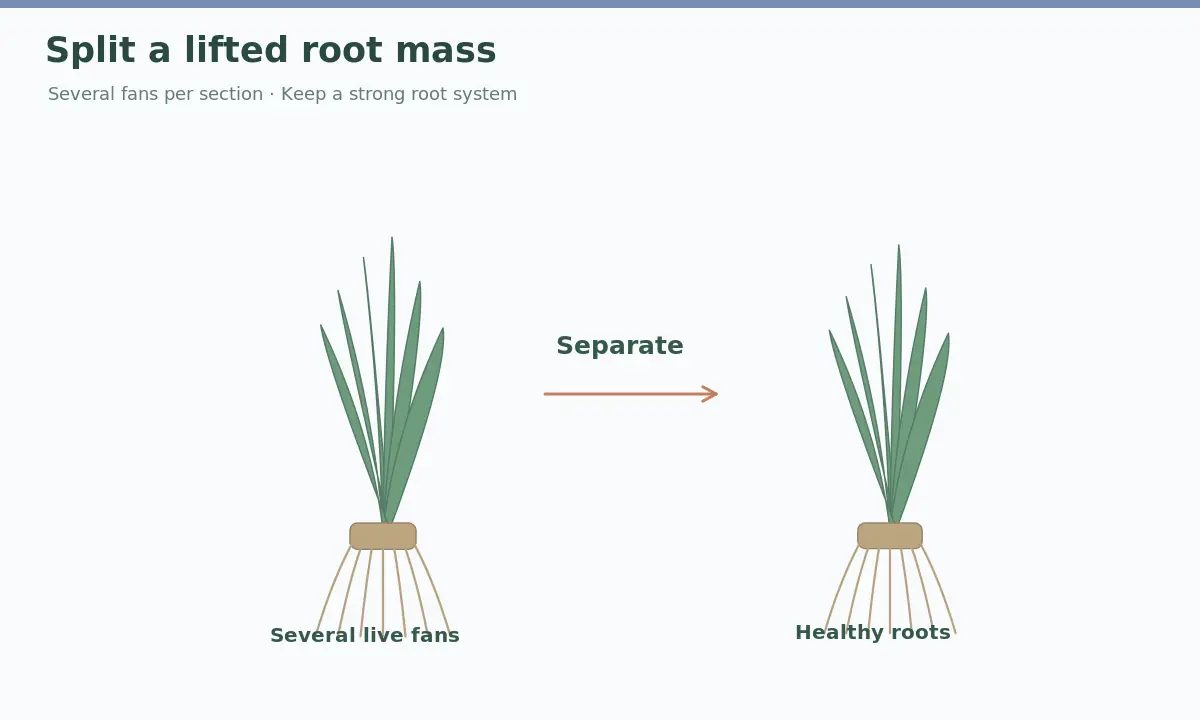
Unlike tiny bearded-iris single-rhizome divisions, Siberian iris pieces benefit from a substantial root mass. Iowa State recommends multiple growing points; for late summer, each section should have several leaf fans and good roots. A sharp spade, soil knife, or two garden forks pushed back-to-back can help separate the firm clump. Work deliberately and discard old, decayed central debris rather than forcing every fragment into a new plant. Keep recognizable living leaf bases connected to healthy roots. Rinse only if necessary to inspect the structure, then prevent roots from drying. Very small divisions are more vulnerable to drying and may take longer to bloom. Larger divisions offer a better balance of vigor and manageable size.
| Situation | Useful action | Avoid |
|---|---|---|
| Clump flowering well | Leave in place | Dig every year |
| Dense ring and bare center | Keep strong rooted outer fans | Make tiny rootless pieces |
| After division | Replant at old depth, water in | Expose crown like bearded iris |
Trim Leaves Without Removing Living Crowns
When dividing in late summer, shortening tall leaves can reduce wind resistance and moisture loss. Iowa State suggests trimming late-summer foliage to approximately six to eight inches. This is not permission to cut through the basal growing points or remove every green fan flush with the crown. In early spring, handle small emerging shoots gently instead of imposing the same hard trim. Remove clearly dead or diseased leaves and clean tools between suspect plants. A healthy section still needs functioning foliage and stored reserves to recover. Never confuse trimmed leaf blades with the underground root bases to preserve. Label each division if you are separating different colors or cultivars whose flowers will not be visible again until a later season. If you are starting from scratch, read When to Divide Ornamental Grasses and Remove a Dead Center.
Replant at the Same Depth as the Original Clump
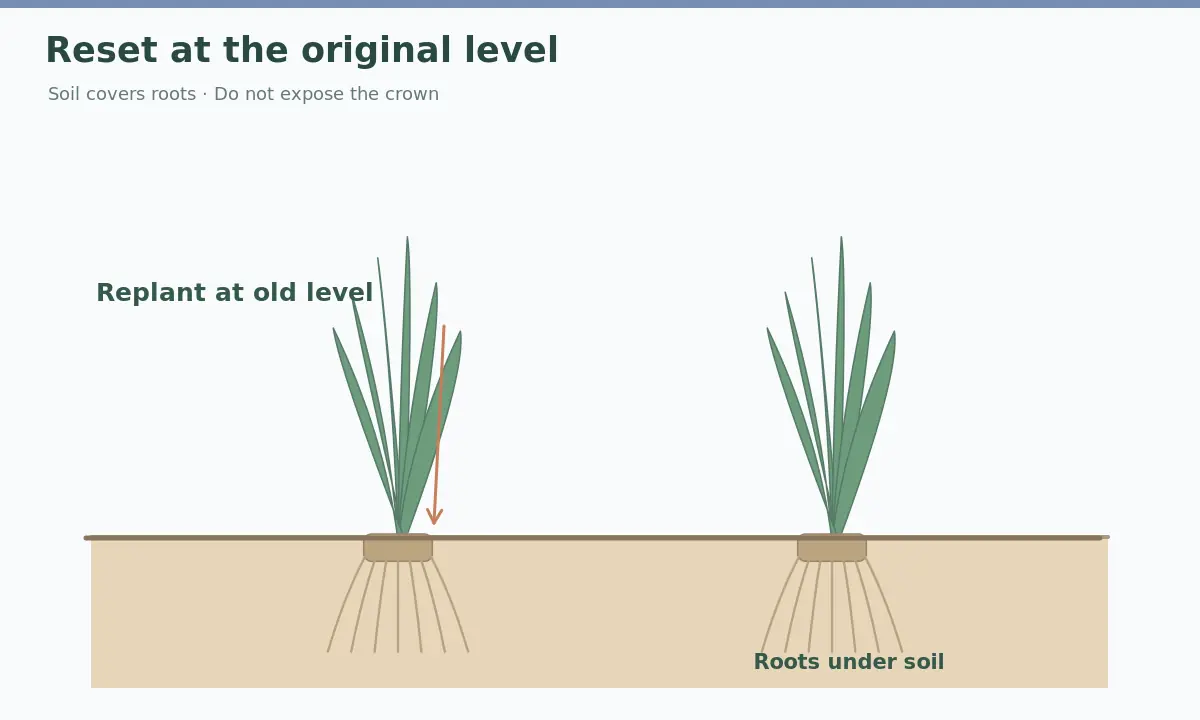
This is the most important difference from common bearded-iris advice. RHS instructs gardeners to reset Siberian iris younger outer sections at the previous planting depth. NC State also describes planting the crown and rhizome system beneath a modest soil cover rather than leaving the thick stem exposed. Find the old soil stain on the leaf bases before placing the division in the hole. Spread roots naturally, refill with loose soil, and firm enough to remove large air pockets without compacting heavily. Water to settle the soil, and add more if roots become exposed. Do not pile a deep mound over the living fans, and do not set the crown high like an exposed bearded rhizome. The goal is familiar root contact and moisture. For a step-by-step method, see how to divide ornamental grasses without losing the living crown.
Choose a Moist but Not Stagnant Location
Siberian iris generally likes fertile soil with dependable moisture and flowers well in sun to part sun. It is often suited to pond edges, but that does not mean an unestablished division should sit in a sealed, waterlogged pot. NC State notes good performance in moist, organically rich soils. Use a site where irrigation can reach the newly planted roots through dry spells. A thin organic mulch over surrounding soil can reduce evaporation, but keep it off the emerging leaf fans and growing crown. Watch runoff and rainfall rather than watering mechanically every day. Good soil contact and repeated checks are more important than applying an arbitrary fertilizer dose right after division. Avoid salt or fertilizer burns on fresh roots.
Expect a Recovery Period Before Full Bloom
Freshly divided Siberian irises may produce foliage before flowering returns to normal. Some divisions bloom sparsely in the first season, especially after a late-summer move. That is not necessarily failure: roots and growing points need time to rebuild. Observe leaf firmness and fresh emergence, and gently check soil moisture instead of digging up the plant to verify success. Brown old leaf tips can coexist with healthy new fans. Record the date and number of fans in each planted section. If one division declines while the rest thrive, investigate depth, root damage, water stress, and shade. Do not apply heavy fertilizer to force immediate flowers; improving establishment conditions is usually a more sensible first response.
Avoid Common Bearded-Iris Instructions and Diagnose Problems
The internet often combines all ‘iris division’ advice into one set of rules. Placing a Siberian iris’s roots at the surface, allowing them to dry for days, or dividing into single tiny fragments can be harmful. Bearded irises can tolerate a conspicuous rhizome on or near the surface, but clump-forming Siberians should go back to their prior depth promptly. If a transplanted clump has poor bloom, look at root establishment and sunlight first; some cultivars also vary in flowering. If leaves yellow in soggy soil, check drainage and rotting roots before watering more. Learn the actual iris group before copying a planting diagram. This species-level identification makes the difference between a useful rejuvenation and an avoidable setback. Our walkthrough on how to divide bearded irises and replant rhizomes at the right depth sets out each step.
Related Guides
- How to Divide Shasta Daisies in Spring and Replant Healthy Crowns
- How to Divide Hostas Without Damaging Crowns or Planting Too Deep
- Dividing Tall Garden Phlox: When, Where to Cut, and How to Replant
- When to Divide Astilbe and Replant Clumps Without Drying Their Roots
- How to Divide Autumn Joy Sedum Without Burying New Crowns
How We Research and Verify These Steps
Sources were opened and cross-checked on 2026-10-24: yardandgarden.extension.iastate.edu — Iowa State Extension details when to divide Siberian irises and how many fans and roots to retain; www.rhs.org.uk — RHS differentiates dividing Siberian iris clumps from shallow planting of bearded iris; plants.ces.ncsu.edu — NC State Extension describes Siberian iris growing conditions, fans and planting depth; ask.extension.org — 2026 Extension response confirms early spring and late summer division windows. We compared seasonal advice, exact plant anatomy, growing methods, and differing regional conditions, and used those findings in the accompanying illustrations. Botanical drawings are explanatory, not to scale. Your local Cooperative Extension and specific cultivar or seed-packet instructions take priority when conditions differ.
Disclosures, Safety, and Regional Differences
These are educational gardening guidelines, not personalized agricultural or medical advice. No sponsorship or partnership is claimed. Read VegWin’s affiliate disclosure. Follow all local plant, food safety, and pesticide regulations and current product labels. USDA hardiness zones describe winter minimum temperatures rather than exact sowing dates. The diagrams are simplified to emphasize the relevant plant structures.
Only when clumps become crowded or flowering declines; a healthy clump can remain undisturbed for several years.
Early spring and late summer are both supported; choose the window with workable soil and time to reestablish before weather extremes.
Keep several healthy growing fans attached to a substantial root system rather than making tiny single-leaf fragments.
No. Replant them promptly at the previous soil level; exposed bearded-iris planting advice does not transfer.
It may, but division can temporarily reduce flowering while roots and fans rebuild.