
Broccoli rabe, also called rapini or broccoli raab, is harvested for its leafy, slightly bitter shoots and young flower clusters—not for one large broccoli head. The most useful harvest signal is the appearance of a tight cluster of buds on a still-tender shoot. This guide shows how to read those buds, what to cut, how to avoid damaging remaining growth, and when flowering or heat changes quality. A ready-to-pick rapini plant can look surprisingly small beside heading broccoli.
Identify Rapini Before Choosing a Harvest Stage
Rapini belongs to Brassica rapa, a different botanical group from heading broccoli, Brassica oleracea. Plants carry branching leafy shoots, irregularly lobed green leaves, and small clusters of unopened buds rather than a heavy compact central crown. Names on seed packets vary: broccoli rabe, broccoli raab and rapini often refer to closely related crops, while sprouting broccoli and broccolini may behave differently. Check the packet for the intended crop and days to first harvest, but let actual bud formation guide the final decision. Do not hold rapini in the garden waiting for a six-inch broccoli head that will never form. Our walkthrough on how to grow broccoli rabe (Rapini) for tender shoots, not heads sets out each step.
Look for Tight Buds and Still-Pliable Stems
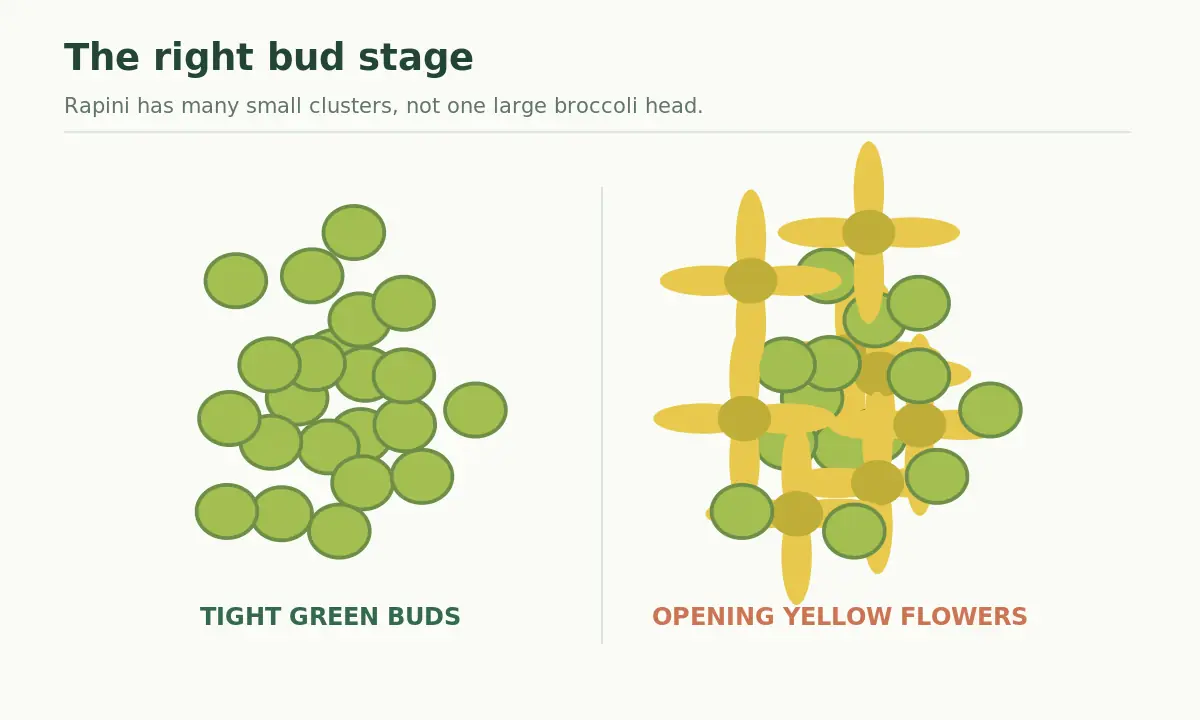
Inspect the tips of several shoots. A desirable harvest usually has small green buds packed closely enough to be recognizable but not yet stretched into conspicuous yellow petals. The upper leaves should look fresh, not leathery or severely wilted, and the stem should feel resilient rather than thick and fibrous. NC State advises harvesting before the flower buds open. A few opening flowers are not automatically a safety concern, but they signal that the tender stage is passing. Assess several shoots because flowering can progress at different rates within the same planting, especially during fast-changing spring weather.
Use Cool-Season Weather as Context, Not a Date
Rapini grows as a cool-season green. It may reach usable size at different calendar dates depending on variety, temperature, sunlight, spacing, and sowing method. Spring plantings can move rapidly from small buds to flowering in a warm spell; fall crops may mature more slowly. Use the local first and last frost patterns to plan sowing, not USDA winter-hardiness zones as an annual planting calendar. Walk the bed every day or two once clusters start forming. If an unexpected warm forecast arrives and buds are tight, harvest promptly rather than assuming the printed days-to-maturity number is a deadline.
Cut the Flowering Shoot With Tender Leaves
Use a clean, sharp knife or snips. Hold the shoot without pulling on the roots, and cut a useful length of tender stem together with the bud cluster and attached young leaves. Start with the highest mature flowering shoots rather than stripping foliage from the entire plant. Feel along the shoot: if the lower section resists bending and seems woody, stop higher where the stem is still tender. The correct cut length varies with variety and growth; there is no need to force every harvested shoot into a universal measurement. Keep the harvest clean and place it out of direct sun immediately.
Leave Healthy Nodes if Seeking a Second Cutting
Some rapini plantings respond to a central shoot harvest with smaller laterals. If trying for another picking, cut above healthy leaf nodes or evident side shoots instead of slicing the whole plant at soil level. Leave several sound leaves to power recovery. This technique cannot force regrowth from a plant already exhausted or bolting in heat. If your particular seed variety is sold as a one-cut crop, harvesting the whole tender plant may be practical. Distinguish that from a repeat-cut experiment; a rootless stump with no foliage is unlikely to produce much more edible growth. If you are starting from scratch, read When to Harvest Purple Sprouting Broccoli for Tender Spears and Side Shoots.
| Shoot stage | Visible clue | Best decision |
|---|---|---|
| Ready | Closed green buds, pliable stem | Harvest bud and tender leaves |
| Changing | First yellow petal or stretching | Pick immediately if tender |
| Past peak | Open yellow flowers, hard lower stem | Assess flavor; usually clear or resow |

Compare Ready, Opening, and Overmature Shoots
At the ready stage, unopened buds form a small firm-looking cluster with nearby smooth leaves and a flexible stem. At the borderline stage, buds enlarge and occasional yellow petals may begin showing; pick immediately if texture remains acceptable. At the late stage, the stalk elongates strongly and multiple yellow flowers appear. The older leaves may taste more pungent and the lower stem can feel tough. Taste preference varies: bitterness is normal for this vegetable. Reject shoots that have slime, decay, heavy contamination or obvious disease rather than treating all bitterness as spoilage.
Handle and Refrigerate the Harvest Promptly
Harvest in the cooler part of the day when possible. Remove torn, damaged or dirty portions and rinse shortly before cooking; if washed for storage, drain and dry surface moisture gently. Put the greens in a clean, food-safe container or loosely wrapped bag in the refrigerator and use them while the leaves and stems still feel fresh. Avoid leaving a wet pile in the sun. Because both stems and leaves are edible, sort by thickness before cooking so tougher sections can receive a little more heat. No home preservation method or storage life should be assumed without separate validated guidance.
Diagnose Small Shoots and Early Bolting
A tiny flowering shoot does not always indicate a mistake at harvest. Heat, irregular water, root stress, crowded seedlings and the particular variety can influence how quickly a Brassica shifts to reproductive growth. Check soil moisture across the root zone rather than guessing from one dry patch at the surface. Avoid sudden heavy fertilizer dosing to rescue a stressed crop: rely on a soil test and local recommendations. When the stand is mostly tall flower stalks and little tender foliage, sowing a new cool-season planting may give better results than repeatedly cutting mature stems.

Plan a More Predictable Next Sowing
For the next crop, choose a window with reasonably cool growing weather, suitable full-sun exposure and enough time before prolonged heat. Space or thin seedlings according to the cultivar information so the leaves can expand and dry after rain. Monitor flea beetles and caterpillars on young Brassicas, using correct identification before deciding on management. Keep a simple photo record of the first visible bud cluster, first cut and any side-shoot harvest. These observations are more useful for choosing future local dates than copying another region’s schedule.
Decide Whether to Continue or Clear the Bed
After a first picking, leave the planting only while healthy leaf nodes and new side shoots are active. Inspect for diseased foliage and accumulated debris that can harbor Brassica pests. If fresh side shoots remain pliable, another small harvest may be worthwhile. If stems become hard, flowers are widely open and flavor is too strong, remove the spent crop and switch to a locally suitable succession crop. Compost only healthy debris according to local composting practices. Record the variety and season because they may explain more than any single fertilizer or pruning trick.
How We Research and Verify This Guidance
This article was checked on 2026-10-24 against plant-specific university Cooperative Extension and government guidance: NC State Extension Plant Toolbox; Virginia Cooperative Extension; University of Maryland Extension. We separated directly supported cultivation, pruning, and insect-life-cycle recommendations from choices that depend on local weather, crop genetics, and gardening goals. Illustrations are simplified teaching diagrams, not photographs or treatment labels. Consult your regional Extension office for local timing, pest identification, and regulations.
Sources, Disclosure, and Regional Limitations
Source links and their supported claims are preserved in the article metadata and linked above. No field trial was performed for this particular garden, and results are not guaranteed. This guide does not assert a paid partnership or endorse a pesticide product. Review VegWin’s affiliate disclosure for site-wide transparency. Do not apply vegetable pesticide recommendations from other Brassica crops without checking the exact crop label.
Look for leafy, tender flowering shoots with compact green buds that have not opened into yellow flowers.
No. Rapini forms comparatively small bud clusters, not the dense large head of traditional heading broccoli.
Some plants form side shoots when healthy leaves and nodes remain, but the amount depends on variety and weather.
Some parts remain edible, but stems can become tougher and more bitter; check quality and freshness.
Only if intentionally taking a one-cut whole-plant harvest; leave healthy nodes and foliage if trying for regrowth.