
Yarrow creates flat-topped clusters of many tiny flowers above finely feathered foliage. Its seeds are also tiny, so sowing depth and seedling crowding matter more than a large planting hole. This guide is aimed at garden yarrow, Achillea, especially common yarrow, rather than medicinal use. You will see how to distinguish fine foliage from weeds, start a modest number of plants, and plan for the rhizomes and self-sown seedlings that can make a vigorous perennial unwelcome in a tight bed.
Know Which Yarrow Your Packet Contains
Common yarrow, Achillea millefolium, has strongly dissected, fernlike leaves and many small flower heads assembled into flat or gently rounded clusters. Garden seed mixes may contain other Achillea species or selected color forms. Seedlings from colorful hybrid selections may not reproduce the identical shade of the parent cultivar. Confirm the botanical name and supplier’s instructions rather than assuming every yarrow seed lot shares a precise dormancy requirement. In some locations wild ecotypes should be preferred for native or restoration plantings, whereas nonlocal ornamental seed can be inappropriate. Ask local native-plant specialists about provenance before sowing near sensitive habitats.
Use a Clean Medium and Shallow Seed Placement
Fill a draining tray or small cells with premoistened, fine-textured seed-starting mix and smooth the surface. Sow yarrow seeds thinly, gently pressing them into contact with the medium. Iowa State Extension notes that garden yarrow may be left exposed to light or covered only lightly; avoid burying seed deep like a pea. The small seed should not be buried as though it were a pea, and a household tray does not need an inch of soil over each seed. Use a spray mist or bottom-watering system so small seeds stay in place. Label both species and cultivar, then keep the upper mix evenly moist until emergence.
Do Not Assume Every Seed Lot Needs Cold
Guidance differs because yarrow includes several species and ecotypes. Iowa State lists yarrow among perennials usually germinating without special pretreatment, while other native-seed sources sometimes recommend stratification for particular collection sources. Follow the current packet first, and compare with seed supplier germination notes rather than inventing a fixed refrigerated period. For a first home-garden attempt, start a small test tray under moderate conditions and record actual emergence. If one batch fails, check seed age, depth and moisture before attributing all failure to a lack of cold treatment. Do not freeze a moist tray arbitrarily.
Give Seedlings Light and Modest Moisture
Provide bright grow-light or suitable window conditions as soon as seedlings emerge. Poor light causes stretched soft stems, while overwatered mix can promote damping-off. Keep the medium evenly moist while young roots are developing, but allow drainage and airflow. The first seed leaves can be simple and unimpressive. Wait for the later finely divided leaves before relying on leaf shape to confirm the crop. If several sprouts occupy one tiny cell, snip weaker extras instead of yanking up their neighbors. Gradual spacing improves light penetration and makes it easier to handle transplant plugs without tearing roots.
Transplant Small Plants at Their Original Depth
Move seedlings outside after hardening them gradually to wind and direct sunlight, using locally appropriate frost and weather guidance. Prepare a sunny, well-drained area and set the seedling plug level with surrounding soil; do not bury the crown. Water to settle the roots, then monitor moisture through establishment instead of maintaining permanently wet soil. Avoid unnecessary rich fertilizer because established yarrow often tolerates relatively lean conditions. Plant spacing should reflect mature size of the actual cultivar and the intended planting pattern. When in doubt, allow generous airflow and room for later division rather than making a dense carpet of plugs.
| Growing stage | What to see | What to do |
|---|---|---|
| Sown seed | Fine specks at surface | Press, mist, provide light |
| Seedling | Finely cut young leaves | Thin and brighten |
| Established perennial | Rhizomes and flower stalks | Monitor spreading edges |

Recognize the Feathered Foliage and Flower Heads
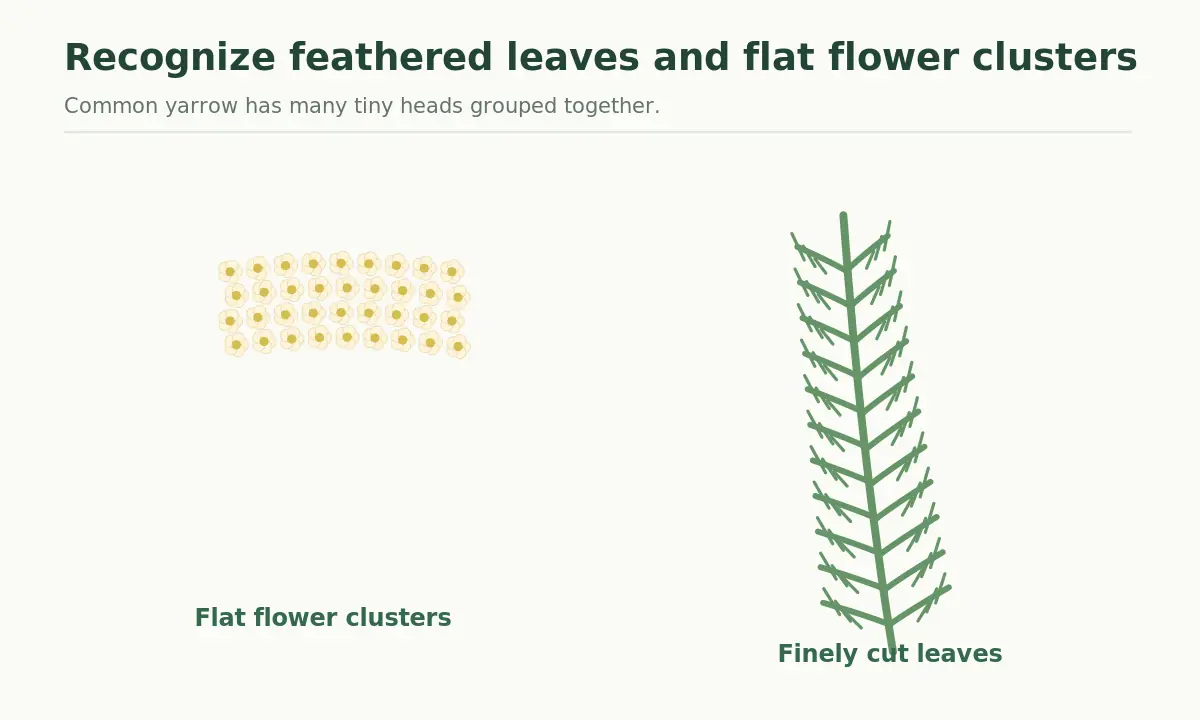
Yarrow leaves have a central midrib with many finely cut leaf segments, giving a soft featherlike silhouette. Flowering stems are upright, with clusters made of numerous tiny florets rather than one large daisy blossom. Identify both features before collecting homegrown seeds; several look-alike weeds and other Apiaceae or Asteraceae plants can occur in the same bed. Seed leaves alone are not a reliable identification key. When mature, seed heads become dry and can release many achenes. Do not use an uncertain roadside plant as edible or therapeutic material; this article is about ornamental cultivation and ecology.
Plan for Rhizomes and Self-Sown Seedlings
Common yarrow is a spreading perennial. Utah State and the U.S. Forest Service both discuss underground rhizomes, and mature flower clusters also carry seed. Depending on climate and site, plants can expand into nearby paths or small neighboring flowers. Give the planting a defined edge, deadhead before unwanted seed drop, and remove stray seedlings promptly. Cultivars can differ in vigor, and a habitat restoration mix has a different objective from a small cutting garden. Before planting near natural areas, check local guidance for potential weediness or nonlocal genetic stock. Container culture may be easier where spread would be inconvenient.
Compare a Young Clump With a Crowded Mature Bed
New seedlings look like small feathered rosettes; established plants form larger basal growth and flowering stalks. A mature patch whose centers thin or whose roots overrun the planned space may benefit from division or removal of surplus rhizomes. Work while soil is reasonably moist but not muddy, and keep healthy rooted crowns for any replanting. Do not assume simply clipping off flowering tops kills an unwanted established patch: underground rhizomes can remain alive. If the goal is only to stop seed rain, timed removal of spent heads may be enough. For full containment, address both roots and seeds.

Respond to Weak Growth Without Overfeeding
Before fertilizing a pale or slow plant, investigate waterlogging, dense shade, root competition and the quality of the original medium. Yarrow is generally tolerant of drought once established but seedlings still need consistent moisture while rooting. Watch for mildew or poor airflow in overly crowded humid plantings. Soil testing can reveal a genuine nutrient deficiency without guesswork. Avoid interpreting one early bloom date as a permanent schedule; local heat, cultivar and the age of the plant can change it considerably. Bloom can take time in a seed-started perennial, so judge establishment first.
Keep a Seed-to-Flower Photo Record
Take photographs of seed placement, first true leaves, transplant size and flowering clumps. Mark how wide the patch becomes by the end of its second growing period. This gives real local evidence about spacing and control needs. If collecting seed, dry heads separately from weed material and label the collection with date and plant identity, recognizing that open-pollinated garden seedlings may vary. Do not promise a purchased ornamental color will breed true. A small trial with a well-defined boundary usually teaches more than broadcasting unknown quantities of seed across an entire landscape. Our walkthrough on how to grow German chamomile from seed without burying the seedlings sets out each step.
Related Guides
How We Research and Verify This Guidance
This article was checked on 2026-10-24 against plant-specific university Cooperative Extension and government guidance: Iowa State Extension; Utah State Extension; U.S. Forest Service species review. We separated directly supported cultivation, pruning, and insect-life-cycle recommendations from choices that depend on local weather, crop genetics, and gardening goals. Illustrations are simplified teaching diagrams, not photographs or treatment labels. Consult your regional Extension office for local timing, pest identification, and regulations.
Sources, Disclosure, and Regional Limitations
Source links and their supported claims are preserved in the article metadata and linked above. No field trial was performed for this particular garden, and results are not guaranteed. This guide does not assert a paid partnership or endorse a pesticide product. Review VegWin’s affiliate disclosure for site-wide transparency. Yarrow may spread vigorously; check regional ecological guidance and avoid planting a nonlocal seed lot into intact native habitats.
No. They are small and typically sown on or just beneath the surface, depending on the seed lot guidance.
Not necessarily. Iowa State reports standard garden yarrow can germinate without treatment, but ecotypes vary.
Not reliably. Seedlings from selected or hybrid garden plants may vary from the named parent.
Common yarrow can spread by rhizomes as well as seed, so make room and monitor the bed.
Generally no. Check soil and growing conditions first; excessive feeding is not a substitute for light and drainage.