
The name potentilla can refer to small herbaceous plants as well as a woody landscape shrub. This guide is for Dasiphora fruticosa, still often sold as Potentilla fruticosa or shrubby cinquefoil. Its fine compound leaves and five-petaled flowers make it a good mound for cold-climate beds, but old stems can collect at the center and leave it looking ragged. University of California guidance recommends shaping in spring before flower buds develop. The useful goal is a healthy open shrub that keeps its natural rounded silhouette, not a flat, tightly clipped ball.
Confirm You Have the Woody Shrubby Cinquefoil
Shrubby potentilla is a deciduous woody shrub with many twiggy upright and arching stems emerging from its base. It has small pinnate leaves made up of narrow leaflets and single five-petaled flowers, frequently yellow but also white, pink or orange-tinted in cultivars. NCSU Extension lists it as Dasiphora fruticosa, formerly Potentilla fruticosa. The similar common name can mislead a gardener with a perennial cinquefoil, which follows different cleanup rules. Look for permanent woody stems and a mounded outline before pruning. If the plant tag names another species, use that species’ guidance instead of assuming all potentillas behave alike.
Schedule Shape Pruning Before the Spring Flush
UC Agriculture and Natural Resources advises spring pruning before flower buds form. In cold regions this often means late winter to early spring, once severe cold is passing but before strong new growth. A calendar date is not universal: snowmelt and bud activity vary greatly. Shrubby cinquefoil generally flowers through summer on new seasonal growth, so an early cleanup can preserve its flowering potential better than indiscriminate trimming of active summer bloom. Examine stems for swelling buds before making large cuts. Remove obviously broken or hazardous wood when needed, but postpone heavy renovation if the weather is extreme or the shrub is already severely stressed.
Examine the Interior Before Choosing Which Canes Go
Step back and look at the whole mound. The oldest wood is often thicker, grayer and more branched than flexible younger stems. Identify branches that are dead, cracked, crossing, rubbing or growing deep through the center. Scratch a small questionable twig with a fingernail: green moist tissue may indicate life, while thoroughly brown brittle tissue suggests deadwood, although a frozen twig can be harder to assess. Do not cut every pale-colored twig just because deciduous stems look bare in winter. Mark the few worst canes first. A selective plan retains a framework of healthy young stems that will carry the next season’s leaves and flowers.

Remove Dead and Rubbing Wood at Its Origin
Use sharp clean bypass pruners on thin canes and suitable loppers for thicker stems. Follow each dead or rubbing branch to an appropriate junction near the ground or a live parent branch. Cut just outside the branch collar where present, rather than leaving a long dead stub or gouging into the base. In a multi-stemmed shrub the useful target may be the cane’s origin within the crown. Keep your free hand away from the blades. Work gradually, checking from different sides to avoid creating a visible empty hole in one place. Remove cut material from the base to inspect what remains.
Thin Old Canes Rather Than Shearing Every Tip
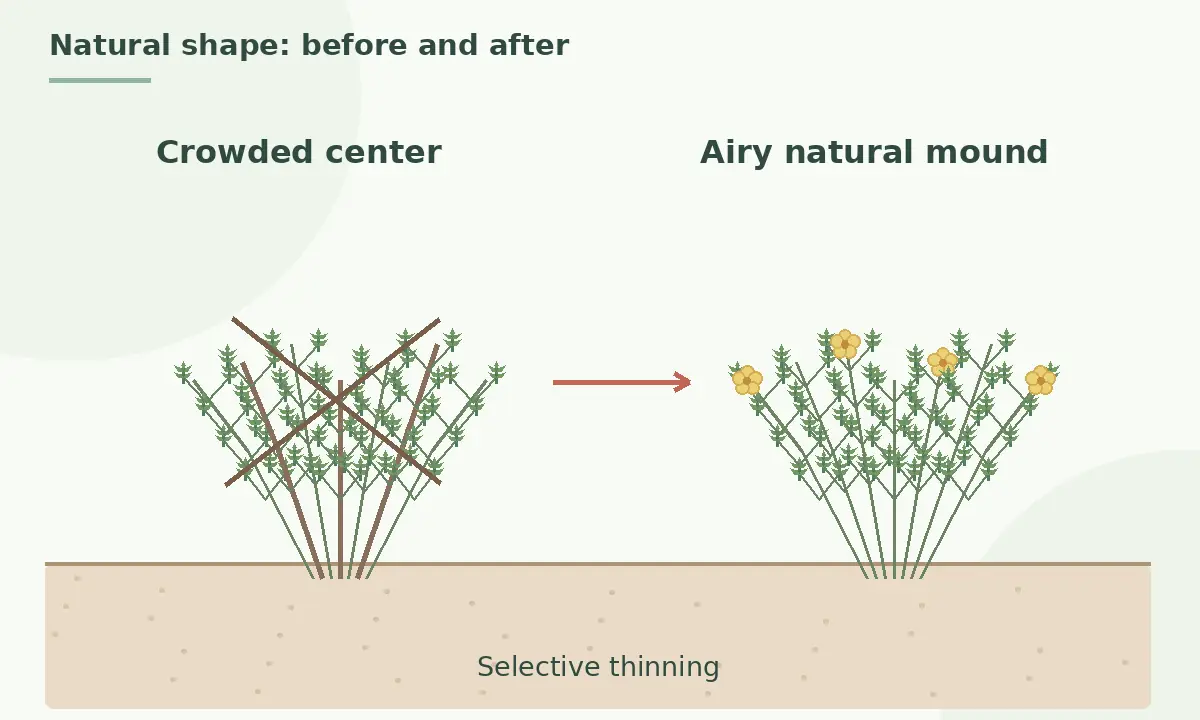
NCSU describes renewal by removing older canes, and UC guidance emphasizes the shrub’s natural habit. A light annual thinning is often more effective than cutting all shoot tips to the same height. Select a small number of the thickest declining stems spread around the plant, then cut them at the base if the crown is strong enough to replace them. This improves access of light and space to newer shoots. Avoid removing all large canes at once on a weak plant. Shearing repeatedly at a rigid outline can produce dense tips over a bare woody center, disguising crowding instead of fixing it.
Make Modest Heading Cuts Only Where Needed
To shorten a stray live shoot, trim to a healthy outward-facing lateral branch or bud. Angling a cut modestly above a useful bud helps direct regrowth; leaving a long bare stub provides no benefit. Reduce irregular branches in several places rather than cutting a horizontal line across the entire top. This preserves the soft dome seen on healthy shrubby cinquefoil. Do not cut deeply into unrelated shrubs that merely look similar. Where a tall branch crosses another stem, removing the whole crossing cane can be tidier than repeatedly shortening its tip. If the shrub already has a dense healthy outline, the best choice may be little or no heading at all.
Handle a Very Old or Bare-Centered Shrub Cautiously
An old potentilla mound may have a dark tangle of wood with only thin foliage near its perimeter. NCSU notes that drastic renewal can be possible, but strong cutting back removes substantial reserves and can leave a temporary gap in the planting. Start with selective removal of the oldest declining canes over more than one season if plant health is uncertain. In a healthy, established plant, more extensive renovation may be considered in dormancy, but do not treat it as a guaranteed instant fix. Water stress, unsuitable shade or disease can mimic an aging problem; identify those conditions before sacrificing live wood.

Avoid the Wrong Season for Routine Hard Pruning
A shrub that is covered in summer flowers has already invested in developing shoots. Heavy trimming then may remove much of the display and reduce the period available for useful regrowth before winter. Dead, broken or diseased stems can be dealt with promptly using clean tools, but elective large-scale reshaping is usually better planned for the spring window. Avoid pruning merely because a shrub is beginning autumn dormancy. Cold climates differ in how late new growth can mature. The calendar should be adjusted by what the buds and weather are doing, not by copying the last frost date of another region.
Support New Growth With Suitable Site Conditions
NCSU and UC resources describe shrubby cinquefoil as most floriferous in good light and reasonably well-drained soil. A crowded shaded shrub may remain thin regardless of how accurately you prune it. After pruning, clear fallen debris, check that mulch is not heaped against stems, and water during extended dry spells while a shrub is reestablishing foliage. Do not assume fertilizer is required whenever growth is sparse; investigate moisture, sun, drainage and soil history first. Cultivars vary in mature size, so a permanently oversized plant in a narrow bed may need replacement with a more compact selection rather than ever more aggressive pruning. If you are starting from scratch, read When to Prune Shrubby Potentilla With Renewal Cuts, Not Hedge Shears.
Evaluate the Shape Again After Summer Bloom
Mark which stems you removed and take a photograph from the same viewpoint in spring and midsummer. A successful light prune produces healthy leaves along newer shoots with flowers across a natural mound, not just a ring on the edges. If the shrub recovers strongly, repeat selective deadwood cleanup next spring. If growth remains sparse, check light and root health before additional cutting. The goal is durable plant structure; there is no need to schedule a yearly drastic reset. New cultivars with different flower colors share the same species-level outline, but their mature size should still guide how closely the planting can be kept. If you are starting from scratch, read When and How to Prune Glossy Abelia Without Spoiling Its Arching Shape.
How We Research and Verify Garden Recommendations
Our editorial review compared the listed university Extension and specialist horticultural guidance for the identified species, growing stage and practical question. We checked the source pages on October 24, 2026, distinguished field trial results from universal instructions and noted when cultivar or local weather may change an outcome. The instructional artwork was created to explain morphology and gardening actions, not copied from published photos or presented as evidence of a particular experiment. We have not run a controlled garden trial for this specific article; readers should use local Cooperative Extension assistance for uncertain symptoms or regional restrictions.
Sources and Editorial Disclosure
Sources reviewed October 24, 2026: UC Agriculture and Natural Resources — University of California ANR: identification, long summer bloom, and shaping before spring bud development.; NC State Extension Plant Toolbox — North Carolina State Extension: shrubby potentilla taxonomy, compact growth and late-winter/spring rejuvenation.; University of Minnesota Extension — University of Minnesota Extension: selective shrub pruning principles and correct placement of cuts.. Source links do not mean these organizations endorse VegWin.
Disclosure: No sponsorship or affiliate payment for a specific product has been verified for this article. Site information is available at VegWin Affiliate Disclosure. Follow current local regulations and the instructions for your cultivar or any registered product.
It generally blooms on current-season growth, which supports pruning early in spring before buds develop.
You can trim it, but selective thinning usually better preserves its natural mound and avoids crowded tips.
No. Severe rejuvenation is a special response to old or neglected wood, not routine yearly maintenance.
Remove damaged or dead wood as needed with clean tools, making cuts back to suitable living junctions or origins.
Yes. The older nursery name is still common; the shrubby plant is usually listed botanically as Dasiphora fruticosa.