
A magnolia may flower gloriously each spring and then look awkward for a few weeks when spent petals collect beneath it. That is not a signal to give the whole tree a haircut. Mature magnolias often need surprisingly little intervention; unnecessary cutting can remove flowering wood, produce an unbalanced outline, and leave large wounds. The practical question is not how much to prune but whether any branch truly needs removal.
The answer changes with tree type and the job at hand. A small deciduous saucer magnolia that flowers on established wood is not maintained quite like an evergreen Southern magnolia trained against a wall. University of Minnesota Extension lists magnolia among early bloomers generally shaped just after flowering, while RHS distinguishes several magnolia habits and timing considerations. Start by identifying the tree, then decide whether the cut serves its health or merely your preference.
Identify the type and reason before picking up pruners
Look for a plant label, flowering season, and whether leaves persist through winter. Many familiar star and saucer magnolias bloom on wood formed earlier; cutting off twig ends late in the season can discard flower buds that were already developing. Evergreen magnolias have different branch growth and may need distinct timing when trained against a wall. A generic calendar month is therefore less useful than the species and intended action.
Decide whether you want to remove a dead twig, eliminate rubbing branches, or reduce an entire tree that outgrew its site. The first two may be limited maintenance. The last is usually a location or long-term design problem, not a quick do-it-yourself shaping task. Record what blocks a path, contacts a structure, or shows damage, so you can leave healthy branches alone.
Schedule modest shaping after spring flowers fade
For spring-flowering deciduous magnolias, light shaping after bloom minimizes immediate loss of flowers and follows University of Minnesota and Delaware Extension guidance. Avoid stripping a crown of young ends in late summer merely because it looks full: those are often the shoots carrying the next flowering season. Some sources advise mid-summer timing for certain deciduous species to avoid heavy sap bleed, which is another reason to identify the tree rather than assume one universal window.
Dead, broken, or hazardous branches are a different category. Safety work should not wait for a perfect flowering date, but climbing or cutting above a house, utility line, or public walkway is professional tree work. When no urgent defect exists, postpone uncertain cuts and watch the tree complete a season. Magnolia is generally a poor candidate for routine heavy shearing. If you are starting from scratch, read When to Prune a Mulberry Tree and Why Fewer Cuts Are Better.

Find a healthy branch collar and make one clean cut
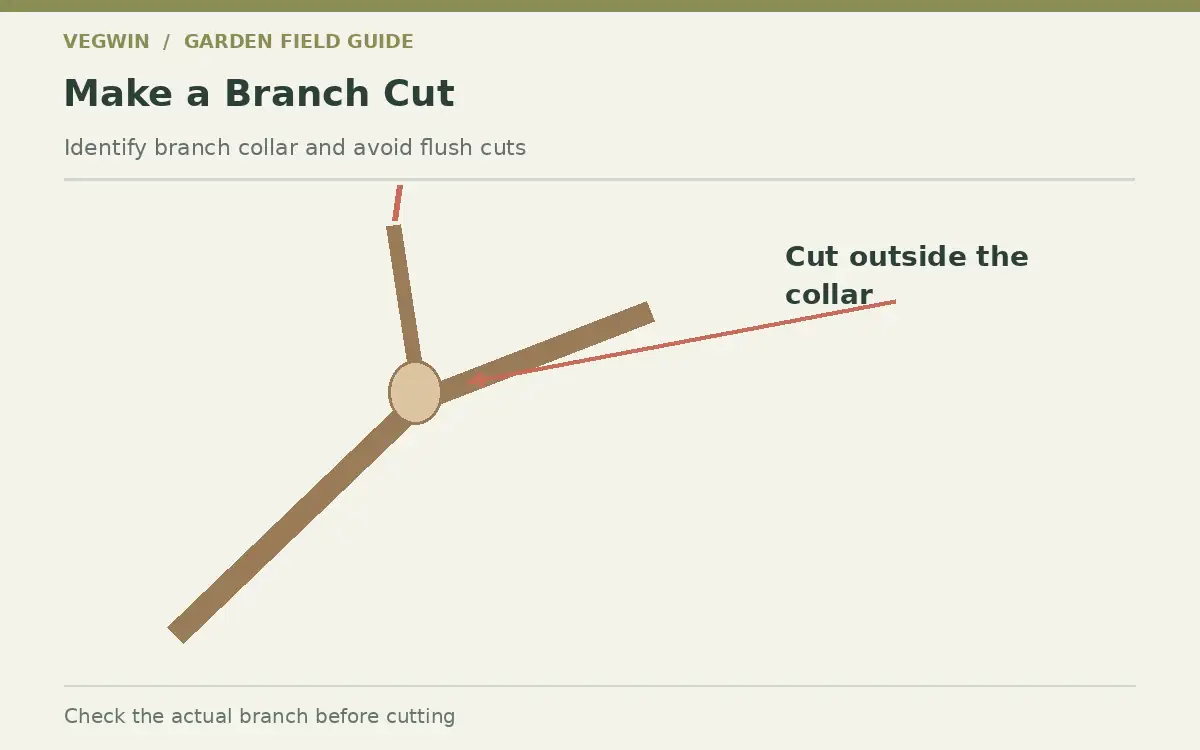
For a small lateral branch, locate the slightly raised collar or junction at its attachment. Place a sharp, appropriately sized tool just outside the collar without leaving a long stub. A flush cut into the trunk removes protective tissue; cutting too far out leaves a stub that dies back. This distinction matters more than drawing a perfect angle with a ruler. If the branch is too thick for comfortable control, choose professional help.
Remove crossing or dead wood selectively; stand back repeatedly to review the outline. For heavier branches, professional arborists use a controlled multi-cut method to avoid bark tearing, but readers should not attempt big limbs with a small hand pruner or ladder. Do not paint wounds or seal fresh cuts with household products. RHS and Extension tree-pruning guidance favors proper cuts and natural wound response.
Preserve an open crown without making a hedge
Two branches that rub in the wind can injure one another; removing a smaller poorly placed twig sometimes solves the issue without altering the entire silhouette. Keep the magnolia’s natural irregular branching rather than trying to create a round ball or a flat screen. Hedge shears shorten dozens of outer tips at once and make it almost impossible to preserve a thoughtful framework.
If a magnolia repeatedly obstructs a gate, patio, or power line, consider whether the location is unsuitable as it matures. A tree that needs annual large reductions is likely to recover poorly and can be left with weak or unattractive regrowth. An ISA-certified arborist can assess long-term options and whether selective restoration is plausible.
Handle evergreen magnolias with additional care
Southern magnolia and other evergreen types normally retain attractive foliage year-round. They rarely need systematic pruning when planted with adequate space. RHS notes evergreen magnolias can be shaped differently depending on whether they are freestanding or wall-trained. An established freestanding specimen may be better left alone except for defects, while a wall-trained plant may have shoots tied and shortened in stages.
Before cutting an evergreen tree, inspect the potential loss of leaf area and the exposure created for inner limbs. Avoid aggressively exposing a previously shaded trunk or cutting during a heat or drought emergency. Discoloration after a freeze is not always evidence of dead wood; allow time for new growth to show which stems survive.
Use symptoms to decide whether pruning is appropriate
Browning blossoms after a freeze, leaf spots, sparse flowering, and temporary droop are not all pruning problems. Flower damage may follow weather while wood remains sound. Inspect buds and living twigs, compare inner and outer portions of the crown, and check soil conditions at root depth. A stressed plant usually benefits more from correcting water or root problems than from losing additional leaf area.
If a branch has suspicious cankers or dieback, obtain diagnosis from a local Cooperative Extension or arborist before widespread removal. Clean blades when moving between damaged and healthy tissue. Do not prescribe fungicides by appearance alone; product use must follow an identified issue and the label.

Compare a small pruning job with a relocation problem
A handful of pencil-width cuts to separate crossed twigs is fundamentally different from taking half the crown off an old magnolia. The former can be checked by walking around the tree after each cut. The latter risks losing flower-bearing branches, exposing bark, and creating serious wounds. No article can give a safe universal percentage of canopy removal for a mature tree in every condition.
Before reducing height, ask whether branches are actually hazardous, whether the tree has clearance from nearby buildings, and whether its natural size was considered when planted. Take photographs now and after flowering to track what truly changed. If a major reduction seems necessary, get a site-specific assessment instead of using a seasonal pruning chart.
| What you observe | Recommended next step |
|---|---|
| Spring bloom, small crossing twig | Inspect after flowering; selectively remove the rubbing twig. |
| Healthy mature crown, no clearance problem | Leave it alone; do not shear. |
| Dead or broken high limb | Keep people away and use an arborist. |
| Evergreen wall-trained magnolia | Follow species- and training-specific timing. |
| Needs major size reduction yearly | Reassess site suitability and professional options. |
Follow a short maintenance check every year
After flowering, inspect from the ground for newly crossing tips, dead twigs, and unintended contact with buildings. Note the location of flower buds for next year; large swollen buds can be easy to remove accidentally. Clean and maintain hand tools, but make no cuts simply to justify the visit. Magnolia grows best when its own architecture is respected.
Mulch and watering may help a tree under stress, but keep mulch away from the trunk flare and avoid constant saturation. A wound should not be hidden under a wrap or a thick coat of sealant. Record your observations and seek a professional evaluation whenever defects, height, equipment, or access make work unsafe.
How We Research These Garden Care Decisions
This article compares the care needs of the actual species, growth stage, season and planting context rather than relying on a universal date. The sources below were checked on October 23, 2026. Where their regional advice differs, use your nearest Cooperative Extension and the plant or seed supplier label. Inspect plants and local conditions before acting; a structural publishing validator does not verify horticultural accuracy.
Sources reviewed: extension.umn.edu horticultural guidance (UMN Extension identifies magnolias among plants generally pruned after spring bloom.); www.udel.edu horticultural guidance (Delaware Extension advises only very light postflowering shaping of magnolias and no stubs.); www.rhs.org.uk horticultural guidance (RHS distinguishes deciduous and evergreen magnolias, sap bleeding and minimal pruning needs.); ask.extension.org horticultural guidance (OSU Extension Ask Extension cautions against coating pruning wounds and separates safety cuts from shaping.).
Editorial and affiliate disclosure: This page is informational. No affiliate offer or partner compensation is assumed. If commercial links are ever added after approval, review our affiliate disclosure.
No. A healthy established magnolia often needs little pruning beyond selective correction.
It can remove buds already formed on spring-blooming magnolias. Identify the type and avoid unnecessary late shaping.
Dead or hazardous wood may be dealt with independently of bloom season; larger limbs require professional work.
Generally no. Use a proper branch-collar cut; paints and sealants are not standard care.
Major reduction risks permanent form and wound problems. Have a qualified arborist evaluate alternatives.