
An ornamental grass that once formed an elegant fountain can gradually resemble a ring of living leaves around a brown, empty center. That pattern often indicates an aging clump, not a mysterious fertilizer deficiency. Before reaching for a bag of plant food, look at where the newest shoots are emerging and decide whether the plant is ready to be divided.
Grass division is not one universal calendar job. Some species begin growth in cool early-spring weather; others stay dormant until the ground warms. The most useful plan is to identify your grass, observe its growth, and lift the clump only when its healthy portions have a realistic chance to reestablish. The steps below apply to clump-forming ornamental grasses, not a spreading lawn or an unidentified invasive grass.
Look for a dead center before forcing a division
A large clump does not automatically need dividing. A healthy ornamental grass can remain attractive for years without disturbance, especially if it still produces an even ring of vigorous shoots and fits its allotted space. The stronger reasons to intervene are a hollow, brown center, reduced vigor, or a clump so broad that it shades neighbors and crowds the border. Iowa State University Extension describes dead centers as a common aging pattern in ornamental grasses and recommends retaining the healthy outer growth rather than planting the lifeless middle again. First part the foliage and inspect the crown close to the soil line. A seasonal tan top is not the same thing as a dead crown: many grasses have dormant-looking leaves in winter but living buds below. Wait until new growth makes the boundary clear if identification is uncertain. A grass with an unfamiliar growth habit deserves a local identification check before you spread divisions elsewhere. If you want the full process, read how to divide ornamental grasses without losing the living crown.
Match division timing to the grass growth season
Early spring, as new growth begins, is a widely recommended time for ornamental-grass division. However, cool-season and warm-season grasses may emerge weeks apart. Cool-season forms such as many feather reed grasses begin moving in cool weather; warm-season switchgrass and miscanthus generally appear later. The Royal Horticultural Society specifically distinguishes late-winter or early-spring division for cool-climate grasses from later-spring division for warm-climate types. Iowa State Extension likewise notes that spring is preferable to fall for most ornamental grasses. Do not divide a dormant warm-season plant simply because the calendar says March. Look for new green shoots and usable soil conditions, then work before the clump has produced a towering mass of foliage. Fall division may work in suitable climates for certain species, but spring gives more establishment time before the next winter. Ask local Extension about marginally hardy or invasive ornamental grasses.

Prepare a new planting spot before lifting the clump
Decide where the surviving divisions will go before you cut a single root. Check the mature width of the species and whether the new position provides the sun, drainage, and winter conditions it needs. Iowa State notes that ornamental grasses have very different site preferences: some tolerate drier sites while others are adapted to consistently moist ground. Mark a planting area broad enough to receive each division at its original depth. Water dry soil ahead of the job so roots are less likely to crumble apart, then wait until it is workable rather than saturated. Sharp spades, stout gloves, and a stable work surface are more useful than a pile of unneeded amendments. Some old grass crowns are astonishingly dense and heavy; ask for help with lifting if necessary. Clean tools between visibly diseased plants. If the existing grass is a locally restricted or invasive species, do not multiply it; seek an approved replacement.
Split the root ball into sections that contain live shoots
Work around the outside of the clump with a spade and lift as much of the root ball as practical. If it is too heavy, cutting sections in place can be safer than levering the whole mass in one piece. Identify living crown tissue and actively growing shoots near the perimeter. Use a sharp spade or sturdy knife to separate sections containing several shoots and their own roots. Iowa State Extension emphasizes that both shoots and roots belong in every viable perennial division. A wedge with only long leaves and almost no roots is not a useful transplant; nor is a central plug of brown dead crown. Discard the nonliving center instead of hoping it will recover merely because it is replanted. Larger well-rooted sections usually provide a quicker visual result than tiny fragments. Never force a blade toward your body, and use protective clothing if the leaves have sharp edges.

Replant the divisions at their former crown depth
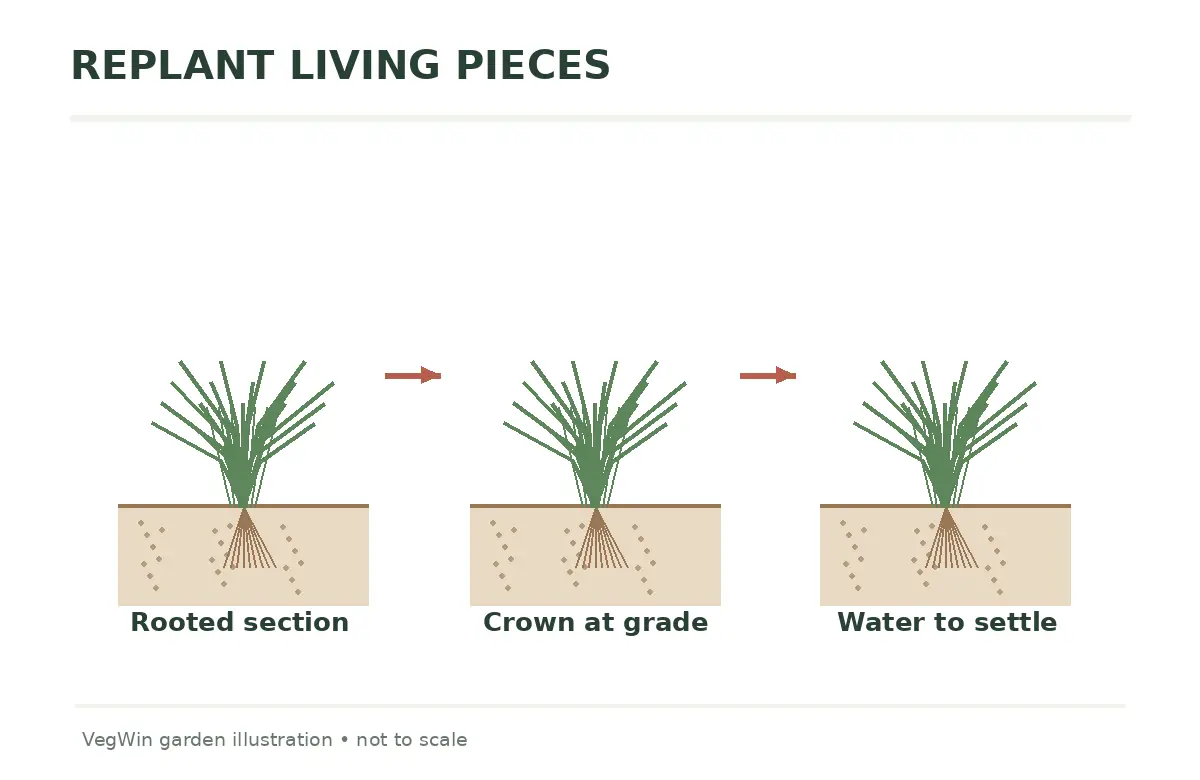
Put healthy sections into prepared soil promptly and keep the crown at approximately the level it grew before digging. Burying the bases under a deep layer of new soil can create unnecessarily wet conditions, while leaving a lifted root ball exposed makes the young division dry out faster. Firm gently to remove large air pockets without compacting the bed like pavement. Water thoroughly, then check moisture beneath the surface over the following weeks. The purpose is steady root contact and establishment, not constant saturation. Iowa State Extension advises watering newly divided perennials regularly during their first growing season and mulching to conserve soil moisture. Keep mulch off the central shoot bases so you can see what is growing. If foliage is long and flops badly after digging, follow species-specific cutback guidance; do not automatically shear every evergreen sedge as if it were a dormant deciduous grass.
Expect a recovery season rather than instant full size
A fresh division is smaller because you deliberately removed old material and some roots. Give it enough room to build its own crown instead of packing several pieces back into the original space. Monitor for steady emerging shoots and changing leaf color rather than demanding immediate plumes in the first season. Iowa State notes that newly divided perennials may not bloom well until the second growing season. Resist trying to accelerate recovery with a large fertilizer dose: where a grass is adapted to lean soils, excess nutrition can produce weak, floppy growth. Use soil-test results for any amendment decisions. If a division remains brown while neighbors are actively growing, inspect the crown and moisture before replacing it. A hot, dry spell, waterlogged planting pocket, or an accidentally buried crown can all interfere with reestablishment. Keep plant labels so you can compare its timing with the correct species next spring. Our walkthrough on how to divide Shasta daisies in spring and replant healthy crowns sets out each step.
Keep a simple record of why the clump needed work
Make a short note of the grass name, date, whether the center was dead, and the number of living divisions retained. This matters because an old, crowding clump can be rejuvenated without committing to annual division. Next season, judge the plant by its shape, placement, and strength of new shoots. If a species repeatedly outgrows a small bed, move it to a more appropriate site or replace it with a genuinely compact species rather than continually hacking it back. If new shoots appear well beyond the intended clump, confirm whether it spreads by runners or self-seeding and consult regional guidance. The most successful division is not the one that produces the most pieces. It is the one that puts healthy roots and shoots into sites where the plants can grow without constant rescue.
Related Guides
- How to Divide Bearded Irises and Replant Healthy Rhizomes
- How to Divide Hostas Without Damaging Crowns or Planting Too Deep
- Dividing Tall Garden Phlox: When, Where to Cut, and How to Replant
- When to Divide Daylilies: Keep Healthy Fans and Replant Crowns Correctly
- When to Divide Astilbe and Replant Clumps Without Drying Their Roots
How We Research and Compare These Gardening Instructions
This is a title-and-intent overlap review, not a line-by-line analysis of all previous WordPress articles. Conditions vary with plant species, cultivar, weather, and region; confirm local restrictions and follow your own Cooperative Extension for climate-specific questions. The diagrams are original not-to-scale educational illustrations. This page includes no paid recommendations or approved affiliate partnerships. Please consult our affiliate disclosure.
Sources checked on October 22, 2026: 1. yardandgarden.extension.iastate.edu — Methods for selecting rooted divisions, disposing of dead centers and replanting. 2. yardandgarden.extension.iastate.edu — When dead centers justify division and general spring maintenance. 3. www.rhs.org.uk — Cool-season versus warm-season grass division timing and tools.
No. Divide when a clump becomes crowded, loses vigor, or develops a dead center; species vary greatly.
Some species tolerate late-summer or fall division, but Iowa State generally prefers spring; use local guidance and species identity.
No. Discard truly dead central crown material and replant sections with living shoots and roots.
Set the crown at the same soil level as before, then settle soil around the roots and water.
It may take a growing season or longer to rebuild the crown; many divided perennials bloom less the first year.