
Coreopsis, or tickseed, is usually grown for cheerful daisy-like flowers and fine or divided green foliage. A pale, powdery coating on the leaves can signal powdery mildew, but white discoloration alone is not a diagnosis. The useful first step is to inspect which leaf surfaces carry fungal-looking growth, how the surrounding tissue looks and whether the plant is otherwise thriving. Distinguishing common powdery mildew from severe leaf spots or downy mildew prevents needless spraying and helps protect healthy growth.
Identify real coreopsis leaves and flowers
Coreopsis is a diverse genus, so leaf shape differs among popular garden types. Some have narrow entire leaves, while others display divided, lacy leaflets along branching stems. Flowers generally resemble small daisies, with a central disk surrounded by yellow or sometimes bicolored ray florets. Both the foliage and the flower heads must connect to stems; an isolated yellow circle is not enough to identify the plant in a diagnostic image.
Inspect the same kind of leaf on several parts of the clump. Older shaded lower foliage may show symptoms first while new growth remains clear. Record whether your plant is a narrow-leaved type or a broad-leaved selection, since a pale leaf margin can be normal in a variegated cultivar. A photograph of one diseased leaf without context can also conceal crowding, poor airflow or a neighboring plant with the actual infection.
Recognize a white powdery surface coating
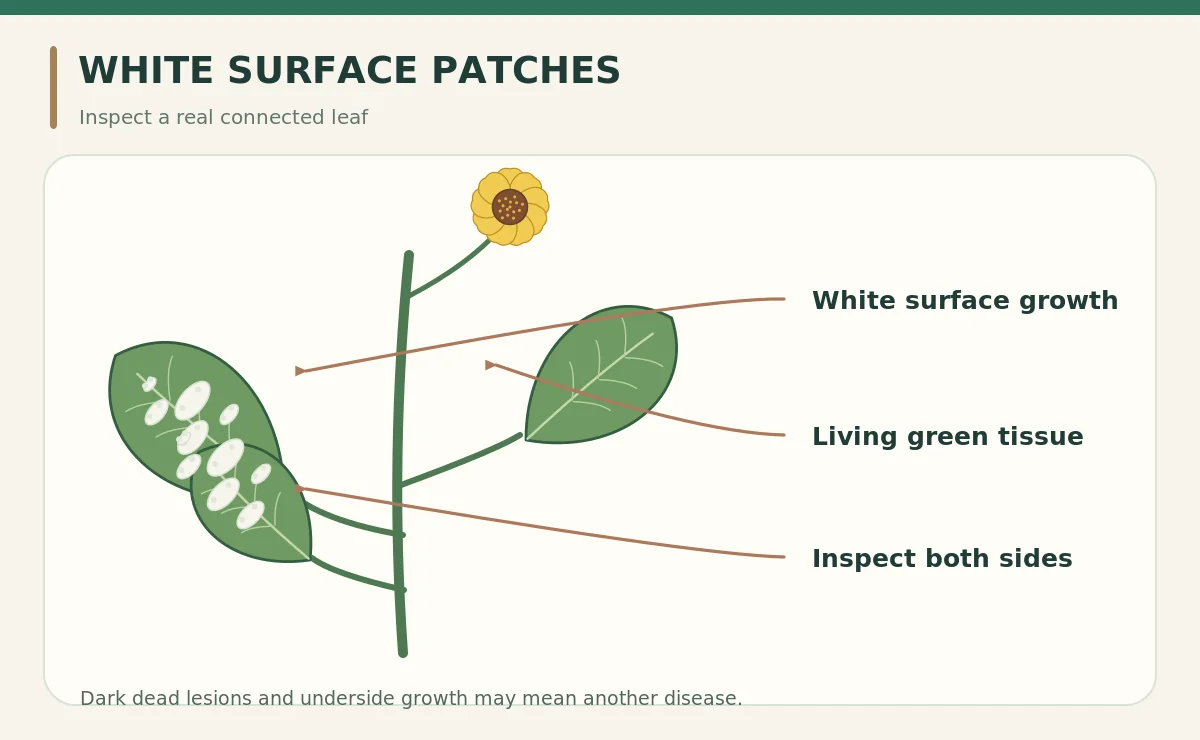
UC IPM describes powdery mildew as white to gray powdery patches that develop on leaf and shoot surfaces. Spots may expand until much of a leaf appears dusted with flour, and severe cases can distort new growth. The fungus grows in close association with living plant tissue. It is not necessary for a leaf to remain visibly wet for powdery mildew to develop, which is one reason this disease can appear during otherwise dry-looking weather.
On coreopsis, look across a cluster of real connected leaves for irregular pale fuzzy areas rather than a tidy geometric white dot on every blade. Check both upper and lower sides. The exact appearance varies with stage and plant, but a rubbing test is not a reliable basis for a final species-level identification. If the condition is only a faint reflection or mineral residue from irrigation, it may look different under magnification and will not follow typical fungal spread.
Differentiate downy mildew and dark lesions
North Carolina State Extension has documented downy mildew on coreopsis and emphasizes a different symptom pattern: dark necrotic spots on upper foliage with pale granular-looking spore production mainly beneath affected areas. Powdery mildew more often produces a conspicuous white fungal surface growth and need not create immediate dark tissue death. A healthy leaf with bright green veins is not the same image as a blackened leaf with underside sporulation.
Turn the leaf over to inspect the underside, but do so without tearing healthy stems from the plant. Check whether the spot is dark and dead, brown from an unrelated leaf spot, or truly covered by whitish fungal growth. Many different agents can make blotches, including environmental injury. If lesions progress rapidly, involve broad stem collapse or affect nursery stock, submit clear upper- and lower-leaf images to a university Extension diagnostic service rather than diagnosing from one online picture.
Decide whether mild infection needs treatment
University of Minnesota Extension recommends tolerating mild powdery mildew on many flower-garden ornamentals because it often looks worse than the harm it causes. A coreopsis clump that is still growing and flowering well with a few dusty leaves may need monitoring, not a pesticide. Identify severity by inspecting multiple stems and observing whether new leaves remain green. Remove only limited badly affected material when practical without stripping most of the plant’s foliage.
A widespread late-season infection can be unsightly, but spraying after nearly every leaf is covered will not restore the original green tissue. This is not the same as treating a food crop for safety; coreopsis is ornamental. Focus on preserving the living crown and the remaining healthy foliage. If entire stems wilt, examine water, root and crown health instead of assuming that every decline is caused by the visible mildew.

Improve light, airflow and plant spacing
UC IPM emphasizes sun, appropriate plant spacing and avoiding excess nitrogen that produces crowded, tender foliage. Thin surrounding plants where needed so air can move around the coreopsis clump. Match sun exposure to the specific variety’s requirements, and avoid placing mildew-prone plants where dense neighboring vegetation shades all their lower leaves. Do not overcorrect by abruptly defoliating a healthy perennial in midsummer.
Water the root zone according to soil moisture and drainage rather than trying to wash an entire clump repeatedly in late evening. The powdery mildew fungi do not rely on prolonged free water in the same way as many leaf-spot pathogens, but wet foliage can favor other problems. Clean up severely diseased fallen material at the appropriate season and keep weeds from sealing off the base of the plant.
Know what fungicides cannot accomplish
Minnesota Extension notes that fungicides do not cure or remove visible established powdery mildew lesions. When a valued plant has a documented history of severe infections, protectant treatment may sometimes be justified early in a season; follow the current product label and local rules. Do not interpret a general UC IPM list of active ingredients as authorization to spray a particular unlabeled coreopsis plant at an improvised rate.
Horticultural oils, sulfur and other materials can damage leaves if used incorrectly or under unsuitable heat or timing. Never mix products or substitute kitchen recipes based on a picture of a white patch. Labels and instructions differ by product and jurisdiction. For a small ornamental bed, changing plant conditions and monitoring the next flush of growth can be the more useful first action.
Build a short, repeatable inspection routine
Choose a few marked stems in the most affected and least affected sections of the clump. Each week, photograph the upper and lower leaf surfaces in similar light. Note whether the pale patches expanded, whether new leaves show spotting, and whether the plant has lost flowering vigor. This sequence makes it easier to judge severity than comparing random photos taken on different sides of the plant.
A useful disease diagram shows one connected healthy leaf, one with distinct white superficial growth, and one with dark lesions and underside signs that need a different diagnostic path. Put arrows on the actual affected tissue, not a flower petal or bare stem. A coreopsis blossom should appear in at least one image so readers can identify which ornamental is being discussed, but the main diagram should still magnify the leaf surface enough to see symptoms.

Plan next season around severity and conditions
At season’s end, review when white patches first appeared, where the clump was shaded, and whether any treatment was actually needed. Consider spacing and watering practices before next year’s regrowth. Some coreopsis varieties behave differently in humidity or crowded plantings, and nearby ornamentals can show their own powdery mildews caused by different fungal species. Do not assume that mildew must pass directly between all neighboring plants.
If the same plant repeatedly loses much of its foliage early, consult local Extension for confirmation and cultivar-specific advice. Replace a chronically unsuitable planting only after considering light, drainage and species requirements. Your goal is not an imaginary perfectly sterile garden; it is a flowering coreopsis with sufficient healthy leaves, good airflow and proportionate decisions grounded in actual symptoms.
Related Guides
- When to Sow Lanceleaf Coreopsis Seeds: Use Climate, Not Guesswork
- How to Sow Coreopsis Seeds: Light, Cold Treatment, and Species Differences
How We Research and Verify Garden Advice
We consulted the following university Extension and research-based IPM sources on 2026-10-29: ipm.ucanr.edu; extension.umn.edu; plantpathology.ces.ncsu.edu. Our decision points focus on the actual plant anatomy, seasonal conditions and observations those resources support. We compared this intent with the full supplied VegWin WordPress title list, adjacent draft-batch topics and live search results to avoid duplicating an existing article. Garden schedules and cultivar traits depend on local conditions; these illustrations explain practices but are not diagnostic laboratory results.
This educational article contains no sponsored products or paid recommendations; no affiliate partnership is claimed. See the VegWin affiliate disclosure for current site policy. Before using any pesticide, rely on current local product labels and your Cooperative Extension guidance, not on a diagram or a general online list.
Yes. Powdery mildew fungi can infect foliage without free-standing water on the leaf surface.
Downy mildew may create dark upper leaf lesions with pale spore growth mainly underneath; seek confirmation for uncertain cases.
Not necessarily. Small infections may be tolerated; removing most of the foliage can harm the plant more than mild mildew.
No. Fungicides do not reverse existing mildew damage; any approved use is mainly to protect healthy tissue.
Confirm the symptom, improve appropriate light and airflow, avoid excess nitrogen and monitor new growth.