
A hydrangea with big cone-shaped flower clusters may look similar to its round-flowered relatives until pruning season arrives. Panicle hydrangea, Hydrangea paniculata, generally produces flowers on stems grown during the current season. This allows late-winter or early-spring pruning without removing preformed flower buds in the same way that heavy pruning can harm many traditional bigleaf hydrangeas. The work still needs care: first identify the species, decide how much size reduction is justified, and make clean cuts above healthy buds rather than stripping the shrub to a random height.
Confirm the Shrub Is a Panicle Hydrangea First
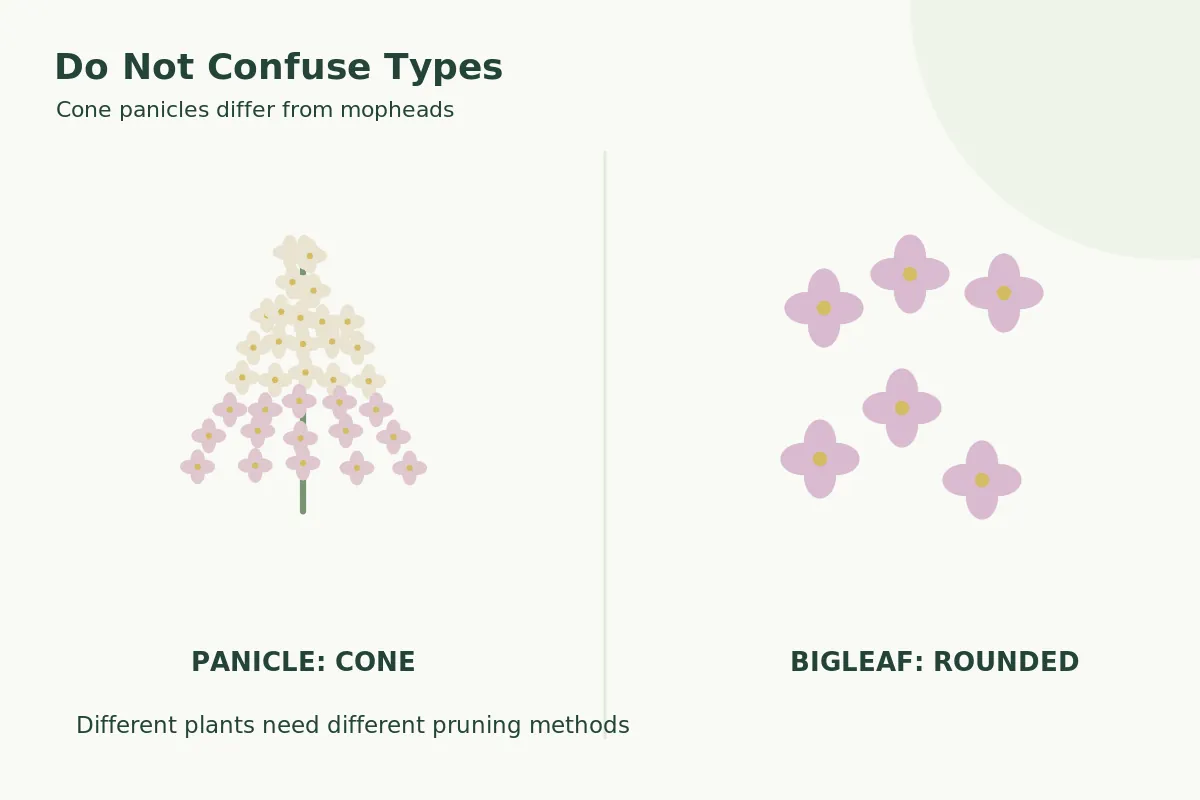
Panicle hydrangeas produce branched conical flower clusters, often maturing from pale colors toward pink or tan, on woody stems. Compare that shape with the round mophead clusters typical of many bigleaf hydrangeas. A faded winter flower is a clue, not a guarantee: cultivar differences exist, and clear identification may require a plant tag or reliable plant key. University of Minnesota Extension explicitly distinguishes panicle, bigleaf, smooth, and climbing hydrangea pruning. Do not transfer one set of cuts to all four. An unknown hydrangea deserves careful identification before any severe pruning, particularly when flower buds may have formed on the previous summer’s stems. If you want the full process, read how to prune panicle hydrangeas in late winter without losing blooms.
Understand Why New Wood Changes Pruning Timing
Panicle hydrangea produces its summer flower clusters on current-season growth. This differs from many traditional bigleaf hydrangeas that rely heavily on buds developed during the preceding growing season. The distinction explains why removing some old panicle stem tips in spring usually does not cancel the upcoming bloom display. It does not mean every pruning intensity gives the same result: very hard pruning can change stem strength, flower count, and plant shape. RHS describes spring cuts back toward a permanent framework for stronger growth. Think of the shrub as a branched scaffold supporting new flowering shoots, not as a hedge that must be sheared flat.
Use Late Winter or Early Spring in Cold Regions
The University of Minnesota notes panicle hydrangeas can be pruned in fall, late winter or spring, and specifically suggests leaving dry tan panicles through winter for interest before pruning later. RHS generally favors early spring before vigorous growth. In a cold-winter climate, waiting for the harshest freeze period to pass helps reveal dead branch tips. Mild climates follow different seasonal cues, and unusually late frosts still deserve attention. Prune when the plant is reasonably dormant or just beginning to wake, not by a rigid nationwide date. If flowering has already begun, postpone major restructuring rather than cutting away active displays. If you are starting from scratch, read When to Prune Hydrangeas.
Choose Between Light Shaping and Strong Reduction
If the shrub is well formed and not obstructing a walkway, simply remove dead, broken and awkward crossing stems and shorten selected shoots. An established vigorous shrub can tolerate more restructuring, but smaller and newly planted specimens may not need annual hard cuts. RHS notes that pruning is not essential for survival or flowering even though it can promote larger clusters. Strong pruning can encourage fewer, larger flowerheads with longer stems that may require support. Your choice should reflect the cultivar’s mature dimensions and the space available. Avoid treating a low border cultivar and a tall tree-form panicle hydrangea as identical.
Find Healthy Buds on Last Year’s Stems
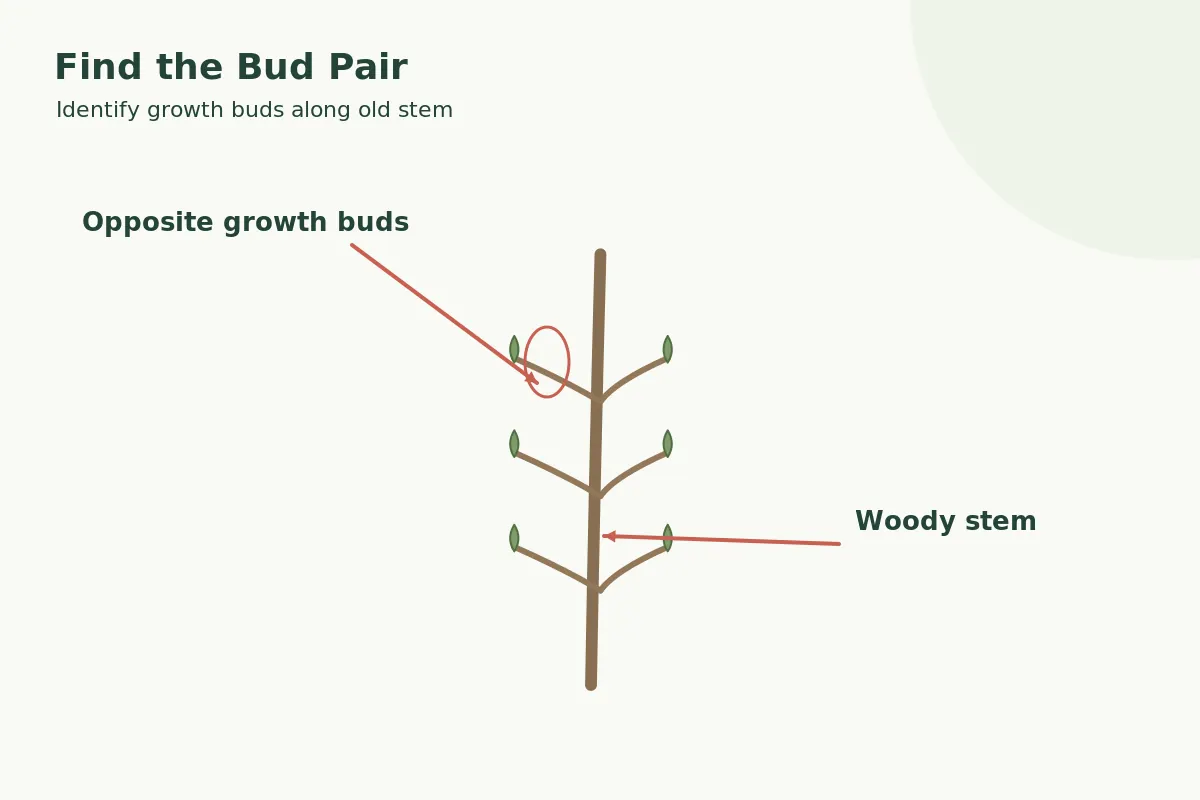
A suitable cut is placed just above a pair or set of healthy buds on sound wood. In late winter buds may look like small raised scales at the nodes; some branches will be gray and carry dried flowerheads above them. Trace the stem from the flowerhead toward the base and look for living buds before choosing a cut. Do not label any random lump of bark a flower bud; at this stage those buds will produce growth that later bears flowers. A dead brown tip above living buds can be removed, but if the whole branch is dead, follow it to the point where sound tissue or the proper removal junction begins.
Make a Clean Heading Cut Above a Bud Pair
Use sharp clean pruners on an appropriately sized stem. Cut just above a healthy bud pair so the emerging shoots have a short intact stem above them, but avoid leaving a long dead stub. University of Minnesota illustrates a heading cut roughly one quarter inch above a bud in general guidance. Keep the blade away from the bud tissue itself and do not cut through the node. A flat or mildly angled cut that sheds moisture and protects the buds is more useful than decorative steep bevels. For stems too thick for handheld pruners, use a suitable lopper and follow proper shrub-pruning methods rather than twisting the wood until it tears.

Keep a Framework Instead of Shearing Every Twig
Look at the whole panicle hydrangea before cutting the next stem. Select sound scaffold branches spaced to allow light and air, then shorten last season’s extension growth to sensible budding points. RHS describes a permanent framework for annual spring pruning; the height chosen may be low for a compact shrub or higher for a larger specimen. Shearing an entire canopy to the same level can trap congestion and cause weak branch angles. Remove dead and crossing wood independently of the general height adjustment. Step back periodically to check balance from more than one direction, especially when one side receives noticeably less sunlight. If you are starting from scratch, read When to Prune Oakleaf Hydrangea Without Removing Next Summer’s Flowers.
Handle Tree-Form Panicle Hydrangeas Differently
Some panicle hydrangeas are trained on a clear trunk as standards. Their crown can be selectively shortened and thinned, but cutting the trunk low would destroy the form. Identify the graft or training point if present and preserve the main stem and structural branches. Watch for shoots from below the desired crown and follow cultivar-specific training advice. A shrub form planted as a wide hedge can be managed differently from a single-stem feature plant. The fact that both may be Hydrangea paniculata does not justify the same hard cut. For an aging standard with large limbs or structural concerns, seek knowledgeable local help before major removal. If you are starting from scratch, read When to Prune Butterfly Bush and Why Local Invasive Rules Matter.
Understand the Tradeoff Between Flower Size and Number
Gardeners sometimes ask whether pruning harder always creates more flowers. It does not. Pruning may redirect growth into fewer strong new shoots carrying bigger cone-shaped clusters, while lightly pruned shrubs may carry more but smaller flowerheads. RHS describes pruning approaches that produce different frameworks and displays. Heavy growth can also be more vulnerable to bending under wet flowerheads, depending on cultivar and site. If a plant blooms well and holds its shape, there is no need to force an elaborate pruning schedule. Try modest adjustments over consecutive seasons and note the response rather than changing every branch at once.
Respond to Winter Damage Without Removing Live Wood
After a hard winter, inspect the bud sites and gently scratch a tiny questionable stem area if needed to distinguish living green tissue from uniformly dead wood. Start with clearly dead, broken or diseased shoots, using clean tools and proper junction cuts. Do not assume every bare stem is dead before spring warmth arrives, because bud break may be delayed. Once active growth begins, review remaining weak sections. Avoid stripping leaves or repeatedly recutting a plant because a single branch looks late. Pruning cannot cure root injury or chronic wet soil, so evaluate site drainage and watering if the entire shrub is slow to grow.
Do Not Apply Panicle Advice to Bigleaf Hydrangeas
The most costly mistake is labeling a mophead hydrangea as panicle and hard-pruning it in spring. Traditional bigleaf hydrangea commonly sets flower buds on older wood, and severe cutting may remove the current season’s potential blooms. Some reblooming cultivars flower on both old and new growth, but cultivar identity still matters. Panicle clusters are generally cone-shaped, while bigleaf clusters are often rounded or flattened. Check the plant label, flowering habit, and university species guide before pruning. It is safer to wait and identify an uncertain shrub than to perform an irreversible cut to satisfy a calendar reminder. For the basics, see our guide: When to Prune Lavender Without Cutting Into Old Woody Stems.
Use This Quick On-Plant Decision Table
| Plant form | Pruning choice | Why |
|---|---|---|
| Panicle hydrangea shrub | Head selected stems above buds | Blooms on current-season growth |
| Tree-form panicle | Preserve trunk and crown framework | Protect trained structure |
| Bigleaf hydrangea | Identify cultivar first; avoid panicle method | Many bloom on older stems |
Related Guides
- When to Take Hydrangea Cuttings and How to Root Softwood Stems
- When to Prune Bigleaf Hydrangeas Without Cutting Off Next Year’s Buds
How We Research and Verify Garden Instructions
The gardening procedures in this article were checked on 2026-10-25 against original university Extension and horticultural guidance: University of Minnesota Extension: panicle hydrangea flowers on new wood, heading cuts above buds, species distinctions.; RHS: prune H. paniculata in early spring to healthy buds on permanent framework; distinguish from bigleaf hydrangea.; RHS: spring pruning before active growth, annual pruning optional, framework choices and variation among hydrangeas.. Our comparison preserves the differences between species, growing stages, local climates and published regional planting methods. The diagrams explain the specific physical actions described above and are instructional schematics rather than diagnostic laboratory images. When a recommendation varies between references, the article identifies the variation and asks readers to follow local guidance instead of claiming one number always fits.
Plant Safety and Independent Editorial Disclosure
This page provides independent garden education, not paid placement or a claim of commercial partnership. Review the VegWin affiliate disclosure. Handle sharp tools carefully, wear appropriate protection for the task, and keep potentially hazardous plants, cuttings and products away from children and pets. Use only treatments labeled for your particular crop and location; read full directions and food-safety intervals. When plant identity, disease or local weather makes the recommended action uncertain, a regional Cooperative Extension office can offer site-specific advice.
They primarily bloom on shoots made during the current growing season, unlike many bigleaf hydrangeas.
Late winter or early spring before vigorous growth is a common choice; adapt timing to local winters.
Make a clean heading cut just above a healthy bud pair on sound wood, avoiding both bud damage and long stubs.
No. A sound framework can be lightly shaped; heavy cutting is optional and changes its growth habit.
No. Many bigleaf cultivars flower from older buds and need different pruning decisions.