
Ninebark grows naturally as a fountain of slender, arching stems. Shearing the outer leaves can make it look tidy for a moment, but often leaves a dense shell around an increasingly congested center. A better approach begins by identifying which canes are old, dead, crossing or crowding valuable new growth. Flower-focused pruning generally fits just after late-spring or early-summer bloom, while some foliage-focused rejuvenation can be done during dormancy at the cost of flowers. The goal is to choose intentional cuts and understand their consequences—not to apply the same pruning rule to every ninebark cultivar, size and climate.
Identify Ninebark and Its Natural Shape
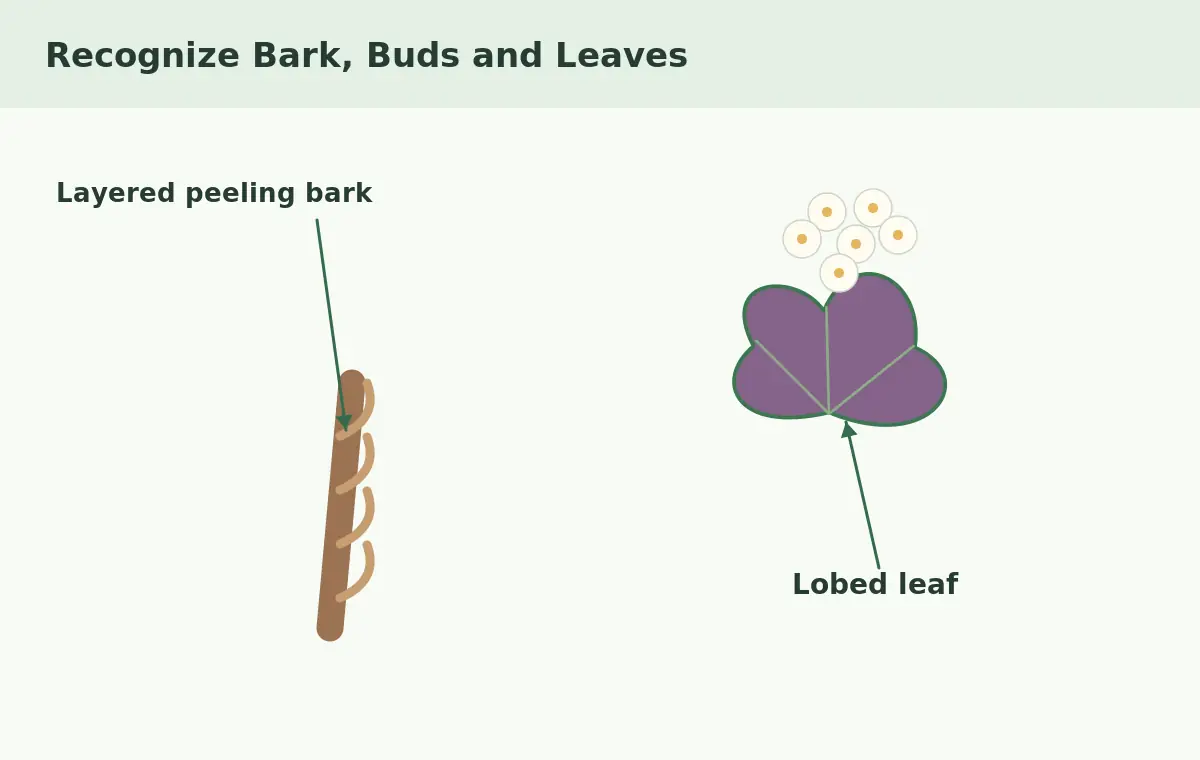
Physocarpus opulifolius is a deciduous shrub that commonly forms many stems from the base. NC State Extension describes rounded, lobed leaves, clustered white-to-pink blossoms and older bark that peels in visible layers. Its natural outline is arching rather than rigidly spherical. Purple-, golden- or green-leafed cultivars can have different mature sizes, but their stem architecture is similar. Before pruning, find the crown at soil level and trace several branches all the way from the base to their tips. A brown peeling cane may be old but alive; exfoliating bark by itself is not a reason to remove it. Look for leaf buds and healthy twigs to assess vitality.
Separate Flower Preservation From Shape Control
Ninebark flowers in late spring or early summer on older growth, so clipping branch ends in winter can remove the buds that would have flowered. NC State recommends pruning when needed just after bloom rather than late in the season. On the other hand, a shrub grown mainly for colorful foliage may be renovated during dormancy, accepting reduced flowering. The choice should follow your priority, not a blanket claim that there is only one correct month. In a region with late frosts or unusually long summers, use the actual end of bloom and the plant’s recovery time to guide decisions. Avoid new hard cuts too late for shoots to mature before winter.
Inspect the Base for Dead and Damaged Canes
Start with dead, broken, rubbing or clearly diseased wood. Follow each suspect cane down to where it arises rather than clipping only the discolored upper twig. A dead cane can be removed near the ground at an appropriate branch union without injuring healthy neighboring shoots. Healthy old bark often peels naturally, so scratch-test or look for viable buds if uncertain. Use clean, sharp bypass pruners for smaller stems and loppers or a pruning saw for larger ones. Keep the cutting blade positioned to avoid splitting a living neighbor. Removing debris first lets light into the center and reveals which canes actually need thinning.
Thin Selected Old Canes From the Crown
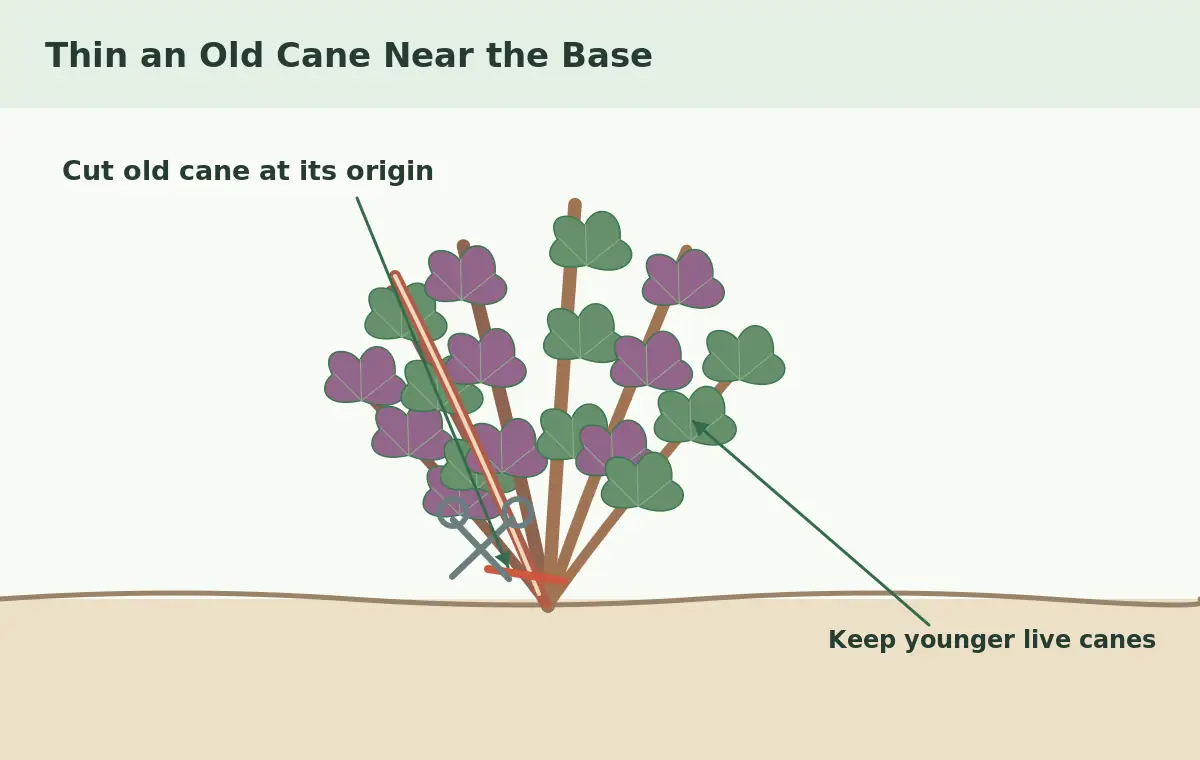
For a crowded mature shrub, select a limited number of the oldest, least productive or badly placed stems and remove each low at its point of origin. This is thinning, not shortening every cane to the same height. A conservative staged approach preserves the shrub’s natural arch and leaves enough leafy stems for photosynthesis and flowering. Never assume that exactly one-third is necessary for every young or stressed plant; the proportion depends on its health and density. Work around the crown to avoid leaving a bare hole on one side. Step back repeatedly and make the next choice based on improved spacing rather than a preset number of cuts.
Cut at the Correct Union, Not Midair
When removing a whole old cane, trace it to the base and cut close to the origin without gouging the crown or neighboring shoots. For shortening an individual branch, cut back to a healthy outward-facing side shoot or bud at a suitable junction, not a random blunt stub. A flush cut that removes the protective branch collar can compromise woody tissues; an unnecessarily long stub may die back. Observe which branch will continue the shape after the cut. A finished shrub should show openings between selected live canes, not dozens of identical stubs across the surface. Clean up fallen stems to avoid trapping moisture at the base.
Avoid Routine Hedge Shearing on Flowering Shrubs
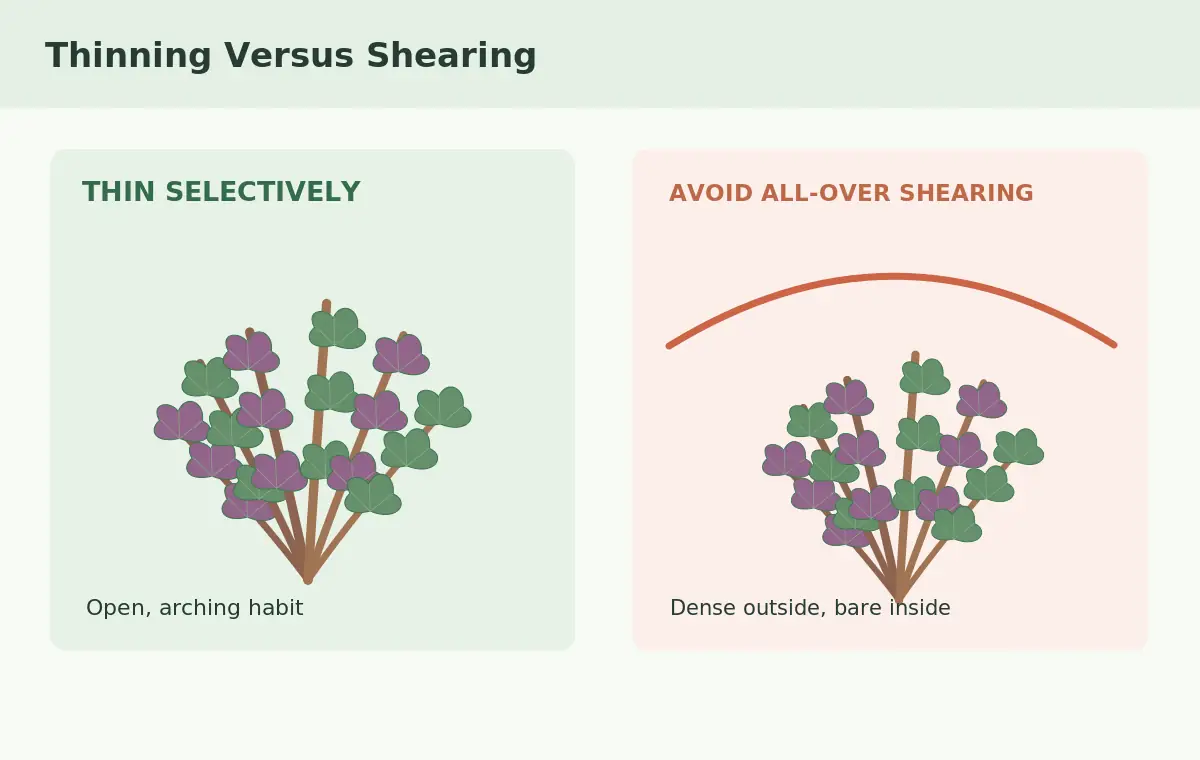
Shearing makes the outside dense and can shade the interior, leaving older wood bare inside. It also clips many flowering tips indiscriminately, especially when done in late summer or winter. If you need a true geometric hedge, choose shrubs and a management system suited to that form rather than forcing ninebark to behave like boxwood. A single too-tall limb can be shortened to a lower suitable lateral, while other branches remain long to maintain the layered silhouette. The visible result of selective pruning is uneven in a healthy, natural way: light penetrates the center and young canes have room to develop. New growth should not be immediately sheared into a compact shell.
Understand Hard Rejuvenation as a Separate Choice
An overgrown ninebark can sometimes be cut back aggressively while dormant because it can regrow from the base, but this is a renovation treatment, not normal annual flowering maintenance. Doing so removes much of the mature branch structure and generally sacrifices the imminent flowers. Older weakened shrubs may respond differently than young vigorous ones, and sudden canopy loss can expose underlying sites to heat or weed growth. If annual bloom and shelter for wildlife matter, spread renewal over multiple seasons instead. Keep the decision separate from removing a few damaged stems. Record how the plant responds before repeating hard pruning on a neighboring specimen.
Handle Young Ninebark Differently From Old Shrubs
A newly planted shrub needs root establishment and a balanced young framework more than drastic thinning. Remove injured or crossed twigs only when necessary and let the plant reveal its natural architecture. Check the cultivar’s mature width and height before trying to keep a large selection in a narrow foundation bed. If the plant is continually pushed against a walkway or window, moving it while small or choosing a compact cultivar may be more sensible than yearly severe cuts. Water stressed specimens according to soil conditions and do not assume pruning fixes an underlying drainage problem. Healthy, well-spaced young canes usually produce the structure you want later.
Watch for Powdery Mildew and Abiotic Stress
Some ninebark cultivars can show powdery mildew, which is a pale fungal growth on leaves rather than the normal light-colored underside or dusty landscape residue. Dense canes and persistent humidity can worsen air movement, but pruning alone is not a proven cure for every outbreak. Brown edges may also reflect heat, drought, salt or transplant stress. Diagnose before removing large amounts of healthy wood or spraying a product. Remove dead wood when appropriate, maintain good spacing and use root-zone irrigation. For uncertain symptoms, consult local Extension diagnosis and follow any pesticide label strictly. Do not confuse naturally peeling bark with an infectious canker.
Review the Result in the Next Flowering Season
After selective pruning, note whether light reaches the interior and whether new basal shoots appear. Photograph the same shrub before bloom and after bloom the following year rather than judging success immediately from a bare winter silhouette. Where flowering remains important, avoid clipping the new shoots late in the season, since they may carry next year’s developing buds. Remove any new branch that rubs a main cane before it becomes a thick crossing stem. If a single cultivar repeatedly grows much larger than the space, reconsider the planting design rather than forcing more frequent shearing. A balanced ninebark should keep recognizable arches with fewer congested stems.
Authoritative Sources and Further Reading
Source materials consulted for these recommendations: plants.ces.ncsu.edu garden guidance (NC State Extension describes ninebark, its peeling bark and foliage, and pruning after bloom to preserve next season flowering.). ask.extension.org garden guidance (Colorado Extension expert explains selective ninebark pruning after bloom and flowering consequences of winter pruning.). extension.umn.edu garden guidance (Minnesota Extension explains renewal thinning and different pruning windows for spring-flowering versus foliage shrubs.).
Related Guides
- When to Prune Ninebark Without Losing Next Spring’s Flowers
- When to Prune Pyracantha Without Losing Spring Flowers or Winter Berries
- How to Prune Flowering Quince After Bloom Without Losing Next Year’s Flowers
- When to Prune Rhododendrons After Bloom Without Removing Next Spring’s Buds
- How to Prune Weigela After Flowering Without Losing Next Spring’s Blooms
How We Research Plant-Care Instructions
We compared the exact plant and practical action against the named university Extension and IPM references, reviewed species and growth-stage differences, checked illustrated plant structures, and avoided unsupported pesticide doses or universal climate calendars. Sources checked October 27, 2026. Topics were screened against available B097–B124 titles and targeted site searches; the earlier B001–B096 production archive remains unavailable for comprehensive comparison.
Safety, Climate and Editorial Disclosures
Advice is educational, without a claimed paid product partnership. Conditions differ by cultivar, climate and site. Keep food and tool safety in mind, and use an appropriate local diagnostic service for uncertain problems. See the site’s affiliate disclosure for its general policies. No pesticide rates or product endorsements are implied.
If preserving flowers is the main goal, selectively prune just after the shrub finishes blooming.
Vigorous mature shrubs can sometimes be rejuvenated during dormancy, but severe pruning sacrifices much of the next bloom.
No. Exfoliating bark is a normal ninebark feature; check buds and living wood before deciding.
Selective removal of selected old canes generally maintains a more natural arching structure than repeated shearing.
Trace the entire cane to its origin and cut near the base without injuring the live crown or adjacent stems.