
A bright red beetle on a lily can be an early warning of severe leaf and bud chewing. Lily leaf beetle, Lilioceris lilii, has a distinctive red adult with a dark head and legs, but its young stages are easy to miss: females lay orange eggs in rows, and feeding larvae hide under moist dark material made largely of their own droppings. University of Maine and University of New Hampshire Extension emphasize checking the underside of leaves and acting on more than just the first visible adult. This guide helps distinguish the insect from harmless red insects, find its eggs and larvae, and make practical decisions that protect the plant without unnecessarily harming other garden life. Correct identification comes before any pesticide choice.
Confirm the Host Plant and the Red Adult
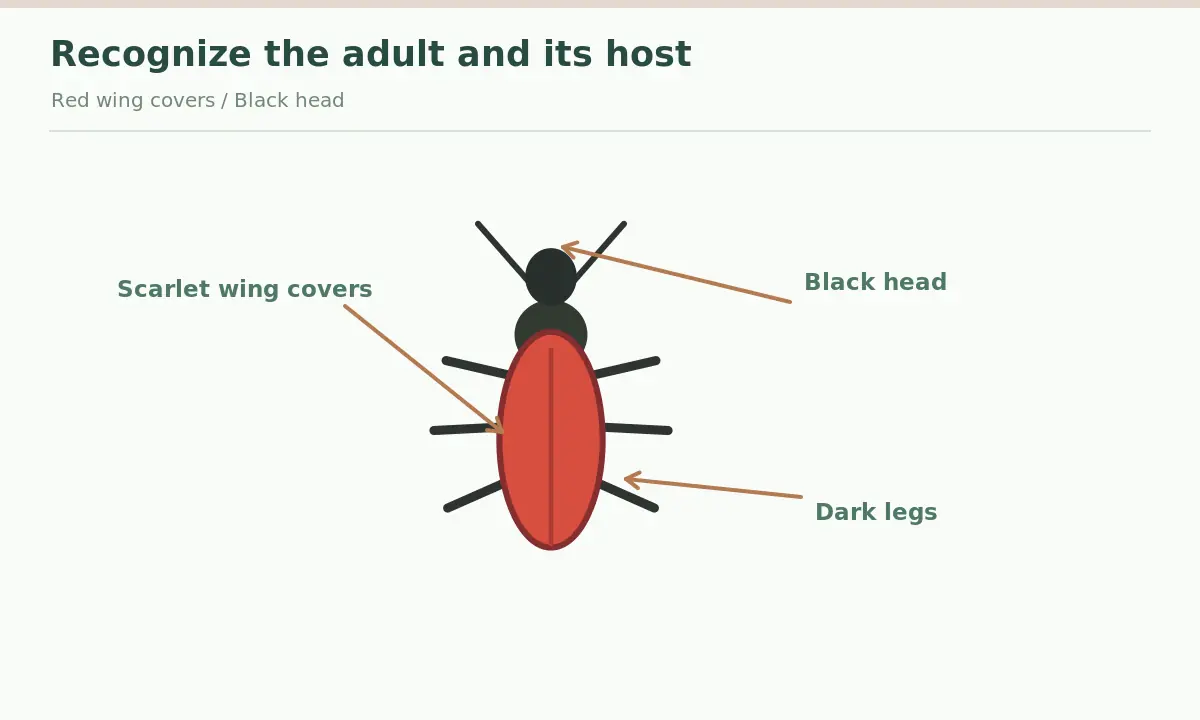
Scarlet lily leaf beetles are most conspicuous as small, shiny, bright red insects on true lilies, Lilium, and some related host plants. Their wing covers are red, while the head, antennae and legs are dark, unlike some uniformly red lady beetles or other garden insects. The body is elongated rather than broadly rounded. When disturbed, adults may drop into the soil or leaf litter, so approach carefully and inspect the foliage before shaking a stalk. University of Maine Extension describes the adult’s distinctive coloration and its capacity to chew lily leaves, buds and flowers. A red beetle on an unrelated flower is not automatically a lily leaf beetle; examine its head, host and feeding injury together. Avoid treating spotted lady beetles as pests just because both insects can appear red. If you want the full process, read how to identify common and spotted asparagus beetles before treating plants.
Turn Leaves Over to Find Orange Egg Lines
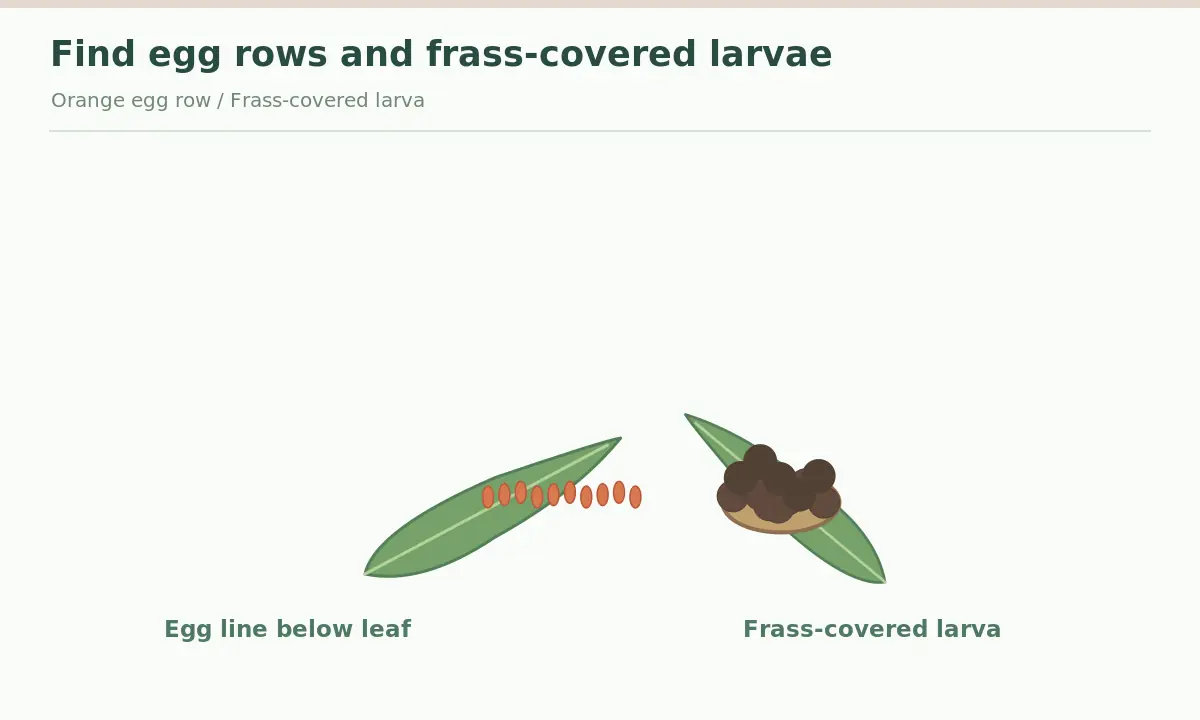
Female lily leaf beetles deposit clusters of orange to reddish eggs in irregular lines, often on the lower surface of leaves. The position matters: an upper-leaf glance may miss a dense egg row directly beneath. Look along the midrib and inner leaf surfaces and also inspect buds or flowers if activity is high. Eggs are not a guarantee that larvae are already present; they are the stage before feeding begins. University of New Hampshire Extension recommends removing eggs when found in home gardens. A gloved finger can crush a small exposed row, or a badly infested leaf can be clipped and disposed of appropriately. Avoid pulling an entire stem down when a small local removal would solve the problem. Recheck plants repeatedly because additional adults can arrive.
Recognize Larvae Hidden Under Dark Frass
The young larvae are among the most confusing stages. Rather than looking like a neat red beetle, they may resemble black-brown slimy lumps stuck on lily foliage. University of Maine Extension explains that the larvae cover themselves in a fecal shield, a protective layer of their own droppings. Beneath it is the feeding larva. This dirty covering is not itself a fungal disease or a colony of aphids. Look for fresh ragged holes or missing leaf tissue beside these dark masses. Wear gloves when removing them, and inspect both faces of the leaves. Larvae can strip a plant much faster than their size suggests when several feed together. A gardener who removes adults but ignores these dark masses may see feeding continue unabated.
Check Typical Lily Feeding Damage
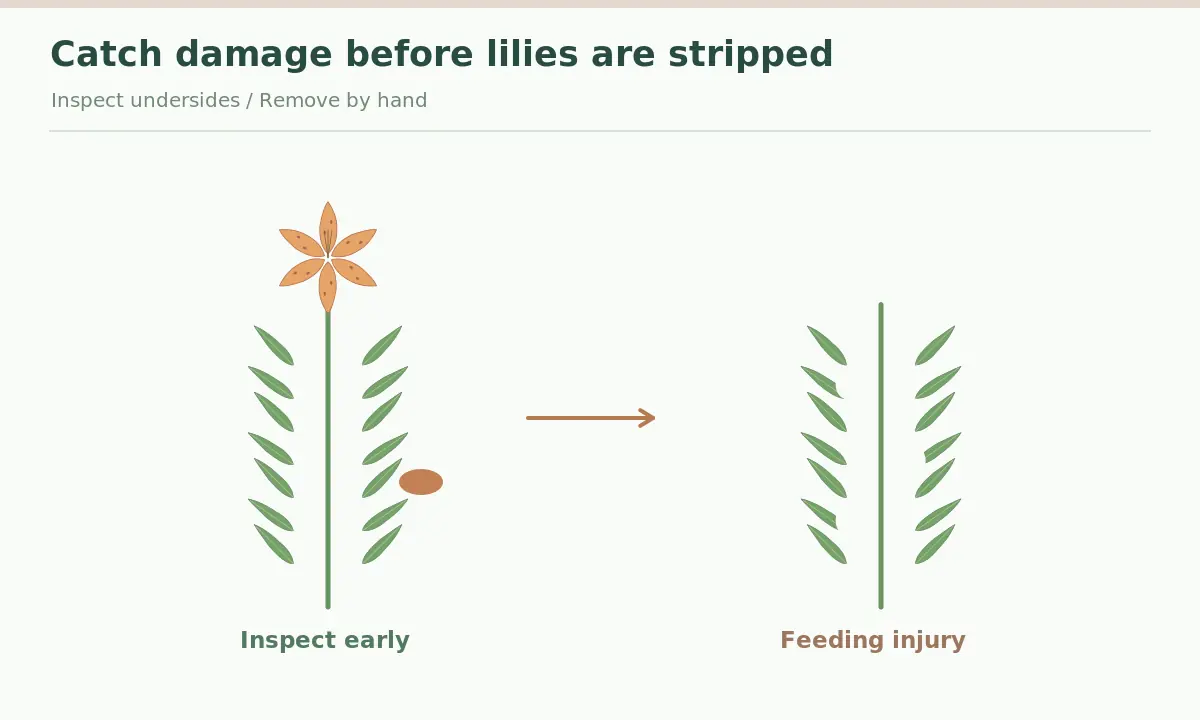
Both adults and larvae chew foliage; buds and flowers can also be injured. A few small holes may be the first visible sign, while extensive feeding can leave skeletal, shredded leaves. The exact symptom pattern depends on the growth stage and insect numbers, so do not claim that one type of hole uniquely identifies lily leaf beetle. Look for the beetle, egg rows, or frass-covered larvae near the damage to confirm the culprit. If a plant has pale leaves without chewing, investigate soil moisture, nutrient supply, disease, and weather instead. A heavily defoliated lily may still survive, but repeated loss of leaves weakens the plant’s ability to replenish its bulb and can reduce future growth and flowering. Early scouting is more efficient than waiting for near-complete defoliation.
| Situation | Better approach | Avoid |
|---|---|---|
| Red wing covers | Recognize Larvae Hidden Under Dark Frass | Skipping a species or growth-stage check |
| Frass-covered larva | Scout From Emerging Shoots Through Flowering | Relying on a rigid date or depth for every situation |
| Inspect undersides | Protect the Entire Lily Rather Than Only Flower Buds | Removing useful living tissue unnecessarily |
Scout From Emerging Shoots Through Flowering
Begin checking lilies as shoots emerge and continue while foliage, buds and flowers are present. Timing varies by regional climate, so an exact nationwide month is misleading. Inspect several upper and lower leaves on each stalk rather than sampling only the tallest plant. Approach quietly: adults can drop when disturbed. Check nearby lilies in the same planting, including plants that still look healthy. University of New Hampshire Extension advises removing adults, eggs and larvae at their respective stages. Consistent short inspections can reveal a new egg line before it becomes a large feeding group. Keep notes on what you actually find and how rapidly new damage appears. This will tell you whether hand control is keeping up or whether you need additional local IPM guidance.
Hand-Remove Adults, Eggs, and Larvae Carefully
For a few lily plants, physical removal is often practical. Place a container beneath an adult before reaching for it, since the beetle may drop. Pick adults off by hand or shake them into a collection cup. Crush egg rows while leaving as much healthy leaf as possible. Remove frass-covered larvae with a gloved hand or a small tool; washing an entire plant blindly may simply move larvae onto nearby foliage. University of New Hampshire Extension describes dropping insects into soapy water as one home-garden method. Dispose of collected insects rather than releasing them at the other end of the same bed. Wash hands and tools after handling insects and plant material. No single inspection clears a garden permanently; repeat while beetles remain active.
Distinguish Lily Beetles From Beneficial Red Insects
Lady beetles tend to have more rounded dome-shaped bodies, often with visible spots, though spots alone are not reliable across all species. Lily leaf beetles have an elongated red-backed form, a black head and long dark antennae. Plant context helps: a shiny red beetle repeatedly feeding on true lilies and accompanied by orange egg lines is strongly suspect. Soldier beetles and other red insects may also visit flowers, so avoid killing every red insect in a mixed border. Do not confuse the frass-covered larvae of lily leaf beetles with bird droppings or plant disease without examining the underside and nearby chew marks. If identification remains uncertain, submit clear close-up images and host details to a university Extension diagnostic service before choosing control measures. Our walkthrough on how to identify bean leaf beetles on snap beans and limit damage sets out each step.
Protect the Entire Lily Rather Than Only Flower Buds
True lilies depend on their green leaves to feed bulbs for the following year. Losing foliage early is not simply an aesthetic problem. Reduce heavy infestations promptly, while avoiding unnecessary removal of healthy leaves. A badly damaged leaf may still be photosynthesizing, so choose targeted insect removal over stripping whole stems. Do not automatically confuse lilies, Lilium, with daylilies, Hemerocallis, or other plants whose common names include lily; the host range of the beetle is specific, and management can differ. If a favorite cultivar is heavily infested, inspect nearby Lilium plants and ask local Extension services about patterns in your area. A plant that is already damaged also benefits from basic care: avoid drought stress and root disturbance while it retains foliage.
Decide Whether an Insecticide Is Justified
Pesticide decisions should start with confirmed identity, actual injury, garden size, and repeated scouting, not a generic homemade spray recipe. For small plantings, Extension sources favor hands-on removal as a reasonable first response. Larger plantings with persistent heavy feeding may need advice about locally registered products and correct growth-stage application. Never substitute a pesticide recommended for a different pest or region. Follow the label’s host, timing, pollinator, protective-equipment and environmental restrictions exactly, and avoid spraying flowers visited by bees unless the specific label and local regulations permit a necessary use. Treatments are not harmless merely because they are called organic. Where sensitive habitats or pets are present, physical control and expert IPM help may be especially appropriate.
Prevent Another Cycle With a Simple Tracking Routine
At the end of a scouting visit, note the number of adults removed, egg rows found, larvae present, and leaves damaged. On the next visit, look for new stages rather than assuming the issue is solved because the visible red adults are gone. Remove old plant debris appropriately when local Extension guidance recommends it, but do not claim fall cleanup alone will eliminate beetles that can overwinter elsewhere. Some gardens have only isolated arrivals while others face repeated waves during the season. Focus on preserving healthy green leaf area and catching the larval stages early. If a plant continues losing leaves despite hand-picking, re-evaluate whether you missed underside egg masses or misidentified the pest. Consistent observation produces a better response plan than calendar-based spraying. Our walkthrough on how to recognize leafminers on beets and protect the leaves early sets out each step.
Related Guides
- When to Divide Asiatic Lilies and Replant Bulb Offsets Correctly
- When to Plant Asiatic Lily Bulbs and How to Avoid Bulb Rot
How We Research and Verify This Guidance
Sources checked on 2026-10-24: extension.umaine.edu — University of Maine Extension: lifecycle, orange egg lines, fecal-shield larvae and injury; extension.unh.edu — University of New Hampshire Extension: recognition and hand removal of adults, eggs, and larvae. We compared identification and practical growing guidance, selected recommendations tied to observable plant or pest stages, and avoided translating regional examples into a universal U.S. calendar. The illustrations are simplified educational drawings, not life-size botanical plates. Local climate, species, cultivar and growing conditions should be checked before acting.
Disclosures, Safety, and Regional Differences
This is general educational gardening information, not personalized medical, agricultural, or pesticide advice. No endorsement, paid relationship, or affiliate arrangement is claimed in this article. See VegWin’s affiliate disclosure. Follow your local Cooperative Extension and legally required pesticide labels when applicable. USDA hardiness zones are not a sowing or pruning calendar, and no invented fertilizer or chemical application rates are supplied.
It is an elongated beetle with glossy scarlet wing covers and a dark head, legs, and antennae.
Females often lay orange-red eggs in lines on the underside of lily leaves and sometimes on buds or flowers.
Larvae hide beneath a fecal shield made from their droppings, which can appear as a dark wet lump.
Small infestations on a few lilies often can be managed by repeated hand-removal of adults, eggs, and larvae.
Severe repeated defoliation can weaken bulbs by removing the foliage that helps store energy for future growth.