
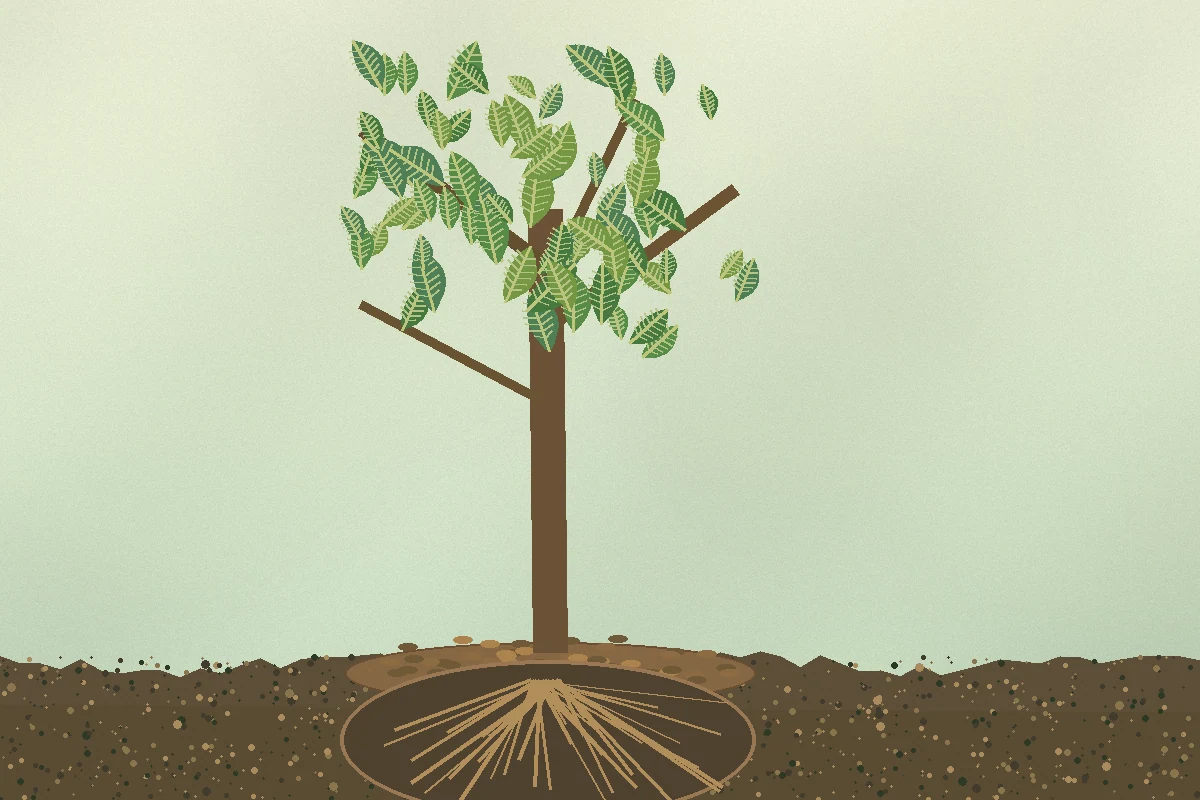
A newly planted tree may stand in a large circle of wet soil and still have a dry root ball. The reason is straightforward: most of the roots initially remain inside the soil or growing medium that arrived from the nursery. That material may drain or dry at a different rate from the native soil backfilled around it. Iowa State Extension advises checking the original root ball itself; watering the surrounding lawn is not a reliable substitute for hydrating that concentrated root system.
The goal is not to deliver a fixed number of minutes from a hose regardless of the site. It is to establish an observation-and-watering routine that wets the roots without leaving them continuously saturated. University of Minnesota Extension provides establishment schedules and volume guidance as starting points, but soil texture, drainage, rainfall, nursery stock and weather modify real needs. This article offers a two-location moisture check that prevents both the “wet lawn, dry tree” and the “water every day forever” mistakes.
Find the root ball and keep the trunk flare visible
Before watering, look at how the tree was planted. The root flare is the widening where the trunk transitions into the main roots and should not disappear beneath a mound of soil or bark. A deeply buried flare is a planting problem, not a watering-frequency problem. Identify the outline of the original root ball from the planting hole or nursery container dimensions; that is the critical target for early irrigation. If a tree is newly installed but its flare is buried, consult local Extension planting guidance to correct depth.
Set mulch in a broad, relatively shallow ring over the planting area while keeping it back from the trunk. University of Minnesota Extension warns against a mulch volcano that contacts the bark or excludes oxygen and water. The mulch should conserve moisture and reduce competition from turf, not conceal the root flare or act as a waterlogged blanket. If the planting site is a low spot that collects standing water, irrigation changes alone cannot fix inadequate drainage.
Check moisture in two separate places
For the first location, pull mulch aside and feel within the actual root ball a short distance from the trunk, avoiding damage to major roots. Iowa State suggests that a newly planted tree needs water as its root ball begins to dry, and explains that this often occurs before the adjacent soil dries. The second location is the surrounding backfill soil at a similar workable depth. Record both observations: dry ball with damp backfill, damp ball with dry backfill, both damp, or both dry.
Each pairing means something different. A dry ball with moist backfill needs careful water directed into the ball and a check that the original nursery medium actually absorbs it. A wet ball with dry surrounding soil means you should avoid automatically soaking the already wet root center while also recognizing that new roots need access to moisture outside it. If both are saturated, wait and look for drainage problems. If both are dry, water slowly across the entire young root zone and check penetration afterward. This is a field decision framework, not a laboratory soil-moisture measurement.
Apply water slowly enough to soak the intended roots
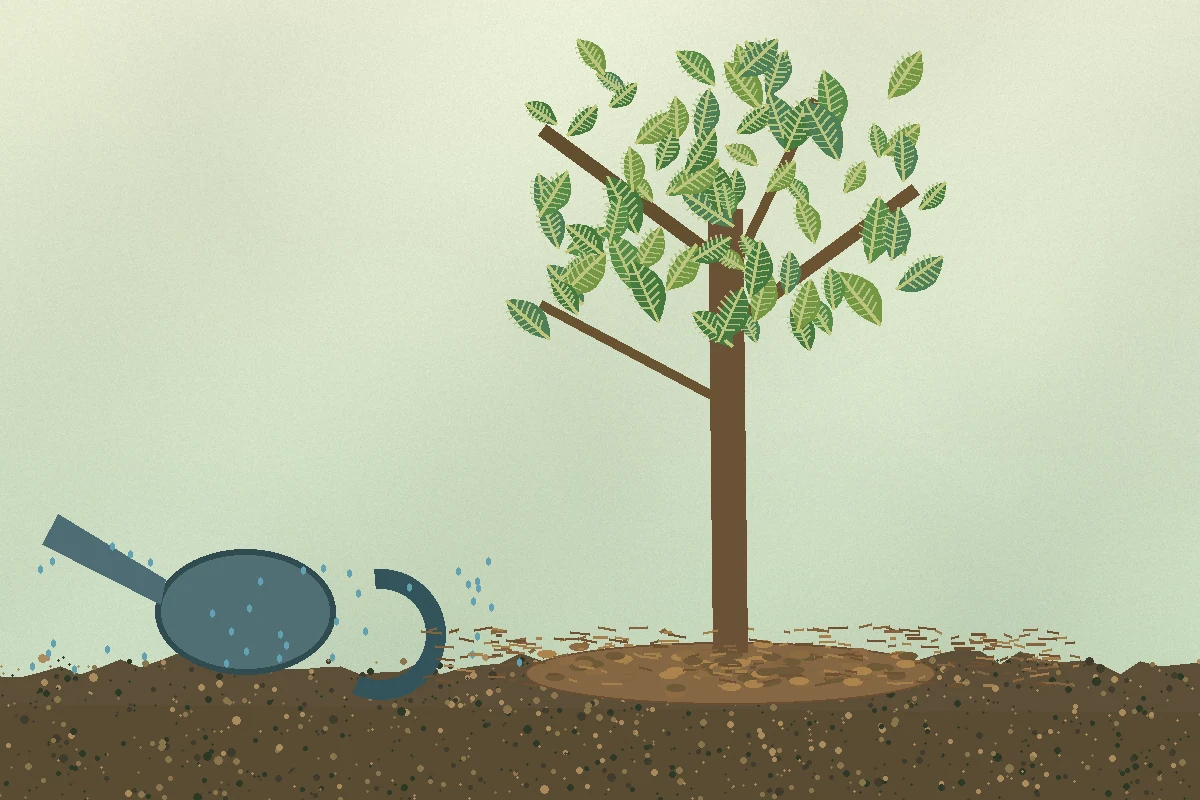
A hose with a gentle flow, watering wand, soaker hose or spot sprinkler can work. Avoid a fast stream that runs off or cuts channels through mulch. Iowa State Extension specifically recommends wetting the entire original root mass, moving a slow trickling hose when necessary rather than letting it wet only one point. As the plant establishes, broaden coverage beyond the original ball to encourage roots into the surrounding soil. Tree-watering bags may help meter water, but the fact that a bag emptied does not prove the root ball retained enough moisture.
Rain requires the same verification. A brief shower may make the surface look dark while leaving the root ball dry. Substantial rainfall can replace a scheduled irrigation when it actually wets the root zone. Conversely, heavy clay soil may remain wet long after the storm has passed. Do not infer a universally correct number of gallons from trunk height alone; University of Minnesota’s volume-by-caliper guide is calibrated guidance to adapt with actual soil checks, not a mandate to add water over already saturated ground.
Treat published watering schedules as starting points
Newly planted trees normally need more frequent attention than established trees. University of Minnesota Extension offers a staged watering schedule during the early weeks after planting, then less frequent irrigation as establishment progresses. That is a useful reminder to inspect frequently at first, but it is not permission to ignore rainfall, drought, drainage and the size of the nursery root ball. In very sandy soil, a check may call for water sooner; in poorly drained soil, another watering may suffocate roots already lacking oxygen.
Create a short log of date, recent rain, ball moisture, backfill moisture and action taken. Make the next check sooner after hot windy weather or a newly discovered dry spot, and later when cool damp conditions persist. You are learning how this particular site behaves rather than programming a timer for every tree on the street. If a tree declines despite sensible moisture management, investigate planting depth, roots, pests, trunk injury and site suitability with local Extension assistance.
Avoid common mulch, sprinkler and soil mistakes
Turf irrigation often wets a wide surface shallowly and frequently. It may fail to penetrate a root ball deeply enough or may keep parts of a clay planting hole chronically soggy. University of Iowa Extension’s forestry guidance discusses this conflict. When possible, establish a separate irrigation area for new trees. Water slowly into the rooting zone and check where the water went. Avoid using wilted foliage as your only signal: heat, root damage and excess water can all cause similar aboveground stress.
Do not excavate aggressively around the new tree to perform daily tests. A narrow hand probe or small inspection spot just below the mulch is sufficient for repeated checks. Replace disturbed soil gently afterward. If the root ball is difficult to identify, ask the installer which type of nursery stock was used: container-grown, balled-and-burlapped and bare-root trees have different starting root arrangements. The core principle remains to wet actual roots, encourage movement into backfill and avoid persistent saturation. If you want the full process, read how to repot a Japanese maple without burying the root flare.

Shift from root-ball watering toward a wider root zone
Over time, roots move into surrounding native soil. Expand the watering area rather than keeping every application tight against the trunk. Watering a mature tree is a different task: the active root system extends widely, and management focuses on the broader root zone. University of Minnesota has separate guidance for established trees; avoid applying new-transplant schedules indefinitely to a tree whose canopy and root spread have become well established.
The transition is gradual. In your record, watch for steadier moisture in the original ball, new growth appropriate to the species, and less dramatic drying between visits. These clues can suggest progress, but they do not prove that a root system has completely established. Tree size, climate and planting conditions change the length of establishment. During a prolonged drought, even an older tree may need supplemental watering; the approach simply covers a much broader portion of the soil.
How We Research transplant watering claims
We checked Iowa State University and University of Minnesota Extension guidance on October 21, 2026. Their advice supports checking the original root ball, wetting both it and the developing root zone, and preventing oxygen stress from overwatering. The two-location check here is an editorial decision aid; it should be adapted to local soils and species. Illustrations are conceptual editorial artwork, not photographs of soil moisture or root distribution.
Extension evidence for tree root ball moisture decisions
Our practical guidance on root-ball versus surrounding soil moisture, establishment watering and trunk flare care is grounded in these Cooperative Extension resources: Iowa State University Extension — Newly Planted Trees; University of Minnesota Extension — Watering Newly Planted Trees; University of Maryland Extension — Planting Trees. Access checked October 21, 2026. Regional guidance may differ by climate and growing conditions.
Editorial disclosure: This article contains no affiliate product links, paid placements, or sponsored endorsements. All plant images are original editorial illustrations, not documentary photographs. See the VegWin affiliate disclosure.
The nursery root ball may dry faster than surrounding soil, especially if the materials differ. Feel the actual root ball before deciding.
Not indefinitely. Early frequent checks are important, but irrigation should reflect root-ball moisture, drainage, weather and tree size.
Start by thoroughly wetting the original root mass and some surrounding backfill; broaden the wetted area as roots grow outward.
Yes. Keep mulch away from the trunk and root flare, and avoid excessively deep applications that retain too much water or limit oxygen.
The transition takes time and varies with stock size, species and site. Expand the area gradually instead of assuming an exact universal number of months.