
Disclosure: This article offers independent educational guidance, not a paid endorsement or a verified affiliate recommendation. See our affiliate disclosure. Local Extension resources, plant variety, regional conditions and product labels take precedence over general examples.
Sweet potatoes are not started the way ordinary potatoes are. What a gardener plants is usually a vine shoot called a slip, grown from a sweet potato storage root. This distinction matters because a cut piece of grocery-store sweet potato is not the usual field planting unit, and a healthy-looking vine does not guarantee disease-free planting stock. For the fuller picture, see our guide “Harvest and Cure Sweet Potatoes Without Bruising or Chilling”.
This guide is about making or choosing slips and moving them to warm ground, not a complete season-long sweet potato growing guide. You will select healthy source roots, create a consistently warm propagation area, recognize harvestable shoots, and decide whether a purchased slip is ready to plant or needs short-term protection.
Start With Disease-Conscious Planting Material
Sweet potatoes are vegetatively propagated: each slip carries the genetics and possibly pathogens of its source plant. Illinois Extension advises gardeners to buy slips raised from certified disease-free roots where available. Seed catalogs and reputable specialty growers provide identified varieties and more traceability than an unknown grocery root. Disease-free status must be documented rather than inferred from a glossy root.
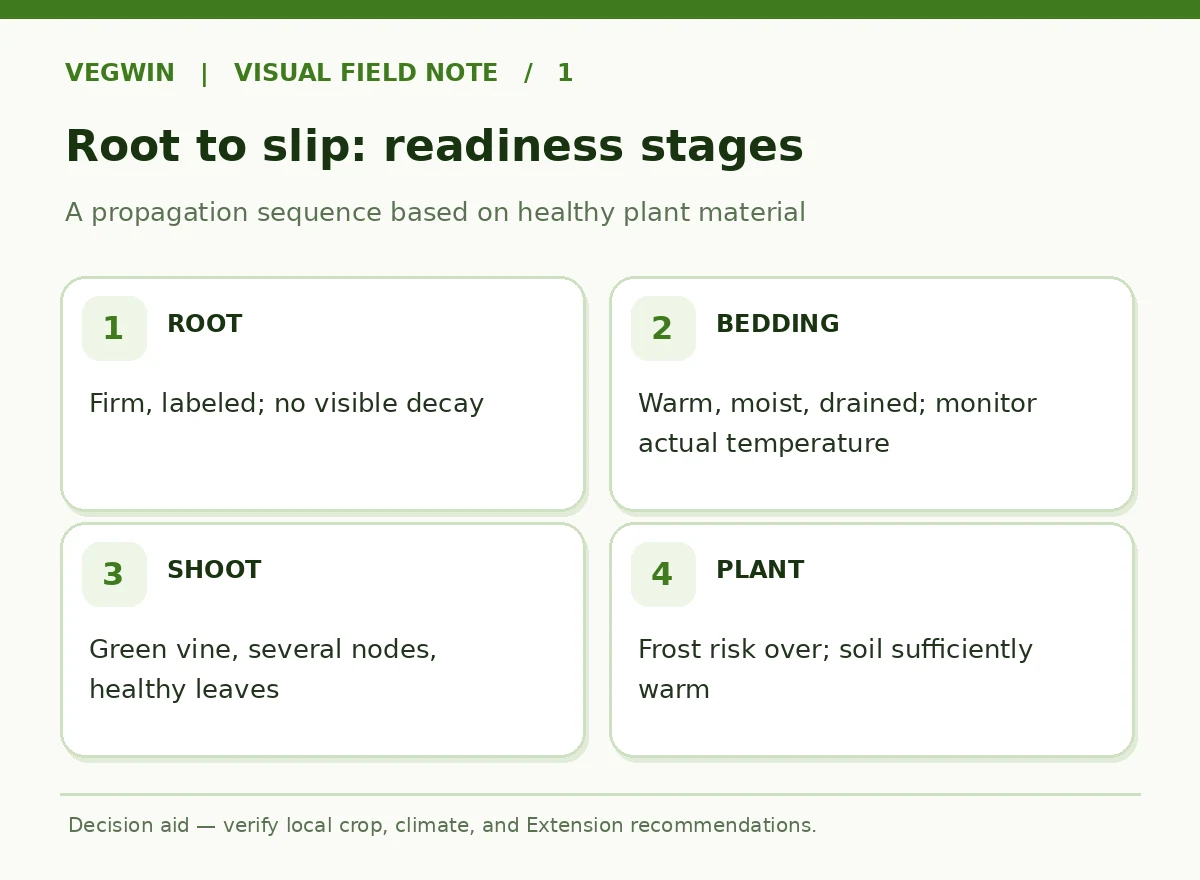
If you propagate your own, choose firm, healthy roots without mold, soft spots or suspicious lesions. Reject material showing decay; do not bury an obviously rotten root and hope warm weather sanitizes it. Grocery roots may have an unknown cultivar name or may have received sprout-inhibiting treatments, so the result can be inconsistent. Some varieties also have propagation or patent restrictions; check rights before propagating protected material.
Keep starting roots from different sources labeled. A homegrown slip from a reliable disease-free plant may be appropriate for a learning bed, but it should not be represented as certified stock. Clean propagation containers and fresh suitable mix lower unnecessary contamination.
Create the Warm Moist Root-Bedding Environment
Place a sound root on its side in a clean container of loose moist growing medium, partially covering it as directed by your source. Washington State Extension describes keeping root bedding around 80–85°F and humid while avoiding a wet, rotting mass. University of Maryland describes roughly 75–85°F for its home slip method. These are propagation conditions, not a garden planting date. For the fuller picture, see our guide to growing potatoes at home.
Use a tray with drainage and a warm location; a thermostatically controlled heat mat can help only when monitored. Keep the medium moist rather than waterlogged. A transparent cover can preserve humidity early, but vent it if condensation accumulates, and remove it when new shoots press against the cover. Once green shoots develop, provide adequate light so they do not become thin and pale.
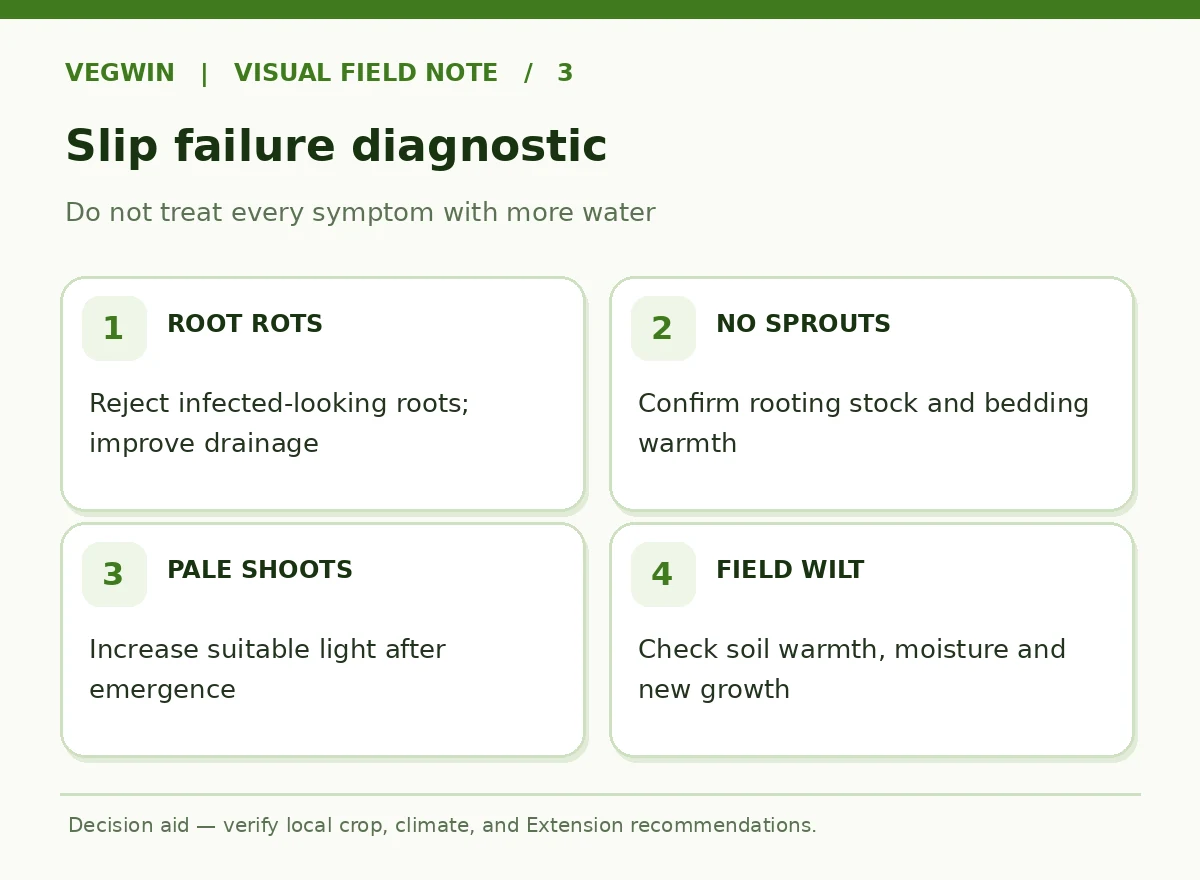
Check every few days for softness, odor or fuzzy growth on the root. If tissue is rotting, remove the root instead of adding more heat and water. Sprouting speed varies with variety, root condition and temperature. Beginning several weeks before your projected safe outdoor planting window is more reliable than expecting instant shoots.
Know the Difference Between a Sprout and a Slip
A tiny bud is not yet useful planting material. A slip is a developed vine shoot with several nodes that can establish new roots after separation. Guidance differs on the preferred cut length: commercial Washington State material often describes vine segments roughly 6–12 inches long with 5–8 nodes, while home guides use visual maturity and the presence of leaves. Follow the specific source rather than treating one measurement as universal.
Lift or cut slips in the manner used by your Extension method, using clean hands or tools. Commercial disease-aware systems may cut above the bedding surface to avoid transferring soil-borne organisms. Other home systems gently pull shoots from the mother root and may temporarily root them. Neither a glass of water nor a rooted pot guarantees that the subsequent storage roots will form better.
Hold the slip by its stem, not by pulling leaves. Reject blackened, slimy or collapsing shoots. Keep newly cut slips hydrated and out of intense sun while arranging planting. A strong slip can still wilt briefly after field planting because it must form an effective root system.
| Observation / option | What to verify | Practical decision |
|---|---|---|
| Firm healthy root | Accept; label source and variety | Start in moist warm bedding |
| Soft or moldy root | Reject; not a heat problem | Discard and clean tray |
| Green vine with nodes | Assess slip maturity and source method | Cut or lift cleanly |
| Rootbound potted slip | Check roots and holding period | Plant promptly if outdoor conditions suitable |
| Cold outdoor soil | Wait even if vine is large | Keep protected with good light |
Compare Rooted and Unrooted Slip Options
Unrooted slips are commonly planted directly into a warm, moist prepared field bed. Washington State Extension notes that prereooting in loose media can help establishment in some cooler short-season settings, but it is not universally required. A heavily rootbound prereooted slip is not an upgrade and can form misshapen storage roots.
If planting must be delayed, keep cuttings protected and moist, following supplier instructions. If prereooting, use well-drained media and monitor root development rather than leaving shoots crowded indefinitely. Do not treat a vessel of stagnant water as the automatic best way to create vigorous roots; some Extension methods use brief water rooting, while current WSU guidance favors loose media for field establishment.
Write down whether a slip is rooted, freshly cut or already stressed by shipping. That informs initial irrigation and handling. Do not mix cold-stored, desiccated material with healthy new cuttings and then interpret uneven establishment as variety performance.

Plant Only After Frost Risk and Soil Warmth Align
Sweet potatoes require sustained warm weather and are damaged by frost. The University of Maryland lists about 65°F soil as a planting benchmark for its guidance; nearby regions and cultivars may warrant different local timing. Check soil temperature in the bed and local frost expectations, not a USDA perennial hardiness zone or a fixed date from a distant state.
Prepare well-drained soil with enough room for spreading vines and storage roots. Spacing recommendations vary by region and system: use the seed supplier or your state Extension planting guide rather than a supposedly universal number. Place several appropriate lower nodes into the soil while keeping the shoot tip and healthy leaves above it, as described by your local source.
Water the planting area promptly and keep the root zone consistently moist while slips establish. Soil that stays saturated invites problems, while dry soil can leave newly planted cuttings without water before new roots develop. Wait to judge growth until shoots have had time to establish. To go further, our guide “Vegetable Transplanting” shows how to set out strong seedlings without root stress.
Triage Weak Sprouting and Early Slip Failure
No sprouts after an expected interval may mean the bedding was too cool, the root was treated to inhibit sprouting, or it is unhealthy. First check actual media temperature and root firmness. If the root is firm and clean, correct temperature and moisture before giving up; if it is soft and foul, discard it rather than introducing pathogens to the bed.
Pale stretched shoots often indicate insufficient usable light after emergence. Adjust lighting rather than adding fertilizer by guesswork. New leaves that fold or wilt during shipping may recover under protected, moist conditions; persistent stem collapse or blackening warrants rejection. Keep a dated photo so recovery can be judged by healthy new growth.
When in doubt about persistent disease-like symptoms, contact a plant diagnostic service with clear photographs and plant origin details. A schedule cannot substitute for identifying a pathogen. The most reliable home test is a small labeled trial using documented starting stock, not an unverified claim that every root source yields identical plants.
How We Research and Apply Local Exceptions
This article adds one specific reader job: A healthy-root-to-slip readiness workflow compares clean purchased planting stock with home propagation and gives explicit stop rules for rotting roots, weak shoots and cold soil. We keep claims traceable to crop biology and site conditions; we do not treat a hardiness zone as an annual planting calendar or presume every cultivar reacts alike. Original diagrams illustrate decision logic rather than experimental data. Also not a generic warm-season planting article.
Sources reviewed 2026-10-20: University of Maryland Extension — Growing Sweet Potatoes; Washington State University Extension — Sweetpotato Slip Production; University of Illinois Extension — Sweet Potato; University of New Hampshire Extension — Growing Sweetpotatoes; Washington State University Extension — Sweetpotato Production Practices. Each source supports the specific factual points recorded in this article’s metadata. These sources are independent educational institutions, not product partners. Recommendations and guidance may be updated; consult your regional Cooperative Extension office for local conditions and read the VegWin disclosure for the site’s commercial policy.
Frequently Asked Questions
No. Sweet potatoes are generally planted as vine shoots derived from storage roots; ordinary potatoes are planted using seed tubers or tuber pieces.
Sometimes, but the cultivar, disease status and sprout-inhibiting treatment may be unknown. Certified disease-free planting stock is preferable when available.
Not always. Unrooted slips are routinely used when soil is warm and moisture is managed; some short-season settings may benefit from carefully prereooted plants.
Check whether the root was damaged or diseased, whether media remains waterlogged, and whether the tray lacks drainage. Discard rotting material.
Use locally verified soil warmth and frost guidance. Maryland Extension gives around 65°F soil as a benchmark, not a national planting date.