
Disclosure: Independent educational gardening content, not an advertisement. There are no confirmed affiliate approvals for this guide; review the site disclosure. The recommendations that follow distinguish crop biology from universal shortcuts. This article addresses old varieties, clear choices, and links to source-specific Extension and federal guidance before the FAQ.
Understand What Heirloom Means on a Seed Packet
An heirloom vegetable is usually an older variety whose seed or planting material has been maintained across generations. Many descriptions use a history of decades, but there is no single universally enforced age threshold. Heirloom is not an official guarantee of organic production, disease resistance, high yield or suitability for your climate. The practical difference is a known variety identity and an origin story that matters to its growers. UF/IFAS Extension emphasizes heritage and local adaptation, while Utah State University Extension notes that not every open-pollinated variety deserves the heirloom label.
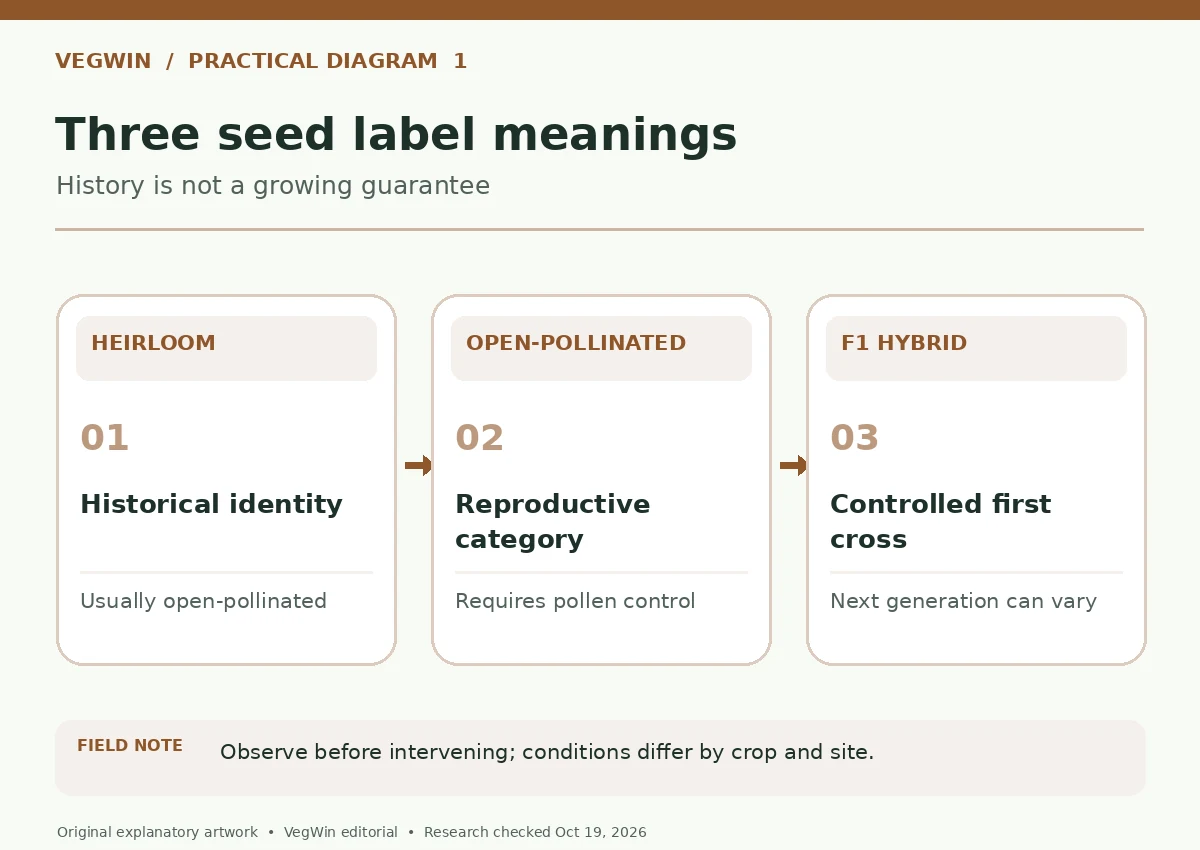
Seed packets may say heirloom, open-pollinated, heritage or F1 hybrid. Those terms describe different things. Heritage refers to history; open-pollinated refers to reproduction under suitable isolation; F1 hybrid indicates a specific controlled cross. A new open-pollinated selection can be very useful without being old. A treasured heirloom can perform poorly in a region where disease pressure, summer humidity or season length differs from the place where it was maintained. Buy for documented traits rather than assuming old equals better or modern equals bland.
Separate Heirloom, Open-Pollinated and F1 Labels
Most vegetable heirlooms are open-pollinated, meaning that—when a variety is pollinated without unwanted crossing—its offspring tend to resemble the parent population. That does not mean seed purity happens automatically. Nearby compatible varieties, insects and cultivation history can change the next generation. Open-pollinated seed also exists for modern cultivars that have no long family history. Utah State and Minnesota Extension both describe that distinction; the easiest way to remember it is that heritage and reproductive predictability are related, but not identical questions.
An F1 hybrid is produced by a deliberate cross of chosen parent lines. Its plants may have useful disease resistance, vigor or uniformity. Saving seed from the hybrid fruit is not a reliable way to reproduce the original F1 combination; the next generation segregates. This is not proof that its seeds are sterile or that hybrids are harmful. Many F1 plants set viable seed, but the resulting plants may have unpredictable traits. If you just want a dependable harvest, an F1 variety can be an excellent choice. If reproducing a named type matters, investigate an open-pollinated option and pollination control. Our walkthrough on how to save pepper seeds without confusing maturity and crosses sets out each step.
Choose Varieties for the Garden You Actually Have
Start with the edible qualities you use: flavor, texture, size, harvest timing and kitchen purpose. Then write down growing-season length, daylight exposure, support needs and local disease history. A large slicing tomato with a late maturity can be poorly suited to a short season even if it has superb flavor in another region. A bean preserved in one household may grow vigorously but need a tall trellis. An older lettuce may bolt earlier than an alternative in high summer heat. These are crop and variety questions, not moral judgments about breeding methods.
Make a small trial with two varieties of the same crop rather than replacing your entire garden. Record days to first useful harvest, total harvest quality, pest or disease observations and whether the produce meets your cooking goal. Compare only when both plants have fair soil, water and exposure. Regional Extension trials and local seed-saving networks can reveal whether a historic variety actually performs well nearby. Flavor is partly subjective; a single fruit from a stressed plant should not become a universal rating. Keep the variety name and supplier attached to every observation. Our guide to growing potatoes at home adds more detail on this.
| Packet label | What it usually tells you | Seed-saving consequence |
|---|---|---|
| Heirloom | Long-kept variety history | Usually OP; still check crossing |
| Open-pollinated | Reproduces consistently if isolated | Seed-saving candidate |
| F1 hybrid | Controlled first-generation cross | Saved offspring may vary |
Screen Seed-Saving Risk by Crop Biology
A seed saver must ask whether the plant self-pollinates readily, whether compatible neighbors are flowering and whether the collected seed came from a healthy, typical parent. Tomatoes, peas and many beans are often easier beginner crops than insect-pollinated squash or some Brassica vegetables, but exceptions exist. Penn State Extension notes that crossing is governed by compatible species, not by superficial resemblance of fruits. Two named varieties of a compatible species may cross; a cucumber and a melon do not simply cross because both climb and have yellow flowers.
Isolation distances, cages and hand-pollination procedures depend on the crop and desired purity. For a squash cross, an unknown pollen parent can change the next generation, even when the current fruit looks normal. For biennial seed crops, keeping the right plants alive through another season adds complexity. If you cannot reasonably prevent crossing, buy new labeled seed next year and treat any saved seed as an experiment rather than a guaranteed continuation of a named variety.

Avoid Two Common Claims About Historic Vegetables
Heirloom does not mean automatically resistant to pests or disease. Some old varieties were retained because they handled local adversity, but many modern breeding programs deliberately improve resistance. University of Georgia Extension notes that historic varieties can require closer management. Similarly, heirloom does not mean organic: certification describes how seed or crops are produced, not the age of the cultivar. Price is another poor proxy for quality; scarce seed can be expensive because it is hard to maintain, while widely grown open-pollinated seed can be affordable.
Nutrition and flavor claims also require evidence for the particular vegetable and variety. Historic fruits can have remarkable colors or shapes, and biodiversity has real conservation value, but it is inaccurate to promise that every heirloom is healthier or sweeter. You can value a family story, unusual texture or cultural food tradition without inventing a health advantage. The honest comparison is among actual varieties grown under stated conditions. Preserve distinctive germplasm when you can, but choose disease resistance and predictable yield when those are your more urgent goals. For the next step, our guide “Heirloom Tomato Varieties” explains how to choose by fruit, vigor, and local risk.
Keep Variety Identity Through One Growing Season
Label seedlings and transplants with the full variety name, source and sowing date. At flowering, note nearby compatible crops and whether insect activity could affect purity. Select seed parents that display the expected mature plant and fruit traits rather than accidentally saving seed from an off-type or severely unhealthy specimen. Mature seed should be processed by the crop-specific method, dried appropriately, packaged with harvest year and protected from heat and excess moisture. Those steps support viability, but they do not correct unwanted pollen already received by the flower. Our guide to saving tomato seeds adds more detail on this.
Maintain one packet for planting, one labeled record of performance and a few photographs. If seedlings from the saved seed unexpectedly vary, consider the possibility of cross-pollination, mislabeling and environmental effects before declaring the whole line genetically unstable. You can preserve an interesting new cross as an experiment, but do not give it to another gardener under a historic variety name without qualification. The objective is faithful, documented stewardship rather than the largest possible jar of mixed, anonymous seed.

Build a Two-Season Variety Trial Before Scaling Up
For the first year, grow the heirloom you want to evaluate beside a locally proven alternative of the same crop. Measure useful harvests, setbacks and labor. Keep notes on weather extremes and disease symptoms; plants can look different in unusually wet or hot years. If a variety has promising flavor but inconsistent productivity, change only one manageable condition in the next trial, such as planting date or support. If plants repeatedly fail for a known local disease pressure, changing the variety may be more sensible than escalating treatment.
The second season confirms whether your first impression was a pattern or weather luck. A stable open-pollinated choice can become a seed-saving project, provided you meet the pollination requirements. A useful hybrid can stay on your purchase list, and a cherished heirloom may earn a small ceremonial space despite lower yield. There is no need to declare one category the winner. Choose a portfolio that preserves the qualities you value while keeping your kitchen supplied; that is more defensible than a blanket ranking of all historic vegetables.
How We Research and Set the Scope
This page addresses variety labels, trade-offs and whether any vegetable is a suitable seed-saving candidate; not a repeat of tomato fermentation. Live WordPress overlap must be checked. A web attempt to access the active VegWin.org article inventory did not succeed; therefore this is an editorial overlap screening, not verification that all live WordPress URLs are unique. Check the site and category assignment in WordPress before manually publishing. Biological claims depend on the crop, variety and region. No unverified affiliate program, product rating, pesticide recipe or fertilization rate is implied.
Sources checked 2026-10-19: UF/IFAS Extension: Heirloom Vegetables; University of Minnesota Extension: Saving Vegetable Seeds; Utah State University Extension: Varietal Selection; Penn State Extension: Seed Saving Basics; University of Georgia Extension: Heirloom Vegetables in the Home Garden. Each institution supports a specific claim in the source record below; these sources do not sponsor VegWin. Their evidence should be interpreted in its own geographic and crop scope. For sponsorship policy, see the affiliate disclosure.
Not exactly. Heirlooms are historically maintained varieties usually open-pollinated, while some newer open-pollinated varieties are not heirlooms.
No. Flavor varies by variety, growing conditions, harvest stage and preference; run a small side-by-side trial.
Seeds may be viable, but their offspring need not match the F1 plant. Treat such seed as an experiment.
Only compatible plants can cross; species, flowering and pollinators matter. Consult crop-specific seed-saving guidance.
No. Organic production is a separate growing and certification matter, not a trait supplied by an heirloom label.