
Bok choy can be harvested as one compact plant or leaf by leaf, but the cuts are not interchangeable. Removing a few mature outer leaves leaves the youngest leaves at the center for continued growth; slicing down through the central growing point ends that particular method of harvesting. The plump white or pale-green petioles are edible, not waste, and they need different handling from the tender green blades. Identify the rosette and examine its center before the first cut, especially with dwarf varieties whose growing points are close to the soil.
Identify Bok Choy Rather Than Napa Cabbage
Typical bok choy grows as an upright, open rosette: dark green leaf blades rise on broad white or greenish, spoon-shaped petioles that meet near the plant base. Napa cabbage usually forms a much more enclosed head and is harvested differently. Oregon State Extension describes variation among bok choy cultivars, so do not insist that every edible stalk be snow-white. Young dwarf plants may appear tightly packed even though their leaves are still separate. Look at where each stalk joins the rosette before cutting. If your sowing mix contains more than one Asian green, consult the seed packet; leaf-by-leaf harvesting is a choice for identified bok choy, not a blanket rule for every cabbage.
Find the Central Growing Point First
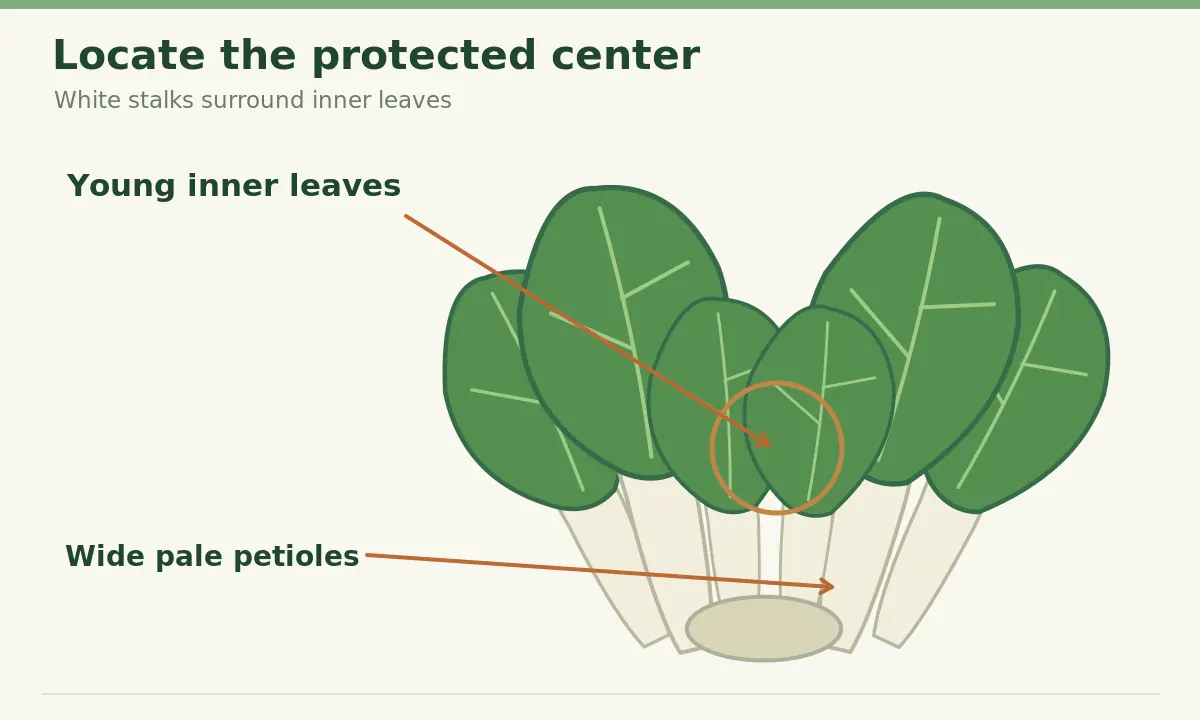
Stand above the plant and gently part the biggest leaves. In the middle, the smallest new leaves emerge tightly together. That cluster marks the portion to preserve for continued harvests. It is not necessary to dig for a hidden root crown or remove foliage simply to inspect it. The first teaching image labels the crowded inner leaves and the older outer petioles separately. When very young plants have only a few true leaves, even one outer cut may remove too much photosynthetic area; wait until a robust rosette has developed. Do not confuse a central rising flower stem with healthy continuing production of leafy shoots.
Choose the Oldest Full-Size Outer Leaves
The University of Minnesota Extension explicitly notes that bok choy can be harvested a few leaves at a time, choosing the oldest, largest leaves on the outside. Select firm leaves whose stalks are substantial but not badly yellowed or torn. If the plant has twelve substantial leaves, you do not need to strip eleven to make a worthwhile salad. Taking a modest portion lets the remaining foliage continue growing. Cut only what will be used promptly because harvested greens lose quality quickly. The exact number of leaves will depend on rosette size, available light, variety, weather and insect injury; avoid rigid leaf-count formulas.
Cut or Snap Each Outer Petiole Separately
Hold a mature outside leaf low on its stalk and follow that stalk to its attachment along the outer rosette. Use clean sharp scissors to cut the chosen petiole without carrying the blade into younger central leaves. If it comes away easily with a controlled sideways movement, avoid tearing neighboring bases; if resistance is high, choose scissors instead. Work from the outer ring inward only as far as necessary, keeping the central cluster untouched. The diagram shows the cut at the selected outside stalk, not through an imaginary common trunk. A damaged petiole base can also trap moisture, so avoid ragged pulls that split the crown.
Leave Enough Leaf Area for Recovery
Selective harvesting works because enough green tissue remains to capture light and supply new growth. Do not harvest when a plant has become severely drought-stressed, pest-defoliated or stunted. After a gentle harvest, stand back and confirm the remaining rosette is balanced rather than a bare stub. Healthy inside leaves should still be visible and able to expand. In cloudy, cool conditions regrowth may be slower; extreme warmth can push bolting instead of fresh leaves. Continuing harvest is an opportunity, not a guarantee that each plant will produce indefinitely. Record how the individual plant responds rather than cutting according to a fixed weekly schedule.
Decide When a Whole-Head Harvest Is Better
Many gardeners prefer to harvest the whole bok choy plant when its head reaches usable size. Minnesota Extension notes that dwarf varieties may mature at roughly six inches while full-size plants can reach about a foot; the packet is the better guide for a named cultivar. If the outer leaves are aging and the center is tight, a whole-head cut just above the soil may produce more usable food than another selective pick. When a central flower stalk begins to extend, the leafy growth period is ending. Harvest before flowers open rather than promising that a late cut will restore a tender leafy crop.

Recognize Bolting and Seasonal Stress
Bok choy is often grown for cool-season harvests. Depending on cultivar, temperature history and day length, flowering can follow cold exposure or increasing warmth. The early sign is the rosette elongating upward with a more obvious central flowering stem; subsequent yellow brassica flowers are unmistakable. Once bolting starts, the plant will not resume its earlier pattern of broad leaf growth simply because the stalk is snipped. A young flowering shoot may be edible if the crop is clean and sound, but it is not the same as tender flat leaves. Choose local sowing windows rather than USDA hardiness zones as annual crop calendars.
Water and Maintain the Bed Between Picks
Leafy crops favor relatively even soil moisture, although the needed frequency changes with soil, weather and containers. Check moisture below the dry-looking surface before irrigating, then water near the root zone without blasting the cut bases with a hose. Keep weeds low to preserve space and access around the crown. Mulch can reduce weed competition but should not be piled over the leaf bases. Foliar fertilizer or heavy nitrogen is not a magic regrowth switch; follow soil-test-based recommendations rather than inventing a feeding schedule. If insects have made holes in the blades, evaluate the cause before removing most of the protective leaves.
Handle Thick Stalks and Tender Blades Correctly
The broad succulent petioles cook more slowly than the thin green blades. Rinse harvested leaves under running potable water, inspect crevices for soil and insects, and trim away visibly damaged areas. A clean knife can separate stalk and blade for staggered cooking; this avoids overcooking the leaf while the white portion is still crunchy. There is no need to peel a healthy, tender bok choy petiole. Keep the harvest out of hot sunlight and move it into the refrigerator promptly. Use food-safe washing and storage rather than soaking the harvest in unverified household chemical mixtures.

Store Small Batches Instead of Stockpiling
Fresh bok choy is relatively short-lived after cutting. Oregon State food guidance recommends refrigerated use within about a week for the whole vegetable, and a cut leaf harvest may lose freshness faster than an intact head. Dry excess surface water after rinsing and store in a clean food-safe container or loosely wrapped bag with suitable humidity. Discard portions that become slimy or unpleasantly odorous. A refrigerator slows deterioration but cannot restore old leaves. Smaller regular harvests match the method’s advantage: use tender outside stalks immediately while the central leaves remain in the garden for further growth.
Inspect the Growing Center After Each Harvest
Before leaving the bed, compare the remaining center with the earlier photograph or diagram. Are the smallest leaves uncut? Are several fully green outside leaves still feeding the plant? Is the crown uncrushed and above the soil? If so, the selective method was followed. If the central tissues have been sliced or the plant is already flowering, stop counting on a cut-and-come-again supply from it. Plan another sowing suited to your climate rather than forcing a damaged crown to behave as a fresh seedling. The objective is reliable food and careful plant care, not the largest possible number of cuts.
Related Guides
- When to Harvest Bok Choy: Outer Leaves, Whole Heads, and Bolting Signs
- How to Grow Bok Choy Without Early Bolting or Damaged Leaves
- How to Save Bok Choy Seeds From Dry Pods Without Mixing Brassica Varieties
How We Research and Verify Plant Advice
Sources checked on 2026-10-26: extension.umn.edu; extension.oregonstate.edu; extension.oregonstate.edu. We reviewed each institution’s plant identification, correct growth stage and relevant cultural recommendations before adapting them into an independently written step-by-step guide. Where sources are region-specific, their calendar details are not applied universally. Pictures use simplified teaching shapes and should be compared with living specimens; they are not a substitute for laboratory disease diagnosis or local climate guidance. The relevant advice is paraphrased rather than reproduced.
Safety and Independent Editorial Disclosure
This independently prepared educational article does not claim sponsorship or affiliate approval. Our category reading links are informational, not product endorsements. See the VegWin affiliate disclosure. Clean sharp tools before cutting plants, protect hands from thorns and blades, and keep cut plant material away from children and pets where appropriate. Use only locally registered plant treatments labeled for the actual crop, and observe the product label. Do not rely on unsupervised home remedies or unverified harvest-safety promises.
Yes. University of Minnesota Extension recommends taking mature leaves from the outer ring while younger inner leaves continue to grow.
No, not for repeated harvest. Keep the clustered new center leaves intact.
It can, but dwarf plants carry fewer leaves, so a single whole-head harvest may be more practical.
Leafy growth usually slows or ends once plants bolt; harvest promptly rather than expecting reliable regrowth.
Refrigerate promptly and use soon, commonly within about a week for intact bok choy, often sooner for separated leaves.