
Saving bok choy seed begins long before a dry brown seedpod appears. Bok choy, also called pak choi, is a Brassica rapa vegetable grown mostly for crisp white or pale-green leaf stalks, but a seed plant must survive to produce a tall flowering stem, yellow four-petaled flowers and narrow pods. Successful saving means planning for pollination, allowing pods to mature and keeping the seeds dry and labeled. Picking green edible heads is a different goal: once those heads are harvested, the seed-production project is over. The biggest hidden risk is crossing with other flowering Brassica rapa vegetables nearby.
Choose a True-to-Type Bok Choy Plant for Seed
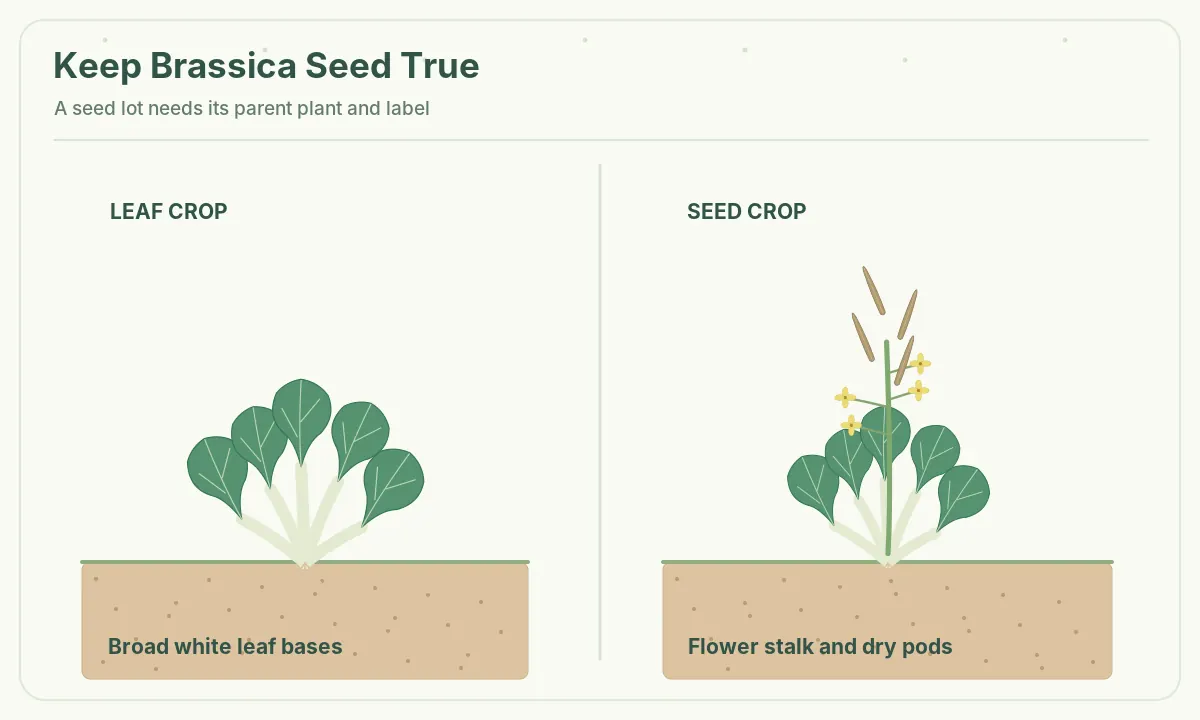
Begin with correctly labeled bok choy, not an anonymous mixed Asian-greens tray. Pak choi forms an upright cluster of thick leaf bases and broad blades near the ground. As the plant runs to seed, a central stalk elongates and branches above that recognizable leafy base. The four-petaled yellow flowers later give way to thin, elongated brassica seedpods. A bag of brown round seeds alone cannot prove cultivar identity.
Start with a healthy, vigorous plant representative of the variety and avoid saving from the earliest stressed bolter if your purpose is to select for dependable leaf production. An F1 hybrid can make viable seed but its descendants may not retain the uniform parental traits. Write the variety name, year and neighboring flowering brassicas down while the plant is still recognizable.
Understand When Bok Choy Can Flower
RHS notes that cold snaps, hot dry conditions and other stress can trigger premature flowering in pak choi. For vegetables this is often called bolting and reduces eating quality; for seed saving, flowering is essential. Many Brassica rapa crops behave as annuals or biennials according to their genetics and conditions, and exposure to cool weather can influence the flowering phase. Do not assume that every cultivar must be kept through an identical two-year schedule.
Let the chosen healthy plants flower fully rather than repeatedly harvesting their shoots. Support tall stalks if wind threatens to break them. Once seed pods begin forming, protect branches from accidental pulling and keep the plants separated from vegetable harvest rows, where family members may otherwise pick them for food.
Plan Pollination Isolation Before Flowers Open
Bok choy belongs to Brassica rapa, a group that also includes many turnips, Chinese cabbage, mizuna, tatsoi and related greens. Seed Savers Connect specifically warns that compatible B. rapa varieties can cross under insect pollination. A nearby cabbage or kale belongs to B. oleracea instead; not every plant casually called a brassica crosses with every other one. Keep that species distinction clear.
If retaining a recognizable open-pollinated line matters, use distance, temporal separation or controlled insect-pollination isolation designed for this crop. The Seed Savers guide offers a substantial isolation distance for open pollination; small home lots surrounded by neighbors’ flowering greens may not meet it. Covering the flowers with insectproof material and excluding every pollinator without a plan also prevents good seed set. Label a seed lot as possibly crossed whenever you lack isolation evidence.
Follow Yellow Flowers to Slender Green Pods
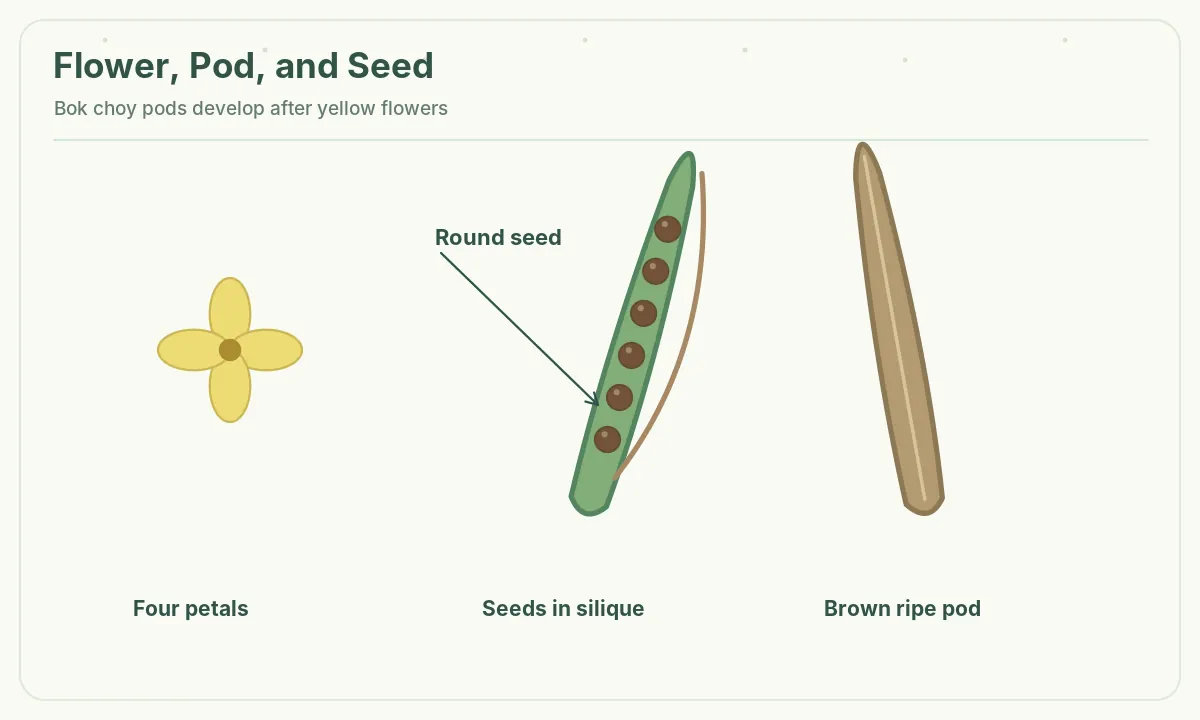
After successful pollination, each spent flower can form a slender elongated pod, or silique, with seeds developing within. The petals are usually yellow and arranged in a cross-shaped set of four, characteristic of the mustard family. The pod is not a pea pod and should not be illustrated with large round green peas bulging out of it. Tiny dark brassica seeds sit in two rows along the interior structures as they mature.
Watch the entire stalk because pods do not ripen simultaneously. Lower pods may turn tan or brown while upper ones remain green. A wet growing period can also alter the look of aging foliage, so judge the pods themselves rather than assuming yellow leaves mean all seeds have matured. Keep a dry tray or paper bag ready before the earliest ripe pods split.
Collect Brown Pods Before They Shatter
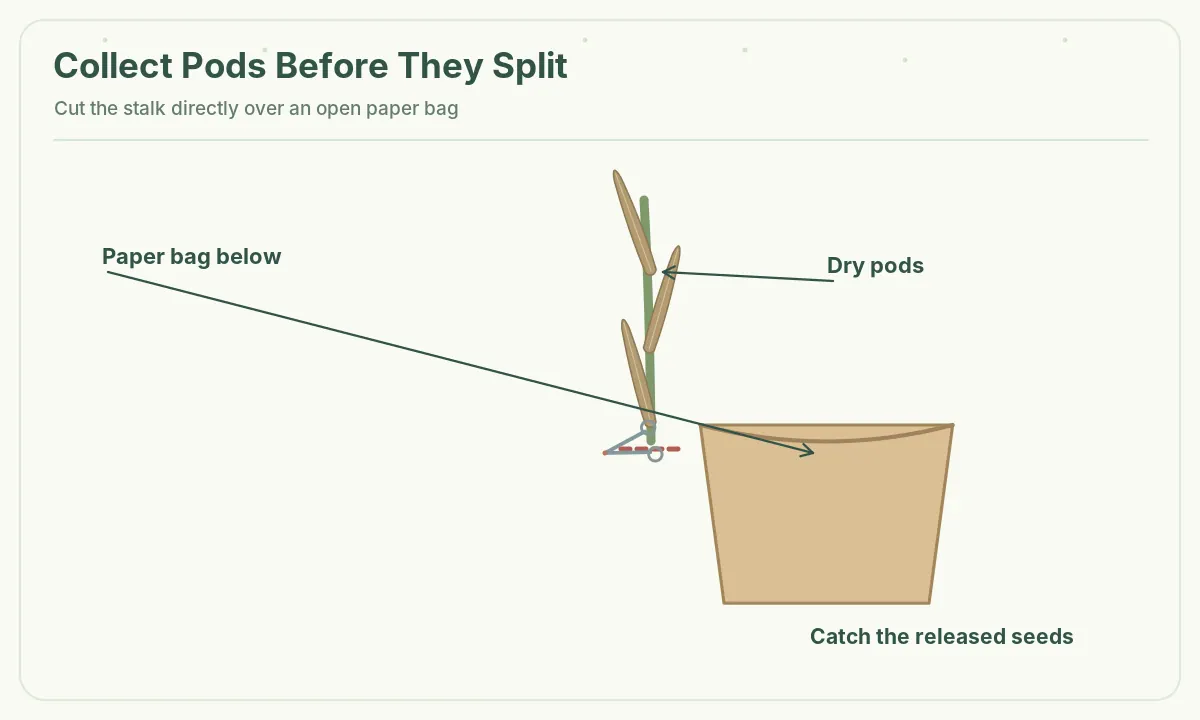
The reliable cue is a dry, papery pod that changes from green toward tan or brown and rattles or splits readily. Seed Savers Connect calls for waiting until pods turn brown. Harvest on a dry day when practical; clip selected branches over a clean large container or a paper bag to catch seeds that fall as you move. Do not shake dry heads while crossing the garden, because pods can release seeds into the path.
A short, clear diagram should show scissors severing the stalk UNDER the dry pods and the open mouth of a paper bag beneath. Do not depict cutting through the seed chambers or placing the bag over rain-wet stems for days. If some pods still seem moist, finish drying the stems somewhere airy before threshing, keeping the variety tag attached.
Dry and Clean the Small Round Seeds
Lay cut stems in a ventilated place protected from rainfall, bright excessive heat, rodents and spilled soil. Once fully dry, crush or roll the pods gently over a tray; they open along seams to release tiny nearly spherical brown to dark seeds. Separate larger pieces of pod by hand or with a clean sieve. Check that the seed is dry before closing a labeled envelope or airtight storage container. Condensation makes otherwise good seed much less useful.
Avoid aggressive grinding that damages the seed coat. Do not add disinfectants, commercial food additives or untested essential oils as drying agents. Seeds with mold or a stale damp smell should not be used as a premium storage lot. Record when they were cleaned and any evidence of cross-pollination.
Separate Similar Brassica Seed Lots
Bok choy, turnip and mizuna seed may look virtually identical once separated from their pods. Color, size and an isolated seed photo will not let you determine which cultivar it came from. The value of a seed packet depends on a label and the parent plant’s identity, not a supposed unique pattern on each microscopic bead. Store separate harvests in separate bowls during threshing and clean the sieve between varieties.
If you also save seeds from broccoli or cabbage, label those by species and variety. Resist claiming all Brassica seeds should share the same crossing rules. Seed Savers’ B. rapa category focuses specifically on that species complex, while other Brassica groups have different compatible partners.
Test a Sample Before Trusting the Next Crop
The last stage is practical verification. Sow a few seeds next season in a small test row and check germination and expected bok choy foliage. A failed test can reflect storage moisture, old seed, sowing conditions or genetic variation; it does not automatically prove hybridization. A seed lot that germinates but develops unexpected leaf stalks may have crossed, may have been mislabelled or may be segregating after an F1 parent. Record the observations.
Keep collecting enough from a healthy population rather than depending on a single unusual bolting plant for long-term seed stewardship. The complete sequence is choose an identified parent, manage pollination before flowers, collect brown pods, thresh dry seed, label everything and test a small sample before distribution.
Related Guides
- How to Grow Bok Choy Without Early Bolting or Damaged Leaves
- When to Harvest Bok Choy: Outer Leaves, Whole Heads, and Bolting Signs
How We Research This Guide
We checked the following horticultural and botanical sources on October 27, 2026: www.seedsavers.org.au — Seed Savers Connect documents Brassica rapa cross-compatibility, insect pollination, mature brown pods and seed cleaning.; www.rhs.org.uk — RHS describes pak choi growth, broad leaves and bolting, which marks its transition from leaf production to flowering.; extension.usu.edu — Utah State Extension explains biennial brassicas, isolation and seed collection challenges in home gardens.. These references support the cited plant traits and growing steps; specific results depend on cultivar, local weather and site conditions.
No paid product or manufacturer endorsement appears here. See our affiliate disclosure for the site-wide policy. We do not imply a sponsorship or a special vendor agreement.
No. A plant cut off for a whole-head harvest cannot then develop its own flowering seed stalk.
Mature seeds are small and round inside dry brown elongated brassica pods.
Yes. Both are Brassica rapa and insect pollination can exchange pollen between compatible flowering varieties.
Leave pods to mature and dry; seed-saving guidance uses brown papery pods as the best collection cue.
Not reliably. Descendants of hybrids may vary even if the pollination was controlled.