
Komatsuna, often called Japanese mustard spinach, is a quick-growing leafy brassica with upright green leaves and juicy green petioles. The best time to harvest it depends on the crop you want: a small bunch of tender baby leaves, one substantial whole-plant picking, or a series of smaller harvests from the same rosette. The critical detail in repeat picking is to take mature outer leaves while protecting the small growing point in the center. Here is how to tell those choices apart without cutting through the crown.
Recognize the Komatsuna Plant You Actually Grew
Komatsuna is classified as Brassica rapa Perviridis Group in Japan’s official food-composition database. Despite the common name mustard spinach, it is not true spinach. A typical young plant forms a loose, upright cluster of smooth, oval-to-spoon-shaped leaf blades carried on relatively long green leaf stalks. The inner leaves are smaller because they emerged more recently. Komatsuna is grown for this aboveground foliage; it does not make the enlarged storage root that gardeners associate with some turnips.
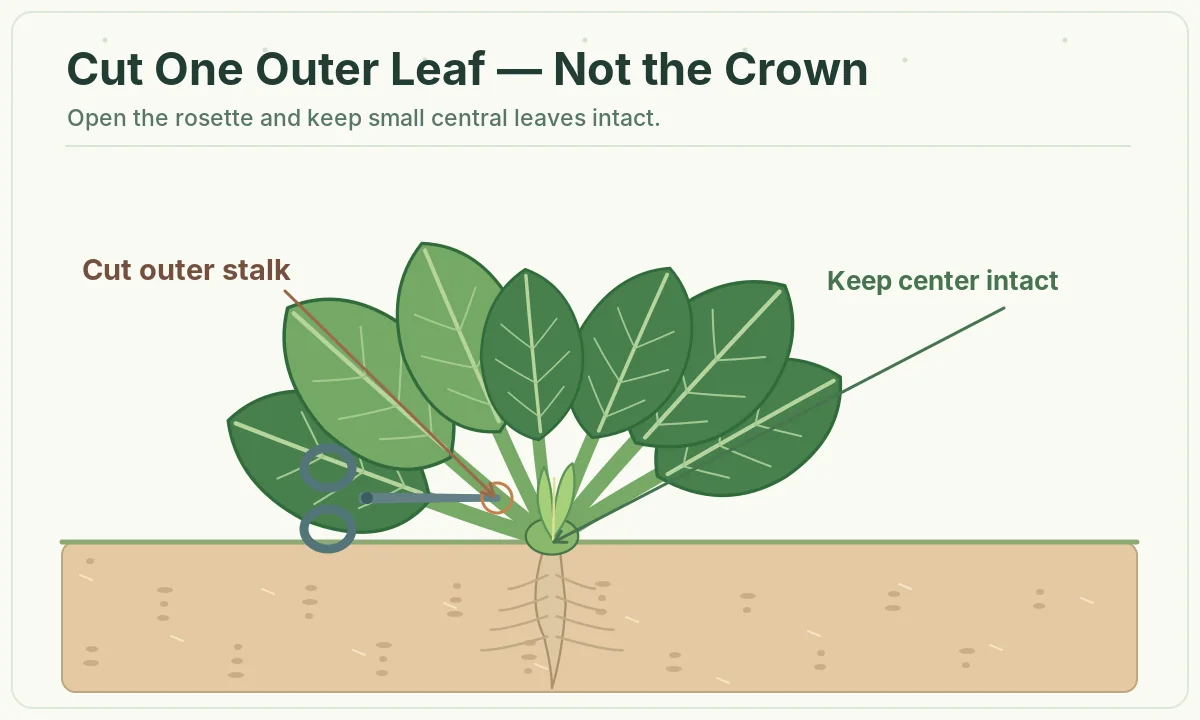
Seed catalogs group several Asian greens together, so read the seed label before diagnosing the leaf shape. Mizuna usually has more deeply divided, frilly blades rather than komatsuna’s broad, relatively smooth foliage. Some named cultivars vary in shade or stalk size, and crowding changes the plant silhouette. If your crop is too young to have several distinct leaves, allow it to establish before attempting selective harvests. The diagram below focuses on the leaf blade, stalk, and center of one komatsuna plant.

Choose Baby Leaves, Mature Bunches, or Repeat Pickings
There is no universal harvest date that fits every season. The RHS describes baby salad leaves as harvestable once actively growing plants are roughly 4 inches (10 cm) tall, although cool or low-light conditions slow the process. The Japanese Ministry of Agriculture gives about 25 cm (10 inches) as a common benchmark for harvesting a mature whole komatsuna plant. These examples serve different purposes rather than contradicting one another. Decide whether you need tender salad-sized greens or a larger bunch for cooking.
For repeat picking, wait until your rosette has several established leaves and the outer blades look usable while the center still holds a healthy cluster of smaller leaves. Do not strip a just-emerged seedling. Keep an eye on leaf quality instead of counting the exact days printed on a packet. Consistently small plants may be crowded, drought-stressed or short of light. In cold weather, the next set of leaves can arrive slowly, so adjust expectations before removing more foliage.
Locate the Growing Point Before Picking a Single Leaf
Look straight down at the komatsuna plant. Older outer petioles spread outward from the base, while the youngest blades sit tightly clustered near the center. That tight center is the growth point you want to keep. A proper outer-leaf cut separates an individual leaf stalk without slashing across the central tuft. Cutting off every visible shoot at the crown may end the repeat-harvest method even though the root remains in the soil.
The RHS specifically recommends cutting outer leaves close to their bases while leaving the growing point intact. Use your fingertips to part the leaves before placing the blades of clean sharp scissors. When visibility is poor, skip the smallest leaves and take a more accessible outer one. The aim is a green, undamaged central bud cluster and enough healthy leaf area for continued growth, not a stripped stalk with a few tiny remnants.
Cut Outer Petioles Without Injuring the Center
Hold the outside leaf by its stalk, trace that stalk toward the base and make a neat cut on that one petiole at a point you can see clearly, a little away from the crowded central leaves. Support the plant so the cut does not pull up the shallow roots. Repeat on a few widely spaced outside leaves instead of stripping one side bare. The illustration shows the scissor tips on an outside stalk only; its line does not pass through the pale central crown.
Harvest in the cool part of the day if possible, keep the leaves out of hot sun, and handle them gently. The RHS suggests taking only what you need at a time, while University of Maryland Extension also supports harvesting individual outer leafy-green leaves. Set damaged, heavily yellowed or suspect leaves aside rather than mixing them into the salad basket. Because komatsuna is a brassica, always inspect under the leaves for common cabbage-family pests such as aphids and caterpillars.
Know When a Whole-Plant Harvest Makes More Sense
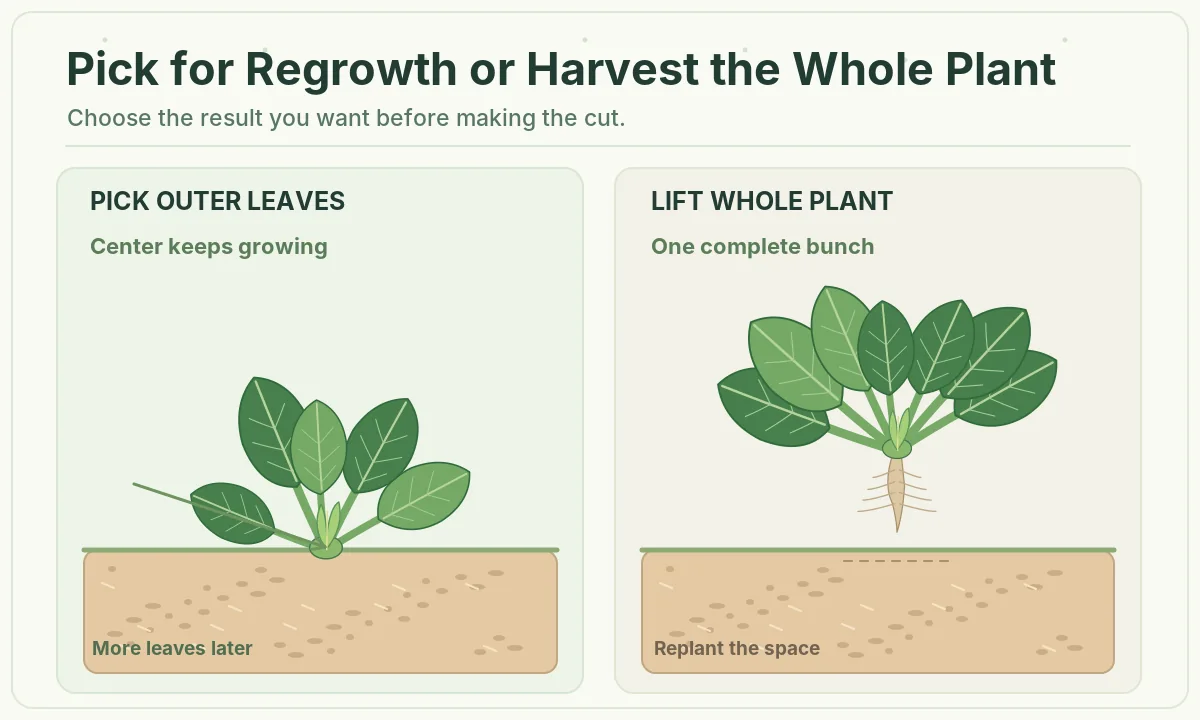
Selective picking is not required if you want one large bunch at once. Japan’s Ministry of Agriculture describes cutting mature komatsuna at its base with scissors or lifting the plant with its roots at about 25 cm (10 inches) tall. A whole-plant harvest is useful when you have many plants, the foliage is full-sized or you want to clear a row for another sowing. Do not confuse that complete removal with the outer-leaf approach designed to allow repeated picking.
Some tightly planted beds can be sheared for baby leaves, but successful regrowth requires leaving functional growing tissue. University of Maryland Extension discusses careful close-to-crown shearing of leafy salad mixes; that is not an instruction to cut through the crown of an individual komatsuna rosette. If your priority is reliable repeat harvests, selective removal is easier to control than one low horizontal cut across a mixed row. Choose the harvesting style before bringing scissors to the bed.
Encourage Useful Regrowth After the First Picking
After taking a few outside leaves, look again at the center. Leave the small new leaves undisturbed and water the soil whenever the root zone needs moisture. Both RHS and University of Maryland note that repeated leafy-green harvesting works best when growth is steady, rather than being interrupted by heat or severe drying. Recovery takes longer in cool, dim weather than during active growth. A plant that was badly stripped cannot necessarily recover just because the crown was left.
Examine the next flush rather than scheduling the following harvest for an exact weekday. If leaves become small, tough, distorted or heavily pest damaged, the remaining crop may not justify more picking. High temperatures, long days and other stress can encourage flowering, a process called bolting. Once a flower stalk starts to rise, the quality of leafy harvests tends to fall. Remove a tired crop and sow a fresh short row when your season and planting conditions permit.
Avoid Three Common Harvesting Mistakes
First, do not confuse a crowded older outside leaf with a young central one. Pulling up a leaf from the center can tear the active growth tissues. Second, avoid scissors that traverse the rosette from side to side. That cut might work for some dense baby-leaf salad beds when made at a height that leaves growing tissue, but it is a poor choice for a single plant when you cannot see the crown. Third, do not take so many leaves that little healthy foliage is left to replenish the plant.
Overcrowding causes a separate problem: the inner plants may stay shaded and undersized. Thin overcrowded seedlings carefully and use healthy thinnings as an early harvest, then reserve the stronger plants for later outer-leaf picking. Inspect foliage for flea-beetle holes, slugs or mildew and improve growing conditions rather than relying on invented home chemical remedies. Use disease-free leaves for food and follow local produce-washing guidance. The right harvest leaves a clearly visible, undamaged center and a plant capable of making new leaves.
Plan Small Successive Sowings for Better Texture
Even well-managed komatsuna will not provide perfect small leaves indefinitely. The Japanese agricultural guide recommends sowing new short batches about every seven to ten days during suitable conditions because this fast crop loses quality when held too long in the bed. A practical home-garden alternative is to sow a small patch, check its growth, and start the next before the first crop bolts or becomes coarse. Do not use a fixed interval when your climate does not support germination.
In warmer or very long-day periods, leafy brassicas may flower earlier; the RHS therefore highlights midsummer onward for some Asian salad-leaf sowings in its UK growing conditions. That seasonal suggestion is not a global calendar. In other climates, choose a window with sufficiently cool weather and enough light for healthy leaf growth. Shade and even moisture can temper summer stress but cannot make severe heat irrelevant. Let the actual condition of your leaves, not a generic planting-zone number, decide when to take the next harvest.
Related Guides
- When to Harvest Komatsuna Leaves and Keep the Growing Crown Intact
- How to Grow Komatsuna From Seed for Baby Leaves or Full Plants
How We Research Komatsuna Harvesting Advice
This guide compares RHS cut-and-come-again salad guidance and its botanical advice on protecting growing points with University of Maryland Extension on harvesting leafy greens and the Japanese Ministry of Agriculture’s komatsuna-specific guide. Botanical identity is confirmed by Japan’s official food composition database. Sources reviewed October 27, 2026. The 10-inch whole-plant benchmark and shorter baby-leaf timing answer different harvesting goals; check your own cultivar and growing conditions.
This article has no paid product recommendation or affiliate product link. See our Affiliate Disclosure for the website’s policy. Illustrations explain the positions of botanical parts and are not a substitute for inspecting the exact plant in your garden.
You can take small baby greens once healthy plants are roughly 4 inches (10 cm) tall or harvest mature plants near 10 inches (25 cm). Readiness depends on temperature, growth, and whether you want tender leaves or a whole bunch.
Yes. Remove a few developed outer leaves and preserve the central growing point and enough foliage. Healthy plants can then produce another flush, although the number and speed of pickings vary.
Cut the stalk of a single outer leaf where you can see it clearly near its base, without cutting through the central young leaves or crown.
No. Komatsuna is a leafy Brassica rapa crop, not true spinach. It generally has broad smooth leaf blades, while mizuna typically has deeply dissected foliage.
Take still-sound leaves promptly if desired, but expect the crop to become less useful for repeat tender-leaf harvests as it bolts. A new sowing in favorable weather is usually the better long-term plan.