
Malabar spinach (Basella alba) is not the cool-season spinach used in salads. It is a warm-loving climbing vine with thick glossy leaves and succulent stems. Those stems can form roots when nodes touch moist soil, making short cuttings a practical way to make new plants. The trick is to distinguish a node from a leaf blade, cut just below it, and keep lower foliage out of standing water or wet potting mix. The diagrams show the vine, the rooting zone and the difference between firm new roots and a decaying submerged leaf.
Confirm You Have a Basella Vine and a Healthy Stem
North Carolina State Extension describes Malabar spinach as a tender, vigorous warm-weather climber with thick heart-shaped leaves; some forms have reddish stems while others are green. This fleshy foliage distinguishes it from ordinary spinach, Spinacia oleracea. Before cutting, inspect the mother vine for healthy growth, firm stems and leaves without serious spotting or collapse. A diseased or mushy section is a poor propagation candidate and may carry the same problem to a new pot.
Choose a stem long enough to leave useful foliage on the parent vine and several nodes on the cutting. Do not strip an entire slow-growing plant bare to create many cuttings. Use clean scissors or pruners and work away from soil contamination. NC State notes that Basella stems can root where they contact moist soil, which is the core biological clue: the node on the stem is the important target, not a severed leaf set into water without a piece of stem.
Find the Nodes Beneath the Leaf Stalks
A node is the point on the vine where a leaf stalk and potential side shoot join the main stem. Internodes are the smooth stretches of stem between those junctions. In the detail illustration, arrows touch the nodes on a living green Basella cutting, not the tip of the leaf blade. Examine a real stem in good light before snipping. Leaves may alternate along the twining vine, so do not demand opposite matched pairs as you would expect on some herbs.
The University of Guam Cooperative Extension specifies cutting just below a growing node and describes sections roughly five to six inches long. That length is a useful starting point, not a requirement to remove extra vigorous growth when a shorter healthy section already contains nodes. Keep a few healthy upper leaves so the cutting can photosynthesize. Remove lower leaves where their blades would lie below the waterline or sit inside saturated media; leave the node itself intact.

Prepare a Short Cutting With a Clean Lower Stem
Cut cleanly just below the selected lower node rather than crushing the tender stem. Remove lower leaves carefully by their petioles, taking care not to gouge the node. Retain some foliage near the top, but reduce an excessively large canopy if it wilts repeatedly. Do not scrape off the entire green surface as if preparing a woody graft. Basella is succulent and roots from living tissue; avoid tearing or folding the stem as you push it into a narrow hole.
If a cutting is long and top heavy, use a taller pot or a temporary support instead of burying many leaves. Put prepared cuttings into their chosen rooting medium soon after collection to limit dehydration. A short delay in clean, slightly humid shade is preferable to leaving them in hot direct sun on a dry bench. Keep mother plants watered before taking the cuttings, but do not flood the rooting vessel in an attempt to compensate for a wilted parent.
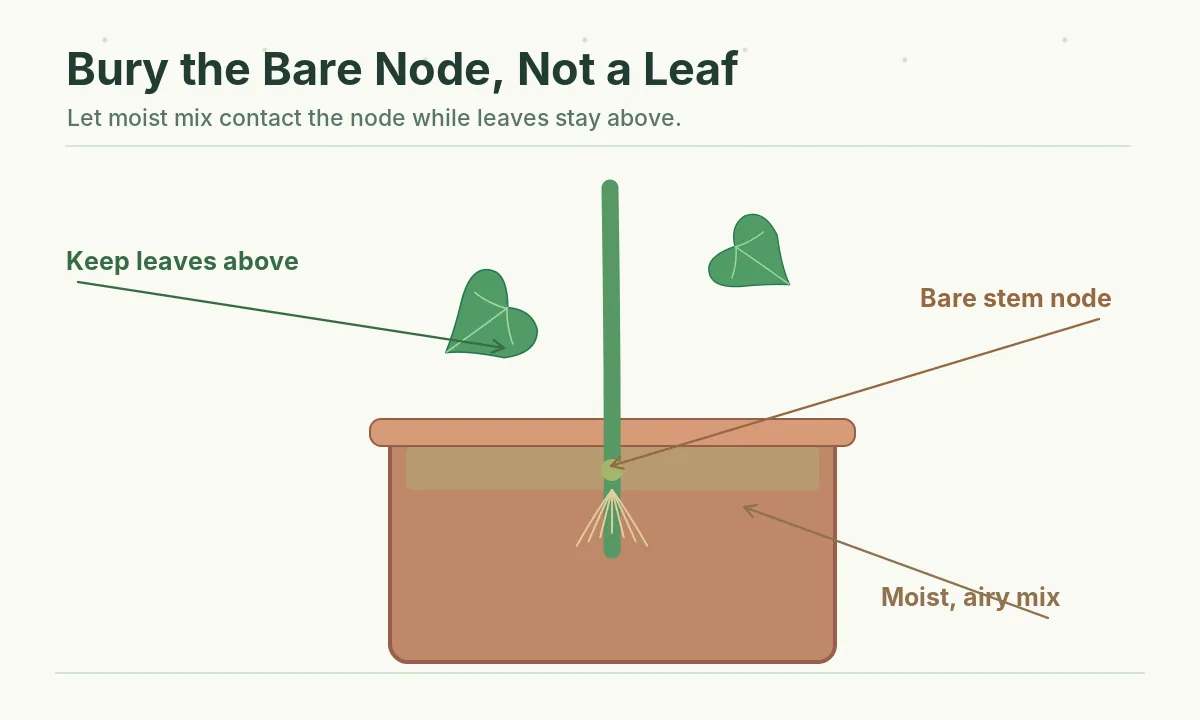
Root a Node in Moist Mix or Clean Water
A small pot of moist, airy, well-draining propagation mix offers support around the stripped lower node while keeping upper leaves above the medium. Make a hole first so the node is not damaged during insertion, then firm the mix lightly around the stem. The University of Guam Extension says cuttings can be raised in pots before transplanting; NC State reports root formation at stem contact points with moist soil. Keep the mix damp, not airless or waterlogged.
Water rooting is another commonly used home method, but the principle is the same: submerge a bare lower node while leaving leaf blades and upper foliage above the water surface. Use a clean vessel, refresh cloudy water and discard cuttings with foul-smelling, soft stem bases. This medium comparison is a practical propagation option informed by stem-cutting biology, not a claim that water always produces stronger final roots. Roots formed in water may need gentle adjustment when they are transferred into potting medium.
Provide Warmth, Light and Reasonable Humidity
Basella excels in warm conditions and dislikes cool temperatures. NC State notes that growth becomes disappointing when temperatures remain low and that plants are sensitive to frost. Root cuttings in a bright area sheltered from harsh afternoon sun and drying drafts. Check moisture daily at first because a cutting has few or no functioning roots to replace water lost from leaves. At the same time, avoid keeping all foliage wet inside a closed bag with no ventilation.
A clear humidity cover can help in some indoor setups but should be ventilated and kept from touching leaves; excessive condensation and rot are not signs of improved rooting. If several cuttings are being rooted together, leave room for airflow and separate any that decay. Growth speed will vary with temperature, stem maturity and light. Do not invent a universal number of days to readiness. Observe firm tissue and genuine root development rather than pulling a cutting out repeatedly to check whether it has changed.
Recognize New Roots and Pot Up Gently
A successful water-rooted cutting may show pale new roots emerging at the submerged node; a mix-rooted cutting should gradually develop stability and fresh upper growth. New leaves alone are not conclusive because stored stem reserves can briefly support shoots even before adequate roots form. Before potting, look for several living roots substantial enough to handle. Lift mix-rooted material with its root mass instead of stripping delicate roots from the stem to inspect them for a diagram-perfect shape.
Transfer into a suitable loose potting medium and water gently to settle the planting. Keep the former water-rooted cutting in protected light until it adjusts, then gradually introduce brighter conditions. For outdoor planting, wait for reliable warmth; hardiness-zone labels do not replace observed frost risk and actual temperatures. A trellis or other support will help Basella’s climbing growth. Never wedge a newly rooted plant against a tight stake that rubs the tender stem.
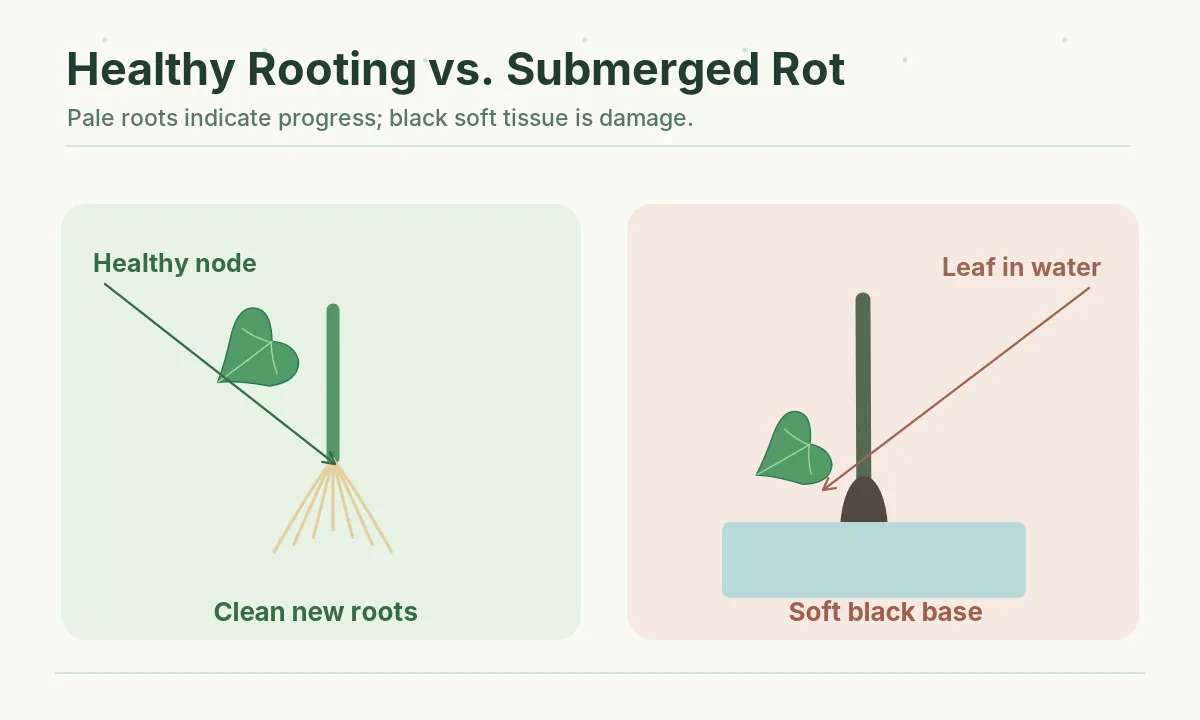
Diagnose Black Bases, Wilting and Failed Cuttings
Soft brown or black stem tissue, bad odor and collapsing lower leaves are warning signs of decay rather than normal rooting. The comparison illustration contrasts a pale-rooted node and a slimy submerged leafy section. Move healthy cuttings into clean media and correct excessive moisture or low airflow. Discard truly rotten cuttings; do not repeatedly recut through spreading rot and reuse dirty rooting water for other plants. Check whether petioles were left below the water surface, where they can deteriorate rapidly.
An otherwise firm cutting can droop temporarily because it has no mature root system. Reduce direct sun and check that the rooting node has moisture without drowning the whole stem. If a variety repeatedly fails outdoors, consider cold weather, dry soil and wind before blaming cutting length. NC State and Guam Extension both portray Malabar spinach as a warm-season species. Propagation cannot override environmental suitability, so maintain the parent plant in conditions where fresh replacement stems can grow.
Related Guides
- How to Grow Malabar Spinach on a Trellis for Summer Harvests
- How to Germinate Malabar Spinach Seeds From Dark Ripe Berries
How We Research These Planting and Propagation Details
These recommendations were checked against botanical and growing guidance from www.uog.edu resource; plants.ces.ncsu.edu resource; yardandgarden.extension.iastate.edu resource. All links were reviewed October 27, 2026. Where a source addresses a closely related crop rather than the exact garden selection, that limitation is stated in the practical section. The educational diagrams show key morphological features and avoid promising a uniform result for every cultivar, climate or growing medium.
This informational guide has no paid product recommendation. Review the site affiliate disclosure for partnership policies. For crop disease, pesticide or local growing-season questions, consult your Cooperative Extension office and actual labeled instructions rather than extrapolating from a diagram.
Cut just below a healthy node where a leaf stalk attaches to the vine; Guam Extension suggests roughly 5–6-inch sections.
Use a stem section with nodes, not a leaf blade alone; roots commonly form at nodes.
A stripped lower node can be placed in clean water while keeping leaves out, but moist rooting mix is also suitable.
Soft dark tissue and bad odor usually indicate decay; improve hygiene and avoid submerged leaf blades or stagnant wet conditions.
After frost risk passes and warm growing conditions are reliable, with a gradual transition to outdoor light.