
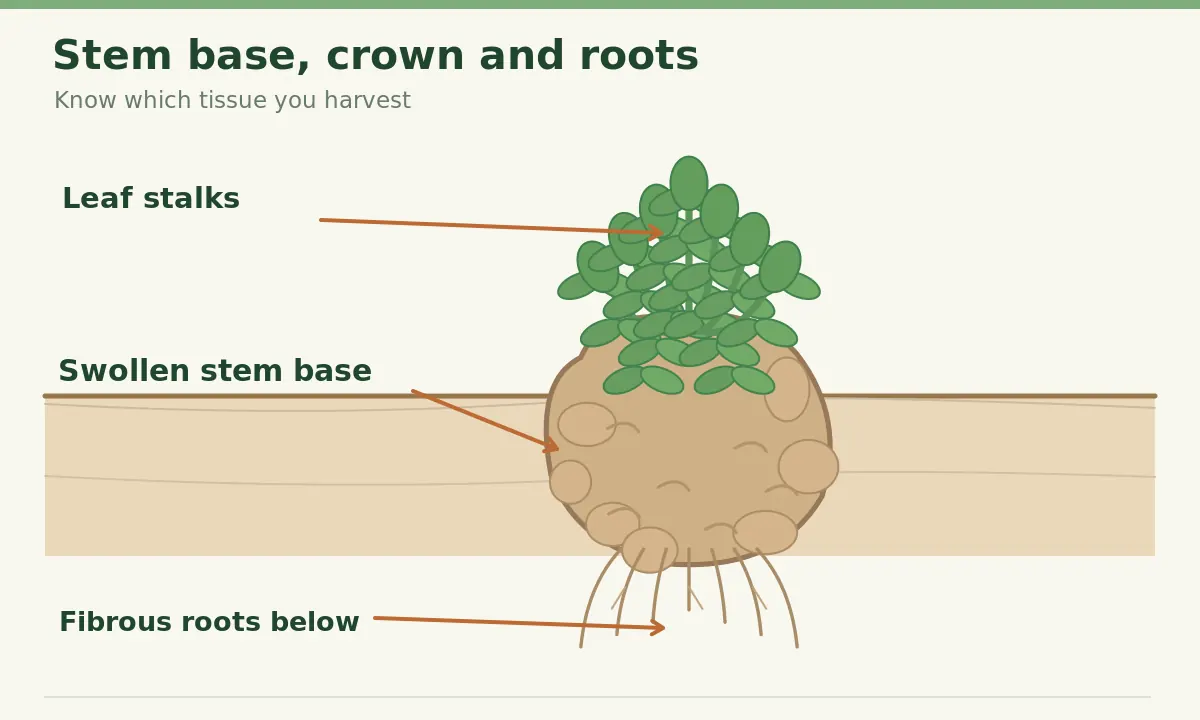
Celeriac, often sold as celery root, is not a long carrot-like root pulled by its leaves. The usable rounded portion is a knobbly enlarged base at the soil line, with many thin roots below and a celery-like cluster of leaves above. It is worth learning that anatomy before reaching for a digging fork: puncturing the swollen base reduces the quality of a crop that takes a long season to grow.
Recognize the Swollen Base at the Soil Line
The rounded edible part of celeriac is formed mainly from a swollen stem base, not a simple taproot. Expect a rough tan exterior with irregular knobs, thin roots concentrated on the lower portion and celery-like leaf stalks rising from the top. Oregon State Extension explicitly distinguishes this structure from the underground storage root of a carrot. Brush loose soil from one side rather than slicing the base to check size. Normal surface bumps are not necessarily disease; soft, black, foul-smelling areas are a different concern. Keeping the crown and thin roots straight in your mind makes the lifting diagram much easier to follow.
Check Width Rather Than Counting Leaves
Celeriac foliage may stay vigorous after the edible base has reached a useful size, or it may show weather wear while the base is still small. Iowa State Extension gives roughly two to three inches as a usable root diameter, while other growing guides sometimes favor larger specimens. These are guides, not a rule that every cultivar must attain an identical measurement. Expose the widest visible portion gently, then compare the size with your variety description and culinary needs. A dense, firm base is generally a better candidate than a mushy one; leaves alone do not establish maturity.
Choose a Harvest Window for Local Conditions
In a cool temperate garden, celeriac commonly reaches useful size in autumn, and RHS describes harvesting through the winter in suitable conditions. Those months refer to particular climates and cannot simply be transferred to a hot tropical bed or an area with early hard freezes. In cold regions, mulch may delay soil freezing and make staged harvest possible; it cannot promise that every unprotected crop will survive severe winter. Record the seed-start date and observe swelling through late-season weather. Choose a workable day when soil is not frozen hard or saturated into a damaging muddy mass.
Loosen Soil Outside the Knobby Base
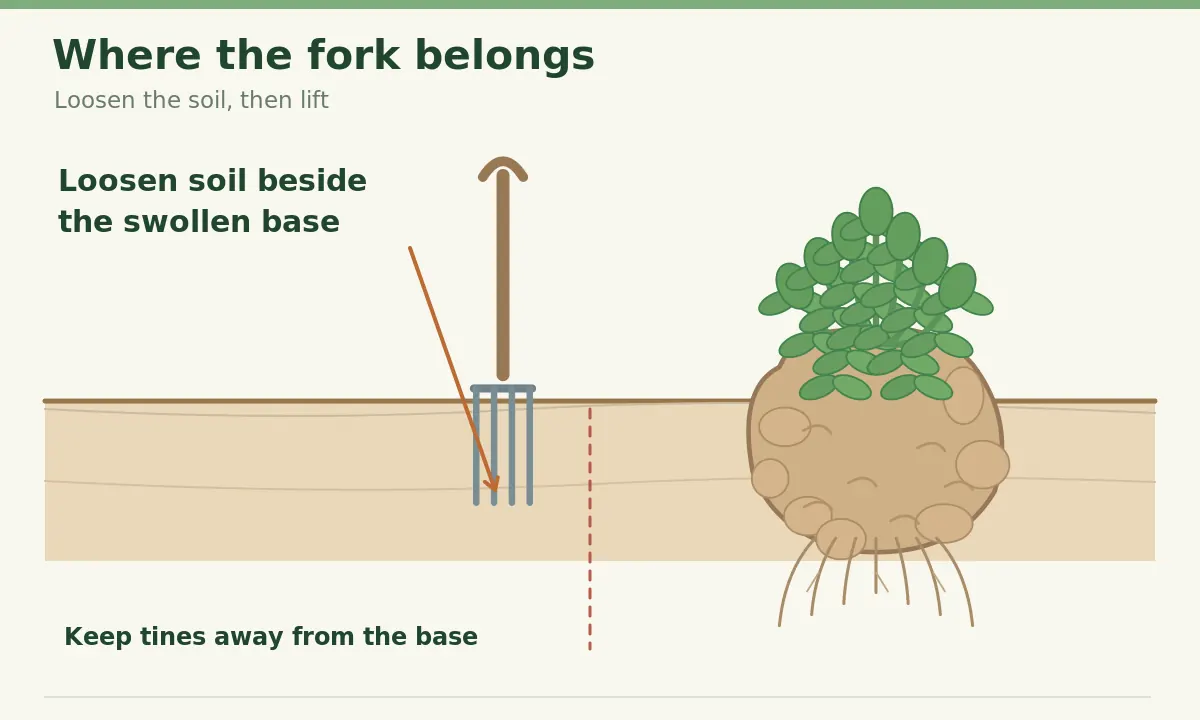
Set a garden fork into soil to the side of the swollen base, with its tines pointing down and away from the edible portion. Gently rock the fork to loosen the surrounding soil before lifting. Do not drive a tine immediately beside the stem junction or under a guessed center, where a puncture can split the harvestable tissue. A compact bed may require loosening soil on two sides. The purpose is to free thin feeding roots and reduce resistance, not to cut a neat circle through the celeriac itself. Work slowly where several plants are close together.
Lift the Plant With the Base Supported
When the surrounding soil has released its grip, hold the leaf-stalk cluster near the base and lift while supporting the knobby part with the other hand. If the plant resists, return to loosening the soil rather than pulling until the leaf stalks snap. Shaking off big clods gently is safer than striking the bulbous base against the fork. Look for cuts, deep forks marks and soft patches before storage. Smaller clean scrapes are usually a handling issue, while spreading decay calls for rejecting that root. Keep healthy harvested roots out of direct sun and harsh wind.
Trim Fine Roots and Damaged Foliage
Use a clean knife or pruners to remove the long stringy roots from beneath the swollen base without gouging its edible body. Iowa State advises shortening the tops for storage; what remains attached may vary with immediate use versus extended storage. Trimming a leafy top is not the same thing as carving off the crown down into sound flesh. Do the rough cleanup outdoors, keeping soil away from clean preparation areas. Set aside badly bruised roots for prompt assessment rather than expecting them to store as long as intact specimens. The rootlets and leaves are anatomically different parts of the harvested plant.
Keep Celeriac Cold and Humid After Harvest
Iowa State Extension recommends a cold, highly humid storage environment for celeriac; ordinary warm kitchen counters are not equivalent. Healthy bases should be checked periodically for soft rot, dehydration or an unpleasant odor. If using a refrigerator, protect roots from drying while allowing whatever ventilation the storage method requires. Do not seal a dripping wet damaged base in an airtight bag and assume it will remain sound. Clean stored produce before eating and keep it apart from raw meat. Longer-lasting storage depends on both correct temperature and the condition of each root at lifting.
Avoid Confusing Celeriac With Stalk Celery
Ordinary celery is grown primarily for crisp leaf stalks, whereas celeriac has a broad enlarged basal portion and often comparatively coarse stalks. The two are related, and the name celery root is convenient but botanically imprecise. Do not harvest celeriac one outer stalk at a time and expect that to replace the mature base crop. Nor should celery harvest instructions about stalk color or blanching automatically determine when to lift celeriac. Read the cultivar label, examine the swollen stem junction and use the correct kind of harvest tool. This prevents damaging an entire slow-growing plant merely to collect its leaves.
Assess Frost, Wet Soil and Disease Separately
A light frost and hard frozen ground do not present the same risk. Some gardeners leave celeriac in the ground under mulch through periods of cool weather, but frozen soil can lock roots in place even before plants are injured. Soggy soil raises another issue: fork pressure and handling can smear clay over tender tissue and promote bruising. If roots are soft or show an unfamiliar decay, do not identify the disease from a diagram alone. Consult a local extension diagnosis and keep obviously affected produce away from sound stored specimens. Hardiness-zone labels do not function as a day-by-day harvest schedule.

Record the Outcome for the Next Planting
Measure a couple of lifted bases and note how well they cooked and stored. If the edible part is small but firm, compare the number of growing days, planting spacing, soil moisture and warmth with local guidance instead of applying an arbitrary fertilizer fix. If harvesting caused punctures, next season mark a wider fork entry point. The most useful result is a repeatable sequence: reveal the base, check its width, loosen soil beyond it, lift gently and trim for the intended storage period. That observation-driven approach is more reliable than promising every celeriac a particular harvest date.
Related Guides
- When to Harvest Celeriac: Check Root Size, Weather, and Storage Needs
- How to Store Root Vegetables: Sort, Cool, and Prevent Spoilage
- How to Germinate Tiny Celeriac Seeds Without Burying Them Too Deep
How We Research and Verify Plant Advice
Sources checked on 2026-10-26: rhs.org.uk; yardandgarden.extension.iastate.edu; extension.oregonstate.edu. We reviewed each institution’s plant identification, correct growth stage and relevant cultural recommendations before adapting them into an independently written step-by-step guide. Where sources are region-specific, their calendar details are not applied universally. Pictures use simplified teaching shapes and should be compared with living specimens; they are not a substitute for laboratory disease diagnosis or local climate guidance. The relevant advice is paraphrased rather than reproduced.
Safety and Independent Editorial Disclosure
This independently prepared educational article does not claim sponsorship or affiliate approval. Our category reading links are informational, not product endorsements. See the VegWin affiliate disclosure. Clean sharp tools before cutting plants, protect hands from thorns and blades, and keep cut plant material away from children and pets where appropriate. Use only locally registered plant treatments labeled for the actual crop, and observe the product label. Do not rely on unsupervised home remedies or unverified harvest-safety promises.
The swollen knobby basal part, botanically mainly enlarged stem tissue, is the main harvested portion.
Iowa State lists about 2–3 inches as a useful diameter; variety and desired use influence the choice.
It may in suitable climates with appropriate protection, but frozen soil and severe cold change the decision.
Loosen the soil with a fork first, then lift while supporting the swollen base rather than relying on stalk strength.
Trim, inspect and keep sound roots in a very cool and humid environment following reliable local storage guidance.