
Swiss chard often surprises gardeners twice. First, a single planted seed may produce more than one seedling because ordinary chard “seed” is commonly a multi-embryo fruit. Later, plants can keep supplying leaves after heat has made true spinach difficult to grow. These traits make chard a useful cut-and-return crop, but they also explain why thinning and preserving the crown matter. Instead of treating chard as a slightly larger spinach, use its beet-family biology to guide the seedbed, spacing and harvest.
Recognize Chard as a Beet Relative, Not Spinach
Swiss chard and beetroot are cultivated forms of Beta vulgaris. Chard has been selected for edible leaves and stalks rather than a swollen storage root. True spinach belongs to a different genus, and its strong response to increasing day length is not shared in the same way by chard. University of Minnesota Extension explains that chard may slow its leaf production in summer heat and resume when weather moderates, rather than simply bolting from long days.
Choose a cultivar for leaf color, size and intended use, not an unsupported claim that one rib color guarantees better vigor. Young leaves can be used in salads, while large leaves and thick ribs are often cooked separately. If gardening with children, colorful stalks make harvest identification fun, but leaf beauty is no substitute for spacing and watering. Read the specific packet because compact and full-size selections will not occupy the same area.
Choose a Planting Window With the Crown in Mind
Chard can be direct sown in spring or started as transplants. Minnesota Extension notes that exposure to cold can sometimes induce flowering in a biennial chard plant, so very early cold stress is not automatically harmless. Regional sowing guidance should consider the probability of frost, soil conditions and the maturity of the seedling. In warm regions, fall planting may be productive; there is no single safe date for the entire country.
Consider chard for a position where you can gather leaves without stepping into the bed. A long-running plant needs room for its mature leaves and a convenient watering path. Partial shade may be acceptable, especially where summer afternoons are intense, but light still matters for steady growth. Do not use a USDA winter-hardiness zone as a substitute for checking local weather and the seed packet.
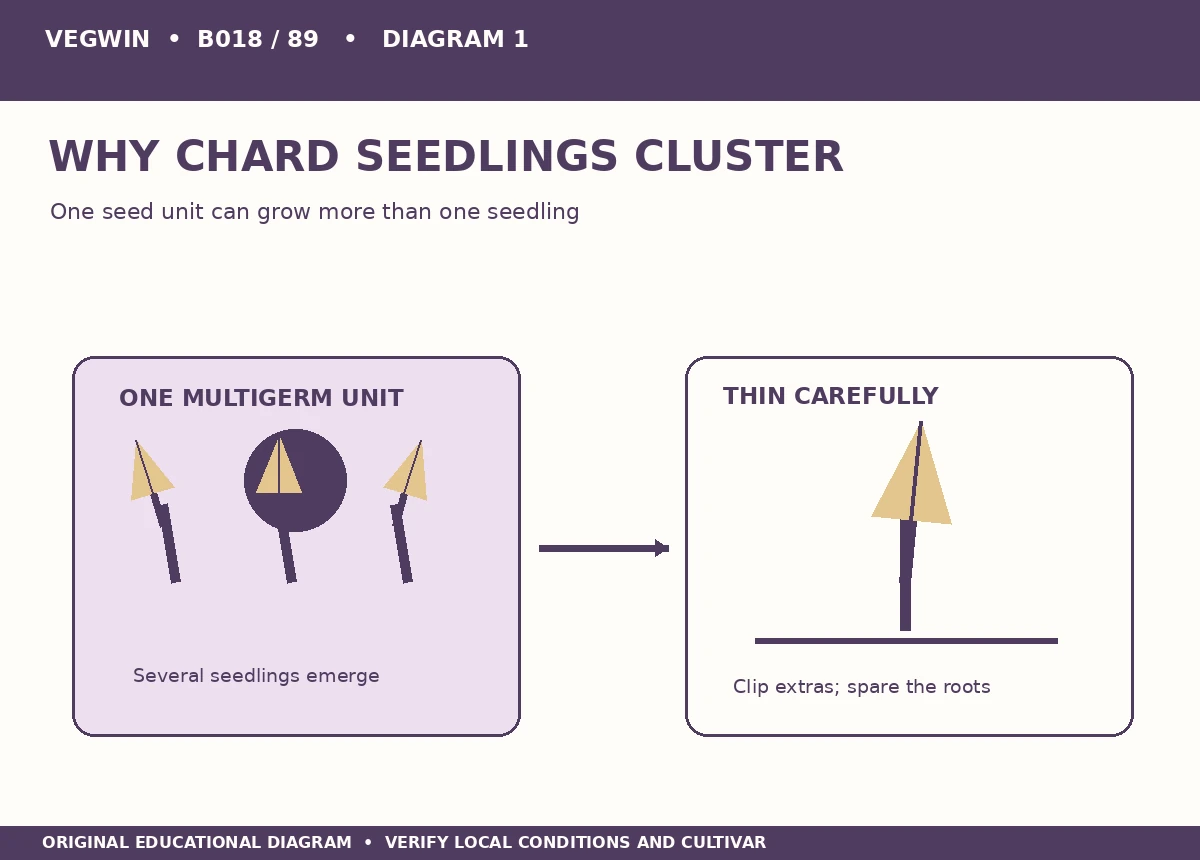
Plan to Thin Multigerm Seed Balls
Many chard seed units are actually small fruits containing several embryos. If you see two or three seedlings emerging from nearly one point, the seed packet may be perfectly normal. Remove extra seedlings while small, taking care not to disturb the roots of a desired plant. For full-size leaves, allow the final spacing described by the cultivar and local Extension guidance; a baby-leaf stand can be managed differently.
Thin by clipping competing plants at the base rather than pulling a whole clump when roots are intertwined. Those young greens may be usable if healthy, but wash them before serving. Label the bed and watch how quickly crowded crowns recover after thinning. In repeated plantings, note whether the packet contained conventional multigerm seed or a monogerm selection. This single detail can save a lot of confusion when planning density and anticipating emergence. For a step-by-step method, see how to thin beet seedling clusters without damaging neighboring roots.
| Observation | Likely decision point | Next check or action |
|---|---|---|
| Several seedlings in one spot | Ordinary multi-embryo chard fruit | Clip extras without pulling roots |
| Need salad-size leaves | Baby-leaf approach | Harvest early; manage density |
| Want large ribs and leaves | Allow full cultivar spacing | Pick outer leaves repeatedly |
| Pale winding or blotchy trails | Possible leafminer inside tissue | Identify first; protect new foliage |
| Leaves slow in hot weather | Check moisture and seasonal stress | Avoid overfeeding; reassess as weather cools |
Water for New Leaves Through Changing Weather
Chard tolerates some fluctuation in summer conditions but stops making generous new leaves when the root zone becomes too dry. Steady watering supports the next harvest. Test moisture several inches down rather than watering every pot and bed on a fixed timer. In heavy soil, allow drainage; in sandy soil, check more often. Avoid constantly wet foliage when leaf diseases are suspected.
A clean mulch layer can moderate drying and limit weed competition, but should not bury the crown. Chard leaves can grow large enough to shade weeds after establishment, though seedlings initially need hand weeding. If a plant remains stunted despite good moisture, check soil fertility, root restriction and past bed problems. University of Maryland Extension documents root-knot nematode symptoms in some affected chard plantings; visible root galls call for diagnosis, not extra nitrogen.

Pick Outer Leaves While Protecting New Growth
For repeated harvest, choose usable outer leaves and cut or pull them cleanly without damaging the central growing point. Small leaves are often tender enough for salads; mature broad leaves and ribs may be cooked. When a plant is productive, small regular harvests can be easier to handle than waiting until older leaves decline. The ideal harvest stage depends on how you prepare the crop, not on a single universal leaf length. Our guide to growing kale goes into more detail.
Use clean tools and avoid leaving torn stalks that interfere with the crown. If you cut back many leaves at once, allow enough foliage and time for recovery; do not demand immediate regrowth in a heat wave. Chard leaves are perishable, so cool them soon after picking and prepare only as much as you can use. Keep leaves with suspicious extensive spots apart until you identify the cause; removal alone does not diagnose infection.
Read Leafminer Trails and Leaf Spots Correctly
Pale winding or blotchy patches within leaf tissue suggest leafminer feeding, which is different from surface chewing by slugs. Chard can also develop fungal leaf spots, including spots with brown centers and purple-toned margins. A hole, tunnel or circular spot is a symptom pattern, not proof of a particular organism. Examine both sides of multiple leaves and consider weather history before acting.
A floating row cover or insect mesh placed early may reduce exposure to some leafminer adults, but protective coverings require management in hot weather. Remove badly affected leaves where appropriate and use local Extension diagnostics for a persistent infestation. Chemical controls have crop-specific labels and preharvest requirements; do not improvise sprays on leaves intended for near-term eating. If the diagnosis is uncertain, seek help rather than escalating treatment.

Compare Chard and Spinach in Your Garden Notes
Record harvest periods for chard beside any true spinach sowings. Both can produce tender greens in mild weather, but spinach often moves to flowering as spring days lengthen, while a well-watered chard plant may continue producing leaves into later periods. That comparison helps you plan kitchen supply without claiming one species is a complete replacement for the other. For a step-by-step method, see how to harvest Swiss chard without stopping new growth.
When production declines, first ask whether the plant has adequate light, water and space, and whether visible pest or disease signs are present. Some reduction during peak summer conditions may reverse with cooler weather; a severely diseased or root-damaged plant needs a different response. At season end, note seed type, thinning method and the number of usable harvests. That record is the unique value of a continuing leaf crop, not merely its attractive stems. Our guide to growing spinach adds more detail on this.
Related Guides
- How to Start Vegetable Seeds Indoors: Timing, Trays, and Transplant Care
- How to Transplant Swiss Chard Seedlings Without Burying Their Crowns
- How to Harvest Swiss Chard Seeds From Second-Year Brown Stalks
How We Research These Crop-Specific Decisions
We reviewed the linked original crop publications on 2026-10-20: University of Minnesota Extension, University of Maryland Extension, University of Minnesota Extension. We checked their claims about crop identity, flowering or harvest physiology, local timing, spacing and preventive management. Publication dates differ; older crop biology has been cross-checked against other current Extension material where possible. These custom diagrams express qualitative decisions, not controlled-trial data, guaranteed yields or fixed planting dates. Confirm the live sitemap and article content before manual publication.
Disclosure: No paid placements, sponsored products or affiliate relationships are claimed in this article. The buttons lead to independent university educational sources and imply no partnership. Verify the live VegWin affiliate disclosure page before manual publication. Any future treatment or product recommendation requires crop-specific label, safety and local-rule checks.
Conventional Swiss chard seed can be a fruit with multiple embryos. Thin emerging clusters carefully unless the packet specifically states otherwise.
Perpetual spinach is often a chard-type crop, but it is not the same species as true spinach, Spinacia oleracea.
Yes. Remove outer leaves while protecting the central crown, and new leaves can grow under favorable conditions.
Chard is less responsive to increasing summer day length than true spinach, although growth can slow in heat and cold exposure can affect biennial flowering.
Leafminer feeding is one possibility. Confirm the symptom with Extension diagnostics before deciding whether control is needed.