
Romaine lettuce (Lactuca sativa var. longifolia) is easiest to manage when each decision follows something visible on the plant. This guide tracks the real leaves, growing points and transitions that matter, not an invented nationwide planting date. Use your cultivar packet and local weather to adjust the steps; a regional Extension schedule is an example for that region, not a guarantee of equal performance everywhere.
Recognize a romaine heart before planting
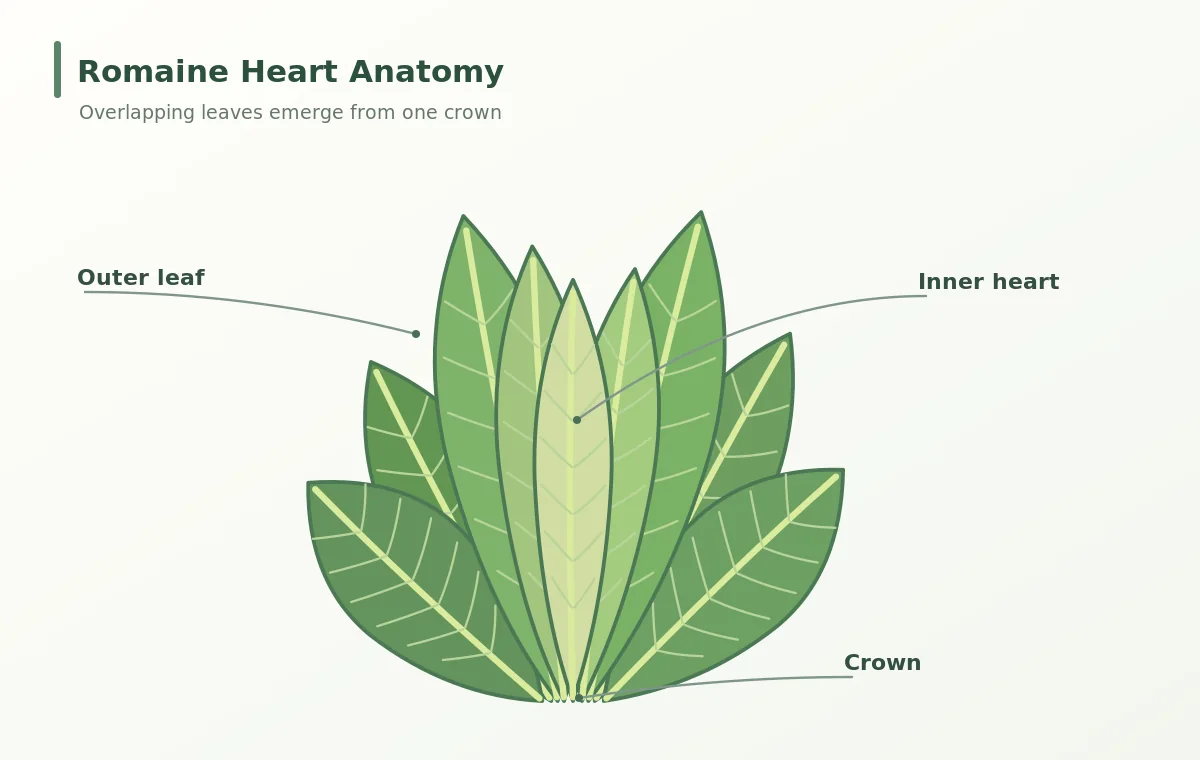
Romaine, also called cos lettuce, is not a miniature iceberg. Its long, spoon-shaped leaves rise around a short central stem, and the younger inner leaves gradually overlap into a narrow heart. The thick midribs remain visible, especially on mature outer leaves. A loosely open rosette in early growth is normal; it does not mean that you bought the wrong seed. Look for a named cos or romaine cultivar when the goal is a standing, crisp head.
Seed catalogs may offer green, red-tinted, full-size and mini romaines. Their head width and maturity vary, so use the actual cultivar description instead of treating every lettuce variety as interchangeable. This guide follows the stage of the center leaves rather than a fixed number of days. That makes it easier to decide whether you are seeing healthy upright growth, crowded outer leaves or an unwanted central seed stalk.
Schedule seed for the cool part of the season
Lettuce is a cool-season crop, and romaine quality declines as summer heat accumulates. Utah State reports that lettuce seeds germinate best around 55–65°F; above 80°F, germination may fall sharply. In many regions you can sow in early spring or time a second crop for cooler fall weather. Check your local frost dates, actual soil temperature and cultivar maturity before selecting a week. A USDA hardiness zone is not a lettuce planting calendar.
For a garden bed, Utah State suggests seed about one-quarter to one-half inch deep. Put the seed in a finely prepared, lightly moistened surface and cover it with the depth specified for the variety and soil texture. Do not bury it in deep, chunky compost. If a forecast suddenly brings hot weather during germination, give the germination zone consistent moisture and consider shifting the next sowing to a cooler window rather than endlessly reseeding the same hot patch.
Thin the rosette so the center can develop
Each plant needs its own space to build that tall heart. The Utah State guide gives head lettuce spacing of roughly 8–12 inches in the row, while Minnesota describes a similar 10–12 inches for full-size head lettuce. A compact mini romaine may use a smaller spacing if its seed packet supports it. Crowding leaves you with many soft outer leaves and less room for uniform heads. Thin when seedlings are established and easy to identify.
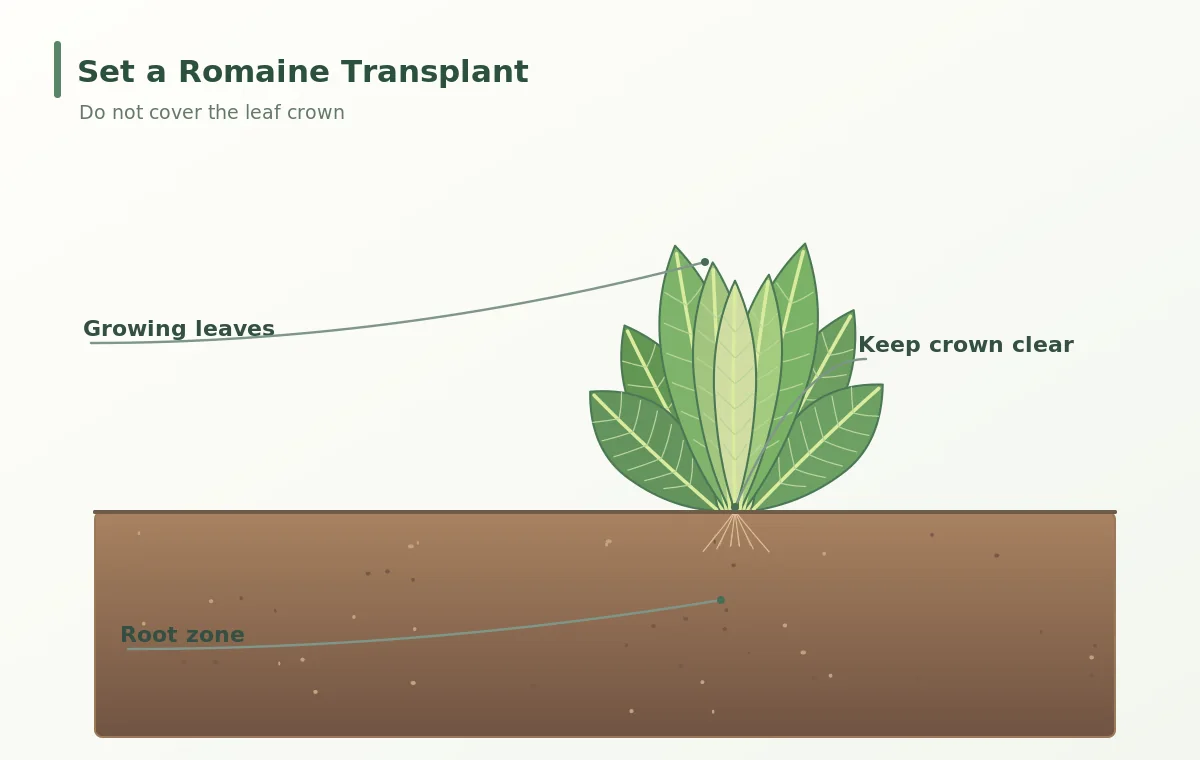
Cut unneeded seedlings at the soil line when their fine roots are intertwined instead of pulling out the plant you intend to keep. Romaine starts as a low cluster with true leaves emerging from the crown; it does not grow a separate aboveground head on a tall stalk before harvest. If starting in modules, move a sturdy plant with its root ball intact. Keep its growing crown at the existing surface, and firm the soil gently around the roots, not over the heart.
Keep the growing crown visible and watered
Romaine takes up much of its water near the surface, where fine feeder roots are concentrated. Water sufficiently to moisten that active root layer, then check the soil rather than assuming a daily schedule always works. Minnesota Extension points out that dry periods followed by sudden heavy moisture can contribute to tipburn, the brown margins on tender inner leaves. Erratic irrigation also changes texture and flavor. Mulch lightly between plants without piling material into their hearts.
Use drainage and a soil test to guide fertility. An excessive nitrogen program does not make lettuce immune to hot weather or tipburn, and a sudden burst of growth can make quality problems harder to predict. Remove small weeds with shallow strokes so that roots are not disturbed. If a tall protective row cover is used against pests or a brief chill, vent it as the weather warms; trapping hot air over romaine can accelerate the same bolting you are trying to avoid.
Read the leaves instead of guessing the date
In the first phase, the plant is an open fan of visible individual leaves. As it develops, more leaves stand upright and pack around a tender central heart. A ready romaine has good head size for its cultivar, crisp intact leaves and an enclosed but not rock-hard center. Utah State notes that cos types are commonly picked in the early heading stage. It is not necessary to wait for an iceberg-style ball, and waiting too long can compromise quality.
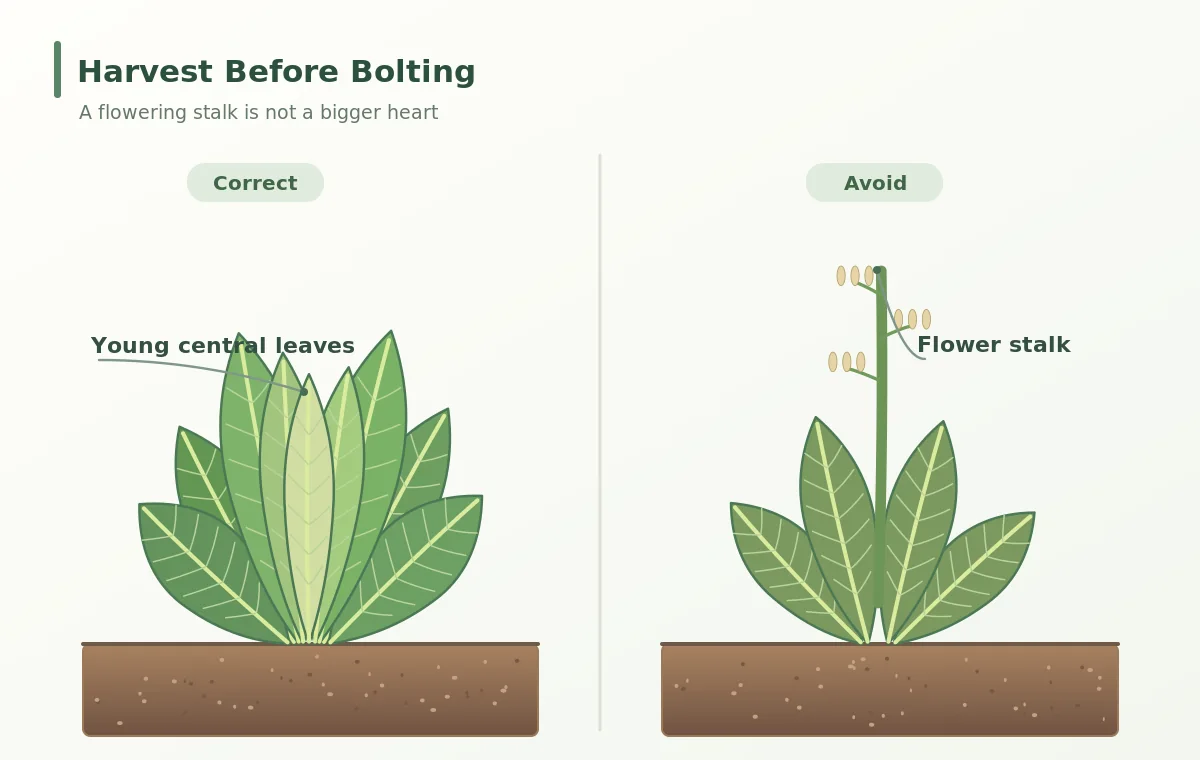
A seed stalk changes the decision. If the center shoots sharply upward and leaves become noticeably more bitter, the lettuce is bolting rather than filling its heart. Heat and long days can contribute to this shift. A tall pointed flower-bearing stem is not simply an extra-tall, better head. Inspect several plants because shade, uneven water and individual cultivars can move through development at different rates even when planted together.
Cut a whole head cleanly at the base
To harvest a head, hold it gently together and use a clean knife near its base, above the soil so that grit does not enter the leaves. Check that the blade is below the usable leafy bundle, not through the center halfway up the heart. Trim damaged outside leaves only after harvest. Alternatively, you may harvest a few outer leaves from a younger plant if you are growing it for repeated loose leaves instead of a complete romaine head.
Do not promise rapid regrowth from a full head cut. The plant may have little usable growing tissue after the cut, and warm conditions can turn the remainder bitter. Harvest in the cooler part of the day if possible, keep cut leaves shaded and refrigerate promptly. Before eating, discard visibly damaged or decaying leaves and follow current food-safety advice for washing produce; a lovely garden illustration is not evidence that raw leaves are pathogen-free.
Troubleshoot tipburn, holes and bitter leaves
Brown leaf margins on the youngest center leaves suggest tipburn, but it is a physiological symptom rather than proof of one single missing fertilizer. Review moisture variation, rapid growth and conditions that restrict calcium transport before adding a product. Ragged holes usually point first toward chewing pests such as slugs or caterpillars. Look for actual animals, droppings or fresh feeding before choosing a response. Identify the problem with local Extension resources and start with appropriate cultural controls.
Bitter leaves, narrow heads and unexpected flower stalks are strongly associated with aging and hot growing conditions. Extra fertilizer will not reverse a plant that has already switched to seed production. For the next crop, choose a heat-tolerant cultivar for the relevant season, move sowing into cooler weather and maintain water evenly. Keep a short garden note about the sow date, first upright leaves, harvest decision and local weather so the next head is timed from evidence.
Use the right harvest outcome for your space
One bed can serve two different goals, but plan them differently. A mini head is a small complete romaine with its inner leaves still enclosed. A baby-leaf crop is harvested while the plants are much smaller and does not require full head spacing. A head left too long becomes a seed-production project, not a large salad heart. Choose which outcome you want when thinning and avoid changing plans simply because crowded plants look green.
If the crop stalls, lift one failed plant and examine root development and soil conditions. Poor drainage, compaction and repeated saturation can mimic a fertilizer shortage. Romaine is best approached as a series of observable transitions: reliable emergence, uncrowded rosette, upright inner leaves, then a timely cut. That sequence is more useful in different US climates than an invented universal date when all heads should be ready.
Related Guides
- Growing Lettuce: Choose the Right Type and Harvest Before Bolting
- How to Save Lettuce Seeds From Flowering to Clean Storage
- How to Stop Slugs on Lettuce With Scouting, Shelter Traps, and Safe Decisions
How We Research and Verify This Advice
We checked the horticultural details in these primary university and botanical-education resources on 2026-10-29: extension.umn.edu; extension.usu.edu. We compared their species descriptions, sowing practices, crop stages and seasonal risks with the diagrams, and separated regional dates from widely useful principles. We checked the available local archive history and publicly indexed VegWin pages for overlapping search intent; private WordPress drafts cannot be verified by public search. Consult regional Extension advice where conditions differ.
This is independent educational material, not a sponsored product recommendation. No commission relationship is asserted. Read the VegWin affiliate disclosure for the site policy. Illustrations are explanatory diagrams, not a substitute for checking an actual plant, crop label or current local safety recommendation.
No. Romaine is a cos lettuce with a tall, overlapping heart. Harvest in the early heading stage rather than expecting an iceberg-like sphere.
About 8–12 inches is a useful Extension range for full-size head lettuce; follow the named cultivar for mini types.
Heat and plant age can trigger bolting. A central flower stalk usually signals declining eating quality rather than a larger head.
No. Cover the original root ball and keep the living leaf crown above the soil surface.
Yes, but repeated outer-leaf picking changes the goal from an intact head to a loose-leaf harvest.