
Clustered mountain mint has fragrant opposite leaves, silver-green bracts and small pale flowers loved by pollinators. Learn seedling care, flower identification and rhizome control. The practical steps below distinguish living plant structures from similar-looking buds and seeds, and use local conditions rather than hardiness zones as a universal sowing calendar.
Identify the species before choosing a seed method
Mountain mint is a group of North American plants in the genus Pycnanthemum. This article focuses specifically on clustered mountain mint, Pycnanthemum muticum, rather than assuming every mountain mint has the same leaf width or flowering head. Its minty foliage includes opposite broad, often toothed leaves; upper leaves surrounding the inflorescence can appear distinctly pale or silver-green. Tiny pale tubular flowers are grouped into rounded or flattened clusters. Penn State Extension and the University of Tennessee both describe the rhizomatous habit. Compare the scientific name on the seed packet with your intended garden plan because an ordinary kitchen mint and a related narrow-leaved Pycnanthemum species can look quite different. The silvery bloom effect is largely provided by modified leaves, not an enormous single flower.
Plan space for shallow spreading rhizomes
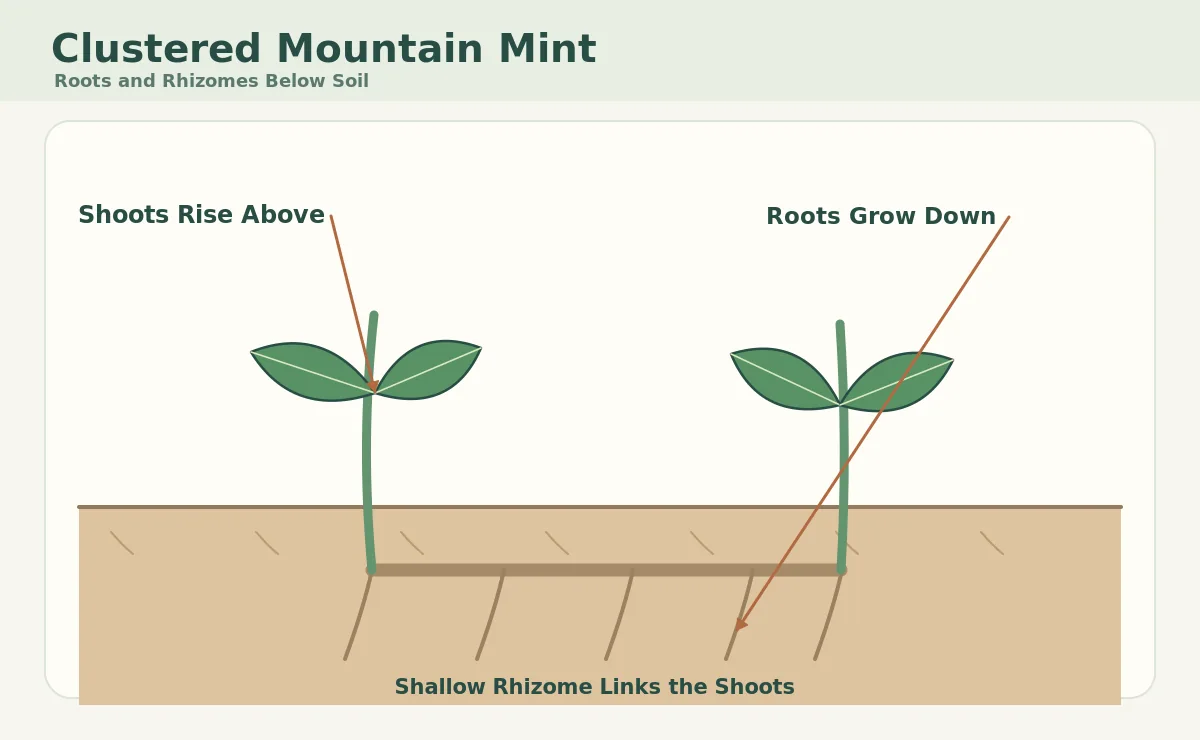
Clustered mountain mint is a vigorous perennial that can expand into colonies through shallow underground rhizomes. University of Tennessee describes that spreading habit, and Penn State suggests slicing around clumps with a spade in spring where containment matters. Choose an area where a slowly enlarging patch is welcome, or plan a visible edge that can be inspected every season. Do not place a new plant inches from a delicate, slow-growing perennial and expect its roots to remain forever inside the original planting hole. In a wildlife border, the colony can be an asset if its footprint is deliberate. If the site is cramped, consider a roomy container with drainage, remembering that roots still need regular checks and the top growth may require dividing or thinning.

Choose a seed-starting approach without promising instant sprouts
University of Tennessee lists a germination code indicating a cold-moist pretreatment and light for clustered mountain mint seed. Seed-source protocols vary, so confirm the particular lot’s directions instead of inventing a fixed universal refrigeration duration. Use a clean starting mix, distribute the small seeds evenly and avoid a thick blanket of medium that blocks light. Keep the mixture slightly moist with a gentle mist or bottom watering and label the tray with the scientific name, treatment and date. Not every seed will emerge together, and very small seedlings need strong indirect or grow-light illumination after they appear. If you try a comparison between treated and untreated seed, label both portions and keep the remaining conditions similar. This is a garden experiment, not a promise of a certain germination percentage.
Distinguish opposite leaves from a flower bract
A healthy young mountain mint grows leaves in opposing pairs along the upright stem. Each blade is joined at a node by its short petiole or base. On older flowering stems, upper leaves near the head can become pale, powdery-looking and silvery; botanically these are still leaves or bracts, not clusters of giant white petals. Penn State describes the smaller white-to-pink tubular blossoms in the central cluster. If the plant has a pale top, examine the tiny individual flowers before calling the whole silver area a flower. The dramatic color difference is useful for identification and for deciding where a careful cut belongs. Draw the silvery bract attached to the flowering stem below the cluster, with the tiny florets seated above it.
Transplant young plants into a sunny, draining bed
Penn State lists sun to partial shade and draining soil for clustered mountain mint, while Tennessee describes a fairly broad tolerance of soils and moisture once established. Move seedlings after they have a stable root ball rather than pulling on a thin stem, and keep the original crown near soil level. Water the transplant thoroughly and then monitor the actual root-zone moisture as it starts growing. This is not a plant that needs permanent water pooling around its crown just because it sometimes appears in rain-garden lists. A bed that periodically dries may suit an established plant better than one that is stagnant and anaerobic. If summer sun is intense, introduce greenhouse plants gradually to avoid leaf scorch, and keep weeds from covering small seedlings while roots develop.
Let the terminal flower clusters support pollinators
Established clustered mountain mint is known for a long display of small flowers visited by bees and other insects. Penn State Extension describes white-to-pink tubular florets and a prolonged bloom period. Rather than trimming every stem as soon as silvery bracts appear, leave many flowering tops intact where insect forage is one of your goals. A silver flower head is a cluster of tiny blooms, not a single overlarge blossom. Observe it closely on a calm day and give insects room when you walk between plants. Avoid spraying an unidentified pest problem over open flower heads. If leaves become spotted, inspect the actual injury and the affected proportion of the planting first; not every insect visitor is a pest, and a little chewing does not necessarily require control.
Manage vigorous shoots without removing every flower
Once the clump is established, you can thin crowded stems or cut a portion for fragrant filler while leaving other tops blooming. NC State cut-flower trials describe stems that can be useful at various development stages and plants that become vigorous after establishment, but early-season performance varied among growers. Make pruning decisions from the actual plant rather than assuming every first-year seedling will become a full-sized flowering colony. Cut an unwanted shoot down at a sensible point using clean hand pruners; do not slice blindly through a nearby flowering crown. When you want to control underground spread, track new shoots beyond the chosen boundary and prune or remove the shallow rhizome connection when soil is workable. Mulch alone does not guarantee containment.
Trace the underground runner back to its living crown
A spreading shoot belongs to a physical rhizome network beneath the soil. In a soil-section diagram, place the rhizome horizontally a little below the surface with roots growing downward and upright shoots rising from nodes. It should not float above ground or end at an isolated leaf. A spade cut made beyond the parent clump can sever the runner, but remove or monitor the separated portion because its living nodes may still establish. Penn State specifically recommends pruning roots in spring to keep a clump in bounds. Use caution near irrigation lines and other plants. This method changes the expansion rate, not the species’ underlying habit. Recheck the edge after rain and new growth rather than relying on a single cut to last for years.

Tell seasonal browning from a serious crown problem
As a perennial enters dormancy, older flowering stems may brown while living root and rhizome structures remain beneath the soil. Check for new basal growth in the following active season before assuming the plant has died. Soft, foul-smelling or persistently waterlogged crowns need a closer look at drainage and root health; a dry brown seed head after blooming may be completely normal. Penn State and Tennessee describe a wide ecological tolerance but do not claim absolute immunity to disease. Take photographs of both the whole clump and detailed symptoms if diagnosis is difficult. Good air movement and proper siting are more defensible starting responses than a routine application of pesticide to an unidentified issue. Leave some dry stems if that fits your wildlife-management goals and local garden conditions.
Write down the border the colony is allowed to occupy
Mark the initial planting area and revisit it in spring when new shoots appear. Measure which side expands fastest and decide whether the colony is helping to fill a gap or pushing into another species. Note where silver upper leaves first develop and how long tiny tubular flowers are visible; these observations are useful for future identification and pollinator gardening. If you intend to share divisions, confirm the plant as Pycnanthemum muticum and include a warning about spread so the next gardener can plan space. A seedling in a tray, a flowering silver-topped stalk and a rhizome-bearing clump are three connected life stages. Understanding those stages makes this a manageable native perennial rather than an unexpected patch of mint.
Related Guides
- Growing Mint Without Takeover: Containers, Water, and Repeat Harvests
- Mint in Pots: Diagnose Drainage, Root Crowding, and Repotting Needs
- How to Grow Chocolate Mint in a Pot and Contain Spreading Runners
- How to Root Mint Cuttings in Water With Leaves Above the Waterline
How We Research Plant Care and Propagation
This guide was checked on October 30, 2026 using primary university Extension and botanical references: extension.psu.edu; tnyards.utk.edu; cutflowers.ces.ncsu.edu. Their botanical descriptions and culture guidance support the growth stages and actions illustrated here. Regional climate, seed provenance and individual plant performance still vary. The drawings clarify anatomy and technique rather than reproduce exact scale or replace local diagnosis.
VegWin provides independent educational gardening information. The internal links in this guide are not paid affiliate promotions; see the affiliate disclosure. For uncertain plant identification, edible-plant safety or significant plant disease symptoms, consult your local Cooperative Extension office before acting.
No. Clustered mountain mint is Pycnanthemum muticum, a different genus from spearmint.
No. The pale areas are bracts and upper leaves around clusters of tiny white-to-pink tubular flowers.
Yes. Shallow rhizomes can extend outward and produce new shoots.
Yes, although seed lots may need species-specific light and cold-moist treatment and can emerge unevenly.
Inspect the edge and prune shallow rhizomes with a spade, commonly in spring, while removing unwanted shoots.